Chapter 3The Psychoanalytical Approach
Why is Freud Important?Profound influence on psychology and modern ideas about the mindDeveloped first comprehensive theory of personality – remains most comprehensive today!Developed first Psychotherapy – 75% (or more) of today’s practitioners rely on Freud’s ideas in some wayHuge influence on Popular CultureStressed the importance of the influence of the environment and early developmentDescribed the Defense MechanismsDiscovered Unconscious thought
basic ideas that govern Psychoanalytical Approach:1. Psychic Determinism – Everything happens for a reason2. Internal Structure of Personality (includes the topographic model and the structural model)3. Psychic Conflict – Describes how the structural model works (healthy personality and unhealthy personality)4. Mental Energy – Libido and ThanatosDoctrine of Opposites - everything contains it’s opposite
Psychic DeterminismEverything in the mind, behavior, and the thought processes of an individual has a cause and this cause can be identifiedThere are no accidents, miracles, or free willUsually the reason for thoughts feelings and behavior lies in the unconscious
Topographic ModelUnconscious – you do not have access to unconscious thoughts, desires, impulses at allPreconscious – just at the tip of consciousness – sometimes have access, usually do notConscious – you have access to all of this information, what you are aware ofModern research supports this theory
Structural ModelThree parts of the mind:(It)			(I)			(Over-I)ID			Ego			SUPEREGOIrrational,		Rational		Moralemotional* In parentheses are the literal German translation of what Freud called the three parts of the mind
Psychic ConflictThe mind can be in conflict with itself, the id, ego, and superego are often in conflict with each other. For example; the Id wants you to go to the big party tonight, the superego does not want you to go to a party ever because it may be dangerous – the “healthy” ego may satisfy both urges by making the decision to go to some parties but not all parties.This is called: Compromise Formation – when the mind is in conflict with itself– a “compromise” is made, a healthy compromise is the example above. An unhealthy compromise according to Freud is revealed in symptoms of psychological disorders such as anxiety, depression, and obsessive compulsive behavior.
Mental EnergyPsychological apparatus of the mind needs energy to make it go…This energy is called: Psychic energy or libidoConservation of energy – the mind needs to conserve energy for cognitive tasks and emotional drains. If the emotional drains become too much not enough energy is left for cognitive tasks (like homework)
Mental energy – libido and thanatosBegins with Motivation – what do people want?Two motives are fundamental:	Toward Life		Toward Death	Libido			Thanatos	(AKA: Sex drive)		(Instinctual desire for death)	Sex = Life			Duality of nature
Mental Energy (cont.)Can neither be created or destroyed – it merely exists in all human mindsModern Research supports:	Psychic energy used for one purpose is not available for another purpose – using previous example…if too much energy is used in managing anxiety, you fail to have enough mental energy to complete cognitive and other life tasks.Modern Research disputes:“venting” out energy – in other words, expressing negative emotion (as in yelling at children or punching a pillow) actually makes you feel worse yet modern research supports positive release of energy, such as exercise and talking about problemsMust “follow the energy” – to determine how to help people
Freud’s Doctrine of oppositesEverything contains it’s opposite		(Happiness – Sadness)Extremes seem to be more like one another than either is with the middle – those that have psychological “trouble” are often living in one extreme or the other – a healthy personality is somewhere in the middle of the continuum, we are both happy and sad but rarely in the extremes of either (unless it is appropriate such as when we are first in love or because of the death of a loved one).
Freud’s theory of Psychosexual human DevelopmentOralAnalPhallicLatentGenitalEach stage has three areas of focus:1. Physical Focus2. Psychological Focus3. Adult Character Type(Outlined in detail in the following slides)
Oral Stage (Birth – 18 months)Physical Focus:Mouth	First place psychic energy is focusedPsychological Focus:Dependency	If needs are filled, psychic energy and attention move to next stage. 		Two things can go wrong: (Doctrine of Opposites)	1. Needs might not be met	2. Needs met to an extremeAdult Character Type:	Oral Character	(One extreme or the other)	1. Fiercely independent	2. Passive
Anal Stage (18 months – 3 years)Physical Focus:		Anus(and related eliminative organs)	Energy is focused on controlling bowels/emotionsPsychological Focus:		Self-Control/Obedience	If needs are filled and receive the appropriate amount of support to learn self-control,  psychic energy and attention move to next stage. Two things can go wrong:(Doctrine of Opposites)	1. Too much control can be traumatic	2. Never demand that child control urgesAdult Character Type:	Anal Character	1. Too much control, OCD or subservient	2. Little or no self-control – compulsive need to disobey authority
Phallic Stage (3 – 7 years)Physical Focus:		Penis	Gender is where psychic energy is focusedPsychological Focus:		Gender Identity	If needs are filled, child establishes secure gender identity by identifying with same sex parent, psychic energy and attention move to next stage.Two things can go wrong: (Doctrine of Opposites)	1. Identify too much with same sex parent	2. Identify too little with same sex parentAdult Character Type:	Confused Identity	(One extreme or the other)	1. Overly sexual (promiscuous)	2. Asexual or prudish
Latency stage (7-11 years)Latent – means underneath, hidden, Freud would say sexual energy (libido) is put towards learning, there is no physical or psychological focus during this stage – most children are relatively free from worry during this stage because they do not have to deal with psychic conflictGet a break from Psychological development to focus on Cognitive development
Genital Stage (12 – Adulthood)Physical Focus:	Genitals/Reproduction   Psychic energy remains focused in this stage, strive to attain adulthoodPsychological Focus:	Creation and 					enhancement of life	If needs are filled, psychic energy and attention focus on maturityAdult Character Type:   Ability to love and work(these are the goals of adulthood; work - find meaningful work and love – find a partner)
Putting it all together:Freud’s Theory of Personality DevelopmentId		 Ego			SuperegoPhysical		  Cognitive		EthicalFollows pleasure	   Reality principle	Personal IdentityPrinciple					and adherence to						identityBegin with Primary Process Thinking:Immediate gratification of every desire – Unconscious mind – IdMove towards Secondary Process Thinking:“THINK” Conscious part of ego, rational, practical, prudent
Freud’s development of “Talk therapy”:  PsychoanalysisFirst system of psychotherapyGoal: Free up psychic energy for help with daily living by removing neurotic energy drains (anxiety, depression…)Original process is lengthy and time consuming (three – four hours per week for many years)When client begins to “resist” therapeutic suggestions it means therapy is working because the therapist has found the uncomfortable and forbidden feelings!!!
Why you may need psychoanalysis: AnxietyThere is a lot going on in your mind that you do not know about!Anxiety from Psychic conflict (Id/Ego/Superego): “I feel bad and I don’t know why”Realistic Anxiety:Too much or too little is the problem; balance is the key (Doctrine of opposites)See the anxiety in parapraxes, dreamsUse defense mechanisms to achieve balanceThe daily use of defense mechanisms is not conscious! (They are deployed by the unconscious part of the ego)
Goal of Psychoanalytical TherapyMake the unconscious conscious!!Cause of problematic thoughts, feelings, and behavior is mysterious and hiddenBest Therapy includes:Therapeutic Alliance (transference/not counter transference)Dream AnalysisFree Association
   Psychoanalysis: The “Talking Cure”Bring thoughts and fears to conscious mindTherapist provides emotional supportAccording to Freud:“Psychoanalysis is the cure through love”“Journey begins with knowing oneself”Humanists share this viewpoint – as do most psychotherapists today
Projective Tests: Rorschach Ink blot test – what do you see?
Rorschach Ink blot testClient is shown a series of ink blots – psychoanalyst looks for patterns of healthy responses or unhealthy responsesThe test is “scored” using one of a few developed scoring booklets which detail possible interpretations based on the answers a person gives the therapistWidely used in forensic diagnosis todayNot widely used as a therapeutic tool
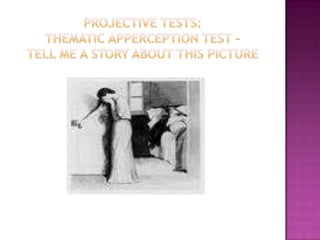
Projective Tests: Thematic Apperception test – tell me a story about this picture
Thematic Apperception test (or tat)Client shown a series of ambiguous drawings and asked to tell the therapist a story about each oneThe unconscious is revealed in the content of the stories because the images are ambiguous – the person put their own life meaning into the storiesUsed primarily as an “ice breaker” currently, not a diagnostic tool in therapySometimes used in forensic diagnosis
Chapter 4The Freudian Approach
Dream Analysis/Interpretation“Royal Road to the Unconscious” – Freud2 Parts:1. Manifest Content	What you remember about a dream2. Latent Content	What is hidden in the dream, the unconscious intent, this is why you tell the psychoanalyst – so they can interpret the hidden meaningA dream must by analyzed in the context of the dreamer’s life!Important to remember that dreams are individual and there are not universal symbols, as Freud said, “Sometimes a cigar is just a cigar”!!
Dream Analysis/InterpretationModern research supports the individuality of dreams and that the content of our dreams are not randomREM sleep is filled with dreams and if you have the “right” amount of REM sleep you are more likely to be healthy – mentally and physically !!! (even if you don’t remember those dreams)Modern research does not support dreams as a way to deal with psychic conflict (as Freud defined it) because babies dream as well as animals
Defense MechanismsRelease of neurotic anxiety by revealing unacceptable unconscious thoughts in the form of:Repression – Push threatening material out of consciousness – most important defense mechanismSublimation – Ego puts threatening unconscious impulses into socially acceptable behavior – you become more productive - only truly successful defense mechanismDisplacement – Unconscious impulses are not aimed at real source but displaced to another – example: kick the dog when you are really mad at your spouse
Defense Mechanisms (cont.)Denial – Refuse to accept that certain facts exist despite evidence to the contrary – the more we use denial the more we lose touch with realityReaction Formation – Hide a threatening unconscious impulse by acting in a manner opposite of our unconscious desire – example: homophobia – those that are hiding same sex attraction often are vehement opponents to gay rights while at the same time engaging in hidden, dangerous sexual liaisons – many examples in the media of such storiesIntellectualization – Remove all emotional content in description of emotional events, only discuss intellectual elementsProjection – Attribute unconscious impulses to someone else rather than to ourselves – example: “everyone is having affairs” –this is not true, demonstrates this person unconsciously may have hostility or lack of desire towards spouse or partner
Parapraxes (Slips) and Humor  Leakage of the unconscious mind manifesting itself in a mistake, accident, omission or memory lapseFailure of ego:ForgettingLeaving someone or something out (unconsciously)Slips: Examples below(Cut and paste in browser or just click):http://www.youtube.com/watch?v=QaHgbOtmgmQhttp://www.youtube.com/watch?v=2VCWmHeTC_8&feature=related(Often sexual in nature as demonstrated in the two clips you just watched!)
HumorCan be a healthy release of tension and bring psychological health, or…Jokes that are sexual in nature or aggressive in nature are found funny because they release forbidden impulses – especially in children – think “potty humor”Some people that find these types of jokes particularly funny as adults may be more likely to imitate the aggressive humor in real life (such as name calling, fighting, sexism, racism…all isms)
HypnosisMany agree with Freud that hypnosis is an altered state of consciousnessCritics state that the person is overly compliant with suggestions, expects to be hypnotized, is motivated to comply, is really in a relaxed state, and feels happy to complyHypnotic responsiveness is individual. Some people are “highly” hypnotizable, others are not. People who have high degrees of concentration may be more likely to be hypnotized (for example, people who do not hear their name called when they are reading)

Personality - Chapters 3 and 4

  • 1.
  • 2.
    Why is FreudImportant?Profound influence on psychology and modern ideas about the mindDeveloped first comprehensive theory of personality – remains most comprehensive today!Developed first Psychotherapy – 75% (or more) of today’s practitioners rely on Freud’s ideas in some wayHuge influence on Popular CultureStressed the importance of the influence of the environment and early developmentDescribed the Defense MechanismsDiscovered Unconscious thought
  • 3.
    basic ideas thatgovern Psychoanalytical Approach:1. Psychic Determinism – Everything happens for a reason2. Internal Structure of Personality (includes the topographic model and the structural model)3. Psychic Conflict – Describes how the structural model works (healthy personality and unhealthy personality)4. Mental Energy – Libido and ThanatosDoctrine of Opposites - everything contains it’s opposite
  • 4.
    Psychic DeterminismEverything inthe mind, behavior, and the thought processes of an individual has a cause and this cause can be identifiedThere are no accidents, miracles, or free willUsually the reason for thoughts feelings and behavior lies in the unconscious
  • 5.
    Topographic ModelUnconscious –you do not have access to unconscious thoughts, desires, impulses at allPreconscious – just at the tip of consciousness – sometimes have access, usually do notConscious – you have access to all of this information, what you are aware ofModern research supports this theory
  • 6.
    Structural ModelThree partsof the mind:(It) (I) (Over-I)ID Ego SUPEREGOIrrational, Rational Moralemotional* In parentheses are the literal German translation of what Freud called the three parts of the mind
  • 7.
    Psychic ConflictThe mindcan be in conflict with itself, the id, ego, and superego are often in conflict with each other. For example; the Id wants you to go to the big party tonight, the superego does not want you to go to a party ever because it may be dangerous – the “healthy” ego may satisfy both urges by making the decision to go to some parties but not all parties.This is called: Compromise Formation – when the mind is in conflict with itself– a “compromise” is made, a healthy compromise is the example above. An unhealthy compromise according to Freud is revealed in symptoms of psychological disorders such as anxiety, depression, and obsessive compulsive behavior.
  • 8.
    Mental EnergyPsychological apparatusof the mind needs energy to make it go…This energy is called: Psychic energy or libidoConservation of energy – the mind needs to conserve energy for cognitive tasks and emotional drains. If the emotional drains become too much not enough energy is left for cognitive tasks (like homework)
  • 9.
    Mental energy –libido and thanatosBegins with Motivation – what do people want?Two motives are fundamental: Toward Life Toward Death Libido Thanatos (AKA: Sex drive) (Instinctual desire for death) Sex = Life Duality of nature
  • 10.
    Mental Energy (cont.)Canneither be created or destroyed – it merely exists in all human mindsModern Research supports: Psychic energy used for one purpose is not available for another purpose – using previous example…if too much energy is used in managing anxiety, you fail to have enough mental energy to complete cognitive and other life tasks.Modern Research disputes:“venting” out energy – in other words, expressing negative emotion (as in yelling at children or punching a pillow) actually makes you feel worse yet modern research supports positive release of energy, such as exercise and talking about problemsMust “follow the energy” – to determine how to help people
  • 11.
    Freud’s Doctrine ofoppositesEverything contains it’s opposite (Happiness – Sadness)Extremes seem to be more like one another than either is with the middle – those that have psychological “trouble” are often living in one extreme or the other – a healthy personality is somewhere in the middle of the continuum, we are both happy and sad but rarely in the extremes of either (unless it is appropriate such as when we are first in love or because of the death of a loved one).
  • 12.
    Freud’s theory ofPsychosexual human DevelopmentOralAnalPhallicLatentGenitalEach stage has three areas of focus:1. Physical Focus2. Psychological Focus3. Adult Character Type(Outlined in detail in the following slides)
  • 13.
    Oral Stage (Birth– 18 months)Physical Focus:Mouth First place psychic energy is focusedPsychological Focus:Dependency If needs are filled, psychic energy and attention move to next stage. Two things can go wrong: (Doctrine of Opposites) 1. Needs might not be met 2. Needs met to an extremeAdult Character Type: Oral Character (One extreme or the other) 1. Fiercely independent 2. Passive
  • 14.
    Anal Stage (18months – 3 years)Physical Focus: Anus(and related eliminative organs) Energy is focused on controlling bowels/emotionsPsychological Focus: Self-Control/Obedience If needs are filled and receive the appropriate amount of support to learn self-control, psychic energy and attention move to next stage. Two things can go wrong:(Doctrine of Opposites) 1. Too much control can be traumatic 2. Never demand that child control urgesAdult Character Type: Anal Character 1. Too much control, OCD or subservient 2. Little or no self-control – compulsive need to disobey authority
  • 15.
    Phallic Stage (3– 7 years)Physical Focus: Penis Gender is where psychic energy is focusedPsychological Focus: Gender Identity If needs are filled, child establishes secure gender identity by identifying with same sex parent, psychic energy and attention move to next stage.Two things can go wrong: (Doctrine of Opposites) 1. Identify too much with same sex parent 2. Identify too little with same sex parentAdult Character Type: Confused Identity (One extreme or the other) 1. Overly sexual (promiscuous) 2. Asexual or prudish
  • 16.
    Latency stage (7-11years)Latent – means underneath, hidden, Freud would say sexual energy (libido) is put towards learning, there is no physical or psychological focus during this stage – most children are relatively free from worry during this stage because they do not have to deal with psychic conflictGet a break from Psychological development to focus on Cognitive development
  • 17.
    Genital Stage (12– Adulthood)Physical Focus: Genitals/Reproduction Psychic energy remains focused in this stage, strive to attain adulthoodPsychological Focus: Creation and enhancement of life If needs are filled, psychic energy and attention focus on maturityAdult Character Type: Ability to love and work(these are the goals of adulthood; work - find meaningful work and love – find a partner)
  • 18.
    Putting it alltogether:Freud’s Theory of Personality DevelopmentId Ego SuperegoPhysical Cognitive EthicalFollows pleasure Reality principle Personal IdentityPrinciple and adherence to identityBegin with Primary Process Thinking:Immediate gratification of every desire – Unconscious mind – IdMove towards Secondary Process Thinking:“THINK” Conscious part of ego, rational, practical, prudent
  • 19.
    Freud’s development of“Talk therapy”: PsychoanalysisFirst system of psychotherapyGoal: Free up psychic energy for help with daily living by removing neurotic energy drains (anxiety, depression…)Original process is lengthy and time consuming (three – four hours per week for many years)When client begins to “resist” therapeutic suggestions it means therapy is working because the therapist has found the uncomfortable and forbidden feelings!!!
  • 20.
    Why you mayneed psychoanalysis: AnxietyThere is a lot going on in your mind that you do not know about!Anxiety from Psychic conflict (Id/Ego/Superego): “I feel bad and I don’t know why”Realistic Anxiety:Too much or too little is the problem; balance is the key (Doctrine of opposites)See the anxiety in parapraxes, dreamsUse defense mechanisms to achieve balanceThe daily use of defense mechanisms is not conscious! (They are deployed by the unconscious part of the ego)
  • 21.
    Goal of PsychoanalyticalTherapyMake the unconscious conscious!!Cause of problematic thoughts, feelings, and behavior is mysterious and hiddenBest Therapy includes:Therapeutic Alliance (transference/not counter transference)Dream AnalysisFree Association
  • 22.
    Psychoanalysis: The “Talking Cure”Bring thoughts and fears to conscious mindTherapist provides emotional supportAccording to Freud:“Psychoanalysis is the cure through love”“Journey begins with knowing oneself”Humanists share this viewpoint – as do most psychotherapists today
  • 23.
    Projective Tests: RorschachInk blot test – what do you see?
  • 24.
    Rorschach Ink blottestClient is shown a series of ink blots – psychoanalyst looks for patterns of healthy responses or unhealthy responsesThe test is “scored” using one of a few developed scoring booklets which detail possible interpretations based on the answers a person gives the therapistWidely used in forensic diagnosis todayNot widely used as a therapeutic tool
  • 25.
    Projective Tests: ThematicApperception test – tell me a story about this picture
  • 26.
    Thematic Apperception test(or tat)Client shown a series of ambiguous drawings and asked to tell the therapist a story about each oneThe unconscious is revealed in the content of the stories because the images are ambiguous – the person put their own life meaning into the storiesUsed primarily as an “ice breaker” currently, not a diagnostic tool in therapySometimes used in forensic diagnosis
  • 27.
  • 28.
    Dream Analysis/Interpretation“Royal Roadto the Unconscious” – Freud2 Parts:1. Manifest Content What you remember about a dream2. Latent Content What is hidden in the dream, the unconscious intent, this is why you tell the psychoanalyst – so they can interpret the hidden meaningA dream must by analyzed in the context of the dreamer’s life!Important to remember that dreams are individual and there are not universal symbols, as Freud said, “Sometimes a cigar is just a cigar”!!
  • 29.
    Dream Analysis/InterpretationModern researchsupports the individuality of dreams and that the content of our dreams are not randomREM sleep is filled with dreams and if you have the “right” amount of REM sleep you are more likely to be healthy – mentally and physically !!! (even if you don’t remember those dreams)Modern research does not support dreams as a way to deal with psychic conflict (as Freud defined it) because babies dream as well as animals
  • 30.
    Defense MechanismsRelease ofneurotic anxiety by revealing unacceptable unconscious thoughts in the form of:Repression – Push threatening material out of consciousness – most important defense mechanismSublimation – Ego puts threatening unconscious impulses into socially acceptable behavior – you become more productive - only truly successful defense mechanismDisplacement – Unconscious impulses are not aimed at real source but displaced to another – example: kick the dog when you are really mad at your spouse
  • 31.
    Defense Mechanisms (cont.)Denial– Refuse to accept that certain facts exist despite evidence to the contrary – the more we use denial the more we lose touch with realityReaction Formation – Hide a threatening unconscious impulse by acting in a manner opposite of our unconscious desire – example: homophobia – those that are hiding same sex attraction often are vehement opponents to gay rights while at the same time engaging in hidden, dangerous sexual liaisons – many examples in the media of such storiesIntellectualization – Remove all emotional content in description of emotional events, only discuss intellectual elementsProjection – Attribute unconscious impulses to someone else rather than to ourselves – example: “everyone is having affairs” –this is not true, demonstrates this person unconsciously may have hostility or lack of desire towards spouse or partner
  • 32.
    Parapraxes (Slips) andHumor Leakage of the unconscious mind manifesting itself in a mistake, accident, omission or memory lapseFailure of ego:ForgettingLeaving someone or something out (unconsciously)Slips: Examples below(Cut and paste in browser or just click):http://www.youtube.com/watch?v=QaHgbOtmgmQhttp://www.youtube.com/watch?v=2VCWmHeTC_8&feature=related(Often sexual in nature as demonstrated in the two clips you just watched!)
  • 33.
    HumorCan be ahealthy release of tension and bring psychological health, or…Jokes that are sexual in nature or aggressive in nature are found funny because they release forbidden impulses – especially in children – think “potty humor”Some people that find these types of jokes particularly funny as adults may be more likely to imitate the aggressive humor in real life (such as name calling, fighting, sexism, racism…all isms)
  • 34.
    HypnosisMany agree withFreud that hypnosis is an altered state of consciousnessCritics state that the person is overly compliant with suggestions, expects to be hypnotized, is motivated to comply, is really in a relaxed state, and feels happy to complyHypnotic responsiveness is individual. Some people are “highly” hypnotizable, others are not. People who have high degrees of concentration may be more likely to be hypnotized (for example, people who do not hear their name called when they are reading)