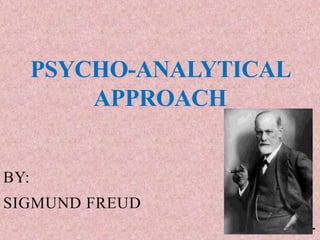
PSYCHO-ANALYTICAL
APPROACH
BY:
SIGMUND FREUD
1
What Is Psycho-Analytical
Approach??
psycho-analytical (psycho-dynamic)
theories are based on the assumption that
personality is to be understood in terms of
interactions and conflicts among needs and
impulses found in an individual, some of
which at least operate at an unconscious
level.
2
Another Definition
Psychoanalytic treatment is highly
individualized and seeks to show how the
unconscious factors affect behavior
patterns, relationships, and overall mental
health. ... In addition to being a
therapy, psychoanalysis is a method of
understanding mental functioning and
the stages of growth and development.
3
Freud’s Psycho-analytical Theory
The psycho-analytical theory of
personality was advocated by Sigmund Freud.
This theory has three major parts :
1. Theory of personality dynamics.
2. Theory of personality structure.
3. Theory of psycho-sexual development.
4
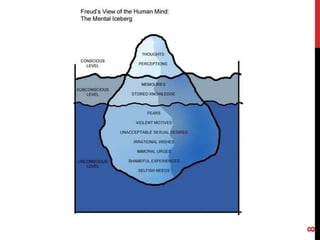
1.Theory Of Personality Dynamics
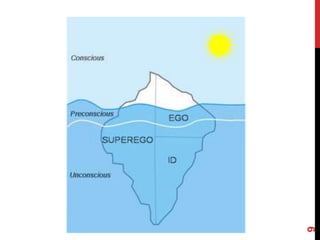
Freud postulated a dynamic concept of
personality by exploring the unconscious part of
human mind. According to Freud, the human
mind has three levels of consciousness :
1. The conscious mind.
2. The preconscious mind.
3. The unconscious mind.
5
6
1. The conscious mind
It is that layer of mind which contains
thoughts and perceptions of which we are aware
at a given moment.
2. The preconscious mind
This layer stands between conscious and
unconscious part of the mind and refers to those
experiences of which the individual is not fully
aware but can be recalled easily. It contains
memories and stored knowledge.
7
3. The unconscious mind
This is the deeper layer of mind which contains
repressed wishes, fears, selfish needs,
unacceptable sexual desires, immoral urges,
shameful experiences and violent motives of
which the individual is unaware and is not able
to recall when
he wants them.
8
9
2. THEORY OF PERSONALITY
STRUCTURE
According to Freud, the personality
structure is made up of three Interlocking systems
– id, ego and super-ego. Each of these systems
has its own properties and mechanisms. But they
interact with one another closly and human
personality is the outcome of such an interaction.
10
a)Id :
The following are the important features
of id:
1. Id is the original source of personality and it
is the reservoir of psychic energy(libido).
2. It is the primitive biogenic impulses in man
consisting of everything that is inherited
psychologically, Including instinctual drives-
sex and aggression.
11
3. It is inborn and operates on animal level.
4. It is unconscious in nature and has no direct
contact with reality.
5. Id is guided by pleasure principle (the
principle of avoiding paint and obtaining
pleasure).
12
b) Ego:
The following are the important features of
ego:
• The ego develops out of id and operates
with the energy derived from id.
• ego is largely conscious and it follows
reality principle.
13
• It acts intelligently and determines what
demands of id could be satisfied. Hence
ego is regarded as the police force in man.
• The keep balance between the demands
of id and super – ego. It checks the flow of
id in those directions which considered
undesirable.
• It functions as the executive with veto
power, and so it can postpone the
fulfillment of the demands of id.
14
c)Super – Ego
Super – ego is called conscience in the
ordinary sense. It is the direct antithesis of id
and represents the ethical and moral force in
man. It has the following features:
• Super- ego is the internalized representation
of the values and morals of society as taught
to the child by the parents and others.
• It develops out of the ego’s experiences with
social reality.
15
• It is idealistic and does not care for
realities.
• It is the decision making force in man and
it is guided by conscience and wisdom.
• The super-ego represents the sense of right
and wrong, good and bad for the society. It
judges whether an action is write or wrong
according to the standards of the society.
16
Instincts
Instincts are pressures that direct an
organism toward particular ends.
Libido
Each instinct has a source of energy. Libido
( from the Latin word for ‘wish’) is the energy
available to the life – instincts or Eros. The
energy of the death – instinct or Thanatos no
special name.
17
3.THEORY OF PSYCHO-SEXUAL
DEVELOPMENT
• According to Freud , all human being move
through a series of psych-sexual stages,
during which the libidinal energy is focused
on different regions of the body(erogenous
zones).
• If a child’s needs at any of the psycho-
sexual stages were either unsatisfied or over
satisfied, fixation(a sort of arrested
development) would take place.
18
• Adult personality of an individual depends
upon the extended of fixation taken place
at different stages of psycho-sexual
development.
• The different stages of psycho-sexual
development are :
19
1.Oral Stage(Birth to 2 years)
At this stage mouth is the erogenous zone.
The infant achieves gratification through oral
activities such as feeding, sucking, biting etc.
2.Anal stage(2 to 3 years)
At this stage sensual pleasure is
focused on the anal zone. The child achieves
gratification through retention and expulsion
of faeces and also through retention and
expulsion of faeces and also through anal
manipulation.
20
3. Phallic Stage(3 To 5 Years)
During this period, pleasure is focused on
the genital region. At this stage pleasure derived
through fondling the genital organs. Children
become aware of sexuality and they develop
sensual feelings towards the parent of the opposite
sex. The oedipus complex is formed in the male
child as a result of sexual child as a result of his
sexual desire towards his mother and an Electra
complex is developed in the female child on
account her desire for the father and rejection of
mother.
21
4. Latency Stage (6 Through
Puberty)
It is a dormant period which is marked
by a temporary repression of sexual
interests and pleasure is derived from
external world.
22
5. Genital Stage (Adolescence And
Beyond)
Here, the pleasure is derived from mature
sexual relations with a partner of opposite sex.
Progression to the genital stage is possible
only if serious fixation has not occurred at the
earlier stages of development. If such fixation has
occurred, then the normal pattern of personality
development is blocked, and various forms of
personality disorders result.
23
ADVANTAGES
Many observations of psychodynamic
therapists appear to be borne out in everyday
life, e.g., defence mechanisms
Many people with psychological
disturbances do recollect childhood traumas
Freudian theory provides a comprehensive
framework to describe human personality
24
Freud ‘rehumanized’ the distressed,
making their suffering more
comprehensible to the rest of society
By developing a method of treatment,
Freud encouraged a more optimistic view
regarding psychological distress. Mental
illness could, in some cases at least, be
treated!
25
LIMITATIONS
Has explanatory power, but lacks
scientific validity
The psychodynamic model is able to provide
believable explanations for the causes of
abnormality, e.g. childhood traumas, but it
lacks the empirical research evidence
needed to support the theory. Freud based
his ideas mainly on his own subjective
analysis of middle class Viennese women.
26
Psychoanalysis depends on the therapist's
subjective interpretation
Psychoanalysis depends heavily on the
therapist’s interpretation of what the client says. Does
a dream about swimming in the sea really mean that
the client has dreamt about sex? Freud said that if the
client accepted the interpretation then it was probably
correct. However, if the client vehemently rejected the
interpretation it may simply be the client’s conscious
mind rejecting an unacceptable but accurate
interpretation. Either way therapist wins!
27
 Freud used a biased sample
Freud studied a group of largely middle-
class Viennese women aged between 20 and 44
years, all of whom had serious emotional
problems, and so his sample cannot reliably
generalize to the general population. He also
only studied one child (Little Hans) when
developing his theory of psychosexual
development, and even then he only
corresponded with the boy's father by letter.
28
Over focus on sexual issues
Psychodynamic theory as developed by
Freud tended to focus too much on sexual
issues, and de-emphasized the importance of
interpersonal and social factors in causing and
maintaining mental disorders. Is it more likely
that failing to resolve the Oedipus complex
causes abnormality, or could a dysfunctional
parenting style leading to an insecure
attachment be the cause?
29
Determinist
The psychodynamic approach is very
determinist as it says that suffering
childhood trauma will lead to abnormal
behavior in adulthood, however it ignores
the influence of genes (biology), reward
(behaviorism), and thinking patterns
(cognitive approach).
30
REFERENCES
1. S.Dandapani, “A Textbook Of Advanced
Educational Psychology(2007)”, Anmol
Publications Pvt. Ltd.
2. N.K.Arjunan, “Psychology Of Learning
And Instruction(2002)”, Atlanta Books
And Publishing Pvt. Ltd.
………

psycho-analytical approach by sigmund freud

  • 1.
  • 2.
    What Is Psycho-Analytical Approach?? psycho-analytical(psycho-dynamic) theories are based on the assumption that personality is to be understood in terms of interactions and conflicts among needs and impulses found in an individual, some of which at least operate at an unconscious level. 2
  • 3.
    Another Definition Psychoanalytic treatmentis highly individualized and seeks to show how the unconscious factors affect behavior patterns, relationships, and overall mental health. ... In addition to being a therapy, psychoanalysis is a method of understanding mental functioning and the stages of growth and development. 3
  • 4.
    Freud’s Psycho-analytical Theory Thepsycho-analytical theory of personality was advocated by Sigmund Freud. This theory has three major parts : 1. Theory of personality dynamics. 2. Theory of personality structure. 3. Theory of psycho-sexual development. 4
  • 5.
    1.Theory Of PersonalityDynamics Freud postulated a dynamic concept of personality by exploring the unconscious part of human mind. According to Freud, the human mind has three levels of consciousness : 1. The conscious mind. 2. The preconscious mind. 3. The unconscious mind. 5
  • 6.
    6 1. The consciousmind It is that layer of mind which contains thoughts and perceptions of which we are aware at a given moment. 2. The preconscious mind This layer stands between conscious and unconscious part of the mind and refers to those experiences of which the individual is not fully aware but can be recalled easily. It contains memories and stored knowledge.
  • 7.
    7 3. The unconsciousmind This is the deeper layer of mind which contains repressed wishes, fears, selfish needs, unacceptable sexual desires, immoral urges, shameful experiences and violent motives of which the individual is unaware and is not able to recall when he wants them.
  • 8.
  • 9.
  • 10.
    2. THEORY OFPERSONALITY STRUCTURE According to Freud, the personality structure is made up of three Interlocking systems – id, ego and super-ego. Each of these systems has its own properties and mechanisms. But they interact with one another closly and human personality is the outcome of such an interaction. 10
  • 11.
    a)Id : The followingare the important features of id: 1. Id is the original source of personality and it is the reservoir of psychic energy(libido). 2. It is the primitive biogenic impulses in man consisting of everything that is inherited psychologically, Including instinctual drives- sex and aggression. 11
  • 12.
    3. It isinborn and operates on animal level. 4. It is unconscious in nature and has no direct contact with reality. 5. Id is guided by pleasure principle (the principle of avoiding paint and obtaining pleasure). 12
  • 13.
    b) Ego: The followingare the important features of ego: • The ego develops out of id and operates with the energy derived from id. • ego is largely conscious and it follows reality principle. 13
  • 14.
    • It actsintelligently and determines what demands of id could be satisfied. Hence ego is regarded as the police force in man. • The keep balance between the demands of id and super – ego. It checks the flow of id in those directions which considered undesirable. • It functions as the executive with veto power, and so it can postpone the fulfillment of the demands of id. 14
  • 15.
    c)Super – Ego Super– ego is called conscience in the ordinary sense. It is the direct antithesis of id and represents the ethical and moral force in man. It has the following features: • Super- ego is the internalized representation of the values and morals of society as taught to the child by the parents and others. • It develops out of the ego’s experiences with social reality. 15
  • 16.
    • It isidealistic and does not care for realities. • It is the decision making force in man and it is guided by conscience and wisdom. • The super-ego represents the sense of right and wrong, good and bad for the society. It judges whether an action is write or wrong according to the standards of the society. 16
  • 17.
    Instincts Instincts are pressuresthat direct an organism toward particular ends. Libido Each instinct has a source of energy. Libido ( from the Latin word for ‘wish’) is the energy available to the life – instincts or Eros. The energy of the death – instinct or Thanatos no special name. 17
  • 18.
    3.THEORY OF PSYCHO-SEXUAL DEVELOPMENT •According to Freud , all human being move through a series of psych-sexual stages, during which the libidinal energy is focused on different regions of the body(erogenous zones). • If a child’s needs at any of the psycho- sexual stages were either unsatisfied or over satisfied, fixation(a sort of arrested development) would take place. 18
  • 19.
    • Adult personalityof an individual depends upon the extended of fixation taken place at different stages of psycho-sexual development. • The different stages of psycho-sexual development are : 19
  • 20.
    1.Oral Stage(Birth to2 years) At this stage mouth is the erogenous zone. The infant achieves gratification through oral activities such as feeding, sucking, biting etc. 2.Anal stage(2 to 3 years) At this stage sensual pleasure is focused on the anal zone. The child achieves gratification through retention and expulsion of faeces and also through retention and expulsion of faeces and also through anal manipulation. 20
  • 21.
    3. Phallic Stage(3To 5 Years) During this period, pleasure is focused on the genital region. At this stage pleasure derived through fondling the genital organs. Children become aware of sexuality and they develop sensual feelings towards the parent of the opposite sex. The oedipus complex is formed in the male child as a result of sexual child as a result of his sexual desire towards his mother and an Electra complex is developed in the female child on account her desire for the father and rejection of mother. 21
  • 22.
    4. Latency Stage(6 Through Puberty) It is a dormant period which is marked by a temporary repression of sexual interests and pleasure is derived from external world. 22
  • 23.
    5. Genital Stage(Adolescence And Beyond) Here, the pleasure is derived from mature sexual relations with a partner of opposite sex. Progression to the genital stage is possible only if serious fixation has not occurred at the earlier stages of development. If such fixation has occurred, then the normal pattern of personality development is blocked, and various forms of personality disorders result. 23
  • 24.
    ADVANTAGES Many observations ofpsychodynamic therapists appear to be borne out in everyday life, e.g., defence mechanisms Many people with psychological disturbances do recollect childhood traumas Freudian theory provides a comprehensive framework to describe human personality 24
  • 25.
    Freud ‘rehumanized’ thedistressed, making their suffering more comprehensible to the rest of society By developing a method of treatment, Freud encouraged a more optimistic view regarding psychological distress. Mental illness could, in some cases at least, be treated! 25
  • 26.
    LIMITATIONS Has explanatory power,but lacks scientific validity The psychodynamic model is able to provide believable explanations for the causes of abnormality, e.g. childhood traumas, but it lacks the empirical research evidence needed to support the theory. Freud based his ideas mainly on his own subjective analysis of middle class Viennese women. 26
  • 27.
    Psychoanalysis depends onthe therapist's subjective interpretation Psychoanalysis depends heavily on the therapist’s interpretation of what the client says. Does a dream about swimming in the sea really mean that the client has dreamt about sex? Freud said that if the client accepted the interpretation then it was probably correct. However, if the client vehemently rejected the interpretation it may simply be the client’s conscious mind rejecting an unacceptable but accurate interpretation. Either way therapist wins! 27
  • 28.
     Freud useda biased sample Freud studied a group of largely middle- class Viennese women aged between 20 and 44 years, all of whom had serious emotional problems, and so his sample cannot reliably generalize to the general population. He also only studied one child (Little Hans) when developing his theory of psychosexual development, and even then he only corresponded with the boy's father by letter. 28
  • 29.
    Over focus onsexual issues Psychodynamic theory as developed by Freud tended to focus too much on sexual issues, and de-emphasized the importance of interpersonal and social factors in causing and maintaining mental disorders. Is it more likely that failing to resolve the Oedipus complex causes abnormality, or could a dysfunctional parenting style leading to an insecure attachment be the cause? 29
  • 30.
    Determinist The psychodynamic approachis very determinist as it says that suffering childhood trauma will lead to abnormal behavior in adulthood, however it ignores the influence of genes (biology), reward (behaviorism), and thinking patterns (cognitive approach). 30
  • 31.
    REFERENCES 1. S.Dandapani, “ATextbook Of Advanced Educational Psychology(2007)”, Anmol Publications Pvt. Ltd. 2. N.K.Arjunan, “Psychology Of Learning And Instruction(2002)”, Atlanta Books And Publishing Pvt. Ltd. ………