
OVERVIEW ON
PERFORMANCE
PRESENTED BY:
MARY ANNE A. PORTUGUEZ, MP, RPm
Performance
• Ability, innate capacities as well as attributes.
Researchers have found no differences in
overall abilities between men and women,
however, women tend to have lower
expectations of success.
• Motivation, reflected by the person’s
willingness to perform, and can be measured
by work effort.
• Opportunity is thought to be related to
environmental variables, including
organizational support.
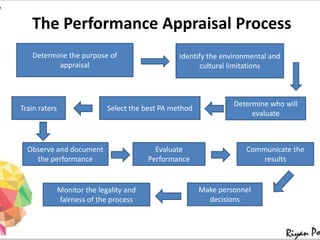
The Performance Appraisal Process
Determine the purpose of
appraisal
Select the best PA method
Determine who will
evaluate
Train raters
Monitor the legality and
fairness of the process
Communicate the
results
Evaluate
Performance
Identify the environmental and
cultural limitations
Observe and document
the performance
Make personnel
decisions
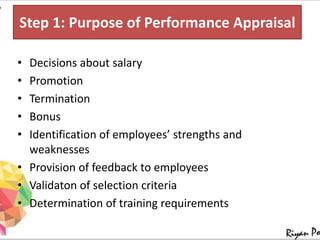
Step 1: Purpose of Performance Appraisal
• Decisions about salary
• Promotion
• Termination
• Bonus
• Identification of employees’ strengths and
weaknesses
• Provision of feedback to employees
• Validaton of selection criteria
• Determination of training requirements
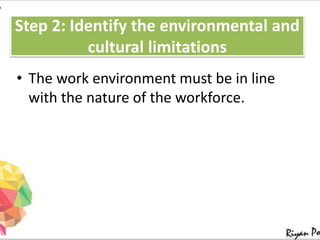
Step 2: Identify the environmental and
cultural limitations
• The work environment must be in line
with the nature of the workforce.
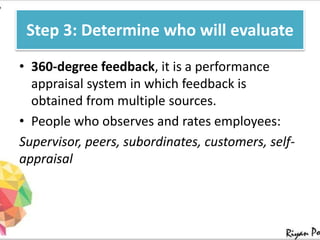
Step 3: Determine who will evaluate
• 360-degree feedback, it is a performance
appraisal system in which feedback is
obtained from multiple sources.
• People who observes and rates employees:
Supervisor, peers, subordinates, customers, self-
appraisal
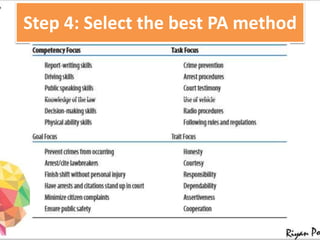
Step 4: Select the best PA method
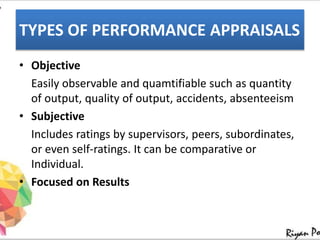
TYPES OF PERFORMANCE APPRAISALS
• Objective
Easily observable and quamtifiable such as quantity
of output, quality of output, accidents, absenteeism
• Subjective
Includes ratings by supervisors, peers, subordinates,
or even self-ratings. It can be comparative or
Individual.
• Focused on Results
Subjective
• COMPARATIVE
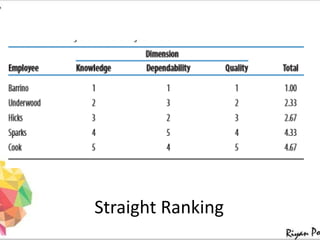
a. Straight rankings, listing of workers from
best to worst.
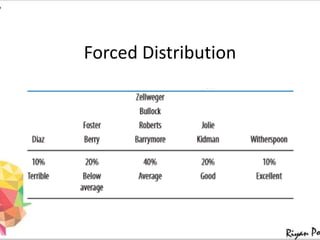
b. Forced Distribution, ranked to fit a
distribution.
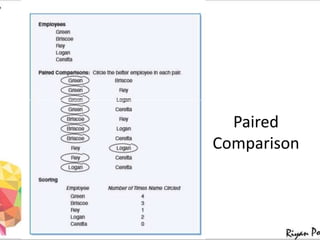
c. Paired comparison, each employee is
compared to every other employee in pairs.
Paired
Comparison
Straight Ranking
Forced Distribution
Objective Measures
• Common types of objective measures include
quantity of work (number of relevant job
behaviors), quality of work (errors),
attendance (absences), and safety (success).
Objective
• INDIVIDUAL
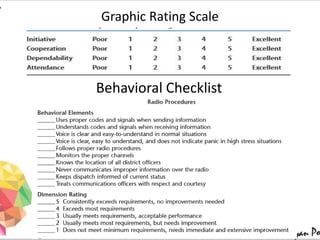
a. Graphic Rating Scales, involves ratings on several
aspects of a job.
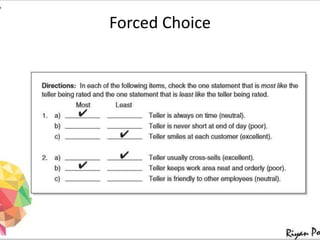
b. BARS, based on critical incidents.
c. BOS (Behavioral Observation Scale), rating to the
extent to which a person engages in every behavior.
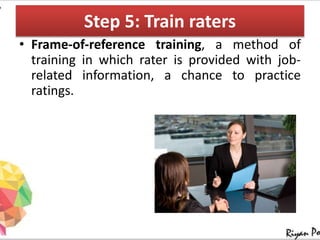
d. Forced choice, the rater must choose between two
seemingly equally desirable or undesirable. It controls
halo effect as well as leniency and strictness.
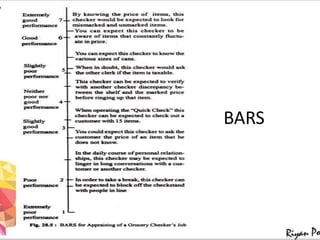
e. Behavioral Checklist, a rater using a behavioral check
list checks off all the adjectives or descriptors that apply
to the employee being rated.
Graphic Rating Scale
Behavioral Checklist
BARS
Forced Choice
Step 5: Train raters
• Frame-of-reference training, a method of
training in which rater is provided with job-
related information, a chance to practice
ratings.
Step 6: Observe and document the
performance
• Critical incidents, a method of performance
appraisal in which the supervisor records
employee behaviors that were observed on
the job and rates the employee on the basis of
that record.
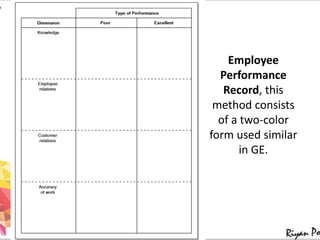
Employee
Performance
Record, this
method consists
of a two-color
form used similar
in GE.
Step 7: Evaluating Performance
• Obtain and review first the objective data
relevant to the employee’s behavior to
avoid errors of evaluation.
ERRORS IN EVALUATION
• INSTRUMENT ERRORS
Deficiency, involve excluding important
aspects of the job from evaluations.
Contamination, rating an employee on
non-important aspects of the job.
ERRORS IN EVALUATION
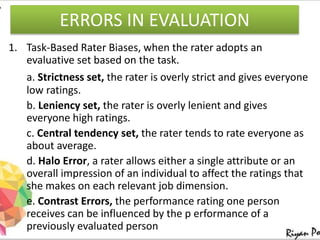
1. Task-Based Rater Biases, when the rater adopts an
evaluative set based on the task.
a. Strictness set, the rater is overly strict and gives everyone
low ratings.
b. Leniency set, the rater is overly lenient and gives
everyone high ratings.
c. Central tendency set, the rater tends to rate everyone as
about average.
d. Halo Error, a rater allows either a single attribute or an
overall impression of an individual to affect the ratings that
she makes on each relevant job dimension.
e. Contrast Errors, the performance rating one person
receives can be influenced by the p erformance of a
previously evaluated person
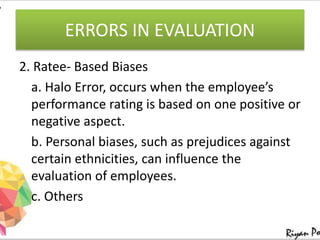
2. Ratee- Based Biases
a. Halo Error, occurs when the employee’s
performance rating is based on one positive or
negative aspect.
b. Personal biases, such as prejudices against
certain ethnicities, can influence the
evaluation of employees.
c. Others
ERRORS IN EVALUATION
Step 8: Communicate the Appraisal
Results
• Allocating Time
• Scheduling the Interview
• Preparing for the Interview
Step 9: Make personnel decisions
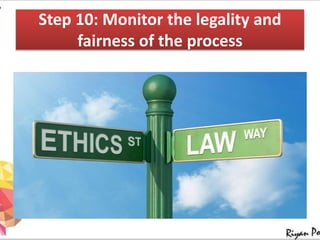
Step 10: Monitor the legality and
fairness of the process
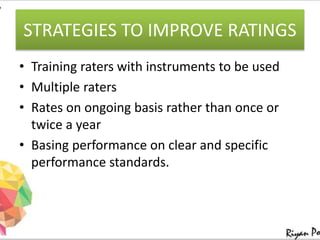
STRATEGIES TO IMPROVE RATINGS
• Training raters with instruments to be used
• Multiple raters
• Rates on ongoing basis rather than once or
twice a year
• Basing performance on clear and specific
performance standards.

5 Overview on Performance

  • 1.
  • 3.
    Performance • Ability, innatecapacities as well as attributes. Researchers have found no differences in overall abilities between men and women, however, women tend to have lower expectations of success. • Motivation, reflected by the person’s willingness to perform, and can be measured by work effort. • Opportunity is thought to be related to environmental variables, including organizational support.
  • 4.
    The Performance AppraisalProcess Determine the purpose of appraisal Select the best PA method Determine who will evaluate Train raters Monitor the legality and fairness of the process Communicate the results Evaluate Performance Identify the environmental and cultural limitations Observe and document the performance Make personnel decisions
  • 5.
    Step 1: Purposeof Performance Appraisal • Decisions about salary • Promotion • Termination • Bonus • Identification of employees’ strengths and weaknesses • Provision of feedback to employees • Validaton of selection criteria • Determination of training requirements
  • 6.
    Step 2: Identifythe environmental and cultural limitations • The work environment must be in line with the nature of the workforce.
  • 7.
    Step 3: Determinewho will evaluate • 360-degree feedback, it is a performance appraisal system in which feedback is obtained from multiple sources. • People who observes and rates employees: Supervisor, peers, subordinates, customers, self- appraisal
  • 8.
    Step 4: Selectthe best PA method
  • 9.
    TYPES OF PERFORMANCEAPPRAISALS • Objective Easily observable and quamtifiable such as quantity of output, quality of output, accidents, absenteeism • Subjective Includes ratings by supervisors, peers, subordinates, or even self-ratings. It can be comparative or Individual. • Focused on Results
  • 10.
    Subjective • COMPARATIVE a. Straightrankings, listing of workers from best to worst. b. Forced Distribution, ranked to fit a distribution. c. Paired comparison, each employee is compared to every other employee in pairs.
  • 11.
  • 12.
  • 13.
  • 14.
    Objective Measures • Commontypes of objective measures include quantity of work (number of relevant job behaviors), quality of work (errors), attendance (absences), and safety (success).
  • 15.
    Objective • INDIVIDUAL a. GraphicRating Scales, involves ratings on several aspects of a job. b. BARS, based on critical incidents. c. BOS (Behavioral Observation Scale), rating to the extent to which a person engages in every behavior. d. Forced choice, the rater must choose between two seemingly equally desirable or undesirable. It controls halo effect as well as leniency and strictness. e. Behavioral Checklist, a rater using a behavioral check list checks off all the adjectives or descriptors that apply to the employee being rated.
  • 16.
  • 17.
  • 18.
  • 19.
    Step 5: Trainraters • Frame-of-reference training, a method of training in which rater is provided with job- related information, a chance to practice ratings.
  • 20.
    Step 6: Observeand document the performance • Critical incidents, a method of performance appraisal in which the supervisor records employee behaviors that were observed on the job and rates the employee on the basis of that record.
  • 21.
    Employee Performance Record, this method consists ofa two-color form used similar in GE.
  • 22.
    Step 7: EvaluatingPerformance • Obtain and review first the objective data relevant to the employee’s behavior to avoid errors of evaluation.
  • 23.
    ERRORS IN EVALUATION •INSTRUMENT ERRORS Deficiency, involve excluding important aspects of the job from evaluations. Contamination, rating an employee on non-important aspects of the job.
  • 24.
    ERRORS IN EVALUATION 1.Task-Based Rater Biases, when the rater adopts an evaluative set based on the task. a. Strictness set, the rater is overly strict and gives everyone low ratings. b. Leniency set, the rater is overly lenient and gives everyone high ratings. c. Central tendency set, the rater tends to rate everyone as about average. d. Halo Error, a rater allows either a single attribute or an overall impression of an individual to affect the ratings that she makes on each relevant job dimension. e. Contrast Errors, the performance rating one person receives can be influenced by the p erformance of a previously evaluated person
  • 25.
    2. Ratee- BasedBiases a. Halo Error, occurs when the employee’s performance rating is based on one positive or negative aspect. b. Personal biases, such as prejudices against certain ethnicities, can influence the evaluation of employees. c. Others ERRORS IN EVALUATION
  • 26.
    Step 8: Communicatethe Appraisal Results • Allocating Time • Scheduling the Interview • Preparing for the Interview
  • 27.
    Step 9: Makepersonnel decisions
  • 28.
    Step 10: Monitorthe legality and fairness of the process
  • 29.
    STRATEGIES TO IMPROVERATINGS • Training raters with instruments to be used • Multiple raters • Rates on ongoing basis rather than once or twice a year • Basing performance on clear and specific performance standards.

Editor's Notes

  • #18 https://www.google.com.ph/url?sa=i&rct=j&q=&esrc=s&source=images&cd=&cad=rja&uact=8&ved=0ahUKEwj6kMGuvdfMAhXDJ5QKHTrbCWEQjRwIBw&url=http%3A%2F%2Fwww.yourarticlelibrary.com%2Fperformance-appraisal%2Fperformance-appraisal-methods-traditional-and-modern-methods-with-example%2F35492%2F&bvm=bv.122129774,d.dGo&psig=AFQjCNHxURvutz889vhqUBCyulNdNZEVWQ&ust=1463243555330234
  • #21 First, focus on employee behaviors rather than traits Second, helps recall behaviors when evaluating performance Third, provides examples to use in reviewing performance ratings Fourth, low adverse impact
  • #25 Distribution errors are made when a rater uses only one part of a rating scale.