Presented by Anita Navarra and Mary Miller
Carl Jung – Introduction 
 
 He founded analytical 
psychology. 
 He was a Swiss 
psychiatrist. 
 He proposed and 
developed the concepts 
of archetypes, collective 
unconscious, 
individuation, 
personality types 
among other ideas.
Carl Jung 
 
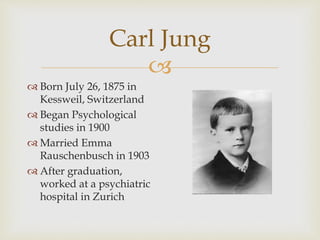
 Born July 26, 1875 in 
Kessweil, Switzerland 
 Began Psychological 
studies in 1900 
 Married Emma 
Rauschenbusch in 1903 
 After graduation, 
worked at a psychiatric 
hospital in Zurich
Carl Jung - Timeline 
 
 1906 – studied word association 
- named President of the International 
Psychoanalytic Association 
 1907 – met Freud. They were friends/colleagues for a 
few years and then parted ways after differing on dream 
interpretation and human personality components. 
 He also taught at Zurich, had a private practice, and 
published, “Psychology of the Unconscious’’ in 1911. 
 1914 – Withdrew from society. 
 1913-1919 – studied inner dreams and fantasy images; he 
believed these were his most important life years.
Psychic Development 
 
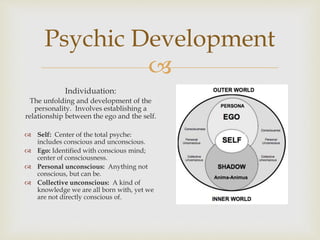
Individuation: 
The unfolding and development of the 
personality. Involves establishing a 
relationship between the ego and the self. 
 Self: Center of the total psyche: 
includes conscious and unconscious. 
 Ego: Identified with conscious mind; 
center of consciousness. 
 Personal unconscious: Anything not 
conscious, but can be. 
 Collective unconscious: A kind of 
knowledge we are all born with, yet we 
are not directly conscious of.
 
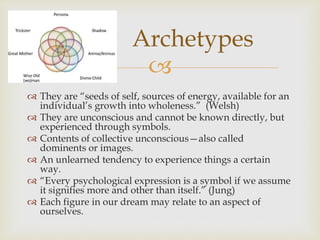
 They are “seeds of self, sources of energy, available for an 
individual’s growth into wholeness.” (Welsh) 
 They are unconscious and cannot be known directly, but 
experienced through symbols. 
 Contents of collective unconscious—also called 
dominents or images. 
 An unlearned tendency to experience things a certain 
way. 
 “Every psychological expression is a symbol if we assume 
it signifies more and other than itself.” (Jung) 
 Each figure in our dream may relate to an aspect of 
ourselves. 
Archetypes
Mother Archetype 
 
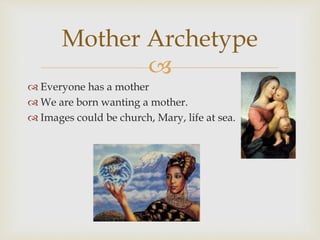
 Everyone has a mother 
 We are born wanting a mother. 
 Images could be church, Mary, life at sea.
Shadow 
 
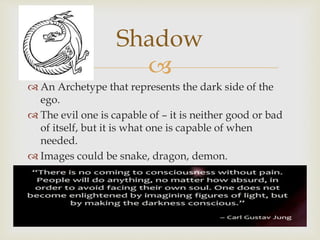
 An Archetype that represents the dark side of the 
ego. 
 The evil one is capable of – it is neither good or bad 
of itself, but it is what one is capable of when 
needed. 
 Images could be snake, dragon, demon.
 
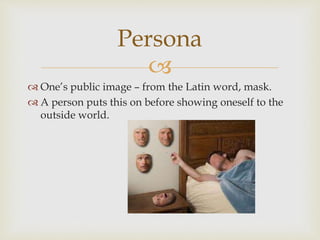
 One’s public image – from the Latin word, mask. 
 A person puts this on before showing oneself to the 
outside world. 
Persona
Other Archetypes 
 
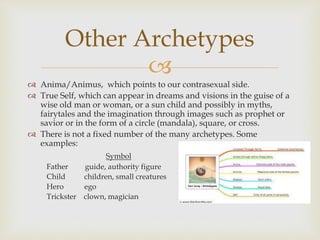
 Anima/Animus, which points to our contrasexual side. 
 True Self, which can appear in dreams and visions in the guise of a 
wise old man or woman, or a sun child and possibly in myths, 
fairytales and the imagination through images such as prophet or 
savior or in the form of a circle (mandala), square, or cross. 
 There is not a fixed number of the many archetypes. Some 
examples: 
Symbol 
Father guide, authority figure 
Child children, small creatures 
Hero ego 
Trickster clown, magician
Self 
 
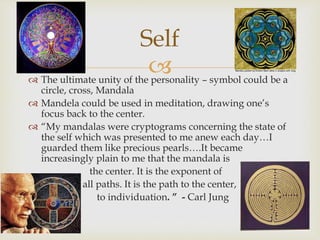
 The ultimate unity of the personality – symbol could be a 
circle, cross, Mandala 
 Mandela could be used in meditation, drawing one’s 
focus back to the center. 
 “My mandalas were cryptograms concerning the state of 
the self which was presented to me anew each day…I 
guarded them like precious pearls….It became 
increasingly plain to me that the mandala is 
the center. It is the exponent of 
 all paths. It is the path to the center, 
to individuation. ” - Carl Jung
Dynamics of the Psyche – 
3 Principles 
 
 1. Opposites – opposition creates energy of the 
psyche. 
 2. Equivalence – energy of opposites is given to both 
sides equally. Acknowledge both ends (poles?) or a 
complex will develop. 
 3. Entropy – energy decreases over a lifetime – 
oppositions come together.
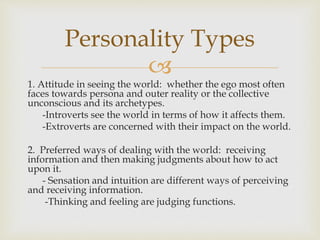
Personality Types 
 
1. Attitude in seeing the world: whether the ego most often 
faces towards persona and outer reality or the collective 
unconscious and its archetypes. 
-Introverts see the world in terms of how it affects them. 
-Extroverts are concerned with their impact on the world. 
2. Preferred ways of dealing with the world: receiving 
information and then making judgments about how to act 
upon it. 
- Sensation and intuition are different ways of perceiving 
and receiving information. 
-Thinking and feeling are judging functions.
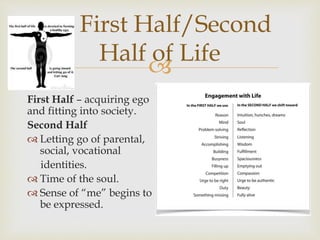
First Half/Second 
Half of Life 
 
First Half – acquiring ego 
and fitting into society. 
Second Half 
 Letting go of parental, 
social, vocational 
identities. 
 Time of the soul. 
 Sense of “me” begins to 
be expressed.
Spiritual Expression 
 
 Life has purpose beyond material good. 
 There is a discovery and fulfillment of deep innate 
potential. 
 The journey is one of meeting the self and at the 
same time meeting the Divine. 
 The journey is one of transformation, individuation, 
which is at the mystical heart of all religions.
Author’s Note 
 
 The author, John Welch states that in his book, 
Spiritual Pilgrims, he assumes the “adequacy” of 
Jung’s theories, and is not attempting to defend 
them. He admits the Jung’s theories are by “no 
means unchallenged today,” particularly his view of 
the reality of the collective unconscious and the 
existence of the archetypes.
Discussion Questions 
 
 How might Jung’s theories be helpful to my personal 
and faith development? 
 How might applying Jung’s theories be helpful in 
my ministry? 
 What are the “sticking points” of Jung’s theories that 
I find limiting or that I find myself resisting?

Carl jung powerpoint

  • 1.
    Presented by AnitaNavarra and Mary Miller
  • 2.
    Carl Jung –Introduction   He founded analytical psychology.  He was a Swiss psychiatrist.  He proposed and developed the concepts of archetypes, collective unconscious, individuation, personality types among other ideas.
  • 3.
    Carl Jung   Born July 26, 1875 in Kessweil, Switzerland  Began Psychological studies in 1900  Married Emma Rauschenbusch in 1903  After graduation, worked at a psychiatric hospital in Zurich
  • 4.
    Carl Jung -Timeline   1906 – studied word association - named President of the International Psychoanalytic Association  1907 – met Freud. They were friends/colleagues for a few years and then parted ways after differing on dream interpretation and human personality components.  He also taught at Zurich, had a private practice, and published, “Psychology of the Unconscious’’ in 1911.  1914 – Withdrew from society.  1913-1919 – studied inner dreams and fantasy images; he believed these were his most important life years.
  • 5.
    Psychic Development  Individuation: The unfolding and development of the personality. Involves establishing a relationship between the ego and the self.  Self: Center of the total psyche: includes conscious and unconscious.  Ego: Identified with conscious mind; center of consciousness.  Personal unconscious: Anything not conscious, but can be.  Collective unconscious: A kind of knowledge we are all born with, yet we are not directly conscious of.
  • 6.
      Theyare “seeds of self, sources of energy, available for an individual’s growth into wholeness.” (Welsh)  They are unconscious and cannot be known directly, but experienced through symbols.  Contents of collective unconscious—also called dominents or images.  An unlearned tendency to experience things a certain way.  “Every psychological expression is a symbol if we assume it signifies more and other than itself.” (Jung)  Each figure in our dream may relate to an aspect of ourselves. Archetypes
  • 7.
    Mother Archetype   Everyone has a mother  We are born wanting a mother.  Images could be church, Mary, life at sea.
  • 8.
    Shadow  An Archetype that represents the dark side of the ego.  The evil one is capable of – it is neither good or bad of itself, but it is what one is capable of when needed.  Images could be snake, dragon, demon.
  • 9.
      One’spublic image – from the Latin word, mask.  A person puts this on before showing oneself to the outside world. Persona
  • 10.
    Other Archetypes   Anima/Animus, which points to our contrasexual side.  True Self, which can appear in dreams and visions in the guise of a wise old man or woman, or a sun child and possibly in myths, fairytales and the imagination through images such as prophet or savior or in the form of a circle (mandala), square, or cross.  There is not a fixed number of the many archetypes. Some examples: Symbol Father guide, authority figure Child children, small creatures Hero ego Trickster clown, magician
  • 11.
    Self  The ultimate unity of the personality – symbol could be a circle, cross, Mandala  Mandela could be used in meditation, drawing one’s focus back to the center.  “My mandalas were cryptograms concerning the state of the self which was presented to me anew each day…I guarded them like precious pearls….It became increasingly plain to me that the mandala is the center. It is the exponent of  all paths. It is the path to the center, to individuation. ” - Carl Jung
  • 12.
    Dynamics of thePsyche – 3 Principles   1. Opposites – opposition creates energy of the psyche.  2. Equivalence – energy of opposites is given to both sides equally. Acknowledge both ends (poles?) or a complex will develop.  3. Entropy – energy decreases over a lifetime – oppositions come together.
  • 13.
    Personality Types  1. Attitude in seeing the world: whether the ego most often faces towards persona and outer reality or the collective unconscious and its archetypes. -Introverts see the world in terms of how it affects them. -Extroverts are concerned with their impact on the world. 2. Preferred ways of dealing with the world: receiving information and then making judgments about how to act upon it. - Sensation and intuition are different ways of perceiving and receiving information. -Thinking and feeling are judging functions.
  • 14.
    First Half/Second Halfof Life  First Half – acquiring ego and fitting into society. Second Half  Letting go of parental, social, vocational identities.  Time of the soul.  Sense of “me” begins to be expressed.
  • 15.
    Spiritual Expression   Life has purpose beyond material good.  There is a discovery and fulfillment of deep innate potential.  The journey is one of meeting the self and at the same time meeting the Divine.  The journey is one of transformation, individuation, which is at the mystical heart of all religions.
  • 16.
    Author’s Note   The author, John Welch states that in his book, Spiritual Pilgrims, he assumes the “adequacy” of Jung’s theories, and is not attempting to defend them. He admits the Jung’s theories are by “no means unchallenged today,” particularly his view of the reality of the collective unconscious and the existence of the archetypes.
  • 17.
    Discussion Questions   How might Jung’s theories be helpful to my personal and faith development?  How might applying Jung’s theories be helpful in my ministry?  What are the “sticking points” of Jung’s theories that I find limiting or that I find myself resisting?