Emotions,
Attitudes, and Job
Satisfaction
Presented by:
Mary Anne A. Portuguez, MP, RPm
FOUNDATIONS OF EMOTIONS AND
MOODS
• Affects
It is a generic term that covers a broad range of feelings that
individuals express.
• Emotions
intense feelings that are directed at someone or something
• Moods
less intense and frequently lack a contextual stimulus
AFFECT
•Positive affectivity
tendency to be perceptually positive
•Negative affectivity
tend to experience negative moods in a wide range of
settings and under many different conditions
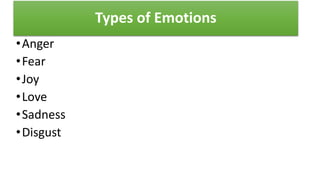
Types of Emotions
•Anger
•Fear
•Joy
•Love
•Sadness
•Disgust
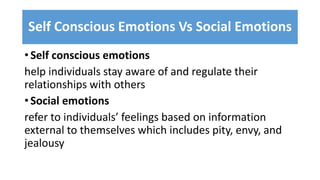
Self Conscious Emotions Vs Social Emotions
• Self conscious emotions
help individuals stay aware of and regulate their
relationships with others
• Social emotions
refer to individuals’ feelings based on information
external to themselves which includes pity, envy, and
jealousy
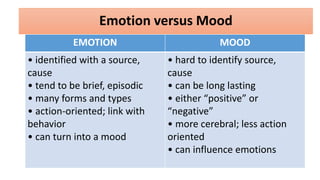
Emotion versus Mood
EMOTION MOOD
• identified with a source,
cause
• tend to be brief, episodic
• many forms and types
• action-oriented; link with
behavior
• can turn into a mood
• hard to identify source,
cause
• can be long lasting
• either “positive” or
“negative”
• more cerebral; less action
oriented
• can influence emotions
Interesting!
•Emotion and mood contagion is the spillover of
one’s emotions and mood onto others.
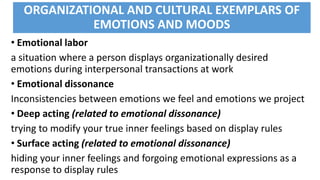
ORGANIZATIONAL AND CULTURAL EXEMPLARS OF
EMOTIONS AND MOODS
• Emotional labor
a situation where a person displays organizationally desired
emotions during interpersonal transactions at work
• Emotional dissonance
Inconsistencies between emotions we feel and emotions we project
• Deep acting (related to emotional dissonance)
trying to modify your true inner feelings based on display rules
• Surface acting (related to emotional dissonance)
hiding your inner feelings and forgoing emotional expressions as a
response to display rules
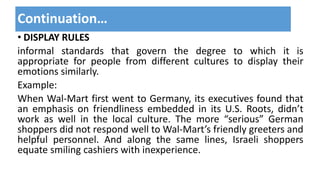
Continuation…
• DISPLAY RULES
informal standards that govern the degree to which it is
appropriate for people from different cultures to display their
emotions similarly.
Example:
When Wal-Mart first went to Germany, its executives found that
an emphasis on friendliness embedded in its U.S. Roots, didn’t
work as well in the local culture. The more “serious” German
shoppers did not respond well to Wal-Mart’s friendly greeters and
helpful personnel. And along the same lines, Israeli shoppers
equate smiling cashiers with inexperience.
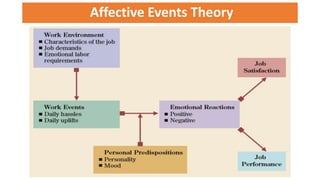
Affective Events Theory
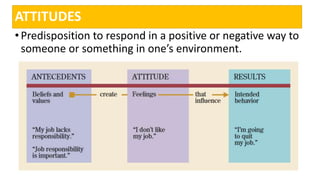
ATTITUDES
•Predisposition to respond in a positive or negative way to
someone or something in one’s environment.
Components of Attitudes
• Cognitive component
reflects the beliefs, opinions, knowledge, or information a person
possesses
• Beliefs
represent ideas about someone or something and the conclusions
people draw about them
• Affective component
specific feeling regarding the personal impact of the antecedents
• Behavioral component
intention to behave in a certain way based on your specific feelings
or attitudes
Attitude and Cognitive Consistency
• Leon Festinger, uses the term cognitive dissonance to describe a
state of inconsistency between an individual’s attitudes and/or
between attitudes and behavior.
• Cognitive dissonance
Describes a state of inconsistency between an individual’s attitudes
and his or her behavior
• Cognitive dissonance can be reduced by:
• Changing the underlying attitude
• Changing future behavior
• Developing new ways of explaining or rationalizing the
inconsistency
JOB SATISFACTION
•The degree to which individuals feel positively or
negatively about their jobs
Facets:
•The work itself
•Quality of supervision
•Relationships with co-workers
•Promotion opportunities
•Pay
Job Involvement
It is the extent to which an individual is dedicated to
a job.
Organizational Commitment
It is the loyalty of an individual to the organization.
Employee Engagement
It is a positive feeling or strong sense of connection
with the organization.
Withdrawal Behaviors
• Absenteeism
•Turnover
•Day dreaming
•Cyber loafing
ORGANIZATIONAL CITIZENSHIP BEHAVIOR
These are the extras people do to go the extra mile in their
work (can be interpersonal and organizational OCB)
COUNTERPRODUCTIVE WORK BEHAVIORS
Intentionally disrupt relationships or performance at work.
Three Possibilities of Job Satisfaction
• Argument: satisfaction causes performance
Managerial implication — to increase employees’ work
performance, make them happy
• Argument: satisfaction causes performance
Performance in a given time period is related to satisfaction in a
later time period
Rewards link performance with later satisfaction
• Argument: rewards cause both satisfaction and performance
Proper allocation of rewards can positively influence both
satisfaction and performance
High job satisfaction and performance

3 Attitudes

  • 1.
    Emotions, Attitudes, and Job Satisfaction Presentedby: Mary Anne A. Portuguez, MP, RPm
  • 2.
    FOUNDATIONS OF EMOTIONSAND MOODS • Affects It is a generic term that covers a broad range of feelings that individuals express. • Emotions intense feelings that are directed at someone or something • Moods less intense and frequently lack a contextual stimulus
  • 3.
    AFFECT •Positive affectivity tendency tobe perceptually positive •Negative affectivity tend to experience negative moods in a wide range of settings and under many different conditions
  • 4.
  • 5.
    Self Conscious EmotionsVs Social Emotions • Self conscious emotions help individuals stay aware of and regulate their relationships with others • Social emotions refer to individuals’ feelings based on information external to themselves which includes pity, envy, and jealousy
  • 6.
    Emotion versus Mood EMOTIONMOOD • identified with a source, cause • tend to be brief, episodic • many forms and types • action-oriented; link with behavior • can turn into a mood • hard to identify source, cause • can be long lasting • either “positive” or “negative” • more cerebral; less action oriented • can influence emotions
  • 7.
    Interesting! •Emotion and moodcontagion is the spillover of one’s emotions and mood onto others.
  • 8.
    ORGANIZATIONAL AND CULTURALEXEMPLARS OF EMOTIONS AND MOODS • Emotional labor a situation where a person displays organizationally desired emotions during interpersonal transactions at work • Emotional dissonance Inconsistencies between emotions we feel and emotions we project • Deep acting (related to emotional dissonance) trying to modify your true inner feelings based on display rules • Surface acting (related to emotional dissonance) hiding your inner feelings and forgoing emotional expressions as a response to display rules
  • 9.
    Continuation… • DISPLAY RULES informalstandards that govern the degree to which it is appropriate for people from different cultures to display their emotions similarly. Example: When Wal-Mart first went to Germany, its executives found that an emphasis on friendliness embedded in its U.S. Roots, didn’t work as well in the local culture. The more “serious” German shoppers did not respond well to Wal-Mart’s friendly greeters and helpful personnel. And along the same lines, Israeli shoppers equate smiling cashiers with inexperience.
  • 10.
  • 11.
    ATTITUDES •Predisposition to respondin a positive or negative way to someone or something in one’s environment.
  • 12.
    Components of Attitudes •Cognitive component reflects the beliefs, opinions, knowledge, or information a person possesses • Beliefs represent ideas about someone or something and the conclusions people draw about them • Affective component specific feeling regarding the personal impact of the antecedents • Behavioral component intention to behave in a certain way based on your specific feelings or attitudes
  • 13.
    Attitude and CognitiveConsistency • Leon Festinger, uses the term cognitive dissonance to describe a state of inconsistency between an individual’s attitudes and/or between attitudes and behavior. • Cognitive dissonance Describes a state of inconsistency between an individual’s attitudes and his or her behavior • Cognitive dissonance can be reduced by: • Changing the underlying attitude • Changing future behavior • Developing new ways of explaining or rationalizing the inconsistency
  • 14.
    JOB SATISFACTION •The degreeto which individuals feel positively or negatively about their jobs Facets: •The work itself •Quality of supervision •Relationships with co-workers •Promotion opportunities •Pay
  • 15.
    Job Involvement It isthe extent to which an individual is dedicated to a job. Organizational Commitment It is the loyalty of an individual to the organization. Employee Engagement It is a positive feeling or strong sense of connection with the organization.
  • 16.
  • 17.
    ORGANIZATIONAL CITIZENSHIP BEHAVIOR Theseare the extras people do to go the extra mile in their work (can be interpersonal and organizational OCB) COUNTERPRODUCTIVE WORK BEHAVIORS Intentionally disrupt relationships or performance at work.
  • 18.
    Three Possibilities ofJob Satisfaction • Argument: satisfaction causes performance Managerial implication — to increase employees’ work performance, make them happy • Argument: satisfaction causes performance Performance in a given time period is related to satisfaction in a later time period Rewards link performance with later satisfaction • Argument: rewards cause both satisfaction and performance Proper allocation of rewards can positively influence both satisfaction and performance High job satisfaction and performance

Editor's Notes

  • #3 Anger Fear Joy Love Sadness Disgust
  • #5 Anger, for example, may involve disgust and envy Fear may contain alarm and anxiety; joy may contain cheerfulness and contentment; love may contain affection, longing, and lust; sadness may contain disappointment, neglect, and shame.
  • #7 Although emotions and moods are influenced by different events and situations, each of us may be prone to displaying some relatively stable tendencies. Some people seem most always positive and upbeat about things. For these optimists we might say the glass is nearly always half full.
  • #8 In one study team members were found to share good and bad moods within two hours of being together; bad moods, interestingly, traveled person to-person faster than good moods.13 Other research found that when mood contagion is positive followers report being more attracted to their leaders and rate the leaders more highly. Mood contagion can also have inflationary and deflationary effects on the moods of co-workers and teammates, as well as family and friends.14
  • #9 It is a form of self-regulation to display organizationally desired emotions in one’s job. Good examples come from service settings such as airline check-in personnel or flight attendants. They are supposed to appear approachable, receptive, and friendly while taking care of the things you require as a customer. Emotional labor isn’t always easy; it can be hard to be consistently “on,” projecting the desired emotions associated with one’s work. If you’re having a bad mood day or just experienced an emotional run-in with a neighbor, for example, being “happy” and “helpful” with a demanding customer might seem a little much to ask.
  • #10 Bottomline: we should be sensitive to the way emotions are displayed in other cultures; often they may not mean what they do at home.
  • #11 The basic notion of the theory is that our emotions and moods are influenced by events involving other people and situations, and these emotions and moods, in turn, influence the work performance and satisfaction of us and others.
  • #12 Schermerhorn, 2010
  • #15  Think about your work experiences or conversations with other people about their work. It isn’t uncommon to hear concerns expressed about someone’s “bad attitude” or another’s “good attitude.” Such attitudes appear in different forms, including job satisfaction, job involvement, organizational commitment, and employee engagement. You often hear the term “morale” used when describing the feelings of a workforce toward their employer. It relates to the more specific notion of job satisfaction The work itself—responsibility, interest, and growth • Quality of supervision—technical help and social support • Relationships with co-workers—social harmony and respect • Promotion opportunities—chances for further advancement • Pay—adequacy of pay and perceived equity vis-à-vis others