INTRODUCTION
TO
EXPERIMENTAL
PSYCHOLOGY
Presented by:
Mary Anne A. Portuguez, MP, RPm
What is the goal of scientific
psychology?
– To understand why people think and act as they
do.
– Follows the five major goals in Psychology.
Describe, explain, predict, control, and influence.
How important is science in
Psychology?
– It offers systematic and objective procedure to
gather information.
– It provides framework.
– It offers evidence-based solutions to problems.
– It guides practitioners.
LET’S DIVE INTO THE REAL
WORLD!
– There are times in a company wherein newly
installed machines are not effective to use.
– More people in the streets take more time to help
another person.
– The negative effects of social media use.
OBJECTIVES:
– To be well-versed in experimental methods.
– To apply the insights in real world.
– To apply the learnings in making psychological
research.
Psychology as a Science
– Establish relationships between
circumstances and behaviors.
– Fit these relationships into an orderly body
of knowledge.
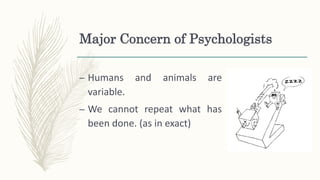
Major Concern of Psychologists
– Humans and animals are
variable.
– We cannot repeat what has
been done. (as in exact)
How can we manage variability?
– Statistical treatment
– Control
Research Techniques
– Quantitative design
– Qualitative design
Quantitative
Methods
Important terms to remember:
Inductive theories:
– Created from a solid database of empirical
observations.
Deductive theories:
– Can be precisely stated and tested.
– Hypotheses are created as tentative answers to
problems.
Postulates - fundamental or core assumptions of a
theory that are taken as self-evidently true.
Propositions - general relational statements that
may be true or false; not tested directly but used to
derive hypotheses.
Important terms to remember:
Conceptual definitions - concepts in the hypotheses
are defined precisely so that accurate measures of the
concepts can be devised.
Operational definitions - procedures (or operations)
used to define particular constructs.
Replication - duplication or repetition of an
experiment or study to determine whether or not the
original findings are reliable.
Experimental Method
– the relationship of interest is between a set of
circumstances and a behavior.
• Independent variables
• Dependent variables
• Experimental group
• Control group
Experimental Method
• Informed consent - practice of telling study participants
about the nature of their participation in a proposed
experiment and then obtaining their written agreement
to participate
• Debriefing - informing study participants of the true
nature and purpose of a study after it is completed
Correlational Method
– It is a general procedure for establishing an
association or relationship between events.
– Correlational coefficient - numerical index of the size
and direction of an association between two
variables.
– Correlation coefficients do not provide us with any
information about which variable causes the other.
Surveys
Typically ask people about their behavior or their
opinions.
Archival Research
It involves using previously collected data or
records to answer a research question (Ex.
Determine good performers from poor performers).
Quasi-Experiment
It is a design involves selecting groups, upon which
a variable is tested, without any random pre-
selection processes (Ex. Noise in the workplace).
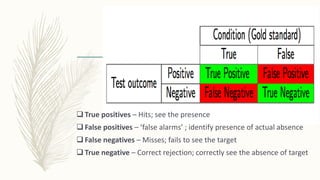
 True positives – Hits; see the presence
 False positives – ‘false alarms’ ; identify presence of actual absence
 False negatives – Misses; fails to see the target
 True negative – Correct rejection; correctly see the absence of target
Qualitative
Methods
Ethnography
A science that concerns itself with the division of mankind
into races and their origin, distribution, relations and
characteristics.
Naturalistic Observation
Sometimes called field studies because the
investigator goes into the field to collect data.
Case History
It is a detailed account of the events in a case; the
case is usually a person’s life.

1 introduction to experimental psychology

  • 1.
  • 2.
    What is thegoal of scientific psychology? – To understand why people think and act as they do. – Follows the five major goals in Psychology. Describe, explain, predict, control, and influence.
  • 3.
    How important isscience in Psychology? – It offers systematic and objective procedure to gather information. – It provides framework. – It offers evidence-based solutions to problems. – It guides practitioners.
  • 4.
    LET’S DIVE INTOTHE REAL WORLD! – There are times in a company wherein newly installed machines are not effective to use. – More people in the streets take more time to help another person. – The negative effects of social media use.
  • 5.
    OBJECTIVES: – To bewell-versed in experimental methods. – To apply the insights in real world. – To apply the learnings in making psychological research.
  • 6.
    Psychology as aScience – Establish relationships between circumstances and behaviors. – Fit these relationships into an orderly body of knowledge.
  • 7.
    Major Concern ofPsychologists – Humans and animals are variable. – We cannot repeat what has been done. (as in exact)
  • 8.
    How can wemanage variability? – Statistical treatment – Control
  • 9.
    Research Techniques – Quantitativedesign – Qualitative design
  • 10.
  • 11.
    Important terms toremember: Inductive theories: – Created from a solid database of empirical observations. Deductive theories: – Can be precisely stated and tested. – Hypotheses are created as tentative answers to problems.
  • 12.
    Postulates - fundamentalor core assumptions of a theory that are taken as self-evidently true. Propositions - general relational statements that may be true or false; not tested directly but used to derive hypotheses. Important terms to remember:
  • 13.
    Important terms toremember: Conceptual definitions - concepts in the hypotheses are defined precisely so that accurate measures of the concepts can be devised. Operational definitions - procedures (or operations) used to define particular constructs. Replication - duplication or repetition of an experiment or study to determine whether or not the original findings are reliable.
  • 14.
    Experimental Method – therelationship of interest is between a set of circumstances and a behavior. • Independent variables • Dependent variables • Experimental group • Control group
  • 15.
    Experimental Method • Informedconsent - practice of telling study participants about the nature of their participation in a proposed experiment and then obtaining their written agreement to participate • Debriefing - informing study participants of the true nature and purpose of a study after it is completed
  • 17.
    Correlational Method – Itis a general procedure for establishing an association or relationship between events. – Correlational coefficient - numerical index of the size and direction of an association between two variables. – Correlation coefficients do not provide us with any information about which variable causes the other.
  • 18.
    Surveys Typically ask peopleabout their behavior or their opinions.
  • 19.
    Archival Research It involvesusing previously collected data or records to answer a research question (Ex. Determine good performers from poor performers).
  • 20.
    Quasi-Experiment It is adesign involves selecting groups, upon which a variable is tested, without any random pre- selection processes (Ex. Noise in the workplace).
  • 21.
     True positives– Hits; see the presence  False positives – ‘false alarms’ ; identify presence of actual absence  False negatives – Misses; fails to see the target  True negative – Correct rejection; correctly see the absence of target
  • 22.
  • 23.
    Ethnography A science thatconcerns itself with the division of mankind into races and their origin, distribution, relations and characteristics.
  • 24.
    Naturalistic Observation Sometimes calledfield studies because the investigator goes into the field to collect data.
  • 25.
    Case History It isa detailed account of the events in a case; the case is usually a person’s life.

Editor's Notes

  • #8 A physicist can make another wooden blocks and repeat it with several trials, receive almost the same results. Psychologist cannot recreate humans.