SOCIAL SELF
Presented by:
Mary Anne A. Portuguez, MP, RPm
WHAT IS SELF?
Self is defined as a symbol using individual who
can reflect upon his/her own behavior (Franzio,
1996).It covers three things: Body, Social Identity,
and Self
It is associated with self-concept and identity. Self-
concept, a collection of beliefs about one’s basic
nature, unique qualities, and typical behavior.
MORE DEFINITIONS ON SELF-
CONCEPT
Individual’s sense of identity, the set of beliefs about
what he/she like as an individual (Feldman, 1998).
Product of experience and as a result of the
individual growth process and his personal-social
development (Apruebo, 2005).
DEFINITION OF IDENTITY
Social identity, composed of interpersonal roles
and traits, a particular conception of potentiality
and a structure of values and priorities.
It recognizes individuals, categories, and types
of individuals in terms of race, class, and
ethnicity.
IDENTITY CATEGORIES
Social Identity, used to describe identification based on first
appearances.
Personal Identity, it refers to biographical details of a given
named individual.
Ego, Self, or Felt Identity, it describes the self-feelings of the
individual; the subjective sense of meaning the person gives
to his or her personal situation.
CLASSICAL
THEORIES OF SELF
SELF THEORY BY WILLIAM JAMES
It outlined the dimensions of the mature self, and
contended the things become part of the self via
emotional identification.
Differentiate the subjective “I” and the objective “me”
THREE ASPECTS OF “ME”
Spiritual me. One’s own understanding of selves as
creatures who think, feel, act, and experience life.
Social me. It consists of the recognition that the self can
get from others. James believed that people have several
social me’s.
Material me. It consists of one’s body, valued possessions,
and loved ones. It identifies the self most clearly in terms
of material possessions.
SELF THEORY BY GEORGE HERBET MEAD
It outlined how the self develops and contended
that it was largely a cognitive process, brought
about through symbolic interaction and role-
taking.
The “I” is the spontaneous actor while “me” is the
self as seen from the imagined perspective others.
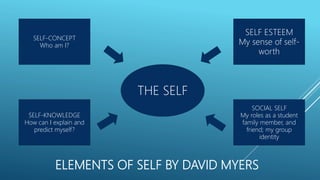
ELEMENTS OF SELF BY DAVID MYERS
THE SELF
SELF-CONCEPT
Who am I?
SELF ESTEEM
My sense of self-
worth
SELF-KNOWLEDGE
How can I explain and
predict myself?
SOCIAL SELF
My roles as a student
family member, and
friend; my group
identity
SELF-CONCEPT
It was viewed as product of experience and as a result of the
individual growth process and his personal-social development.
Self-schema is a belief about the self that organizes and guides
the processing of self relevant information. It summarizes the
personality traits, attitudes, values, interests, and other
characteristics that people attribute to themselves.
Social information refers to influences how a person
perceives, thinks, or evaluates in both oneself and others.
Self-concept involves self-reference effect and possible
selves as important self-psychological concepts.
Self-reference effect, tendency to process efficiently and
remember well information related to oneself.
Possible selves, images of what people dream or dread
becoming in the future.
SELF-CONCEPT
SELF-KNOWLEDGE
Accepted ways in achieving self-fulfillment, and the
perceived relationship between the self and society.
SELF-KNOWLEDGE
TIME PERIOD WAYS OF ACHIEVING
SELF-KNOWLEDGE
WAYS OF REACHING SELF-
FULFILLMENT
RELATIONSHIP BET.
SOCIETY AND SELF
Late Medieval (pre 16th
Century)
No problem. Self is fixed
society.
Salvation will be in heaven Individual is an integral
part of the “Great chain of
being”
Early Modern (16th – 18th
Century)
Self may change other
people may have two
selves
Primary salvation will be in
heaven
Relationship individual may
move up or down the
of being
Puritan (18th- 19th Century) Self-conscious
introspection; self-
deception is possible
Salvation predetermined
but individual must
struggle against inner sin
and weaknesses
Society recognizes
individual as saved if he is
successful at work
Victorian (mid-19th
Century)
Repression, hypocrisy,
concern with involuntary
self-disclosure
Seek fulfillment alone and
through private family life
Individual exists side by
side with or may try to
improve society
Early 20th Century Complete self-knowledge
recognized as impossible
Work is not fulfilling.
Society prevents self-
fulfillment.
Individual is hostile to and
critical to society.
Know thyself.
Socrates
SELF-ESTEEM
It refers to a person’s overall self-evaluation or sense
of self-worth. It is totally of self-schemas and
possible selves.
SOCIAL SELF
It is surrounded by the person’s social roles, social
identities, social comparisons, successes and failures,
social judgment, and the surrounding culture.
SYMBOLIC INTERACTIONISM
Herbert Blumer originally exhorts symbolic interaction as
sociological and social psychological approach.
It plays a vital role to describe self, attitude, motive, gender, and
emotion.
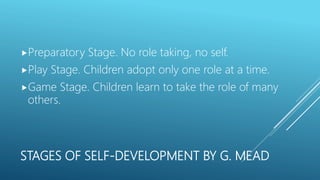
STAGES OF SELF-DEVELOPMENT BY G. MEAD
Preparatory Stage. No role taking, no self.
Play Stage. Children adopt only one role at a time.
Game Stage. Children learn to take the role of many
others.
INFLUENCES OF SOCIAL SELF
 Social roles
 Social identities
 Social comparisons
 Successes and Failures
 Social judgment
 Surrounding culture
SELF-PERCEPTION THEORY BY DARYL BEM
Suggests that people come to be aware of their own
dispositions, emotions, attitudes, and other internal
states in the same way they learn about other people
via observation of behavior.
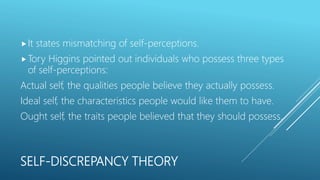
SELF-DISCREPANCY THEORY
It states mismatching of self-perceptions.
Tory Higgins pointed out individuals who possess three types
of self-perceptions:
Actual self, the qualities people believe they actually possess.
Ideal self, the characteristics people would like them to have.
Ought self, the traits people believed that they should possess.
SELF-ATTRIBUTION BY FRITZ HEIDER
It refers to inferences that people draw about the causes of
their own behavior.
Internal attribution, the process of assigning the cause of
behaviour to some internal characteristic, rather than to
outside forces.
External attribution, the process of assigning the cause of
behaviour to some situation or event outside a person's
control rather than to some internal characteristic.
SELF-AWARENESS
A psychological state in which one takes oneself as an
object of attention. The self is a target of attention and
contemplation. Two types:
Private self-awareness. A psychological state in which one
is aware of one’s hidden private self-aspects.
Public self-awareness. A psychological state in which one
is aware of one’s public self aspects.

2 Social Self

  • 1.
    SOCIAL SELF Presented by: MaryAnne A. Portuguez, MP, RPm
  • 2.
    WHAT IS SELF? Selfis defined as a symbol using individual who can reflect upon his/her own behavior (Franzio, 1996).It covers three things: Body, Social Identity, and Self It is associated with self-concept and identity. Self- concept, a collection of beliefs about one’s basic nature, unique qualities, and typical behavior.
  • 3.
    MORE DEFINITIONS ONSELF- CONCEPT Individual’s sense of identity, the set of beliefs about what he/she like as an individual (Feldman, 1998). Product of experience and as a result of the individual growth process and his personal-social development (Apruebo, 2005).
  • 4.
    DEFINITION OF IDENTITY Socialidentity, composed of interpersonal roles and traits, a particular conception of potentiality and a structure of values and priorities. It recognizes individuals, categories, and types of individuals in terms of race, class, and ethnicity.
  • 5.
    IDENTITY CATEGORIES Social Identity,used to describe identification based on first appearances. Personal Identity, it refers to biographical details of a given named individual. Ego, Self, or Felt Identity, it describes the self-feelings of the individual; the subjective sense of meaning the person gives to his or her personal situation.
  • 6.
  • 7.
    SELF THEORY BYWILLIAM JAMES It outlined the dimensions of the mature self, and contended the things become part of the self via emotional identification. Differentiate the subjective “I” and the objective “me”
  • 8.
    THREE ASPECTS OF“ME” Spiritual me. One’s own understanding of selves as creatures who think, feel, act, and experience life. Social me. It consists of the recognition that the self can get from others. James believed that people have several social me’s. Material me. It consists of one’s body, valued possessions, and loved ones. It identifies the self most clearly in terms of material possessions.
  • 9.
    SELF THEORY BYGEORGE HERBET MEAD It outlined how the self develops and contended that it was largely a cognitive process, brought about through symbolic interaction and role- taking. The “I” is the spontaneous actor while “me” is the self as seen from the imagined perspective others.
  • 10.
    ELEMENTS OF SELFBY DAVID MYERS THE SELF SELF-CONCEPT Who am I? SELF ESTEEM My sense of self- worth SELF-KNOWLEDGE How can I explain and predict myself? SOCIAL SELF My roles as a student family member, and friend; my group identity
  • 11.
    SELF-CONCEPT It was viewedas product of experience and as a result of the individual growth process and his personal-social development. Self-schema is a belief about the self that organizes and guides the processing of self relevant information. It summarizes the personality traits, attitudes, values, interests, and other characteristics that people attribute to themselves.
  • 12.
    Social information refersto influences how a person perceives, thinks, or evaluates in both oneself and others. Self-concept involves self-reference effect and possible selves as important self-psychological concepts. Self-reference effect, tendency to process efficiently and remember well information related to oneself. Possible selves, images of what people dream or dread becoming in the future. SELF-CONCEPT
  • 13.
    SELF-KNOWLEDGE Accepted ways inachieving self-fulfillment, and the perceived relationship between the self and society.
  • 14.
    SELF-KNOWLEDGE TIME PERIOD WAYSOF ACHIEVING SELF-KNOWLEDGE WAYS OF REACHING SELF- FULFILLMENT RELATIONSHIP BET. SOCIETY AND SELF Late Medieval (pre 16th Century) No problem. Self is fixed society. Salvation will be in heaven Individual is an integral part of the “Great chain of being” Early Modern (16th – 18th Century) Self may change other people may have two selves Primary salvation will be in heaven Relationship individual may move up or down the of being Puritan (18th- 19th Century) Self-conscious introspection; self- deception is possible Salvation predetermined but individual must struggle against inner sin and weaknesses Society recognizes individual as saved if he is successful at work Victorian (mid-19th Century) Repression, hypocrisy, concern with involuntary self-disclosure Seek fulfillment alone and through private family life Individual exists side by side with or may try to improve society Early 20th Century Complete self-knowledge recognized as impossible Work is not fulfilling. Society prevents self- fulfillment. Individual is hostile to and critical to society.
  • 15.
  • 16.
    SELF-ESTEEM It refers toa person’s overall self-evaluation or sense of self-worth. It is totally of self-schemas and possible selves.
  • 17.
    SOCIAL SELF It issurrounded by the person’s social roles, social identities, social comparisons, successes and failures, social judgment, and the surrounding culture.
  • 18.
    SYMBOLIC INTERACTIONISM Herbert Blumeroriginally exhorts symbolic interaction as sociological and social psychological approach. It plays a vital role to describe self, attitude, motive, gender, and emotion.
  • 19.
    STAGES OF SELF-DEVELOPMENTBY G. MEAD Preparatory Stage. No role taking, no self. Play Stage. Children adopt only one role at a time. Game Stage. Children learn to take the role of many others.
  • 20.
    INFLUENCES OF SOCIALSELF  Social roles  Social identities  Social comparisons  Successes and Failures  Social judgment  Surrounding culture
  • 21.
    SELF-PERCEPTION THEORY BYDARYL BEM Suggests that people come to be aware of their own dispositions, emotions, attitudes, and other internal states in the same way they learn about other people via observation of behavior.
  • 22.
    SELF-DISCREPANCY THEORY It statesmismatching of self-perceptions. Tory Higgins pointed out individuals who possess three types of self-perceptions: Actual self, the qualities people believe they actually possess. Ideal self, the characteristics people would like them to have. Ought self, the traits people believed that they should possess.
  • 23.
    SELF-ATTRIBUTION BY FRITZHEIDER It refers to inferences that people draw about the causes of their own behavior. Internal attribution, the process of assigning the cause of behaviour to some internal characteristic, rather than to outside forces. External attribution, the process of assigning the cause of behaviour to some situation or event outside a person's control rather than to some internal characteristic.
  • 24.
    SELF-AWARENESS A psychological statein which one takes oneself as an object of attention. The self is a target of attention and contemplation. Two types: Private self-awareness. A psychological state in which one is aware of one’s hidden private self-aspects. Public self-awareness. A psychological state in which one is aware of one’s public self aspects.

Editor's Notes

  • #5 It comes from social interaction process
  • #6 Identity categories (Lindesmith, Strauss, and Denzin, 1999)
  • #8 I is a passing thought Me is the self as an object of awareness which consists of three regions…
  • #21 Surrounding culture Individualistic, one’s own goals are more prioritized over group goals and define one’s identity in terms of personal attributes rather than group identifications. Collectivism, is the opposite.
  • #23 Mismatch actual self and ideal self= disappointments, sadness Mismatch actual self and ought self = irritability and guilt Discrepancies can result serious psychological problems