Protection Devices and the Lightning
Contents
• Introduction
• Air Break Switches
• Disconnect switches
• Grounding switches
• Current limiting reactors
• Grounding transformers
• Co-ordination of protective devices
• Grounding of electrical installations
• Electric shock
• Lightning protection
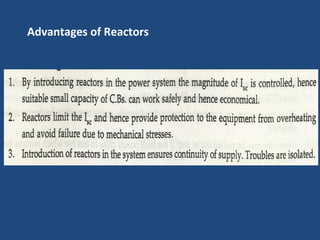
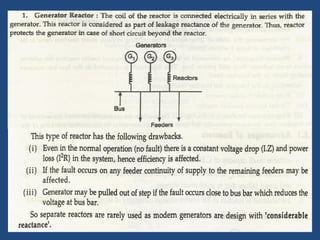
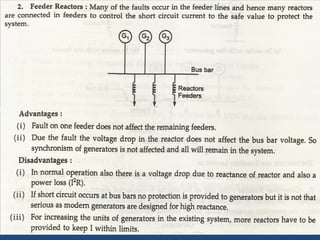
Current limiting reactors
• The short circuit currents under fault conditions are of very high
values. These heavy currents suggest to use the circuit breakers
of higher capacity which will not be economical also there is
possibility of damaging the equipment in the power system.
• Therefore some additional reactance shall be introduced in the
system to limit the short circuiting currents to the safe value
such that CBs are not overburdened and find capable of
sustaining these currents.
• The inductive coils located at proper places in the system are
called reactors. So reactors are high reactance coils with
negligibly small resistance.
Advantages of Reactors
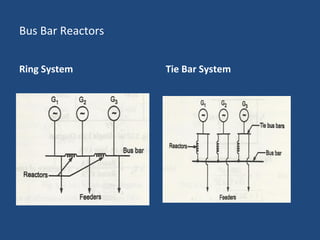
Bus Bar Reactors
Ring System Tie Bar System
Ring System
• In this case the reactors are connected between the sections
of the bus bar. One feeder is generally fed from one
generator only. In the normal working of the system each
generator supplies its own section and a very little power is
supplied to that section by the remaining generators .Hence
low voltage drop and low power loss in the reactors.
• If the fault occurs on any feeder only one generator to which
that feeder is connected mainly feeds that fault. Very little
current is supplied by the remaining generators to the fault
duet to presence of reactors in the feeder section. Only that
section of bus bar is affected to which the feeder is
connected . Other sections work normal.
Tie Bar System
• In this case there are two reactors in series act between the
sections .So reactance of reactors are ½ value as that of in ring
main system. One more advantage of this system is thet on
adding the generator units no change is necessary in the
existing reactors.
• Only drawback of this system is that additional bus bars(tie
bars) are required.
Grounding of Electrical Installations
• Ear thing means connecting the non-current carrying parts of
the electrical equipment or the neutral point to the general
mass of the earth in such a manner that at all times an
immediate discharge of electrical energy takes place without
any danger.
• Ear thing is achieved by connecting the respective parts of
installation s to some system of electrical conductors or
electrodes placed in the intimate contact with the soil some
distance below the ground level. The contacting assembly is
called Ear thing.
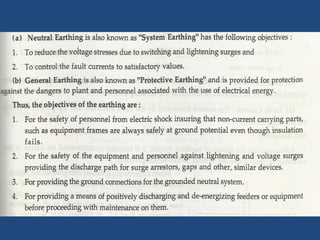
• The subject of Ear thing is divided in two parts
• 1.Neutral ear thing
• 2.General ear thing or Equipment Ear thing
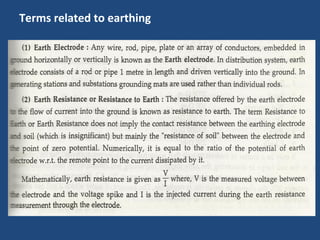
Terms related to earthing
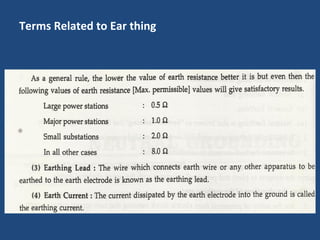
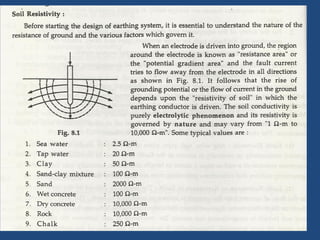
Terms Related to Ear thing
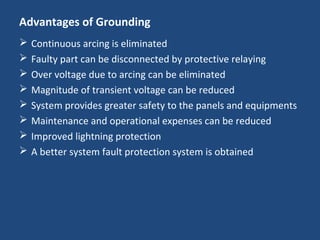
Advantages of Grounding
 Continuous arcing is eliminated
 Faulty part can be disconnected by protective relaying
 Over voltage due to arcing can be eliminated
 Magnitude of transient voltage can be reduced
 System provides greater safety to the panels and equipments
 Maintenance and operational expenses can be reduced
 Improved lightning protection
 A better system fault protection system is obtained
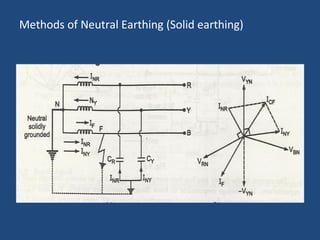
Methods of Neutral Earthing (Solid earthing)
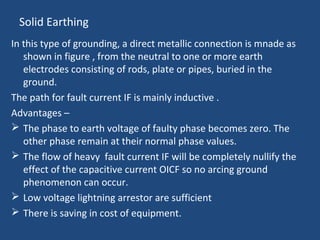
Solid Earthing
In this type of grounding, a direct metallic connection is mnade as
shown in figure , from the neutral to one or more earth
electrodes consisting of rods, plate or pipes, buried in the
ground.
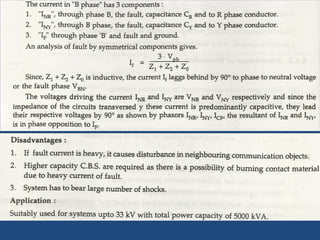
The path for fault current IF is mainly inductive .
Advantages –
 The phase to earth voltage of faulty phase becomes zero. The
other phase remain at their normal phase values.
 The flow of heavy fault current IF will be completely nullify the
effect of the capacitive current OICF so no arcing ground
phenomenon can occur.
 Low voltage lightning arrestor are sufficient
 There is saving in cost of equipment.
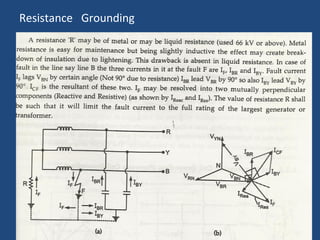
Resistance Grounding
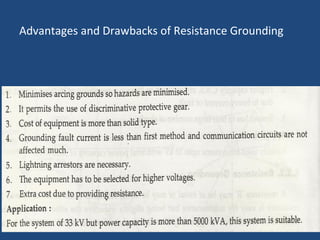
Advantages and Drawbacks of Resistance Grounding
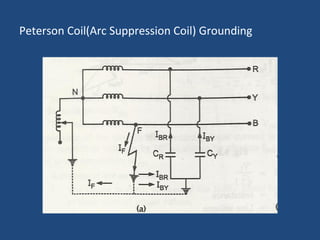
Peterson Coil(Arc Suppression Coil) Grounding
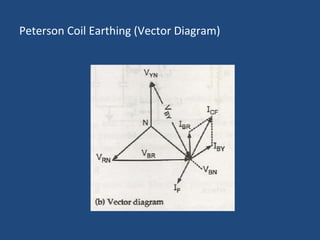
Peterson Coil Earthing (Vector Diagram)
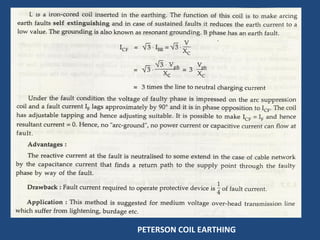
PETERSON COIL EARTHING
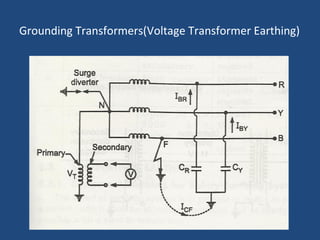
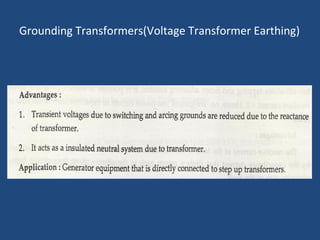
Grounding Transformers(Voltage Transformer Earthing)
In this system, a voltage transformer VT is connected to neutral
point N and grounded. It acts as a very high reactance earthing
device. It serves as a voltage measuring device to indicate a fault
to earth on the system. The surge diverter is connected as shown
in figure.
The generator circuits are disconnected from the main distribution
system.
In this system ,there is no risk of over voltage conditions arising due
to arcing grounds.
The extent of fault can be detected by measuring voltage on
secondary winding of the transformer.
Grounding Transformers(Voltage Transformer Earthing)
Lightning Protection
The discharge of charged cloud to the ground is called as
Lightning phenomenon.
Lightning is a huge spark and it take place when the clouds are
charged to such a high potential positive or negative with
respect to the earth or a neighboring cloud and if this happens
then there is possibility of insulation of air breaks down
(destroyed)
An electric discharge between cloud and earth ,between clouds
or between the charge centers of same cloud is known as
lightning.
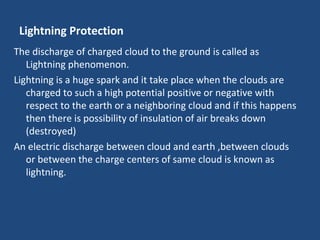
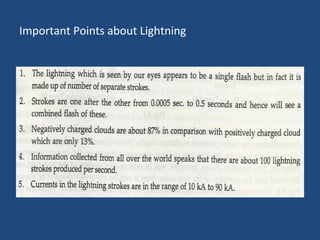
Important Points about Lightning
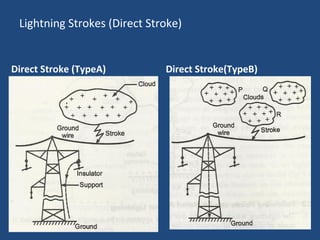
Lightning Strokes (Direct Stroke)
Direct Stroke (TypeA) Direct Stroke(TypeB)
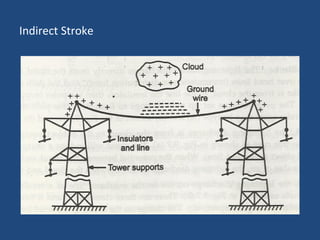
Indirect Stroke
Protection of Transmission Line Substation From Direct
Stroke
The lightning surges may cause damage to the expensive
equipment in the power system(e.g. generators,
transformers) either by direct stroke on the equipment or by
the stroke on transmission lines that reach the equipment as
travelling wave.
Devices commonly used fror protection against lightning surges
 Ear thing Screen
 Overhead ground wires
 Lightning arrestors or surge diverters
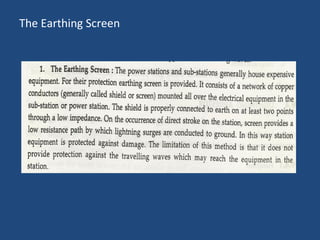
The Earthing Screen
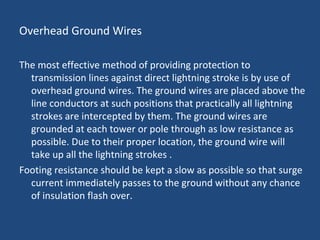
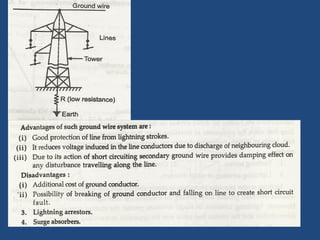
Overhead Ground Wires
The most effective method of providing protection to
transmission lines against direct lightning stroke is by use of
overhead ground wires. The ground wires are placed above the
line conductors at such positions that practically all lightning
strokes are intercepted by them. The ground wires are
grounded at each tower or pole through as low resistance as
possible. Due to their proper location, the ground wire will
take up all the lightning strokes .
Footing resistance should be kept a slow as possible so that surge
current immediately passes to the ground without any chance
of insulation flash over.
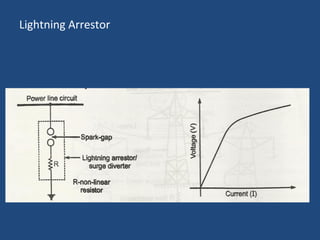
Lightning Arrestor
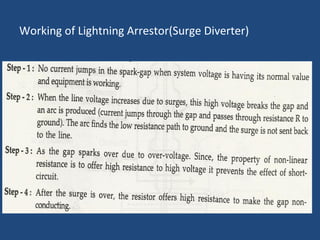
Working of Lightning Arrestor(Surge Diverter)
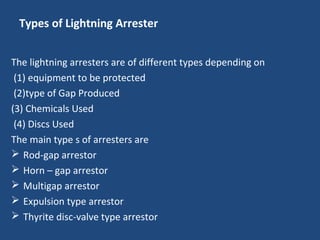
Types of Lightning Arrester
The lightning arresters are of different types depending on
(1) equipment to be protected
(2)type of Gap Produced
(3) Chemicals Used
(4) Discs Used
The main type s of arresters are
 Rod-gap arrestor
 Horn – gap arrestor
 Multigap arrestor
 Expulsion type arrestor
 Thyrite disc-valve type arrestor
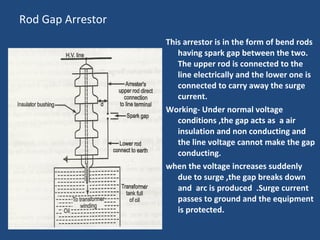
Rod Gap Arrestor
This arrestor is in the form of bend rods
having spark gap between the two.
The upper rod is connected to the
line electrically and the lower one is
connected to carry away the surge
current.
Working- Under normal voltage
conditions ,the gap acts as a air
insulation and non conducting and
the line voltage cannot make the gap
conducting.
when the voltage increases suddenly
due to surge ,the gap breaks down
and arc is produced .Surge current
passes to ground and the equipment
is protected.
Drawbacks and application
Drawbacks
1.After the surge is over , sometimes it may happen that the arc
continues due to normal voltage .This may lead to short circuit.
2.If not properly designed the rods may bend ,melt , damage due
to over heating caused by the arc.
3.Rain water , humidity ,temperature may affect the gap and
arrester may not give good service.
4.The polarity of the surge may also affect the performance of
arrestor.
Applications
1.Transformer Protection
2.Back up protection with main arrestor.
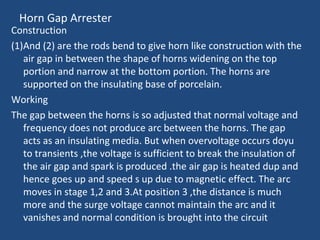
Horn Gap Arrester
Horn Gap Arrester
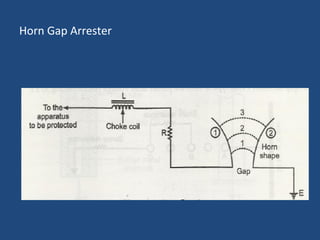
Construction
(1)And (2) are the rods bend to give horn like construction with the
air gap in between the shape of horns widening on the top
portion and narrow at the bottom portion. The horns are
supported on the insulating base of porcelain.
Working
The gap between the horns is so adjusted that normal voltage and
frequency does not produce arc between the horns. The gap
acts as an insulating media. But when overvoltage occurs doyu
to transients ,the voltage is sufficient to break the insulation of
the air gap and spark is produced .the air gap is heated dup and
hence goes up and speed s up due to magnetic effect. The arc
moves in stage 1,2 and 3.At position 3 ,the distance is much
more and the surge voltage cannot maintain the arc and it
vanishes and normal condition is brought into the circuit
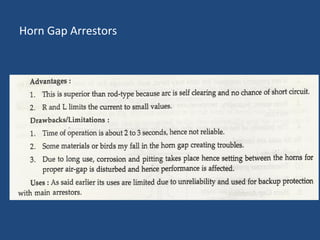
Horn Gap Arrestors
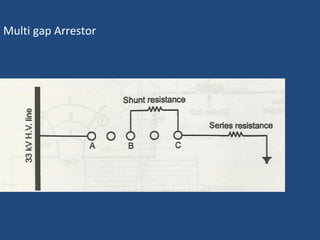
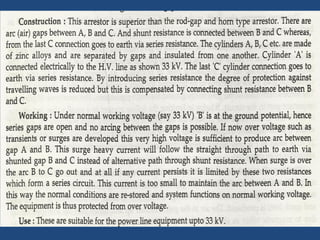
Multi gap Arrestor
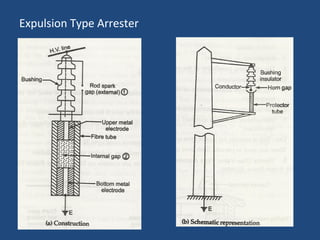
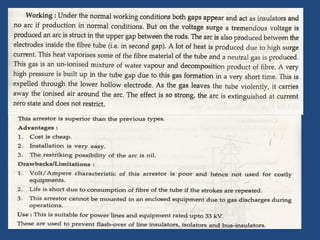
Expulsion Type Arrester
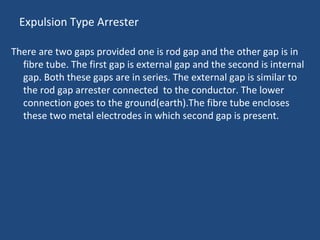
There are two gaps provided one is rod gap and the other gap is in
fibre tube. The first gap is external gap and the second is internal
gap. Both these gaps are in series. The external gap is similar to
the rod gap arrester connected to the conductor. The lower
connection goes to the ground(earth).The fibre tube encloses
these two metal electrodes in which second gap is present.
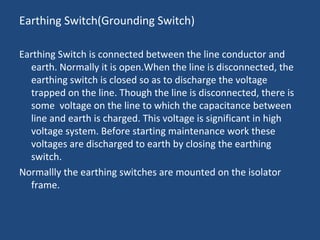
Earthing Switch(Grounding Switch)
Earthing Switch is connected between the line conductor and
earth. Normally it is open.When the line is disconnected, the
earthing switch is closed so as to discharge the voltage
trapped on the line. Though the line is disconnected, there is
some voltage on the line to which the capacitance between
line and earth is charged. This voltage is significant in high
voltage system. Before starting maintenance work these
voltages are discharged to earth by closing the earthing
switch.
Normallly the earthing switches are mounted on the isolator
frame.
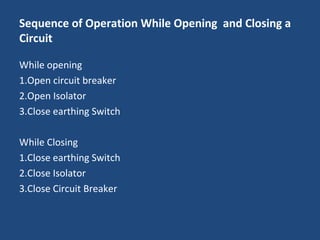
Sequence of Operation While Opening and Closing a
Circuit
While opening
1.Open circuit breaker
2.Open Isolator
3.Close earthing Switch
While Closing
1.Close earthing Switch
2.Close Isolator
3.Close Circuit Breaker
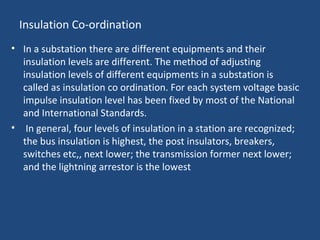
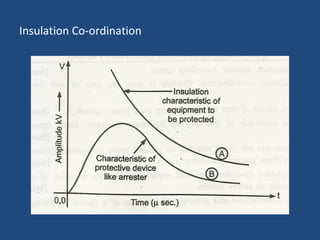
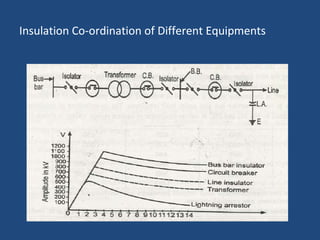
Insulation Co-ordination
• In a substation there are different equipments and their
insulation levels are different. The method of adjusting
insulation levels of different equipments in a substation is
called as insulation co ordination. For each system voltage basic
impulse insulation level has been fixed by most of the National
and International Standards.
• In general, four levels of insulation in a station are recognized;
the bus insulation is highest, the post insulators, breakers,
switches etc,, next lower; the transmission former next lower;
and the lightning arrestor is the lowest
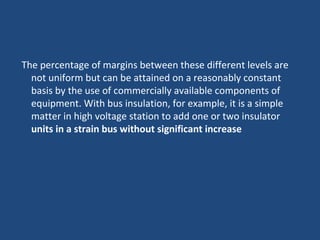
The percentage of margins between these different levels are
not uniform but can be attained on a reasonably constant
basis by the use of commercially available components of
equipment. With bus insulation, for example, it is a simple
matter in high voltage station to add one or two insulator
units in a strain bus without significant increase
Insulation Co-ordination
Insulation Co-ordination of Different Equipments

Protection Devices and the Lightning

  • 1.
  • 2.
    Contents • Introduction • AirBreak Switches • Disconnect switches • Grounding switches • Current limiting reactors • Grounding transformers • Co-ordination of protective devices • Grounding of electrical installations • Electric shock • Lightning protection
  • 3.
    Current limiting reactors •The short circuit currents under fault conditions are of very high values. These heavy currents suggest to use the circuit breakers of higher capacity which will not be economical also there is possibility of damaging the equipment in the power system. • Therefore some additional reactance shall be introduced in the system to limit the short circuiting currents to the safe value such that CBs are not overburdened and find capable of sustaining these currents. • The inductive coils located at proper places in the system are called reactors. So reactors are high reactance coils with negligibly small resistance.
  • 4.
  • 7.
    Bus Bar Reactors RingSystem Tie Bar System
  • 8.
    Ring System • Inthis case the reactors are connected between the sections of the bus bar. One feeder is generally fed from one generator only. In the normal working of the system each generator supplies its own section and a very little power is supplied to that section by the remaining generators .Hence low voltage drop and low power loss in the reactors. • If the fault occurs on any feeder only one generator to which that feeder is connected mainly feeds that fault. Very little current is supplied by the remaining generators to the fault duet to presence of reactors in the feeder section. Only that section of bus bar is affected to which the feeder is connected . Other sections work normal.
  • 9.
    Tie Bar System •In this case there are two reactors in series act between the sections .So reactance of reactors are ½ value as that of in ring main system. One more advantage of this system is thet on adding the generator units no change is necessary in the existing reactors. • Only drawback of this system is that additional bus bars(tie bars) are required.
  • 10.
    Grounding of ElectricalInstallations • Ear thing means connecting the non-current carrying parts of the electrical equipment or the neutral point to the general mass of the earth in such a manner that at all times an immediate discharge of electrical energy takes place without any danger. • Ear thing is achieved by connecting the respective parts of installation s to some system of electrical conductors or electrodes placed in the intimate contact with the soil some distance below the ground level. The contacting assembly is called Ear thing. • The subject of Ear thing is divided in two parts • 1.Neutral ear thing • 2.General ear thing or Equipment Ear thing
  • 12.
  • 13.
  • 15.
    Advantages of Grounding Continuous arcing is eliminated  Faulty part can be disconnected by protective relaying  Over voltage due to arcing can be eliminated  Magnitude of transient voltage can be reduced  System provides greater safety to the panels and equipments  Maintenance and operational expenses can be reduced  Improved lightning protection  A better system fault protection system is obtained
  • 16.
    Methods of NeutralEarthing (Solid earthing)
  • 17.
    Solid Earthing In thistype of grounding, a direct metallic connection is mnade as shown in figure , from the neutral to one or more earth electrodes consisting of rods, plate or pipes, buried in the ground. The path for fault current IF is mainly inductive . Advantages –  The phase to earth voltage of faulty phase becomes zero. The other phase remain at their normal phase values.  The flow of heavy fault current IF will be completely nullify the effect of the capacitive current OICF so no arcing ground phenomenon can occur.  Low voltage lightning arrestor are sufficient  There is saving in cost of equipment.
  • 19.
  • 20.
    Advantages and Drawbacksof Resistance Grounding
  • 21.
  • 22.
    Peterson Coil Earthing(Vector Diagram)
  • 23.
  • 24.
  • 25.
    Grounding Transformers(Voltage TransformerEarthing) In this system, a voltage transformer VT is connected to neutral point N and grounded. It acts as a very high reactance earthing device. It serves as a voltage measuring device to indicate a fault to earth on the system. The surge diverter is connected as shown in figure. The generator circuits are disconnected from the main distribution system. In this system ,there is no risk of over voltage conditions arising due to arcing grounds. The extent of fault can be detected by measuring voltage on secondary winding of the transformer.
  • 26.
  • 28.
    Lightning Protection The dischargeof charged cloud to the ground is called as Lightning phenomenon. Lightning is a huge spark and it take place when the clouds are charged to such a high potential positive or negative with respect to the earth or a neighboring cloud and if this happens then there is possibility of insulation of air breaks down (destroyed) An electric discharge between cloud and earth ,between clouds or between the charge centers of same cloud is known as lightning.
  • 29.
  • 30.
    Lightning Strokes (DirectStroke) Direct Stroke (TypeA) Direct Stroke(TypeB)
  • 31.
  • 32.
    Protection of TransmissionLine Substation From Direct Stroke The lightning surges may cause damage to the expensive equipment in the power system(e.g. generators, transformers) either by direct stroke on the equipment or by the stroke on transmission lines that reach the equipment as travelling wave. Devices commonly used fror protection against lightning surges  Ear thing Screen  Overhead ground wires  Lightning arrestors or surge diverters
  • 33.
  • 34.
    Overhead Ground Wires Themost effective method of providing protection to transmission lines against direct lightning stroke is by use of overhead ground wires. The ground wires are placed above the line conductors at such positions that practically all lightning strokes are intercepted by them. The ground wires are grounded at each tower or pole through as low resistance as possible. Due to their proper location, the ground wire will take up all the lightning strokes . Footing resistance should be kept a slow as possible so that surge current immediately passes to the ground without any chance of insulation flash over.
  • 36.
  • 37.
    Working of LightningArrestor(Surge Diverter)
  • 38.
    Types of LightningArrester The lightning arresters are of different types depending on (1) equipment to be protected (2)type of Gap Produced (3) Chemicals Used (4) Discs Used The main type s of arresters are  Rod-gap arrestor  Horn – gap arrestor  Multigap arrestor  Expulsion type arrestor  Thyrite disc-valve type arrestor
  • 39.
    Rod Gap Arrestor Thisarrestor is in the form of bend rods having spark gap between the two. The upper rod is connected to the line electrically and the lower one is connected to carry away the surge current. Working- Under normal voltage conditions ,the gap acts as a air insulation and non conducting and the line voltage cannot make the gap conducting. when the voltage increases suddenly due to surge ,the gap breaks down and arc is produced .Surge current passes to ground and the equipment is protected.
  • 40.
    Drawbacks and application Drawbacks 1.Afterthe surge is over , sometimes it may happen that the arc continues due to normal voltage .This may lead to short circuit. 2.If not properly designed the rods may bend ,melt , damage due to over heating caused by the arc. 3.Rain water , humidity ,temperature may affect the gap and arrester may not give good service. 4.The polarity of the surge may also affect the performance of arrestor. Applications 1.Transformer Protection 2.Back up protection with main arrestor.
  • 41.
  • 42.
    Horn Gap Arrester Construction (1)And(2) are the rods bend to give horn like construction with the air gap in between the shape of horns widening on the top portion and narrow at the bottom portion. The horns are supported on the insulating base of porcelain. Working The gap between the horns is so adjusted that normal voltage and frequency does not produce arc between the horns. The gap acts as an insulating media. But when overvoltage occurs doyu to transients ,the voltage is sufficient to break the insulation of the air gap and spark is produced .the air gap is heated dup and hence goes up and speed s up due to magnetic effect. The arc moves in stage 1,2 and 3.At position 3 ,the distance is much more and the surge voltage cannot maintain the arc and it vanishes and normal condition is brought into the circuit
  • 43.
  • 44.
  • 46.
  • 47.
    Expulsion Type Arrester Thereare two gaps provided one is rod gap and the other gap is in fibre tube. The first gap is external gap and the second is internal gap. Both these gaps are in series. The external gap is similar to the rod gap arrester connected to the conductor. The lower connection goes to the ground(earth).The fibre tube encloses these two metal electrodes in which second gap is present.
  • 49.
    Earthing Switch(Grounding Switch) EarthingSwitch is connected between the line conductor and earth. Normally it is open.When the line is disconnected, the earthing switch is closed so as to discharge the voltage trapped on the line. Though the line is disconnected, there is some voltage on the line to which the capacitance between line and earth is charged. This voltage is significant in high voltage system. Before starting maintenance work these voltages are discharged to earth by closing the earthing switch. Normallly the earthing switches are mounted on the isolator frame.
  • 50.
    Sequence of OperationWhile Opening and Closing a Circuit While opening 1.Open circuit breaker 2.Open Isolator 3.Close earthing Switch While Closing 1.Close earthing Switch 2.Close Isolator 3.Close Circuit Breaker
  • 51.
    Insulation Co-ordination • Ina substation there are different equipments and their insulation levels are different. The method of adjusting insulation levels of different equipments in a substation is called as insulation co ordination. For each system voltage basic impulse insulation level has been fixed by most of the National and International Standards. • In general, four levels of insulation in a station are recognized; the bus insulation is highest, the post insulators, breakers, switches etc,, next lower; the transmission former next lower; and the lightning arrestor is the lowest
  • 52.
    The percentage ofmargins between these different levels are not uniform but can be attained on a reasonably constant basis by the use of commercially available components of equipment. With bus insulation, for example, it is a simple matter in high voltage station to add one or two insulator units in a strain bus without significant increase
  • 53.
  • 54.
    Insulation Co-ordination ofDifferent Equipments