Presented by – Shemy Elhady
 Introduction.
 Most Common Power Quality Problems.
 Solution for Power Quality problems.
 Develop Codes and Standards.
 Merus A-series Active Filter.
 References.
 Definition of Power Quality:
• Power Quality is a term that means different things to different people.
• A set of electrical boundaries that allows equipment to function in its
intended manner without significant loss of performance or life expectancy.
• The concept of powering and grounding sensitive electronic equipment
in a manner suitable for the equipment.
• Power Quality means quality of the normal voltage supplied to your facility.
• Voltage provided should be as close as possible to nominal voltage and
waveform must be pure sine wave free from any harmonics and other
disturbances.
 Harmonic distortion.
 Voltage sag (or dip).
 Voltage swell.
 Voltage fluctuation.
 Voltage spike.
 Noise.
 Voltage Unbalance.
 Very short Interruptions.
 Long Interruptions.
 Harmonic distortion:
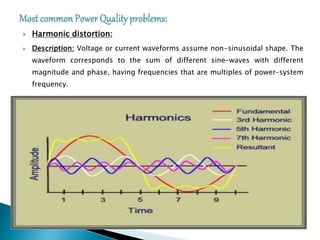
 Description: Voltage or current waveforms assume non-sinusoidal shape. The
waveform corresponds to the sum of different sine-waves with different
magnitude and phase, having frequencies that are multiples of power-system
frequency.
 Harmonic distortion:
 Description: Voltage or current waveforms assume non-sinusoidal shape. The
waveform corresponds to the sum of different sine-waves with different
magnitude and phase, having frequencies that are multiples of power-system
frequency.
 Causes: Classic sources: electric machines working above the knee of the
magnetization curve (magnetic saturation), arc furnaces, welding machines,
rectifiers, and DC brush motors. Modern sources: all non-linear loads, such
as power electronics equipment including ASDs, switched mode power
supplies, data processing equipment, high efficiency lighting.
 Consequences: Increased probability in occurrence of resonance, neutral
overload in 3-phase systems, overheating of all cables and equipment, loss of
efficiency in electric machines, electromagnetic interference with
communication systems, errors in measures when using average reading
meters, nuisance tripping of thermal protections.
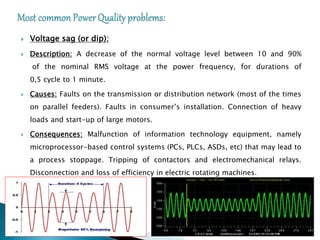
 Voltage sag (or dip):
 Description: A decrease of the normal voltage level between 10 and 90%
of the nominal RMS voltage at the power frequency, for durations of
0,5 cycle to 1 minute.
 Causes: Faults on the transmission or distribution network (most of the times
on parallel feeders). Faults in consumer’s installation. Connection of heavy
loads and start-up of large motors.
 Consequences: Malfunction of information technology equipment, namely
microprocessor-based control systems (PCs, PLCs, ASDs, etc) that may lead to
a process stoppage. Tripping of contactors and electromechanical relays.
Disconnection and loss of efficiency in electric rotating machines.
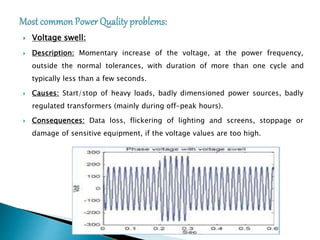
 Voltage swell:
 Description: Momentary increase of the voltage, at the power frequency,
outside the normal tolerances, with duration of more than one cycle and
typically less than a few seconds.
 Causes: Start/stop of heavy loads, badly dimensioned power sources, badly
regulated transformers (mainly during off-peak hours).
 Consequences: Data loss, flickering of lighting and screens, stoppage or
damage of sensitive equipment, if the voltage values are too high.
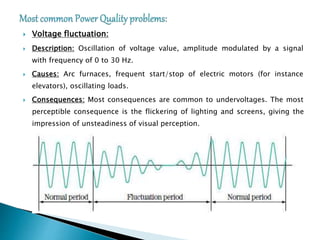
 Voltage fluctuation:
 Description: Oscillation of voltage value, amplitude modulated by a signal
with frequency of 0 to 30 Hz.
 Causes: Arc furnaces, frequent start/stop of electric motors (for instance
elevators), oscillating loads.
 Consequences: Most consequences are common to undervoltages. The most
perceptible consequence is the flickering of lighting and screens, giving the
impression of unsteadiness of visual perception.
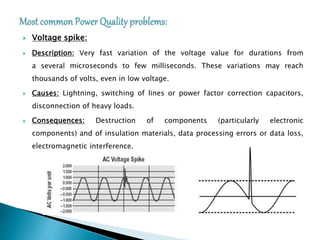
 Voltage spike:
 Description: Very fast variation of the voltage value for durations from
a several microseconds to few milliseconds. These variations may reach
thousands of volts, even in low voltage.
 Causes: Lightning, switching of lines or power factor correction capacitors,
disconnection of heavy loads.
 Consequences: Destruction of components (particularly electronic
components) and of insulation materials, data processing errors or data loss,
electromagnetic interference.
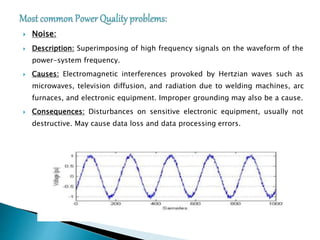
 Noise:
 Description: Superimposing of high frequency signals on the waveform of the
power-system frequency.
 Causes: Electromagnetic interferences provoked by Hertzian waves such as
microwaves, television diffusion, and radiation due to welding machines, arc
furnaces, and electronic equipment. Improper grounding may also be a cause.
 Consequences: Disturbances on sensitive electronic equipment, usually not
destructive. May cause data loss and data processing errors.
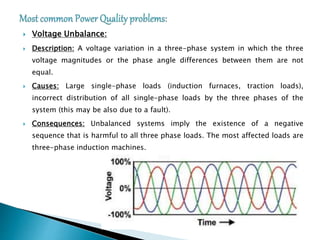
 Voltage Unbalance:
 Description: A voltage variation in a three-phase system in which the three
voltage magnitudes or the phase angle differences between them are not
equal.
 Causes: Large single-phase loads (induction furnaces, traction loads),
incorrect distribution of all single-phase loads by the three phases of the
system (this may be also due to a fault).
 Consequences: Unbalanced systems imply the existence of a negative
sequence that is harmful to all three phase loads. The most affected loads are
three-phase induction machines.
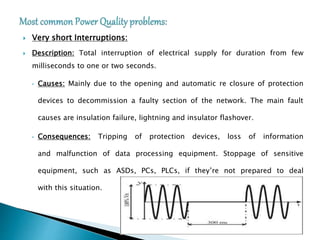
 Very short Interruptions:
 Description: Total interruption of electrical supply for duration from few
milliseconds to one or two seconds.
• Causes: Mainly due to the opening and automatic re closure of protection
devices to decommission a faulty section of the network. The main fault
causes are insulation failure, lightning and insulator flashover.
• Consequences: Tripping of protection devices, loss of information
and malfunction of data processing equipment. Stoppage of sensitive
equipment, such as ASDs, PCs, PLCs, if they’re not prepared to deal
with this situation.
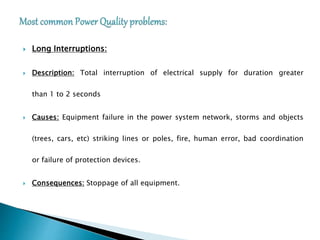
 Long Interruptions:
 Description: Total interruption of electrical supply for duration greater
than 1 to 2 seconds
 Causes: Equipment failure in the power system network, storms and objects
(trees, cars, etc) striking lines or poles, fire, human error, bad coordination
or failure of protection devices.
 Consequences: Stoppage of all equipment.
 Grid Adequacy.
 Distributed Resources.
 Distributed Generation .
 Energy Storage (Restoring Technologies).
 Enhanced Interface Devices.
 Grid Adequacy:
• Many power quality problems have origin in the transmission or distribution
grid. Thus, a proper transmission and distribution grid, with adequate
planning and maintenance, is essential to minimize the occurrence of power
quality problems.
 Cleaning of insulators.
 Trimming of trees nearby power lines.
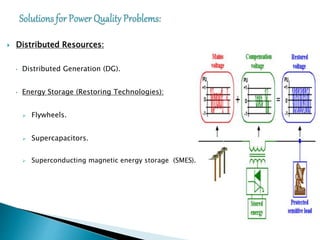
 Distributed Resources:
• Distributed Generation (DG).
• Energy Storage (Restoring Technologies):
 Flywheels.
 Supercapacitors.
 Superconducting magnetic energy storage (SMES).
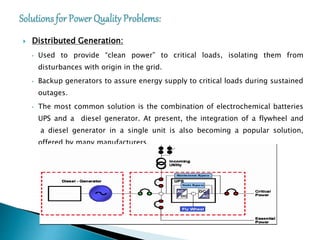
 Distributed Generation:
• Used to provide “clean power” to critical loads, isolating them from
disturbances with origin in the grid.
• Backup generators to assure energy supply to critical loads during sustained
outages.
• The most common solution is the combination of electrochemical batteries
UPS and a diesel generator. At present, the integration of a flywheel and
a diesel generator in a single unit is also becoming a popular solution,
offered by many manufacturers.
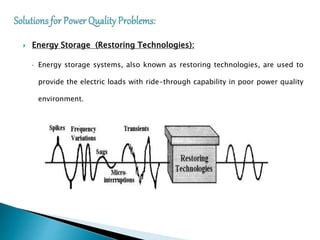
 Energy Storage (Restoring Technologies):
• Energy storage systems, also known as restoring technologies, are used to
provide the electric loads with ride-through capability in poor power quality
environment.
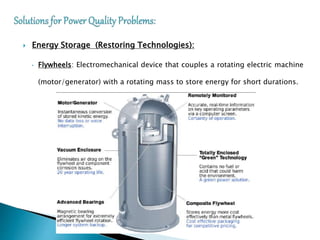
 Energy Storage (Restoring Technologies):
• Flywheels: Electromechanical device that couples a rotating electric machine
(motor/generator) with a rotating mass to store energy for short durations.
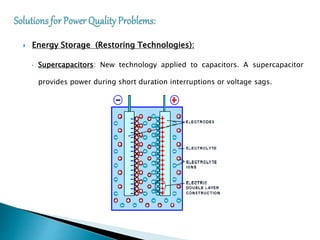
 Energy Storage (Restoring Technologies):
• Supercapacitors: New technology applied to capacitors. A supercapacitor
provides power during short duration interruptions or voltage sags.
 Energy Storage (restoring technologies):
• Superconducting magnetic energy storage (SMES): Energy is stored in the
magnetic field of a coil made of superconductor material.
 High power density.
 Very fast response.
 Very expensive.
 Enhanced Interface Devices: Using proper interface devices, one can
isolate the loads from disturbances deriving from the grid.
 Some of the enhanced interface devices are:
• Dynamic Voltage Restorer (DVR): Acts like a voltage source connected in
series with the load. The output voltage of the DVR is kept approximately
constant voltage at the load terminals by using a step-up transformer
and/or stored energy to inject active and reactive power in the output supply
through a voltage converter.
• Transient Voltage Surge suppressors (TVSS): Are used as interface between
the power source and sensitive loads, so that the transient voltage
is clamped by the TVSS before it reaches the load.
 Enhanced Interface Devices:
• Constant Voltage Transformers (CVT): were one of the first power quality
solutions used to mitigate the effects of voltage sags and transients.
• Noise Filters: Noise filters are used to avoid unwanted frequency current or
voltage signals (noise) from reaching sensitive equipment. This can be
accomplished by using a combination of capacitors and inductances that
creates a low impedance path to the fundamental frequency and high
impedance to higher frequencies, that is, a low-pass filter. They should be
used when noise with frequency in the kHz range is considerable.
 Enhanced Interface Devices:
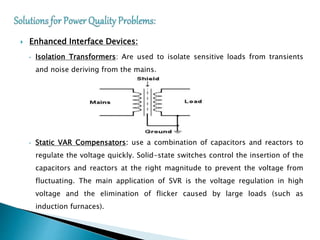
• Isolation Transformers: Are used to isolate sensitive loads from transients
and noise deriving from the mains.
• Static VAR Compensators: use a combination of capacitors and reactors to
regulate the voltage quickly. Solid-state switches control the insertion of the
capacitors and reactors at the right magnitude to prevent the voltage from
fluctuating. The main application of SVR is the voltage regulation in high
voltage and the elimination of flicker caused by large loads (such as
induction furnaces).
 Enhanced Interface Devices:
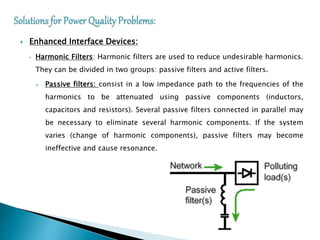
• Harmonic Filters: Harmonic filters are used to reduce undesirable harmonics.
They can be divided in two groups: passive filters and active filters.
 Passive filters: consist in a low impedance path to the frequencies of the
harmonics to be attenuated using passive components (inductors,
capacitors and resistors). Several passive filters connected in parallel may
be necessary to eliminate several harmonic components. If the system
varies (change of harmonic components), passive filters may become
ineffective and cause resonance.
 Enhanced Interface Devices:
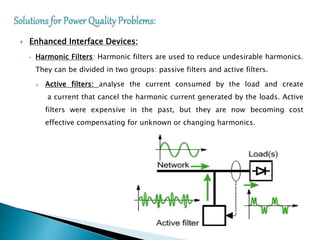
• Harmonic Filters: Harmonic filters are used to reduce undesirable harmonics.
They can be divided in two groups: passive filters and active filters.
 Active filters: analyse the current consumed by the load and create
a current that cancel the harmonic current generated by the loads. Active
filters were expensive in the past, but they are now becoming cost
effective compensating for unknown or changing harmonics.
 Need to regulate:
• the minimum power quality level that utilities have to provide to consumers,
and the immunity level that equipment should have.
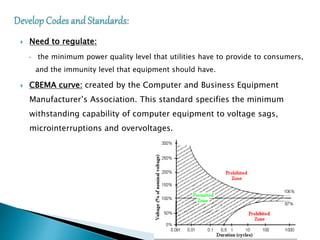
 CBEMA curve: created by the Computer and Business Equipment
Manufacturer’s Association. This standard specifies the minimum
withstanding capability of computer equipment to voltage sags,
microinterruptions and overvoltages.
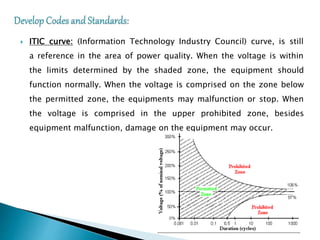
 ITIC curve: (Information Technology Industry Council) curve, is still
a reference in the area of power quality. When the voltage is within
the limits determined by the shaded zone, the equipment should
function normally. When the voltage is comprised on the zone below
the permitted zone, the equipments may malfunction or stop. When
the voltage is comprised in the upper prohibited zone, besides
equipment malfunction, damage on the equipment may occur.
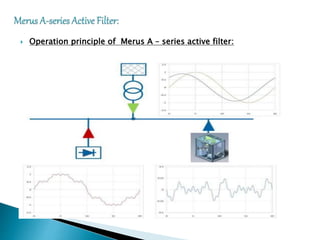
 Operation principle of Merus A – series active filter:
 General description of Merus active filter:
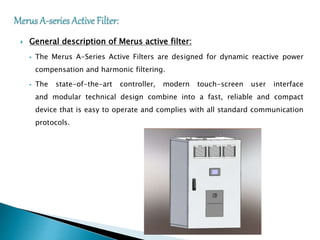
 The Merus A-Series Active Filters are designed for dynamic reactive power
compensation and harmonic filtering.
 The state-of-the-art controller, modern touch-screen user interface
and modular technical design combine into a fast, reliable and compact
device that is easy to operate and complies with all standard communication
protocols.
 Operation modes of active filter:
• Operation mode I – All harmonics: This operation mode is the most
dynamic and offers real time compensation of all harmonics and
fundamental reactive power. Also fundamental frequency active and
reactive load is balanced in this mode. The remaining current in the
network consists of positive sequence active current and negligible
amount of harmonic currents.
• Operation mode II – All harmonics but not fundamental frequency:
This operation mode is the most dynamic and offers real time
compensation of all harmonics. Fundamental frequency load balancing
and reactive power compensation are excluded in this mode. The
remaining current in the network consists of active current, fundamental
reactive current and negligible amount of harmonic currents.
 Operation modes of active filter:
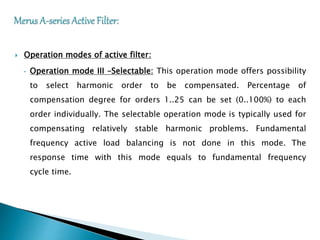
• Operation mode III –Selectable: This operation mode offers possibility
to select harmonic order to be compensated. Percentage of
compensation degree for orders 1..25 can be set (0..100%) to each
order individually. The selectable operation mode is typically used for
compensating relatively stable harmonic problems. Fundamental
frequency active load balancing is not done in this mode. The
response time with this mode equals to fundamental frequency
cycle time.
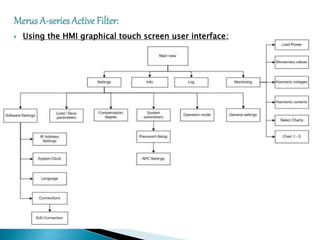
 Using the HMI graphical touch screen user interface:
 Maintenance:
• The recommended maintenance interval is one year. The yearly
maintenance should include:
 Replacing the air filter.
 Checking the operation of the cooling fans.
 Checking the event log.
 Checking the general operation of the filter.
 Power Quality Problems and New Solutions: A. de Almeida, L. Moreira.
J. Delgado .
 Power Quality: C. SANKARAN.
 Merus A-series Active Filter User’s Manual A100.

Power Quality

  • 1.
    Presented by –Shemy Elhady
  • 2.
     Introduction.  MostCommon Power Quality Problems.  Solution for Power Quality problems.  Develop Codes and Standards.  Merus A-series Active Filter.  References.
  • 4.
     Definition ofPower Quality: • Power Quality is a term that means different things to different people. • A set of electrical boundaries that allows equipment to function in its intended manner without significant loss of performance or life expectancy. • The concept of powering and grounding sensitive electronic equipment in a manner suitable for the equipment. • Power Quality means quality of the normal voltage supplied to your facility. • Voltage provided should be as close as possible to nominal voltage and waveform must be pure sine wave free from any harmonics and other disturbances.
  • 6.
     Harmonic distortion. Voltage sag (or dip).  Voltage swell.  Voltage fluctuation.  Voltage spike.  Noise.  Voltage Unbalance.  Very short Interruptions.  Long Interruptions.
  • 7.
     Harmonic distortion: Description: Voltage or current waveforms assume non-sinusoidal shape. The waveform corresponds to the sum of different sine-waves with different magnitude and phase, having frequencies that are multiples of power-system frequency.
  • 8.
     Harmonic distortion: Description: Voltage or current waveforms assume non-sinusoidal shape. The waveform corresponds to the sum of different sine-waves with different magnitude and phase, having frequencies that are multiples of power-system frequency.  Causes: Classic sources: electric machines working above the knee of the magnetization curve (magnetic saturation), arc furnaces, welding machines, rectifiers, and DC brush motors. Modern sources: all non-linear loads, such as power electronics equipment including ASDs, switched mode power supplies, data processing equipment, high efficiency lighting.  Consequences: Increased probability in occurrence of resonance, neutral overload in 3-phase systems, overheating of all cables and equipment, loss of efficiency in electric machines, electromagnetic interference with communication systems, errors in measures when using average reading meters, nuisance tripping of thermal protections.
  • 9.
     Voltage sag(or dip):  Description: A decrease of the normal voltage level between 10 and 90% of the nominal RMS voltage at the power frequency, for durations of 0,5 cycle to 1 minute.  Causes: Faults on the transmission or distribution network (most of the times on parallel feeders). Faults in consumer’s installation. Connection of heavy loads and start-up of large motors.  Consequences: Malfunction of information technology equipment, namely microprocessor-based control systems (PCs, PLCs, ASDs, etc) that may lead to a process stoppage. Tripping of contactors and electromechanical relays. Disconnection and loss of efficiency in electric rotating machines.
  • 10.
     Voltage swell: Description: Momentary increase of the voltage, at the power frequency, outside the normal tolerances, with duration of more than one cycle and typically less than a few seconds.  Causes: Start/stop of heavy loads, badly dimensioned power sources, badly regulated transformers (mainly during off-peak hours).  Consequences: Data loss, flickering of lighting and screens, stoppage or damage of sensitive equipment, if the voltage values are too high.
  • 11.
     Voltage fluctuation: Description: Oscillation of voltage value, amplitude modulated by a signal with frequency of 0 to 30 Hz.  Causes: Arc furnaces, frequent start/stop of electric motors (for instance elevators), oscillating loads.  Consequences: Most consequences are common to undervoltages. The most perceptible consequence is the flickering of lighting and screens, giving the impression of unsteadiness of visual perception.
  • 12.
     Voltage spike: Description: Very fast variation of the voltage value for durations from a several microseconds to few milliseconds. These variations may reach thousands of volts, even in low voltage.  Causes: Lightning, switching of lines or power factor correction capacitors, disconnection of heavy loads.  Consequences: Destruction of components (particularly electronic components) and of insulation materials, data processing errors or data loss, electromagnetic interference.
  • 13.
     Noise:  Description:Superimposing of high frequency signals on the waveform of the power-system frequency.  Causes: Electromagnetic interferences provoked by Hertzian waves such as microwaves, television diffusion, and radiation due to welding machines, arc furnaces, and electronic equipment. Improper grounding may also be a cause.  Consequences: Disturbances on sensitive electronic equipment, usually not destructive. May cause data loss and data processing errors.
  • 14.
     Voltage Unbalance: Description: A voltage variation in a three-phase system in which the three voltage magnitudes or the phase angle differences between them are not equal.  Causes: Large single-phase loads (induction furnaces, traction loads), incorrect distribution of all single-phase loads by the three phases of the system (this may be also due to a fault).  Consequences: Unbalanced systems imply the existence of a negative sequence that is harmful to all three phase loads. The most affected loads are three-phase induction machines.
  • 15.
     Very shortInterruptions:  Description: Total interruption of electrical supply for duration from few milliseconds to one or two seconds. • Causes: Mainly due to the opening and automatic re closure of protection devices to decommission a faulty section of the network. The main fault causes are insulation failure, lightning and insulator flashover. • Consequences: Tripping of protection devices, loss of information and malfunction of data processing equipment. Stoppage of sensitive equipment, such as ASDs, PCs, PLCs, if they’re not prepared to deal with this situation.
  • 16.
     Long Interruptions: Description: Total interruption of electrical supply for duration greater than 1 to 2 seconds  Causes: Equipment failure in the power system network, storms and objects (trees, cars, etc) striking lines or poles, fire, human error, bad coordination or failure of protection devices.  Consequences: Stoppage of all equipment.
  • 18.
     Grid Adequacy. Distributed Resources.  Distributed Generation .  Energy Storage (Restoring Technologies).  Enhanced Interface Devices.
  • 19.
     Grid Adequacy: •Many power quality problems have origin in the transmission or distribution grid. Thus, a proper transmission and distribution grid, with adequate planning and maintenance, is essential to minimize the occurrence of power quality problems.  Cleaning of insulators.  Trimming of trees nearby power lines.
  • 20.
     Distributed Resources: •Distributed Generation (DG). • Energy Storage (Restoring Technologies):  Flywheels.  Supercapacitors.  Superconducting magnetic energy storage (SMES).
  • 21.
     Distributed Generation: •Used to provide “clean power” to critical loads, isolating them from disturbances with origin in the grid. • Backup generators to assure energy supply to critical loads during sustained outages. • The most common solution is the combination of electrochemical batteries UPS and a diesel generator. At present, the integration of a flywheel and a diesel generator in a single unit is also becoming a popular solution, offered by many manufacturers.
  • 22.
     Energy Storage(Restoring Technologies): • Energy storage systems, also known as restoring technologies, are used to provide the electric loads with ride-through capability in poor power quality environment.
  • 23.
     Energy Storage(Restoring Technologies): • Flywheels: Electromechanical device that couples a rotating electric machine (motor/generator) with a rotating mass to store energy for short durations.
  • 24.
     Energy Storage(Restoring Technologies): • Supercapacitors: New technology applied to capacitors. A supercapacitor provides power during short duration interruptions or voltage sags.
  • 25.
     Energy Storage(restoring technologies): • Superconducting magnetic energy storage (SMES): Energy is stored in the magnetic field of a coil made of superconductor material.  High power density.  Very fast response.  Very expensive.
  • 26.
     Enhanced InterfaceDevices: Using proper interface devices, one can isolate the loads from disturbances deriving from the grid.  Some of the enhanced interface devices are: • Dynamic Voltage Restorer (DVR): Acts like a voltage source connected in series with the load. The output voltage of the DVR is kept approximately constant voltage at the load terminals by using a step-up transformer and/or stored energy to inject active and reactive power in the output supply through a voltage converter. • Transient Voltage Surge suppressors (TVSS): Are used as interface between the power source and sensitive loads, so that the transient voltage is clamped by the TVSS before it reaches the load.
  • 27.
     Enhanced InterfaceDevices: • Constant Voltage Transformers (CVT): were one of the first power quality solutions used to mitigate the effects of voltage sags and transients. • Noise Filters: Noise filters are used to avoid unwanted frequency current or voltage signals (noise) from reaching sensitive equipment. This can be accomplished by using a combination of capacitors and inductances that creates a low impedance path to the fundamental frequency and high impedance to higher frequencies, that is, a low-pass filter. They should be used when noise with frequency in the kHz range is considerable.
  • 28.
     Enhanced InterfaceDevices: • Isolation Transformers: Are used to isolate sensitive loads from transients and noise deriving from the mains. • Static VAR Compensators: use a combination of capacitors and reactors to regulate the voltage quickly. Solid-state switches control the insertion of the capacitors and reactors at the right magnitude to prevent the voltage from fluctuating. The main application of SVR is the voltage regulation in high voltage and the elimination of flicker caused by large loads (such as induction furnaces).
  • 29.
     Enhanced InterfaceDevices: • Harmonic Filters: Harmonic filters are used to reduce undesirable harmonics. They can be divided in two groups: passive filters and active filters.  Passive filters: consist in a low impedance path to the frequencies of the harmonics to be attenuated using passive components (inductors, capacitors and resistors). Several passive filters connected in parallel may be necessary to eliminate several harmonic components. If the system varies (change of harmonic components), passive filters may become ineffective and cause resonance.
  • 30.
     Enhanced InterfaceDevices: • Harmonic Filters: Harmonic filters are used to reduce undesirable harmonics. They can be divided in two groups: passive filters and active filters.  Active filters: analyse the current consumed by the load and create a current that cancel the harmonic current generated by the loads. Active filters were expensive in the past, but they are now becoming cost effective compensating for unknown or changing harmonics.
  • 32.
     Need toregulate: • the minimum power quality level that utilities have to provide to consumers, and the immunity level that equipment should have.  CBEMA curve: created by the Computer and Business Equipment Manufacturer’s Association. This standard specifies the minimum withstanding capability of computer equipment to voltage sags, microinterruptions and overvoltages.
  • 33.
     ITIC curve:(Information Technology Industry Council) curve, is still a reference in the area of power quality. When the voltage is within the limits determined by the shaded zone, the equipment should function normally. When the voltage is comprised on the zone below the permitted zone, the equipments may malfunction or stop. When the voltage is comprised in the upper prohibited zone, besides equipment malfunction, damage on the equipment may occur.
  • 35.
     Operation principleof Merus A – series active filter:
  • 36.
     General descriptionof Merus active filter:  The Merus A-Series Active Filters are designed for dynamic reactive power compensation and harmonic filtering.  The state-of-the-art controller, modern touch-screen user interface and modular technical design combine into a fast, reliable and compact device that is easy to operate and complies with all standard communication protocols.
  • 37.
     Operation modesof active filter: • Operation mode I – All harmonics: This operation mode is the most dynamic and offers real time compensation of all harmonics and fundamental reactive power. Also fundamental frequency active and reactive load is balanced in this mode. The remaining current in the network consists of positive sequence active current and negligible amount of harmonic currents. • Operation mode II – All harmonics but not fundamental frequency: This operation mode is the most dynamic and offers real time compensation of all harmonics. Fundamental frequency load balancing and reactive power compensation are excluded in this mode. The remaining current in the network consists of active current, fundamental reactive current and negligible amount of harmonic currents.
  • 38.
     Operation modesof active filter: • Operation mode III –Selectable: This operation mode offers possibility to select harmonic order to be compensated. Percentage of compensation degree for orders 1..25 can be set (0..100%) to each order individually. The selectable operation mode is typically used for compensating relatively stable harmonic problems. Fundamental frequency active load balancing is not done in this mode. The response time with this mode equals to fundamental frequency cycle time.
  • 39.
     Using theHMI graphical touch screen user interface:
  • 40.
     Maintenance: • Therecommended maintenance interval is one year. The yearly maintenance should include:  Replacing the air filter.  Checking the operation of the cooling fans.  Checking the event log.  Checking the general operation of the filter.
  • 42.
     Power QualityProblems and New Solutions: A. de Almeida, L. Moreira. J. Delgado .  Power Quality: C. SANKARAN.  Merus A-series Active Filter User’s Manual A100.