DESIGN PROJECT
SURGE ARRESTERS
Submitted by
Irin Elsa Peter
S5 EEE
Roll no 15
ELECTRICAL SURGE
• Surge is a transient wave of current,voltage or power
in an electrical circuit
• brief overvoltage spikes or disturbances on a power
waveform that can destroy electronic equipment
within any home, commercial building, industrial, or
manufacturing facility.
• Classification
1.Internal surge
2.external surge
3.Pulsed surge
4.long lasting surge
CAUSES OF SURGE
• Electrical Overload.
Trying to connect too many appliances in an extension chord
• Faulty wiring
Wiring that is damaged or exposed offers little electrical resistance,
meaning any conductive material can spike the wire’s current to
dangerous levels.
• Lightning.
when lightning does strike your electrical system, overwhelmingly
excessive current flows. This creates a massive spike, therefore
creating a power surge.
• Power Outage/Blackout.
Once power is restored after an outage, the sudden jump in current
can create a power surge, damaging any previously unpowered
appliances.
SURGE ARRESTERS
• A protective device for limiting voltage on equipment
by discharging or bypassing surge current.
• It prevents continued flow to follow current to
ground and it is capable of repeating these functions
• An arrester does not absorb lightning or stop
lightning. It diverts the lightning, limits the voltage
and protects the equipment installed in parallel.
CONSTRUCTION
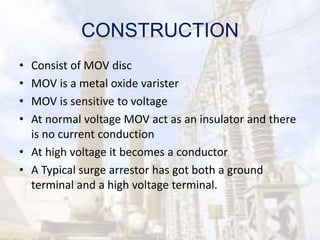
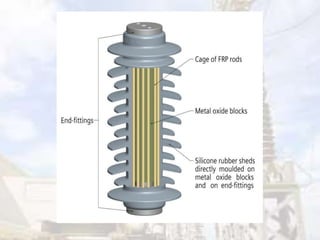
• Consist of MOV disc
• MOV is a metal oxide varister
• MOV is sensitive to voltage
• At normal voltage MOV act as an insulator and there
is no current conduction
• At high voltage it becomes a conductor
• A Typical surge arrestor has got both a ground
terminal and a high voltage terminal.
TYPES
• Secondary Arrester
The rate of voltage supply used by this arrester is below
1000V.
• Distribution Arresters
These arresters are rated from 1 kV to 36 kV.
• Intermediate Arresters
voltage ratings of these arresters are from 3 kV to 120
kV.
• Station Class Arresters
3 kV to 684 kV.
How does surge arrestors work
• When lightening event occurs it always find a shortest
path to earth
• Mostly it targets electrical towers and poles
• Eventhough towers are earthed heavy voltage could
reach the main electrical circuit using electromagnetic
induction.
• However in transmission lines insulators are provided
with arc ring in conjunction with guard ring.
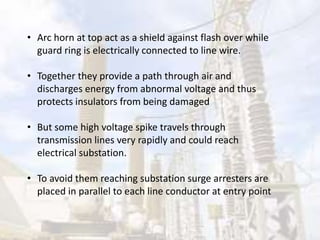
• Arc horn at top act as a shield against flash over while
guard ring is electrically connected to line wire.
• Together they provide a path through air and
discharges energy from abnormal voltage and thus
protects insulators from being damaged
• But some high voltage spike travels through
transmission lines very rapidly and could reach
electrical substation.
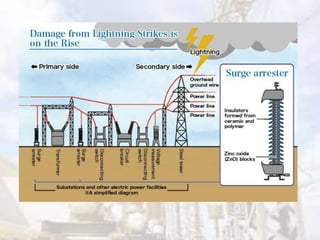
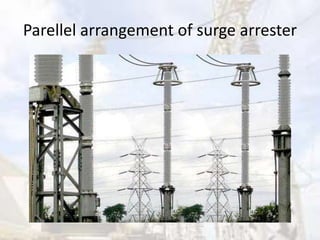
• To avoid them reaching substation surge arresters are
placed in parallel to each line conductor at entry point
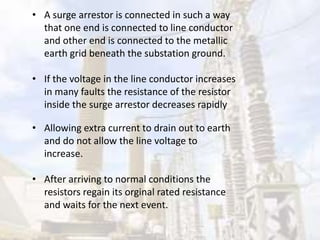
• A surge arrestor is connected in such a way
that one end is connected to line conductor
and other end is connected to the metallic
earth grid beneath the substation ground.
• If the voltage in the line conductor increases
in many faults the resistance of the resistor
inside the surge arrestor decreases rapidly
• Allowing extra current to drain out to earth
and do not allow the line voltage to
increase.
• After arriving to normal conditions the
resistors regain its orginal rated resistance
and waits for the next event.
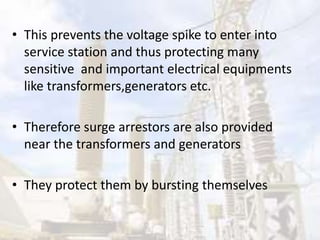
• This prevents the voltage spike to enter into
service station and thus protecting many
sensitive and important electrical equipments
like transformers,generators etc.
• Therefore surge arrestors are also provided
near the transformers and generators
• They protect them by bursting themselves
To remember
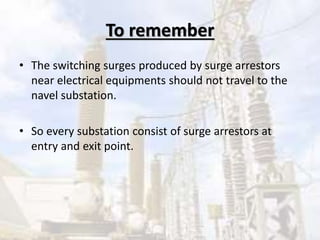
• The switching surges produced by surge arrestors
near electrical equipments should not travel to the
navel substation.
• So every substation consist of surge arrestors at
entry and exit point.
Parellel arrangement of surge arrester
Surge arrester vs lightening arrester
• Surge arresters are devices installed on Over head lines, substations etc
to avoid a surge of an additional current/ voltage/charge due to various
faults occurring and since one of the major reasons of a surge is due to
lightning, these surge arresters are also coined as Lightning arrester.
• However Lightning arresters are separate instruments specifically
designed for protection of structures solely from lightning this
equipment neutralizes the charge by nullifying the charge it receives
from the lightning and grounds it.
• Lightning arresters don't intervene with the excess current / voltage
surge due to electrical faults - it is solely for lightning protection unlike
surge arrestors which is a protection against electrical faults and
Lightning which is a natural charge dispenser.
• In short, lightning arrester is not supposed to conduct at power
frequency. Whereas surge arrester is supposed to conduct at power
frequency.
Applications
• Surge Arrester for transformer neutral
One of the most widely used special applications of
arresters is for the protection of transformer neutrals.
• Surge Arrester for capacitor switching
• Protection of the cable sheath
Surge arresters for cable sheath protection are
sometimes called Sheath Voltage Limiters (SVL).
• Transmission line arrester,
• Surge arresters between phases
Advantages
• It eliminates the risk of spark over and also the risk of shock to the system when
the gaps break down.
• It eliminates the need of voltage grading system.
• At the normal operating condition, the leakage current in the ZnO is very low as
compared to other diverters.
• There is no power follow current in ZnO diverter.
• It has high energy absorbing capability.
• ZnO diverters possess high stability during and after prolonged discharge.
• In ZnO diverter, it is possible to control the dynamic overvoltages in addition to
switching surges. This results in economic insulation coordination.
DISADVANTAGES
• Conducting surge arrester blow fuses.
• Surge arrester has no live line capabilities.
• The earth connection should be checked periodically.
THANK YOU

Surge arrester ppt

  • 1.
    DESIGN PROJECT SURGE ARRESTERS Submittedby Irin Elsa Peter S5 EEE Roll no 15
  • 2.
    ELECTRICAL SURGE • Surgeis a transient wave of current,voltage or power in an electrical circuit • brief overvoltage spikes or disturbances on a power waveform that can destroy electronic equipment within any home, commercial building, industrial, or manufacturing facility. • Classification 1.Internal surge 2.external surge 3.Pulsed surge 4.long lasting surge
  • 3.
    CAUSES OF SURGE •Electrical Overload. Trying to connect too many appliances in an extension chord • Faulty wiring Wiring that is damaged or exposed offers little electrical resistance, meaning any conductive material can spike the wire’s current to dangerous levels. • Lightning. when lightning does strike your electrical system, overwhelmingly excessive current flows. This creates a massive spike, therefore creating a power surge. • Power Outage/Blackout. Once power is restored after an outage, the sudden jump in current can create a power surge, damaging any previously unpowered appliances.
  • 4.
    SURGE ARRESTERS • Aprotective device for limiting voltage on equipment by discharging or bypassing surge current. • It prevents continued flow to follow current to ground and it is capable of repeating these functions • An arrester does not absorb lightning or stop lightning. It diverts the lightning, limits the voltage and protects the equipment installed in parallel.
  • 5.
    CONSTRUCTION • Consist ofMOV disc • MOV is a metal oxide varister • MOV is sensitive to voltage • At normal voltage MOV act as an insulator and there is no current conduction • At high voltage it becomes a conductor • A Typical surge arrestor has got both a ground terminal and a high voltage terminal.
  • 7.
    TYPES • Secondary Arrester Therate of voltage supply used by this arrester is below 1000V. • Distribution Arresters These arresters are rated from 1 kV to 36 kV. • Intermediate Arresters voltage ratings of these arresters are from 3 kV to 120 kV. • Station Class Arresters 3 kV to 684 kV.
  • 8.
    How does surgearrestors work • When lightening event occurs it always find a shortest path to earth • Mostly it targets electrical towers and poles • Eventhough towers are earthed heavy voltage could reach the main electrical circuit using electromagnetic induction. • However in transmission lines insulators are provided with arc ring in conjunction with guard ring.
  • 9.
    • Arc hornat top act as a shield against flash over while guard ring is electrically connected to line wire. • Together they provide a path through air and discharges energy from abnormal voltage and thus protects insulators from being damaged • But some high voltage spike travels through transmission lines very rapidly and could reach electrical substation. • To avoid them reaching substation surge arresters are placed in parallel to each line conductor at entry point
  • 10.
    • A surgearrestor is connected in such a way that one end is connected to line conductor and other end is connected to the metallic earth grid beneath the substation ground. • If the voltage in the line conductor increases in many faults the resistance of the resistor inside the surge arrestor decreases rapidly • Allowing extra current to drain out to earth and do not allow the line voltage to increase. • After arriving to normal conditions the resistors regain its orginal rated resistance and waits for the next event.
  • 11.
    • This preventsthe voltage spike to enter into service station and thus protecting many sensitive and important electrical equipments like transformers,generators etc. • Therefore surge arrestors are also provided near the transformers and generators • They protect them by bursting themselves
  • 12.
    To remember • Theswitching surges produced by surge arrestors near electrical equipments should not travel to the navel substation. • So every substation consist of surge arrestors at entry and exit point.
  • 14.
  • 15.
    Surge arrester vslightening arrester • Surge arresters are devices installed on Over head lines, substations etc to avoid a surge of an additional current/ voltage/charge due to various faults occurring and since one of the major reasons of a surge is due to lightning, these surge arresters are also coined as Lightning arrester. • However Lightning arresters are separate instruments specifically designed for protection of structures solely from lightning this equipment neutralizes the charge by nullifying the charge it receives from the lightning and grounds it. • Lightning arresters don't intervene with the excess current / voltage surge due to electrical faults - it is solely for lightning protection unlike surge arrestors which is a protection against electrical faults and Lightning which is a natural charge dispenser. • In short, lightning arrester is not supposed to conduct at power frequency. Whereas surge arrester is supposed to conduct at power frequency.
  • 16.
    Applications • Surge Arresterfor transformer neutral One of the most widely used special applications of arresters is for the protection of transformer neutrals. • Surge Arrester for capacitor switching • Protection of the cable sheath Surge arresters for cable sheath protection are sometimes called Sheath Voltage Limiters (SVL). • Transmission line arrester, • Surge arresters between phases
  • 17.
    Advantages • It eliminatesthe risk of spark over and also the risk of shock to the system when the gaps break down. • It eliminates the need of voltage grading system. • At the normal operating condition, the leakage current in the ZnO is very low as compared to other diverters. • There is no power follow current in ZnO diverter. • It has high energy absorbing capability. • ZnO diverters possess high stability during and after prolonged discharge. • In ZnO diverter, it is possible to control the dynamic overvoltages in addition to switching surges. This results in economic insulation coordination.
  • 18.
    DISADVANTAGES • Conducting surgearrester blow fuses. • Surge arrester has no live line capabilities. • The earth connection should be checked periodically.
  • 19.