Presented by:-
Debases Panda
120301EER037
EEE
Guided by:-
Mr. Amit Kumar Sahoo
CONTENTS:-
Introduction
Function of earthing
Methods of conventional earthing
Types of earthing system
Application
Conclusion
Introduction:-
Grounding:
Grounding is the process of removing the excess charge
on an object by means of the transfer of electrons
between it and another object of substantial size. When
a charged object is grounded, the excess charge is
balanced by the transfer of electrons between the
charged object and a ground.
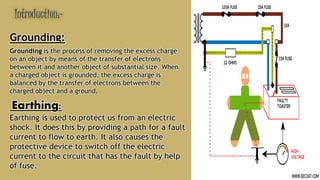
Earthing:
Earthing is used to protect us from an electric
shock. It does this by providing a path for a fault
current to flow to earth. It also causes the
protective device to switch off the electric
current to the circuit that has the fault by help
of fuse.
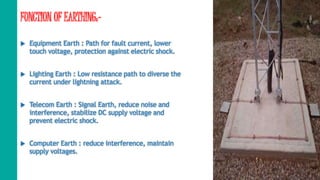
FUNCTION OF EARTHING:-
 Equipment Earth : Path for fault current, lower
touch voltage, protection against electric shock.
 Lighting Earth : Low resistance path to diverse the
current under lightning attack.
 Telecom Earth : Signal Earth, reduce noise and
interference, stabilize DC supply voltage and
prevent electric shock.
 Computer Earth : reduce interference, maintain
supply voltages.
Methods of Conventional Earthing:-
Plate Earthing
Pipe Earthing
Rod Earthing
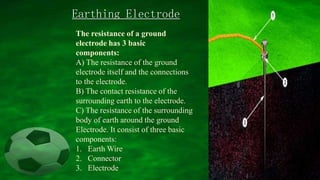
The resistance of a ground
electrode has 3 basic
components:
A) The resistance of the ground
electrode itself and the connections
to the electrode.
B) The contact resistance of the
surrounding earth to the electrode.
C) The resistance of the surrounding
body of earth around the ground
Electrode. It consist of three basic
components:
1. Earth Wire
2. Connector
3. Electrode
Earthing Electrode
Plate Earthing
 In this type of earthing plate either of copper
or of G.I. is buried into the ground at a depth
of not less than 3 meter from the ground level.
 The earth plate is embedded in alternative
layer of coke and salts for a minimum
thickness of about 15cm.
 The earth wire(copper wire for copper plate
earthing and G.I. wire for G.I. plate earthing)
is securely bolted to an earth plate with the
help of bolt nut and washer made of copper, in
case of copper plate earthing and of G.I. in
case of G.I. plate earthing.
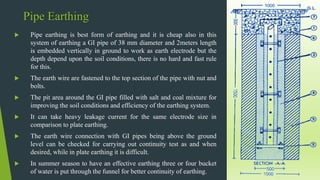
Pipe Earthing
 Pipe earthing is best form of earthing and it is cheap also in this
system of earthing a GI pipe of 38 mm diameter and 2meters length
is embedded vertically in ground to work as earth electrode but the
depth depend upon the soil conditions, there is no hard and fast rule
for this.
 The earth wire are fastened to the top section of the pipe with nut and
bolts.
 The pit area around the GI pipe filled with salt and coal mixture for
improving the soil conditions and efficiency of the earthing system.
 It can take heavy leakage current for the same electrode size in
comparison to plate earthing.
 The earth wire connection with GI pipes being above the ground
level can be checked for carrying out continuity test as and when
desired, while in plate earthing it is difficult.
 In summer season to have an effective earthing three or four bucket
of water is put through the funnel for better continuity of earthing.
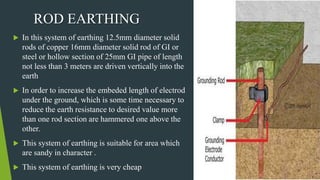
 In this system of earthing 12.5mm diameter solid
rods of copper 16mm diameter solid rod of GI or
steel or hollow section of 25mm GI pipe of length
not less than 3 meters are driven vertically into the
earth
 In order to increase the embeded length of electrod
under the ground, which is some time necessary to
reduce the earth resistance to desired value more
than one rod section are hammered one above the
other.
 This system of earthing is suitable for area which
are sandy in character .
 This system of earthing is very cheap
ROD EARTHING
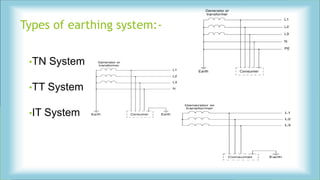
•TN System
•TT System
•IT System
Types of earthing system:-
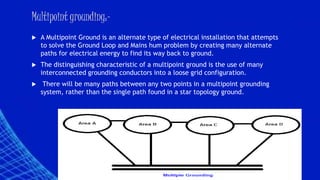
 A Multipoint Ground is an alternate type of electrical installation that attempts
to solve the Ground Loop and Mains hum problem by creating many alternate
paths for electrical energy to find its way back to ground.
 The distinguishing characteristic of a multipoint ground is the use of many
interconnected grounding conductors into a loose grid configuration.
 There will be many paths between any two points in a multipoint grounding
system, rather than the single path found in a star topology ground.
Multipoint grounding:-
Virtual grounding:-
 If two opposite power sources are connected each other by a
conductive medium so that their opposite output quantities are
superposed (summed), zero or reference level result referred to as
virtual ground appears somewhere along the medium.
 In this "conflict" point, the efforts of the "fighting" sources are
"neutralized". The process is associated with continuous energy
wasting from both the sources as a result of a continuous energy flow
through the medium.
 Shortly, virtual ground phenomenon is summing of opposite equal
quantities associated with continuous energy wasting; virtual ground
represents the result of summing two opposite equal quantities.
TWO CLASS OF PROTECTION:-
 Class I protection –use of barrier/insulation and connection of protective
conductor to equipment metallic enclosure in order to protect against
electric shock.
 Class II protection –beside of the basic insulation, addition layer of
insulation apply to the enclosure. Therefore no extraneous conductive part.
The additional layer is independent to the basic insulation so that under
failure of basic insulation, it offers additional protection.
APPLICATION:-
 Protect human against lightning and earth fault condition.
 Protect the premises against lightning and earth fault
condition.
 Provide low resistance and safe path for lightning and fault
current.
 All metallic enclosure and extraneous conductive parts are at
equipotential.
 LV System Earth.
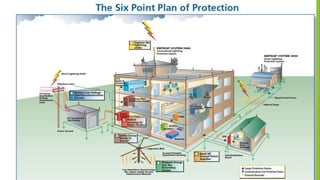
1. Capture the lightning strike. Capture the lightning strike to a known and
preferred attachment point using purpose-designed air terminal system.
2. Convey this energy to ground. Conduct the energy to the ground via a purpose-
designed down conductor.
3. Dissipate the energy into the grounding system. Dissipate the energy into a low
impedance grounding system.
4. Bond all ground points together. Bond all ground points to eliminate ground loops
and create an equipotential plane.
5. Protect incoming AC power feeders. Protect equipment from surges and
transients on incoming power lines to prevent equipment damage and costly
operational downtime.
6. Protect low voltage data/telecommunications circuits. Protect equipment from
surges and transients on incoming telecommunications and signal lines to prevent
equipment damage and costly operational downtime.
 Grounding and Earthing systems form the first
line of defense in every type of electrical
systems.
 The system may be a generator/transformer/
housing installation/generating station/etc.
 So it is strictly advised to know the basic
concepts of grounding as far as electrical
engineering is concerned.
 WIKIPEDIA
 GOOGLE IMAGES
 www.google.com
 www.slideshare.com
 www.electricalworld.com
Electrical grounding and earthing

Electrical grounding and earthing

  • 1.
  • 2.
    CONTENTS:- Introduction Function of earthing Methodsof conventional earthing Types of earthing system Application Conclusion
  • 3.
    Introduction:- Grounding: Grounding is theprocess of removing the excess charge on an object by means of the transfer of electrons between it and another object of substantial size. When a charged object is grounded, the excess charge is balanced by the transfer of electrons between the charged object and a ground. Earthing: Earthing is used to protect us from an electric shock. It does this by providing a path for a fault current to flow to earth. It also causes the protective device to switch off the electric current to the circuit that has the fault by help of fuse.
  • 4.
    FUNCTION OF EARTHING:- Equipment Earth : Path for fault current, lower touch voltage, protection against electric shock.  Lighting Earth : Low resistance path to diverse the current under lightning attack.  Telecom Earth : Signal Earth, reduce noise and interference, stabilize DC supply voltage and prevent electric shock.  Computer Earth : reduce interference, maintain supply voltages.
  • 5.
    Methods of ConventionalEarthing:- Plate Earthing Pipe Earthing Rod Earthing
  • 6.
    The resistance ofa ground electrode has 3 basic components: A) The resistance of the ground electrode itself and the connections to the electrode. B) The contact resistance of the surrounding earth to the electrode. C) The resistance of the surrounding body of earth around the ground Electrode. It consist of three basic components: 1. Earth Wire 2. Connector 3. Electrode Earthing Electrode
  • 7.
    Plate Earthing  Inthis type of earthing plate either of copper or of G.I. is buried into the ground at a depth of not less than 3 meter from the ground level.  The earth plate is embedded in alternative layer of coke and salts for a minimum thickness of about 15cm.  The earth wire(copper wire for copper plate earthing and G.I. wire for G.I. plate earthing) is securely bolted to an earth plate with the help of bolt nut and washer made of copper, in case of copper plate earthing and of G.I. in case of G.I. plate earthing.
  • 8.
    Pipe Earthing  Pipeearthing is best form of earthing and it is cheap also in this system of earthing a GI pipe of 38 mm diameter and 2meters length is embedded vertically in ground to work as earth electrode but the depth depend upon the soil conditions, there is no hard and fast rule for this.  The earth wire are fastened to the top section of the pipe with nut and bolts.  The pit area around the GI pipe filled with salt and coal mixture for improving the soil conditions and efficiency of the earthing system.  It can take heavy leakage current for the same electrode size in comparison to plate earthing.  The earth wire connection with GI pipes being above the ground level can be checked for carrying out continuity test as and when desired, while in plate earthing it is difficult.  In summer season to have an effective earthing three or four bucket of water is put through the funnel for better continuity of earthing.
  • 9.
     In thissystem of earthing 12.5mm diameter solid rods of copper 16mm diameter solid rod of GI or steel or hollow section of 25mm GI pipe of length not less than 3 meters are driven vertically into the earth  In order to increase the embeded length of electrod under the ground, which is some time necessary to reduce the earth resistance to desired value more than one rod section are hammered one above the other.  This system of earthing is suitable for area which are sandy in character .  This system of earthing is very cheap ROD EARTHING
  • 10.
    •TN System •TT System •ITSystem Types of earthing system:-
  • 11.
     A MultipointGround is an alternate type of electrical installation that attempts to solve the Ground Loop and Mains hum problem by creating many alternate paths for electrical energy to find its way back to ground.  The distinguishing characteristic of a multipoint ground is the use of many interconnected grounding conductors into a loose grid configuration.  There will be many paths between any two points in a multipoint grounding system, rather than the single path found in a star topology ground. Multipoint grounding:-
  • 12.
    Virtual grounding:-  Iftwo opposite power sources are connected each other by a conductive medium so that their opposite output quantities are superposed (summed), zero or reference level result referred to as virtual ground appears somewhere along the medium.  In this "conflict" point, the efforts of the "fighting" sources are "neutralized". The process is associated with continuous energy wasting from both the sources as a result of a continuous energy flow through the medium.  Shortly, virtual ground phenomenon is summing of opposite equal quantities associated with continuous energy wasting; virtual ground represents the result of summing two opposite equal quantities.
  • 13.
    TWO CLASS OFPROTECTION:-  Class I protection –use of barrier/insulation and connection of protective conductor to equipment metallic enclosure in order to protect against electric shock.  Class II protection –beside of the basic insulation, addition layer of insulation apply to the enclosure. Therefore no extraneous conductive part. The additional layer is independent to the basic insulation so that under failure of basic insulation, it offers additional protection.
  • 14.
    APPLICATION:-  Protect humanagainst lightning and earth fault condition.  Protect the premises against lightning and earth fault condition.  Provide low resistance and safe path for lightning and fault current.  All metallic enclosure and extraneous conductive parts are at equipotential.  LV System Earth.
  • 16.
    1. Capture thelightning strike. Capture the lightning strike to a known and preferred attachment point using purpose-designed air terminal system. 2. Convey this energy to ground. Conduct the energy to the ground via a purpose- designed down conductor. 3. Dissipate the energy into the grounding system. Dissipate the energy into a low impedance grounding system. 4. Bond all ground points together. Bond all ground points to eliminate ground loops and create an equipotential plane. 5. Protect incoming AC power feeders. Protect equipment from surges and transients on incoming power lines to prevent equipment damage and costly operational downtime. 6. Protect low voltage data/telecommunications circuits. Protect equipment from surges and transients on incoming telecommunications and signal lines to prevent equipment damage and costly operational downtime.
  • 17.
     Grounding andEarthing systems form the first line of defense in every type of electrical systems.  The system may be a generator/transformer/ housing installation/generating station/etc.  So it is strictly advised to know the basic concepts of grounding as far as electrical engineering is concerned.
  • 18.
     WIKIPEDIA  GOOGLEIMAGES  www.google.com  www.slideshare.com  www.electricalworld.com