LIGHTNING PROTECTION
&
LIGHTNING ARRESTOR
S. P Nanda
SURGE/ LIGHTNING
ARRESTORS
CONTENTS
• Introduction of Surge Arresters
• Introduction of lightning
• Lightning protection
• Construction of Surge
Arresters
• How does Surge Arresters
work?
• Uses of Surge Arresters
• Types of Surge Arresters
INTRODUCTION OF SURGE
ARRESTERS
What is SUGRE ?
• A surge is basically a very High voltage which suddenly acts on
a transmission line just like lightning which strikes on a
transmission line or any where else.
• Generally speaking, the greater the voltages are & the longer
period over which they are experienced, the greater will be the
damage.
OTHER DEVICES SIMILAR TO
LIGHTNING ARRESTERS
• Surge Suppressor:
This is also a surge diverter, but generally for voltages
well below 1100 volts.
• TVSS (Transient Voltage Surge Suppressor):
Again this is also a surge diverter, but generally for
voltages well below 1100 volts.
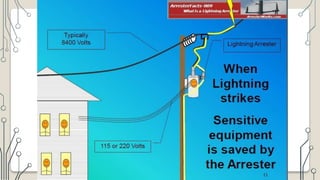
How do Lightning
Arresters Protect
Power Systems?
LIGHTENING
 Definition of Lightning
 Significance of Lighning
 Mechanism of lightning discharge
 Keraunic Level
 Types of Lightning
 Effect of Lighning
 Protection against Lightning.
INTRODUCTION OF
LIGHTNING
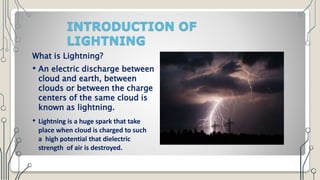
What is Lightning?
• An electric discharge between
cloud and earth, between
clouds or between the charge
centers of the same cloud is
known as lightning.
• Lightning is a huge spark that take
place when cloud is charged to such
a high potential that dielectric
strength of air is destroyed.
INTRODUCTION OF
LIGHTNING
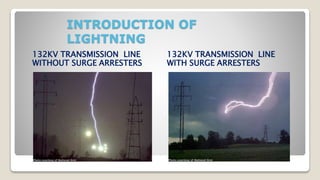
132KV TRANSMISSION LINE
WITHOUT SURGE ARRESTERS
132KV TRANSMISSION LINE
WITH SURGE ARRESTERS
MECHANISM OF LIGHTNING
DISCHARGE
• Lightning discharge is initiated
by a streamer from the cloud
which progress towards the
earth in series of steps called
Stepped Leader.
• Streamer moves from earth
towards cloud is called Return
Streamer.
• Leader streamer and return
streamer has opposite charge.
• When Leader streamer and
return streamer meets, lightning
is initiated. another then a
short circuit is established between
earth and cloud give rise to a large
KEY POINTS ABOUT LIGHTNING
DISCHARGE
• A lightning discharge usually made up of a number of separate
strokes.
• 87% of all lightning strokes results from negatively charged
clouds.
• 13% of all lightning strokes results from positively charged
clouds.
• Through out the world nearly 100 lightning strokes occur per
second
• Lightning discharge current range from 10kA to 90kA.
KERAUNIC LEVEL
• It is defined as the average number of days per year when
thunder can be heard in a given area.
• The keraunic number has been used to set standards for safe
design of electrical systems in structures connected to the local
power grid.
• The annual number of lightning flashes hitting one square km
of ground, Ng, can be calculated from the following formula
• Td is the keraunic number.
TYPES OF LIGHTNING
STROKES
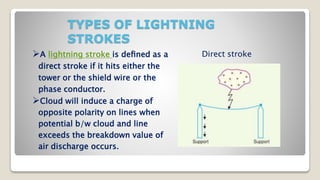
A lightning stroke is defined as a
direct stroke if it hits either the
tower or the shield wire or the
phase conductor.
Cloud will induce a charge of
opposite polarity on lines when
potential b/w cloud and line
exceeds the breakdown value of
air discharge occurs.
Direct stroke
TYPES OF LIGHTNING
STROKES
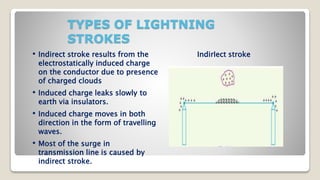
• Indirect stroke results from the
electrostatically induced charge
on the conductor due to presence
of charged clouds
• Induced charge leaks slowly to
earth via insulators.
• Induced charge moves in both
direction in the form of travelling
waves.
• Most of the surge in
transmission line is caused by
indirect stroke.
IndirIect stroke
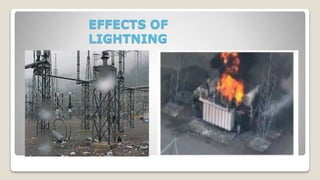
EFFECTS OF
LIGHTNING
• Traveling waves
• Insulator damage
• Transformer damage
• Lightning discharge constitute the main cause of non-
programmed outages of electrical system.
• 65% line outages originate from Lightning strokes
EFFECTS OF
LIGHTNING
PROTECTION AGAINST
LIGHTNING
• Earthing screen.
• Overhead ground wires
• Lightening Arresters
EARTHING
SCREEN
• Earthing screen provides protection to power stations and sub-
stations against direct stroke.
• It consist of a network of line conductor mounted all over
the electrical equipment in the substation and power station.
• Shield is properly ground through low resistance path.
• Limitation:
• It does not provide protection against travelling
waves.
OVER HEAD GROUND
WIRES
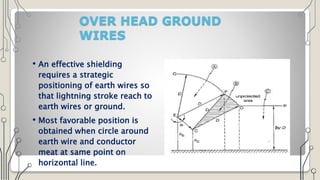
• Protect transmission line against direct stroke.
• Ground wires are placed above line conductors in such a way
that all lightning strokes are intercepted by them.
• Tower rises potential is given by
Vt= I.R
• Vt less than insulator flashover then no trouble occur
• Tower footing resistance must be very low.
OVER HEAD GROUND
WIRES
OVER HEAD GROUND
WIRES
• An effective shielding
requires a strategic
positioning of earth wires so
that lightning stroke reach to
earth wires or ground.
• Most favorable position is
obtained when circle around
earth wire and conductor
meat at same point on
horizontal line.
OVER HEAD GROUND
WIRES
LIGHTNING
ARRESTERS
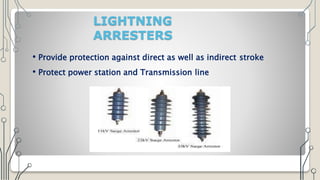
• Provide protection against direct as well as indirect stroke
• Protect power station and Transmission line
EARTHING IN VIEW OF
LIGHTNING PROTECTION
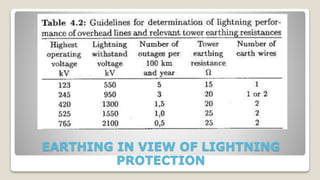
• Tower Earthing resistance and surge impedance is an important
parameter in determination of lightning flashover.
• Earthing resistance is a variable quantity.
• Depend upon soil and non linear conduction of earth
•Even if constant stroke current pass it changes
with time.
EARTHING IN VIEW OF LIGHTNING
PROTECTION
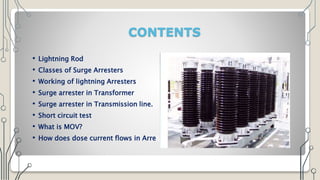
CONTENTS
• Lightning Rod
• Classes of Surge Arresters
• Working of lightning Arresters
• Surge arrester in Transformer
• Surge arrester in Transmission line.
• Short circuit test
• What is MOV?
• How does dose current flows in Arresters
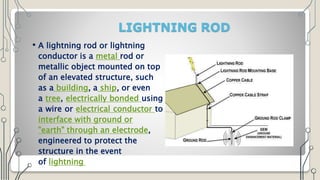
LIGHTNING ROD
• A lightning rod or lightning
conductor is a metal rod or
metallic object mounted on top
of an elevated structure, such
as a building, a ship, or even
a tree, electrically bonded using
a wire or electrical conductor to
interface with ground or
"earth" through an electrode,
engineered to protect the
structure in the event
of lightning strike
LIGHTNING ROD
• Surge arresters is not a
lightning Rod although it
does the same operation that
the lightening do.
• But its construction and
working principle is very
different from the lightning
Rod.
CLASSES OF SURGE
ARRESTERS
s
• Station Class
• Intermediate Clas
• Distribution Class
• Secondary Class
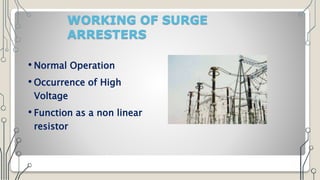
WORKING OF SURGE
ARRESTERS
• Normal Operation
• Occurrence of High
Voltage
• Function as a non linear
resistor
SURGE ARRESTERS IN
TRANSFORMER
• Surge Arresters are used in
transformer both at
transmission level and at
distribution level.
• The rating of arresters used
at these are different because
of voltage levels.
SURGE ARRESTERS IN
TRANSFORMER
SURGE ARRESTERS IN
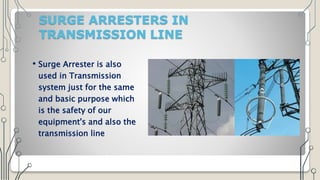
TRANSMISSION LINE
• Surge Arrester is also
used in Transmission
system just for the same
and basic purpose which
is the safety of our
equipment's and also the
transmission line
SURGE ARRESTERS (BASIC
CONSTRUCTION)
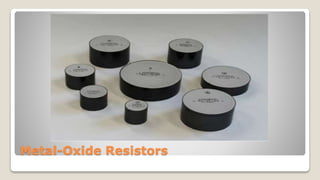
• Surge arresters is consist of MOV
discs.
• What is MOV?
• MOV is Metal Oxide Varistor.
• The most common type
of Varistor is the Metal-Oxide
Varistor (MOV). This type
contains a ceramic mass of
zinc oxide grains, in a matrix of
other metal oxides (such as small
amounts of bismuth, cobalt,
manganese) sandwiched
SURGE ARRESTERS (BASIC CONSTRUCTION)
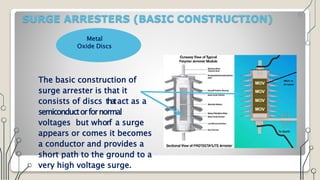
Metal
Oxide Discs
The basic construction of
surge arrester is that it
consists of discs thatact as a
semiconductorfornormal
voltages but whorf a surge
appears or comes it becomes
a conductor and provides a
short path to the ground to a
very high voltage surge.
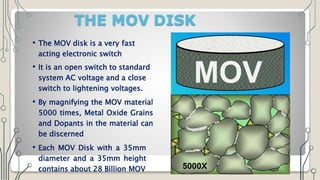
THE MOV DISK
• The MOV disk is a very fast
acting electronic switch
• It is an open switch to standard
system AC voltage and a close
switch to lightening voltages.
• By magnifying the MOV material
5000 times, Metal Oxide Grains
and Dopants in the material can
be discerned
• Each MOV Disk with a 35mm
diameter and a 35mm height
contains about 28 Billion MOV
The MOV Grains and their Junctions are the Electronic
Switches that turn on and off in unison to divert the
surge
A lightning arrester is essentially a
collection of billions of microscopic
junctions of Metal Oxide Grains that turn
on and off in microseconds to form a
current path from the top terminal to the
ground terminal of the arrester.
TYPES OF SURGE
ARRESTERS
• Rod Gap Arrester
• Horn Gap Arrester
• Multigap Arresters
• Expulsion Type Arrester
• Valve Type Arresters
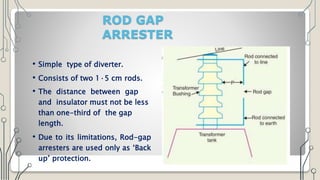
ROD GAP
ARRESTER
• Simple type of diverter.
• Consists of two 1·5 cm rods.
• The distance between gap
and insulator must not be less
than one-third of the gap
length.
• Due to its limitations, Rod-gap
arresters are used only as ‘Back
up’ protection.
ADVANTAGES
• Under normal operating
conditions gap remains non-
conducting.
• On the occurrence of a high
voltage surge on the line, the
gap sparks over and the
surge current is conducted to
earth.
DISADVANTAGES
• Rods may melt or get
damaged.
• The climatic conditions affect
the performance of rod gap
arrester.
• The polarity of the surge also
affects the performance of
this arrester.
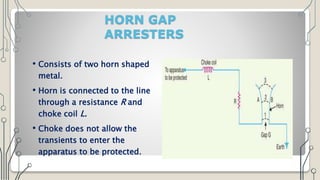
HORN GAP
ARRESTERS
• Consists of two horn shaped
metal.
• Horn is connected to the line
through a resistance R and
choke coil L.
• Choke does not allow the
transients to enter the
apparatus to be protected.
ADVANTAGES DISADVANTAGES
• The arc is self-clearing.
• Series resistance helps in
limiting the follow
current to a small value.
• The bridging of gap can
render the device useless.
• The setting of horn gap is
likely to change due to
corrosion or pitting.
• Time of operation is
comparatively long.
MULTIGAP
ARRESTER
• It consists of a series of
metallic (generally alloy of
zinc) cylinders.
• Cylinders are separated by air
gap and are connected with
series and shunt resistances.
• Such arresters are applied
where voltage does not
exceed 33kV.
ADVANTAGES DISADVANTAGES
• They have the lowest let-
through voltage and the best
controlled clamping behavior
of the various arrestor types.
• It provides safety and
prevents damage to
expensive equipment.
• Their current handling
capabilities are the smallest
of all.
• Such arresters can be
employed only where system
voltage may not exceed
33kV.
EXPULSION TYPE
ARRESTERS
• This type of arrester is also
called ‘Protector tube’.
• Commonly used on system
operating at voltages up to 33
kV.
• It essentially consists of Rod
Gap, Upper Electrode and Lower
Electrode.
• One expulsion arrester is placed
under each line conductor.
DISADVANTAGES
• They can perform only limited
number of operations.
• it is not suitable for the
protection of expensive
equipment.
• This type of arresters cannot
be mounted in an
enclosed equipment.
ADVANTAGES
• They are not very expensive.
• They are improved form of
rod gap arresters.
• They can be easily installed.
VALVE TYPE ARRESTERS
• They are extensively used on
systems operating at high
voltages.
• They incorporate non-linear
resistors
• It consists of two assemblies
• Series spark gaps
• Non-linear resistor discs.
• The non linear elements are
connected in series with the
spark gap.
ADVANTAGES DISADVANTAGES
• They provide very effective
protection (especially for
transformers and cables)
against surges.
• They operate very rapidly
• They fail to check the surges
of every steep Wave.
• Their performance is
adversely affected by the
entry of moisture into the
enclosure.
APPLICATIONS OF VALVE TYPE
ARRESTERS
• According to there applications valve type arresters are
classified as Two types
• Station type: Generally used for protection of equipment in
power stations operating on voltages upto 220kV or higher.
• Line type: Are used for station handling voltages upto 66kV.
Metal-Oxide Resistors
Porcelain Housed Surge Arrester
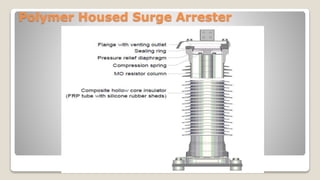
Polymer Housed Surge Arrester
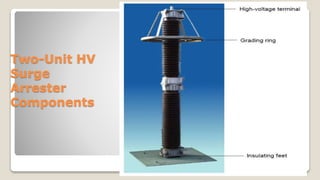
Two-Unit HV
Surge
Arrester
Components
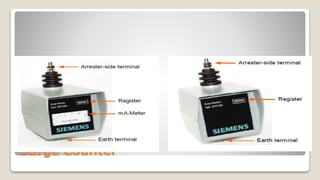
Surge Counter
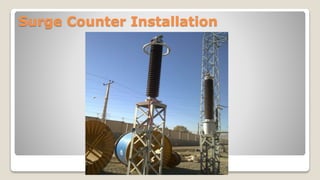
Surge Counter Installation
RATING OF LIGHTNING ARRESTERS
The Rating of lightning arrestor are given below
Normal or rated voltage: It is designated by the
maximum permissible value of power frequency
voltage which it can support across its line and earth
terminal while still carrying effectively and without the
automatic extinction of the follow up current. The
voltage rating of the arrestors should be greater than
the maximum sound phase to ground voltage
RATING OF LIGHTNING ARRESTERS
Normal Discharge current: It is the surge current which
flows through the LA after the spark over, expressed in crest
value (peak value) for a specified wave shape. Example 10,
5, 2.5, 1.5, 1 kA rating.
Power frequency spark over voltage: It is the RMS value
of the power frequency voltage applied between the line and
earth terminals of the arrestor and earth which causes spark
over of the series gap. As per IS 3070, the recommended
spark over voltage is 1.5 times the rated voltage.
SELECTION OF LIGHTNING ARRESTERS
For the protection of substation above 66KV an arrestor of
10kA rating is used.
Voltage rating of LA = Line to line voltage × 1.1 × coefficient
of earthing.
Power frequency spark over voltage = 1.5 ×Voltage rating of
LA
(Assuming coefficient of earthing equals 0.8 for effectively
earthed system)
SELECTION OF LIGHTNING ARRESTERS
For 132KV system:
Voltage rating = 1.1 × 132×0.8 = 116.16KV
Power frequency spark over voltage = 1.5 × 116.16 = 174.24KV
Rated discharge current = 10kA
For 66kV System:
Voltage rating = 1.1 × 66×0.8 = 58.08kV
Power frequency spark over voltage = 1.5 × 58.08 = 87.12kV
Rated discharge current = 10kA
SELECTION OF LIGHTNING ARRESTERS
For 11KV system:
Voltage rating = 1.1× 11×0.8 = 9.68KV
Power frequency spark over voltage = 1.5×9.68 = 14.52KV
Nominal discharge current = 5kA
The standard rating of surge arresters available are 2.7, 3, 6, 9, 10,
12, 15, 18, 21, 24, 27, 30, 36, 39, 45, 48, 54, 60, 72, 90, 96, 108,
132, 144, 168, 172, 180, 192, 198, 228, 240, 258, 264, 276, 288,
294, 312, 360, 390, 396 & 420 KV.
Selection is to be made considering the system voltage rating & the
type of earthing employed.
MAINTENANCE OF LIGHTNING ARRESTERS
Monthly Check:
Bushing Inspection from ground visually & taking surge counter
reading. Any abnormal trend in surge counter reading is to be
investigated.
Yearly Check:
Cleaning & inspection of bushing for any crack, checking terminal
tightness & Leakage current measurement.
Appropriate shutdown is to be taken for carrying out the work.
Understanding_lightning_protection.pptx

Understanding_lightning_protection.pptx

  • 1.
  • 2.
  • 3.
    CONTENTS • Introduction ofSurge Arresters • Introduction of lightning • Lightning protection • Construction of Surge Arresters • How does Surge Arresters work? • Uses of Surge Arresters • Types of Surge Arresters
  • 4.
    INTRODUCTION OF SURGE ARRESTERS Whatis SUGRE ? • A surge is basically a very High voltage which suddenly acts on a transmission line just like lightning which strikes on a transmission line or any where else. • Generally speaking, the greater the voltages are & the longer period over which they are experienced, the greater will be the damage.
  • 5.
    OTHER DEVICES SIMILARTO LIGHTNING ARRESTERS • Surge Suppressor: This is also a surge diverter, but generally for voltages well below 1100 volts. • TVSS (Transient Voltage Surge Suppressor): Again this is also a surge diverter, but generally for voltages well below 1100 volts.
  • 6.
    How do Lightning ArrestersProtect Power Systems?
  • 11.
    LIGHTENING  Definition ofLightning  Significance of Lighning  Mechanism of lightning discharge  Keraunic Level  Types of Lightning  Effect of Lighning  Protection against Lightning.
  • 12.
    INTRODUCTION OF LIGHTNING What isLightning? • An electric discharge between cloud and earth, between clouds or between the charge centers of the same cloud is known as lightning. • Lightning is a huge spark that take place when cloud is charged to such a high potential that dielectric strength of air is destroyed.
  • 13.
    INTRODUCTION OF LIGHTNING 132KV TRANSMISSIONLINE WITHOUT SURGE ARRESTERS 132KV TRANSMISSION LINE WITH SURGE ARRESTERS
  • 14.
    MECHANISM OF LIGHTNING DISCHARGE •Lightning discharge is initiated by a streamer from the cloud which progress towards the earth in series of steps called Stepped Leader. • Streamer moves from earth towards cloud is called Return Streamer. • Leader streamer and return streamer has opposite charge. • When Leader streamer and return streamer meets, lightning is initiated. another then a short circuit is established between earth and cloud give rise to a large
  • 15.
    KEY POINTS ABOUTLIGHTNING DISCHARGE • A lightning discharge usually made up of a number of separate strokes. • 87% of all lightning strokes results from negatively charged clouds. • 13% of all lightning strokes results from positively charged clouds. • Through out the world nearly 100 lightning strokes occur per second • Lightning discharge current range from 10kA to 90kA.
  • 16.
    KERAUNIC LEVEL • Itis defined as the average number of days per year when thunder can be heard in a given area. • The keraunic number has been used to set standards for safe design of electrical systems in structures connected to the local power grid. • The annual number of lightning flashes hitting one square km of ground, Ng, can be calculated from the following formula • Td is the keraunic number.
  • 17.
    TYPES OF LIGHTNING STROKES Alightning stroke is defined as a direct stroke if it hits either the tower or the shield wire or the phase conductor. Cloud will induce a charge of opposite polarity on lines when potential b/w cloud and line exceeds the breakdown value of air discharge occurs. Direct stroke
  • 18.
    TYPES OF LIGHTNING STROKES •Indirect stroke results from the electrostatically induced charge on the conductor due to presence of charged clouds • Induced charge leaks slowly to earth via insulators. • Induced charge moves in both direction in the form of travelling waves. • Most of the surge in transmission line is caused by indirect stroke. IndirIect stroke
  • 19.
    EFFECTS OF LIGHTNING • Travelingwaves • Insulator damage • Transformer damage • Lightning discharge constitute the main cause of non- programmed outages of electrical system. • 65% line outages originate from Lightning strokes
  • 20.
  • 21.
    PROTECTION AGAINST LIGHTNING • Earthingscreen. • Overhead ground wires • Lightening Arresters
  • 22.
    EARTHING SCREEN • Earthing screenprovides protection to power stations and sub- stations against direct stroke. • It consist of a network of line conductor mounted all over the electrical equipment in the substation and power station. • Shield is properly ground through low resistance path. • Limitation: • It does not provide protection against travelling waves.
  • 23.
    OVER HEAD GROUND WIRES •Protect transmission line against direct stroke. • Ground wires are placed above line conductors in such a way that all lightning strokes are intercepted by them. • Tower rises potential is given by Vt= I.R • Vt less than insulator flashover then no trouble occur • Tower footing resistance must be very low.
  • 24.
  • 25.
    OVER HEAD GROUND WIRES •An effective shielding requires a strategic positioning of earth wires so that lightning stroke reach to earth wires or ground. • Most favorable position is obtained when circle around earth wire and conductor meat at same point on horizontal line.
  • 26.
  • 27.
    LIGHTNING ARRESTERS • Provide protectionagainst direct as well as indirect stroke • Protect power station and Transmission line
  • 28.
    EARTHING IN VIEWOF LIGHTNING PROTECTION • Tower Earthing resistance and surge impedance is an important parameter in determination of lightning flashover. • Earthing resistance is a variable quantity. • Depend upon soil and non linear conduction of earth •Even if constant stroke current pass it changes with time.
  • 29.
    EARTHING IN VIEWOF LIGHTNING PROTECTION
  • 30.
    CONTENTS • Lightning Rod •Classes of Surge Arresters • Working of lightning Arresters • Surge arrester in Transformer • Surge arrester in Transmission line. • Short circuit test • What is MOV? • How does dose current flows in Arresters
  • 31.
    LIGHTNING ROD • Alightning rod or lightning conductor is a metal rod or metallic object mounted on top of an elevated structure, such as a building, a ship, or even a tree, electrically bonded using a wire or electrical conductor to interface with ground or "earth" through an electrode, engineered to protect the structure in the event of lightning strike
  • 32.
    LIGHTNING ROD • Surgearresters is not a lightning Rod although it does the same operation that the lightening do. • But its construction and working principle is very different from the lightning Rod.
  • 33.
    CLASSES OF SURGE ARRESTERS s •Station Class • Intermediate Clas • Distribution Class • Secondary Class
  • 34.
    WORKING OF SURGE ARRESTERS •Normal Operation • Occurrence of High Voltage • Function as a non linear resistor
  • 35.
    SURGE ARRESTERS IN TRANSFORMER •Surge Arresters are used in transformer both at transmission level and at distribution level. • The rating of arresters used at these are different because of voltage levels.
  • 36.
  • 37.
    SURGE ARRESTERS IN TRANSMISSIONLINE • Surge Arrester is also used in Transmission system just for the same and basic purpose which is the safety of our equipment's and also the transmission line
  • 38.
    SURGE ARRESTERS (BASIC CONSTRUCTION) •Surge arresters is consist of MOV discs. • What is MOV? • MOV is Metal Oxide Varistor. • The most common type of Varistor is the Metal-Oxide Varistor (MOV). This type contains a ceramic mass of zinc oxide grains, in a matrix of other metal oxides (such as small amounts of bismuth, cobalt, manganese) sandwiched
  • 39.
    SURGE ARRESTERS (BASICCONSTRUCTION) Metal Oxide Discs The basic construction of surge arrester is that it consists of discs thatact as a semiconductorfornormal voltages but whorf a surge appears or comes it becomes a conductor and provides a short path to the ground to a very high voltage surge.
  • 40.
    THE MOV DISK •The MOV disk is a very fast acting electronic switch • It is an open switch to standard system AC voltage and a close switch to lightening voltages. • By magnifying the MOV material 5000 times, Metal Oxide Grains and Dopants in the material can be discerned • Each MOV Disk with a 35mm diameter and a 35mm height contains about 28 Billion MOV
  • 41.
    The MOV Grainsand their Junctions are the Electronic Switches that turn on and off in unison to divert the surge
  • 42.
    A lightning arresteris essentially a collection of billions of microscopic junctions of Metal Oxide Grains that turn on and off in microseconds to form a current path from the top terminal to the ground terminal of the arrester.
  • 43.
    TYPES OF SURGE ARRESTERS •Rod Gap Arrester • Horn Gap Arrester • Multigap Arresters • Expulsion Type Arrester • Valve Type Arresters
  • 44.
    ROD GAP ARRESTER • Simpletype of diverter. • Consists of two 1·5 cm rods. • The distance between gap and insulator must not be less than one-third of the gap length. • Due to its limitations, Rod-gap arresters are used only as ‘Back up’ protection.
  • 45.
    ADVANTAGES • Under normaloperating conditions gap remains non- conducting. • On the occurrence of a high voltage surge on the line, the gap sparks over and the surge current is conducted to earth. DISADVANTAGES • Rods may melt or get damaged. • The climatic conditions affect the performance of rod gap arrester. • The polarity of the surge also affects the performance of this arrester.
  • 46.
    HORN GAP ARRESTERS • Consistsof two horn shaped metal. • Horn is connected to the line through a resistance R and choke coil L. • Choke does not allow the transients to enter the apparatus to be protected.
  • 47.
    ADVANTAGES DISADVANTAGES • Thearc is self-clearing. • Series resistance helps in limiting the follow current to a small value. • The bridging of gap can render the device useless. • The setting of horn gap is likely to change due to corrosion or pitting. • Time of operation is comparatively long.
  • 48.
    MULTIGAP ARRESTER • It consistsof a series of metallic (generally alloy of zinc) cylinders. • Cylinders are separated by air gap and are connected with series and shunt resistances. • Such arresters are applied where voltage does not exceed 33kV.
  • 49.
    ADVANTAGES DISADVANTAGES • Theyhave the lowest let- through voltage and the best controlled clamping behavior of the various arrestor types. • It provides safety and prevents damage to expensive equipment. • Their current handling capabilities are the smallest of all. • Such arresters can be employed only where system voltage may not exceed 33kV.
  • 50.
    EXPULSION TYPE ARRESTERS • Thistype of arrester is also called ‘Protector tube’. • Commonly used on system operating at voltages up to 33 kV. • It essentially consists of Rod Gap, Upper Electrode and Lower Electrode. • One expulsion arrester is placed under each line conductor.
  • 51.
    DISADVANTAGES • They canperform only limited number of operations. • it is not suitable for the protection of expensive equipment. • This type of arresters cannot be mounted in an enclosed equipment. ADVANTAGES • They are not very expensive. • They are improved form of rod gap arresters. • They can be easily installed.
  • 52.
    VALVE TYPE ARRESTERS •They are extensively used on systems operating at high voltages. • They incorporate non-linear resistors • It consists of two assemblies • Series spark gaps • Non-linear resistor discs. • The non linear elements are connected in series with the spark gap.
  • 53.
    ADVANTAGES DISADVANTAGES • Theyprovide very effective protection (especially for transformers and cables) against surges. • They operate very rapidly • They fail to check the surges of every steep Wave. • Their performance is adversely affected by the entry of moisture into the enclosure.
  • 54.
    APPLICATIONS OF VALVETYPE ARRESTERS • According to there applications valve type arresters are classified as Two types • Station type: Generally used for protection of equipment in power stations operating on voltages upto 220kV or higher. • Line type: Are used for station handling voltages upto 66kV.
  • 55.
  • 56.
  • 57.
  • 58.
  • 59.
  • 60.
  • 61.
    RATING OF LIGHTNINGARRESTERS The Rating of lightning arrestor are given below Normal or rated voltage: It is designated by the maximum permissible value of power frequency voltage which it can support across its line and earth terminal while still carrying effectively and without the automatic extinction of the follow up current. The voltage rating of the arrestors should be greater than the maximum sound phase to ground voltage
  • 62.
    RATING OF LIGHTNINGARRESTERS Normal Discharge current: It is the surge current which flows through the LA after the spark over, expressed in crest value (peak value) for a specified wave shape. Example 10, 5, 2.5, 1.5, 1 kA rating. Power frequency spark over voltage: It is the RMS value of the power frequency voltage applied between the line and earth terminals of the arrestor and earth which causes spark over of the series gap. As per IS 3070, the recommended spark over voltage is 1.5 times the rated voltage.
  • 63.
    SELECTION OF LIGHTNINGARRESTERS For the protection of substation above 66KV an arrestor of 10kA rating is used. Voltage rating of LA = Line to line voltage × 1.1 × coefficient of earthing. Power frequency spark over voltage = 1.5 ×Voltage rating of LA (Assuming coefficient of earthing equals 0.8 for effectively earthed system)
  • 64.
    SELECTION OF LIGHTNINGARRESTERS For 132KV system: Voltage rating = 1.1 × 132×0.8 = 116.16KV Power frequency spark over voltage = 1.5 × 116.16 = 174.24KV Rated discharge current = 10kA For 66kV System: Voltage rating = 1.1 × 66×0.8 = 58.08kV Power frequency spark over voltage = 1.5 × 58.08 = 87.12kV Rated discharge current = 10kA
  • 65.
    SELECTION OF LIGHTNINGARRESTERS For 11KV system: Voltage rating = 1.1× 11×0.8 = 9.68KV Power frequency spark over voltage = 1.5×9.68 = 14.52KV Nominal discharge current = 5kA The standard rating of surge arresters available are 2.7, 3, 6, 9, 10, 12, 15, 18, 21, 24, 27, 30, 36, 39, 45, 48, 54, 60, 72, 90, 96, 108, 132, 144, 168, 172, 180, 192, 198, 228, 240, 258, 264, 276, 288, 294, 312, 360, 390, 396 & 420 KV. Selection is to be made considering the system voltage rating & the type of earthing employed.
  • 66.
    MAINTENANCE OF LIGHTNINGARRESTERS Monthly Check: Bushing Inspection from ground visually & taking surge counter reading. Any abnormal trend in surge counter reading is to be investigated. Yearly Check: Cleaning & inspection of bushing for any crack, checking terminal tightness & Leakage current measurement. Appropriate shutdown is to be taken for carrying out the work.