BUILDING SERVICES ENGINEERING’13
RITESH G. AMBADKAR(123)
AKASH (118)
ROSHAN (129)
ABHIJIT BISWAS (124)
MANOJ PIKLE (121)
HARSHAL DEKATE (125)
(ELECTRICAL ENGG. DEPT)
} Ramteke
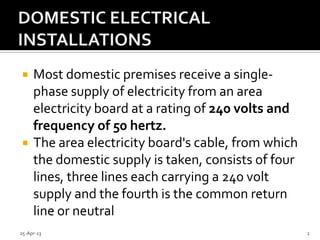
 Most domestic premises receive a single-
phase supply of electricity from an area
electricity board at a rating of 240 volts and
frequency of 50 hertz.
 The area electricity board's cable, from which
the domestic supply is taken, consists of four
lines, three lines each carrying a 240 volt
supply and the fourth is the common return
line or neutral
25-Apr-13 2
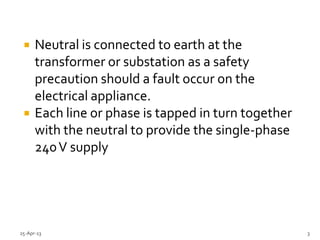
 Neutral is connected to earth at the
transformer or substation as a safety
precaution should a fault occur on the
electrical appliance.
 Each line or phase is tapped in turn together
with the neutral to provide the single-phase
240V supply
25-Apr-13 3
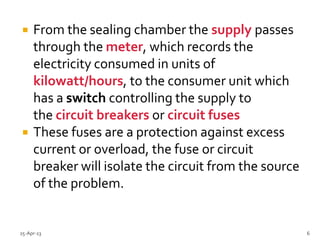
 The supply or intake cable may enter
building in two ways
I. Underground duct
II. Overhead supply.
 An underground supply is preferred since all
of the electrical service is hidden.
25-Apr-13 4
25-Apr-13 5
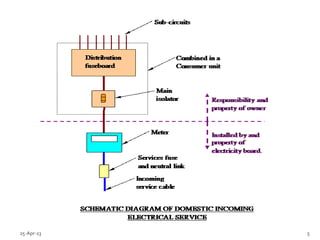
 From the sealing chamber the supply passes
through the meter, which records the
electricity consumed in units of
kilowatt/hours, to the consumer unit which
has a switch controlling the supply to
the circuit breakers or circuit fuses
 These fuses are a protection against excess
current or overload, the fuse or circuit
breaker will isolate the circuit from the source
of the problem.
25-Apr-13 6
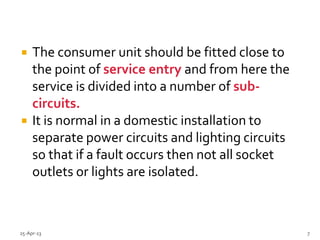
 The consumer unit should be fitted close to
the point of service entry and from here the
service is divided into a number of sub-
circuits.
 It is normal in a domestic installation to
separate power circuits and lighting circuits
so that if a fault occurs then not all socket
outlets or lights are isolated.
25-Apr-13 7
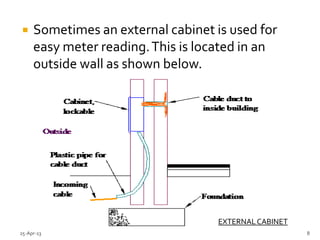
 Sometimes an external cabinet is used for
easy meter reading.This is located in an
outside wall as shown below.
EXTERNALCABINET
25-Apr-13 8
 When deciding on the number of circuits for a
house, a useful rule is; one power circuit for
every 100m2 of floor area.
 In larger houses this means that two circuits
can be used for power socket outlets, in a
two-storey house this would be one circuit for
upstairs and one for downstairs.
 In some larger houses a separate power
circuit is also installed for the garage / utility
area
25-Apr-13 9
 In all domestic installations a separate power
circuit is required for the cooker since the
electrical demand is likely to be high.The
immersion heater in the hot water cylinder
can also be supplied from a separate circuit
since a 3kW load is quite high.
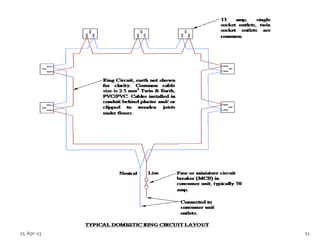
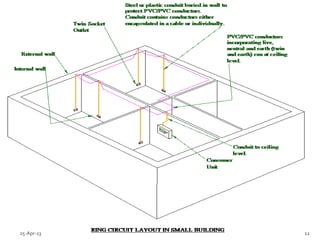
 Ring circuits are used as a safe and economic
method of distribution of electricity to socket
outlets.
 Many consumer unit manufacturers produce
8 way and 12 way units.
25-Apr-13 10
25-Apr-13 11
25-Apr-13 12
 Protection against electric shock is provided
by insulating and placing live parts out of
reach in suitable enclosures, earthing and
bonding metal work and providing fuses or
circuit breakers.
 A fuse or miniature circuit breaker (MCB) will
disconnect the supply automatically before
the overload current can cause a rise in
temperature which would damage the
installation.
25-Apr-13 13
 An isolator is a mechanical device, which is
opened manually and is provided so that the
whole of the installation, one circuit or one
piece of equipment may be cut off from the
live supply.
 In addition, a means of switching off for
maintenance or emergency switching must
also be provided.
 In practice it is the aim to bring the Electrical
supply to the appliance with as small a loss of
voltage through the conductor as possible.
 This means that the wiring must have the
smallest resistance that is economical
25-Apr-13 14
 The electrical distribution system in high rise
flats and office buildings uses a busbar system.
 A busbar is a solid copper bar that carries the
electrical current.
 The busbars run vertically inside trunking and
are supported by insulated bars across the
trunking chamber.
 The electrical supply to each floor is connected
to the rising main by means of tap-off units.
25-Apr-13 15
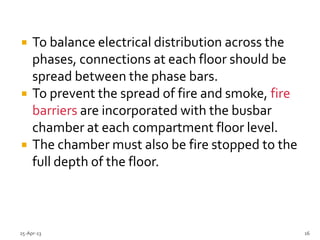
 To balance electrical distribution across the
phases, connections at each floor should be
spread between the phase bars.
 To prevent the spread of fire and smoke, fire
barriers are incorporated with the busbar
chamber at each compartment floor level.
 The chamber must also be fire stopped to the
full depth of the floor.
25-Apr-13 16
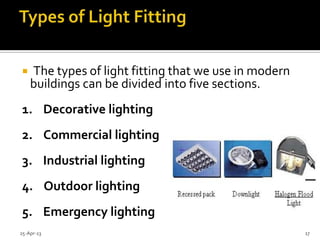
 The types of light fitting that we use in modern
buildings can be divided into five sections.
1. Decorative lighting
2. Commercial lighting
3. Industrial lighting
4. Outdoor lighting
5. Emergency lighting
25-Apr-13 17
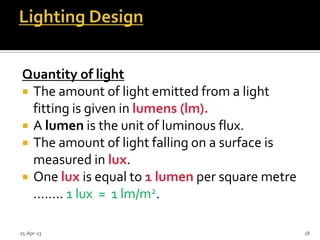
Quantity of light
 The amount of light emitted from a light
fitting is given in lumens (lm).
 A lumen is the unit of luminous flux.
 The amount of light falling on a surface is
measured in lux.
 One lux is equal to 1 lumen per square metre
…….. 1 lux = 1 lm/m2.
25-Apr-13 18
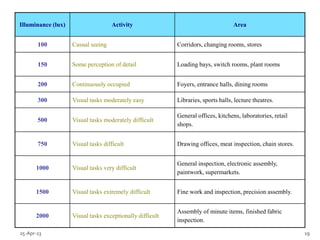
Illuminance (lux) Activity Area
100 Casual seeing Corridors, changing rooms, stores
150 Some perception of detail Loading bays, switch rooms, plant rooms
200 Continuously occupied Foyers, entrance halls, dining rooms
300 Visual tasks moderately easy Libraries, sports halls, lecture theatres.
500 Visual tasks moderately difficult
General offices, kitchens, laboratories, retail
shops.
750 Visual tasks difficult Drawing offices, meat inspection, chain stores.
1000 Visual tasks very difficult
General inspection, electronic assembly,
paintwork, supermarkets.
1500 Visual tasks extremely difficult Fine work and inspection, precision assembly.
2000 Visual tasks exceptionally difficult
Assembly of minute items, finished fabric
inspection.
25-Apr-13 19
ND PHTGRPHY25-Apr-13 20
25-Apr-13 21

Building Services Engg. (Electrical installations)

  • 1.
    BUILDING SERVICES ENGINEERING’13 RITESHG. AMBADKAR(123) AKASH (118) ROSHAN (129) ABHIJIT BISWAS (124) MANOJ PIKLE (121) HARSHAL DEKATE (125) (ELECTRICAL ENGG. DEPT) } Ramteke
  • 2.
     Most domesticpremises receive a single- phase supply of electricity from an area electricity board at a rating of 240 volts and frequency of 50 hertz.  The area electricity board's cable, from which the domestic supply is taken, consists of four lines, three lines each carrying a 240 volt supply and the fourth is the common return line or neutral 25-Apr-13 2
  • 3.
     Neutral isconnected to earth at the transformer or substation as a safety precaution should a fault occur on the electrical appliance.  Each line or phase is tapped in turn together with the neutral to provide the single-phase 240V supply 25-Apr-13 3
  • 4.
     The supplyor intake cable may enter building in two ways I. Underground duct II. Overhead supply.  An underground supply is preferred since all of the electrical service is hidden. 25-Apr-13 4
  • 5.
  • 6.
     From thesealing chamber the supply passes through the meter, which records the electricity consumed in units of kilowatt/hours, to the consumer unit which has a switch controlling the supply to the circuit breakers or circuit fuses  These fuses are a protection against excess current or overload, the fuse or circuit breaker will isolate the circuit from the source of the problem. 25-Apr-13 6
  • 7.
     The consumerunit should be fitted close to the point of service entry and from here the service is divided into a number of sub- circuits.  It is normal in a domestic installation to separate power circuits and lighting circuits so that if a fault occurs then not all socket outlets or lights are isolated. 25-Apr-13 7
  • 8.
     Sometimes anexternal cabinet is used for easy meter reading.This is located in an outside wall as shown below. EXTERNALCABINET 25-Apr-13 8
  • 9.
     When decidingon the number of circuits for a house, a useful rule is; one power circuit for every 100m2 of floor area.  In larger houses this means that two circuits can be used for power socket outlets, in a two-storey house this would be one circuit for upstairs and one for downstairs.  In some larger houses a separate power circuit is also installed for the garage / utility area 25-Apr-13 9
  • 10.
     In alldomestic installations a separate power circuit is required for the cooker since the electrical demand is likely to be high.The immersion heater in the hot water cylinder can also be supplied from a separate circuit since a 3kW load is quite high.  Ring circuits are used as a safe and economic method of distribution of electricity to socket outlets.  Many consumer unit manufacturers produce 8 way and 12 way units. 25-Apr-13 10
  • 11.
  • 12.
  • 13.
     Protection againstelectric shock is provided by insulating and placing live parts out of reach in suitable enclosures, earthing and bonding metal work and providing fuses or circuit breakers.  A fuse or miniature circuit breaker (MCB) will disconnect the supply automatically before the overload current can cause a rise in temperature which would damage the installation. 25-Apr-13 13
  • 14.
     An isolatoris a mechanical device, which is opened manually and is provided so that the whole of the installation, one circuit or one piece of equipment may be cut off from the live supply.  In addition, a means of switching off for maintenance or emergency switching must also be provided.  In practice it is the aim to bring the Electrical supply to the appliance with as small a loss of voltage through the conductor as possible.  This means that the wiring must have the smallest resistance that is economical 25-Apr-13 14
  • 15.
     The electricaldistribution system in high rise flats and office buildings uses a busbar system.  A busbar is a solid copper bar that carries the electrical current.  The busbars run vertically inside trunking and are supported by insulated bars across the trunking chamber.  The electrical supply to each floor is connected to the rising main by means of tap-off units. 25-Apr-13 15
  • 16.
     To balanceelectrical distribution across the phases, connections at each floor should be spread between the phase bars.  To prevent the spread of fire and smoke, fire barriers are incorporated with the busbar chamber at each compartment floor level.  The chamber must also be fire stopped to the full depth of the floor. 25-Apr-13 16
  • 17.
     The typesof light fitting that we use in modern buildings can be divided into five sections. 1. Decorative lighting 2. Commercial lighting 3. Industrial lighting 4. Outdoor lighting 5. Emergency lighting 25-Apr-13 17
  • 18.
    Quantity of light The amount of light emitted from a light fitting is given in lumens (lm).  A lumen is the unit of luminous flux.  The amount of light falling on a surface is measured in lux.  One lux is equal to 1 lumen per square metre …….. 1 lux = 1 lm/m2. 25-Apr-13 18
  • 19.
    Illuminance (lux) ActivityArea 100 Casual seeing Corridors, changing rooms, stores 150 Some perception of detail Loading bays, switch rooms, plant rooms 200 Continuously occupied Foyers, entrance halls, dining rooms 300 Visual tasks moderately easy Libraries, sports halls, lecture theatres. 500 Visual tasks moderately difficult General offices, kitchens, laboratories, retail shops. 750 Visual tasks difficult Drawing offices, meat inspection, chain stores. 1000 Visual tasks very difficult General inspection, electronic assembly, paintwork, supermarkets. 1500 Visual tasks extremely difficult Fine work and inspection, precision assembly. 2000 Visual tasks exceptionally difficult Assembly of minute items, finished fabric inspection. 25-Apr-13 19
  • 20.
  • 21.