Construction and Condition Monitoring   Lightning Arresters
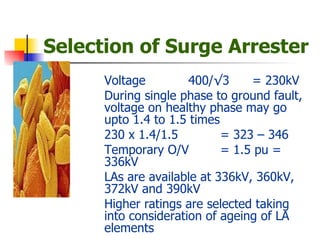
Selection of Surge Arrester Voltage 400/√3 = 230kV During single phase to ground fault, voltage on healthy phase may go upto 1.4 to 1.5 times 230 x 1.4/1.5 = 323 – 346 Temporary O/V = 1.5 pu = 336kV LAs are available at 336kV, 360kV, 372kV and 390kV  Higher ratings are selected taking into consideration of ageing of LA elements
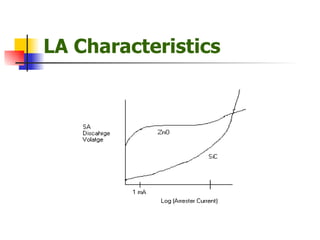
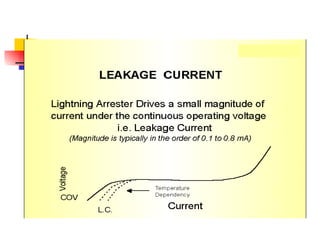
LA Characteristics
 
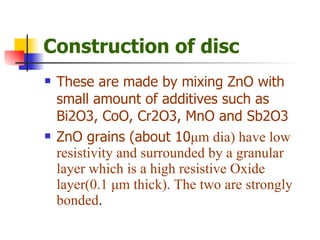
Construction of disc These are made by mixing ZnO with small amount of additives such as Bi2O3, CoO, Cr2O3, MnO and Sb2O3 ZnO grains (about 10 μ m dia) have low resistivity and surrounded by a granular layer which is a high resistive Oxide layer(0.1  μ m thick). The two are strongly bonded .
LA


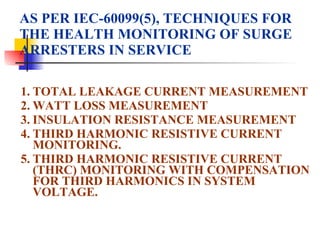
AS PER IEC-60099(5), TECHNIQUES FOR THE HEALTH MONITORING OF SURGE ARRESTERS IN SERVICE 1. TOTAL LEAKAGE CURRENT MEASUREMENT 2. WATT LOSS MEASUREMENT 3. INSULATION RESISTANCE MEASUREMENT 4. THIRD HARMONIC RESISTIVE CURRENT MONITORING. 5. THIRD HARMONIC RESISTIVE CURRENT (THRC) MONITORING WITH COMPENSATION FOR THIRD HARMONICS IN SYSTEM VOLTAGE.
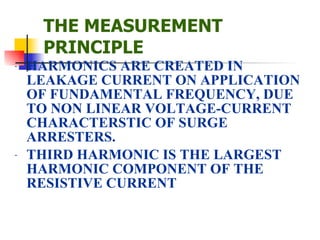
THE MEASUREMENT PRINCIPLE HARMONICS ARE CREATED IN LEAKAGE CURRENT ON APPLICATION OF FUNDAMENTAL FREQUENCY, DUE TO NON LINEAR VOLTAGE-CURRENT CHARACTERSTIC OF SURGE ARRESTERS.  THIRD HARMONIC IS THE LARGEST HARMONIC COMPONENT OF THE RESISTIVE CURRENT
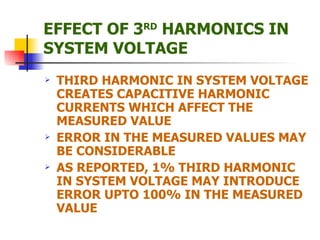
EFFECT OF 3 RD  HARMONICS IN SYSTEM VOLTAGE THIRD HARMONIC IN SYSTEM VOLTAGE CREATES CAPACITIVE HARMONIC CURRENTS WHICH AFFECT THE MEASURED VALUE ERROR IN THE MEASURED VALUES MAY BE CONSIDERABLE AS REPORTED, 1% THIRD HARMONIC IN SYSTEM VOLTAGE MAY INTRODUCE ERROR UPTO 100% IN THE MEASURED VALUE
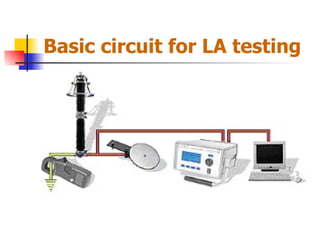
Basic circuit for LA testing
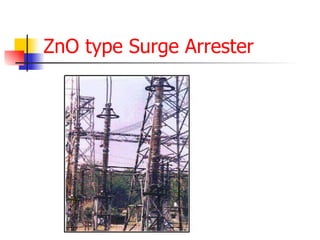
ZnO type Surge Arrester
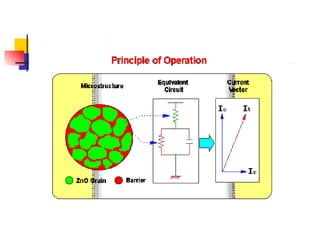
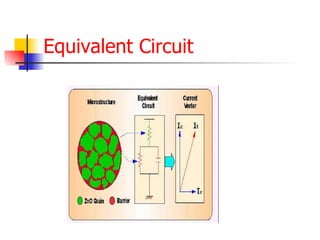
Equivalent Circuit
Equivalent Circuit Rp = Non-linear resistance of the granular layer (10 8  Ώ m for low electric field stress and 10 -2  Ώ m for high electric field stresses) C= Granular layer has a relative dielectric constant between 500 and 1200 depending upon the manufacturing process. Rs= Resistance of the ZnO grains with resistivity of 10 -2  Ώ m
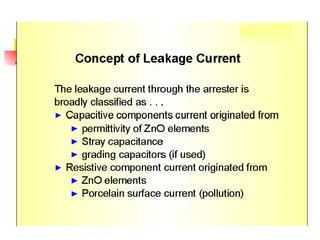
Ageing of Metal Oxide Surge Arresters Normal Operating Voltage causes ageing of ZnO Blocks Temporary O/V, Switching O/V and Lightning O/V may cause overloading of all or some of the ZnO blocks External Pollution may cause non-linear voltage distribution. Accelerated ageing caused by internal PDs Moisture Entry through sealing gaskets, may lead to shorting of ZnO discs and overstressing of healthy ZnO blocks. The degree of ageing depends on the nature/ quality of the granular layer.  The increase in Resistive Leakage Current may bring the arrester to Thermal instability and complete Arrester Breakdown
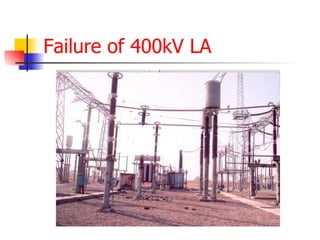
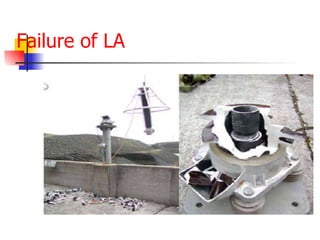
Failure of 400kV LA
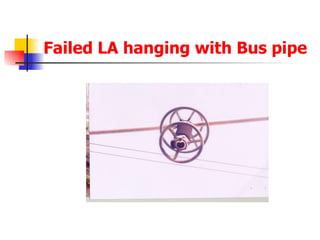
Failed LA hanging with Bus pipe
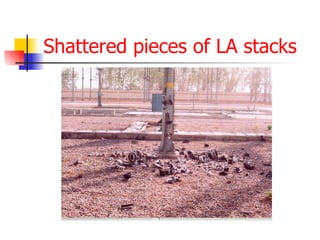
Shattered pieces of LA stacks
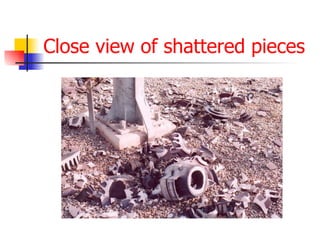
Close view of shattered pieces
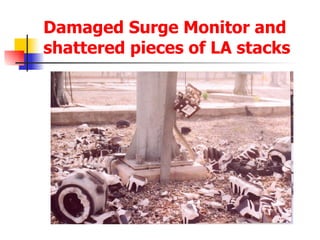
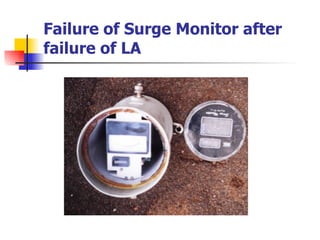
Damaged Surge Monitor and shattered pieces of LA stacks
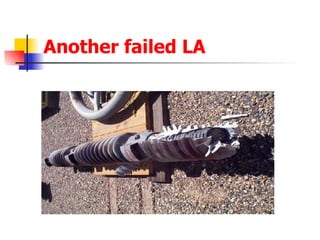
Another failed LA
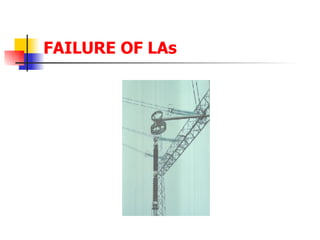
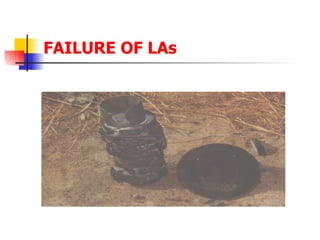
FAILURE OF LAs
FAILURE OF LAs
Failure of LA
Failure of Surge Monitor after failure of LA
Preventive Action taken by POWERGRID Condition Monitoring of Surge Arresters to avoid sudden failures/ blasting leading to unplanned outages. Failure investigations with manufacturers and improvements in manufacturing quality
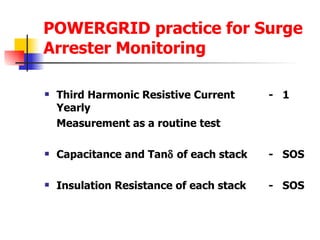
POWERGRID practice for Surge Arrester Monitoring Third Harmonic Resistive Current -  1 Yearly Measurement as a routine test  Capacitance and Tan   of each stack -  SOS Insulation Resistance of each stack -  SOS
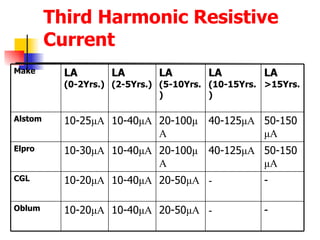
Third Harmonic Resistive Current - - 40-125 μ A 40-125 μ A LA   (10-15Yrs.) - - 50-150 μ A 50-150 μ A LA   >15Yrs. 20-50 μ A 10-40 μ A 10-20 μ A CGL 20-50 μ A 10-40 μ A 10-20 μ A Oblum 20-100 μ A 10-40 μ A 10-30 μ A Elpro 20-100 μ A 10-40 μ A 10-25 μ A Alstom LA   (5-10Yrs.) LA   (2-5Yrs.) LA (0-2Yrs.) Make
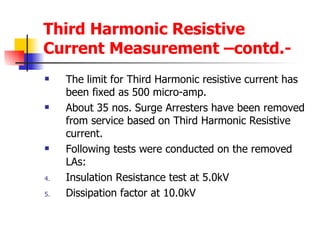
Third Harmonic Resistive Current Measurement –contd.- The limit for Third Harmonic resistive current has been fixed as 500 micro-amp. About 35 nos. Surge Arresters have been removed from service based on Third Harmonic Resistive current. Following tests were conducted on the removed LAs: Insulation Resistance test at 5.0kV Dissipation factor at 10.0kV
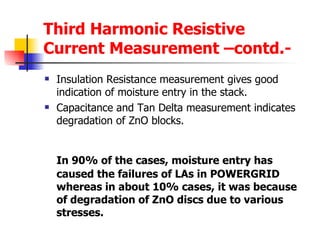
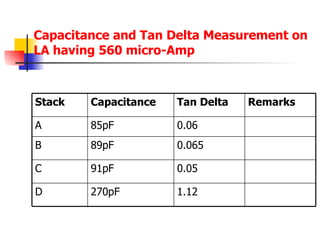
Third Harmonic Resistive Current Measurement –contd.- Insulation Resistance measurement gives good indication of moisture entry in the stack. Capacitance and Tan Delta measurement indicates degradation of ZnO blocks. In 90% of the cases, moisture entry has caused the failures of LAs in POWERGRID whereas in about 10% cases, it was because of degradation of ZnO discs due to various stresses.
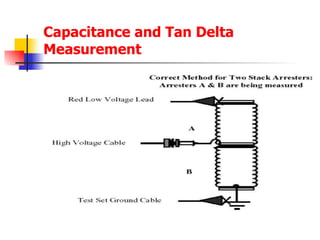
Capacitance and Tan Delta Measurement
Capacitance and Tan Delta Measurement on LA having 560 micro-Amp  1.12 270pF D 0.05 91pF C 0.065 89pF B 0.06 85pF A Remarks Tan Delta Capacitance Stack
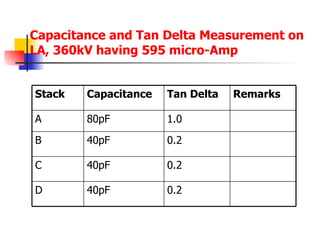
Capacitance and Tan Delta Measurement on LA, 360kV having 595 micro-Amp  0.2 40pF D 0.2 40pF C 0.2 40pF B 1.0 80pF A Remarks Tan Delta Capacitance Stack
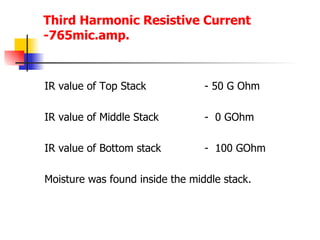
Third Harmonic Resistive Current -765mic.amp. IR value of Top Stack  - 50 G Ohm IR value of Middle Stack -  0 GOhm IR value of Bottom stack -  100 GOhm Moisture was found inside the middle stack.
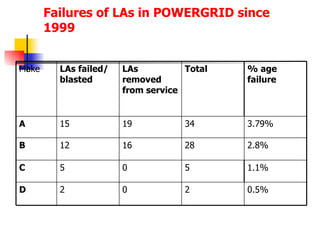
Failures of LAs in POWERGRID since 1999 0.5% 2 0 2 D 5 28 34 Total 0 16 19 LAs removed from service 5 12 15 LAs failed/ blasted 1.1% C 2.8% B 3.79% A % age failure Make
Failure investigations Investigations carried out involving all the manufacturers viz M/s CGL, M/s Alstom, M/s Oblum and M/s Elpro.
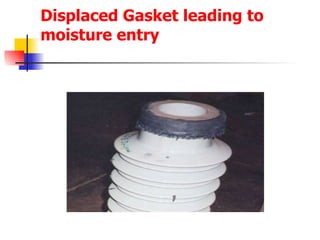
Displaced Gasket leading to moisture entry
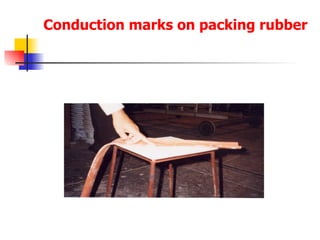
Conduction marks on packing rubber
Cracked packing material
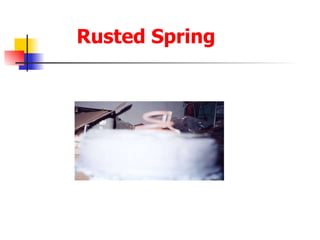
Rusted Spring
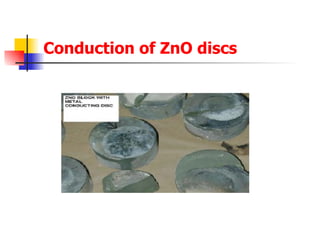
Conduction of ZnO discs
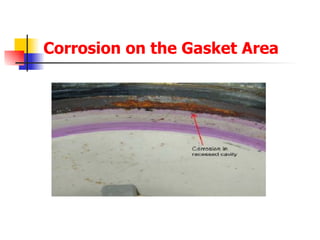
Corrosion on the Gasket Area
Failures of LAs   Failures of LA stacks Failures of Surge Monitors Failures of LA stacks and LA monitors more in rainy seasons. Many LAs removed based on Third Harmonic Resistive Current Measurements whereas leakage current as indicated by Meter was still within limits.
Investigation on Surge Arrester Stacks Defective LAs (based on THRC),  were tested. Resistive leakage current measured to be high. Only 90kV could be applied and leakage current was 1400 micro-Amp. Following observations were made:  Rusting of various components due to moisture entry. Sealing gasket de-shaped. Conduction marks on the surface of ZnO discs and heating of wedges was also observed. Increase of third harmonic current during service was mainly due to moisture entry and then conduction over ZnO discs leading to overstressing of the healthy stacks.
Investigation on Surge Arrester Stacks-contd.- Manufacturer-A 5 Units of LA stacks tested for moisture entry at 1.0m, 1.5m and 2.0m. Following tests conducted before and after dip test : 1.  Partial Discharge Measurement 2.  Resistive Leakage Current Measurement 3.  Reference Voltage 4.  Megger Test All tests passed successfully indicating no moisture entry in the stack. Based on this, it was agreed to carry out dip test at 1.5 m as a routine test in future.
Investigation on Surge Arrester Stacks-contd .- Manufacturer - B All the stacks had shown very high value of resistive current upto 2000micro-amp. All the stacks except bottom stacks were defective due to entry of moisture through cracked copper tube used for dry air filling and also from flat gaskets used in these stacks. All the inner MS components were found rusted. Gaskets were also found cracked. Slippage of gasket in one case was also observed.
Improvements – Surge Arrester Stack “ O” rings/ elliptical cross sections (neoprene, butyl or equivalent) is a better sealing option in comparison to flat gasket with no groove. Water dip test to be conducted at a minimum depth of 1.5m from top of the Arrester for 30 minutes to be followed by routine electrical tests PD, Reference Voltage, Residual Voltage and IR measurements(5kV Megger). For IR acceptance criteria to be within ±10% of the pre-dip values.
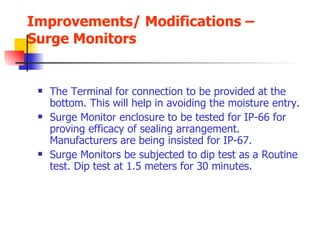
Improvements/ Modifications – Surge Monitors The Terminal for connection to be provided at the bottom. This will help in avoiding the moisture entry. Surge Monitor enclosure to be tested for IP-66 for proving efficacy of sealing arrangement. Manufacturers are being insisted for IP-67. Surge Monitors be subjected to dip test as a Routine test. Dip test at 1.5 meters for 30 minutes.
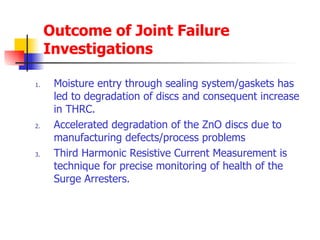
Outcome of Joint Failure Investigations  Moisture entry through sealing system/gaskets has led to degradation of discs and consequent increase in THRC. Accelerated degradation of the ZnO discs due to manufacturing defects/process problems Third Harmonic Resistive Current Measurement is technique for precise monitoring of health of the Surge Arresters.
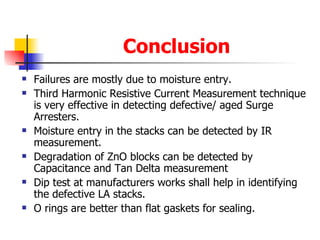
Conclusion Failures are mostly due to moisture entry. Third Harmonic Resistive Current Measurement technique is very effective in detecting defective/ aged Surge Arresters. Moisture entry in the stacks can be detected by IR measurement. Degradation of ZnO blocks can be detected by Capacitance and Tan Delta measurement  Dip test at manufacturers works shall help in identifying the defective LA stacks. O rings are better than flat gaskets for sealing.
Thank You for your kind attention please

Lightning arresters

  • 1.
    Construction and ConditionMonitoring Lightning Arresters
  • 2.
    Selection of SurgeArrester Voltage 400/√3 = 230kV During single phase to ground fault, voltage on healthy phase may go upto 1.4 to 1.5 times 230 x 1.4/1.5 = 323 – 346 Temporary O/V = 1.5 pu = 336kV LAs are available at 336kV, 360kV, 372kV and 390kV Higher ratings are selected taking into consideration of ageing of LA elements
  • 3.
  • 4.
  • 5.
    Construction of discThese are made by mixing ZnO with small amount of additives such as Bi2O3, CoO, Cr2O3, MnO and Sb2O3 ZnO grains (about 10 μ m dia) have low resistivity and surrounded by a granular layer which is a high resistive Oxide layer(0.1 μ m thick). The two are strongly bonded .
  • 6.
  • 7.
  • 8.
  • 9.
  • 10.
    AS PER IEC-60099(5),TECHNIQUES FOR THE HEALTH MONITORING OF SURGE ARRESTERS IN SERVICE 1. TOTAL LEAKAGE CURRENT MEASUREMENT 2. WATT LOSS MEASUREMENT 3. INSULATION RESISTANCE MEASUREMENT 4. THIRD HARMONIC RESISTIVE CURRENT MONITORING. 5. THIRD HARMONIC RESISTIVE CURRENT (THRC) MONITORING WITH COMPENSATION FOR THIRD HARMONICS IN SYSTEM VOLTAGE.
  • 11.
    THE MEASUREMENT PRINCIPLEHARMONICS ARE CREATED IN LEAKAGE CURRENT ON APPLICATION OF FUNDAMENTAL FREQUENCY, DUE TO NON LINEAR VOLTAGE-CURRENT CHARACTERSTIC OF SURGE ARRESTERS. THIRD HARMONIC IS THE LARGEST HARMONIC COMPONENT OF THE RESISTIVE CURRENT
  • 12.
    EFFECT OF 3RD HARMONICS IN SYSTEM VOLTAGE THIRD HARMONIC IN SYSTEM VOLTAGE CREATES CAPACITIVE HARMONIC CURRENTS WHICH AFFECT THE MEASURED VALUE ERROR IN THE MEASURED VALUES MAY BE CONSIDERABLE AS REPORTED, 1% THIRD HARMONIC IN SYSTEM VOLTAGE MAY INTRODUCE ERROR UPTO 100% IN THE MEASURED VALUE
  • 13.
  • 14.
  • 15.
  • 16.
    Equivalent Circuit Rp= Non-linear resistance of the granular layer (10 8 Ώ m for low electric field stress and 10 -2 Ώ m for high electric field stresses) C= Granular layer has a relative dielectric constant between 500 and 1200 depending upon the manufacturing process. Rs= Resistance of the ZnO grains with resistivity of 10 -2 Ώ m
  • 17.
    Ageing of MetalOxide Surge Arresters Normal Operating Voltage causes ageing of ZnO Blocks Temporary O/V, Switching O/V and Lightning O/V may cause overloading of all or some of the ZnO blocks External Pollution may cause non-linear voltage distribution. Accelerated ageing caused by internal PDs Moisture Entry through sealing gaskets, may lead to shorting of ZnO discs and overstressing of healthy ZnO blocks. The degree of ageing depends on the nature/ quality of the granular layer. The increase in Resistive Leakage Current may bring the arrester to Thermal instability and complete Arrester Breakdown
  • 18.
  • 19.
    Failed LA hangingwith Bus pipe
  • 20.
  • 21.
    Close view ofshattered pieces
  • 22.
    Damaged Surge Monitorand shattered pieces of LA stacks
  • 23.
  • 24.
  • 25.
  • 26.
  • 27.
    Failure of SurgeMonitor after failure of LA
  • 28.
    Preventive Action takenby POWERGRID Condition Monitoring of Surge Arresters to avoid sudden failures/ blasting leading to unplanned outages. Failure investigations with manufacturers and improvements in manufacturing quality
  • 29.
    POWERGRID practice forSurge Arrester Monitoring Third Harmonic Resistive Current - 1 Yearly Measurement as a routine test Capacitance and Tan  of each stack - SOS Insulation Resistance of each stack - SOS
  • 30.
    Third Harmonic ResistiveCurrent - - 40-125 μ A 40-125 μ A LA (10-15Yrs.) - - 50-150 μ A 50-150 μ A LA >15Yrs. 20-50 μ A 10-40 μ A 10-20 μ A CGL 20-50 μ A 10-40 μ A 10-20 μ A Oblum 20-100 μ A 10-40 μ A 10-30 μ A Elpro 20-100 μ A 10-40 μ A 10-25 μ A Alstom LA (5-10Yrs.) LA (2-5Yrs.) LA (0-2Yrs.) Make
  • 31.
    Third Harmonic ResistiveCurrent Measurement –contd.- The limit for Third Harmonic resistive current has been fixed as 500 micro-amp. About 35 nos. Surge Arresters have been removed from service based on Third Harmonic Resistive current. Following tests were conducted on the removed LAs: Insulation Resistance test at 5.0kV Dissipation factor at 10.0kV
  • 32.
    Third Harmonic ResistiveCurrent Measurement –contd.- Insulation Resistance measurement gives good indication of moisture entry in the stack. Capacitance and Tan Delta measurement indicates degradation of ZnO blocks. In 90% of the cases, moisture entry has caused the failures of LAs in POWERGRID whereas in about 10% cases, it was because of degradation of ZnO discs due to various stresses.
  • 33.
    Capacitance and TanDelta Measurement
  • 34.
    Capacitance and TanDelta Measurement on LA having 560 micro-Amp 1.12 270pF D 0.05 91pF C 0.065 89pF B 0.06 85pF A Remarks Tan Delta Capacitance Stack
  • 35.
    Capacitance and TanDelta Measurement on LA, 360kV having 595 micro-Amp 0.2 40pF D 0.2 40pF C 0.2 40pF B 1.0 80pF A Remarks Tan Delta Capacitance Stack
  • 36.
    Third Harmonic ResistiveCurrent -765mic.amp. IR value of Top Stack - 50 G Ohm IR value of Middle Stack - 0 GOhm IR value of Bottom stack - 100 GOhm Moisture was found inside the middle stack.
  • 37.
    Failures of LAsin POWERGRID since 1999 0.5% 2 0 2 D 5 28 34 Total 0 16 19 LAs removed from service 5 12 15 LAs failed/ blasted 1.1% C 2.8% B 3.79% A % age failure Make
  • 38.
    Failure investigations Investigationscarried out involving all the manufacturers viz M/s CGL, M/s Alstom, M/s Oblum and M/s Elpro.
  • 39.
    Displaced Gasket leadingto moisture entry
  • 40.
    Conduction marks onpacking rubber
  • 41.
  • 42.
  • 43.
  • 44.
    Corrosion on theGasket Area
  • 45.
    Failures of LAs Failures of LA stacks Failures of Surge Monitors Failures of LA stacks and LA monitors more in rainy seasons. Many LAs removed based on Third Harmonic Resistive Current Measurements whereas leakage current as indicated by Meter was still within limits.
  • 46.
    Investigation on SurgeArrester Stacks Defective LAs (based on THRC), were tested. Resistive leakage current measured to be high. Only 90kV could be applied and leakage current was 1400 micro-Amp. Following observations were made: Rusting of various components due to moisture entry. Sealing gasket de-shaped. Conduction marks on the surface of ZnO discs and heating of wedges was also observed. Increase of third harmonic current during service was mainly due to moisture entry and then conduction over ZnO discs leading to overstressing of the healthy stacks.
  • 47.
    Investigation on SurgeArrester Stacks-contd.- Manufacturer-A 5 Units of LA stacks tested for moisture entry at 1.0m, 1.5m and 2.0m. Following tests conducted before and after dip test : 1. Partial Discharge Measurement 2. Resistive Leakage Current Measurement 3. Reference Voltage 4. Megger Test All tests passed successfully indicating no moisture entry in the stack. Based on this, it was agreed to carry out dip test at 1.5 m as a routine test in future.
  • 48.
    Investigation on SurgeArrester Stacks-contd .- Manufacturer - B All the stacks had shown very high value of resistive current upto 2000micro-amp. All the stacks except bottom stacks were defective due to entry of moisture through cracked copper tube used for dry air filling and also from flat gaskets used in these stacks. All the inner MS components were found rusted. Gaskets were also found cracked. Slippage of gasket in one case was also observed.
  • 49.
    Improvements – SurgeArrester Stack “ O” rings/ elliptical cross sections (neoprene, butyl or equivalent) is a better sealing option in comparison to flat gasket with no groove. Water dip test to be conducted at a minimum depth of 1.5m from top of the Arrester for 30 minutes to be followed by routine electrical tests PD, Reference Voltage, Residual Voltage and IR measurements(5kV Megger). For IR acceptance criteria to be within ±10% of the pre-dip values.
  • 50.
    Improvements/ Modifications –Surge Monitors The Terminal for connection to be provided at the bottom. This will help in avoiding the moisture entry. Surge Monitor enclosure to be tested for IP-66 for proving efficacy of sealing arrangement. Manufacturers are being insisted for IP-67. Surge Monitors be subjected to dip test as a Routine test. Dip test at 1.5 meters for 30 minutes.
  • 51.
    Outcome of JointFailure Investigations Moisture entry through sealing system/gaskets has led to degradation of discs and consequent increase in THRC. Accelerated degradation of the ZnO discs due to manufacturing defects/process problems Third Harmonic Resistive Current Measurement is technique for precise monitoring of health of the Surge Arresters.
  • 52.
    Conclusion Failures aremostly due to moisture entry. Third Harmonic Resistive Current Measurement technique is very effective in detecting defective/ aged Surge Arresters. Moisture entry in the stacks can be detected by IR measurement. Degradation of ZnO blocks can be detected by Capacitance and Tan Delta measurement Dip test at manufacturers works shall help in identifying the defective LA stacks. O rings are better than flat gaskets for sealing.
  • 53.
    Thank You foryour kind attention please