Overcurrent Protection
Presented by
Mohammad Zishan
3/14/2019 1
Introduction : Overcurrent its cause
and effects
Overcurrent :
• In an electrical power system overcurrent or excess current is a
situation where a larger than intended electric current exists
through a conductor, leading to excessive generation of heat, and
the risk of fire or damage to equipment.
Cause :
• Short Circuit
• Excessive Loading
• Incorrect Design
• Ground fault
Effects
• Equipment overloading and Equipment damage
2
Overcurrent Relay
Overcurrent Relay :
• A protective relay which operates when the load current exceeds
a preset value, is called an Overcurrent relay.
• The value of the preset current above which relay operate is
know as pickup value.
• Overcurrent relay offer a cheapest and simplest form of
protection.
• These relays are used for the protection of distribution lines,
large motor , Power equipments and industrial system.
3
Working Principle
• In an over current relay , there would be essentially a current coil.
When normal current flows through this coil, the magnetic effect
generated by the coil is not sufficient to move the moving element of
the relay, as in this condition the restraining force is grater than
deflecting force.
• When the current through the coil increased, the magnetic effect
increases and after certain level of current the deflecting force
generated by the magnetic effect of the coil, crosses the restraining
force, as a result the moving element starts moving to change the
contact position in the relay.
4
Overcurrent Protection
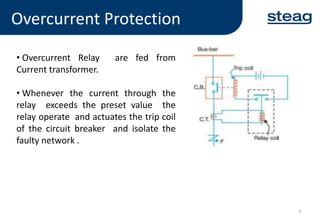
• Overcurrent Relay are fed from
Current transformer.
• Whenever the current through the
relay exceeds the preset value the
relay operate and actuates the trip coil
of the circuit breaker and isolate the
faulty network .
5
Types of Overcurrent relay
Depending upon the operating time of the overcurrent relay
• Instantaneous Overcurrent Relay
• Definite time Overcurrent Relay
• Inverse time Overcurrent Relay
6
Instantaneous Overcurrent Relay
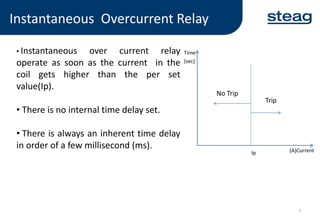
• Instantaneous over current relay
operate as soon as the current in the
coil gets higher than the per set
value(Ip).
• There is no internal time delay set.
• There is always an inherent time delay
in order of a few millisecond (ms). (A)Current
Time
(sec)
No Trip
Trip
Ip
7
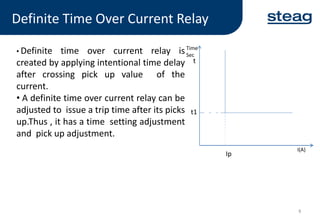
Definite Time Over Current Relay
• Definite time over current relay is
created by applying intentional time delay
after crossing pick up value of the
current.
• A definite time over current relay can be
adjusted to issue a trip time after its picks
up.Thus , it has a time setting adjustment
and pick up adjustment.
I(A)
Time
Sec
t1
t
8
Ip
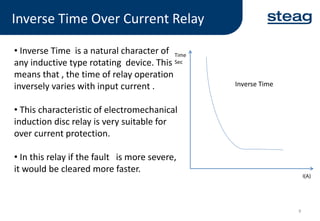
Inverse Time Over Current Relay
• Inverse Time is a natural character of
any inductive type rotating device. This
means that , the time of relay operation
inversely varies with input current .
• This characteristic of electromechanical
induction disc relay is very suitable for
over current protection.
• In this relay if the fault is more severe,
it would be cleared more faster.
Time
Sec
I(A)
Inverse Time
9
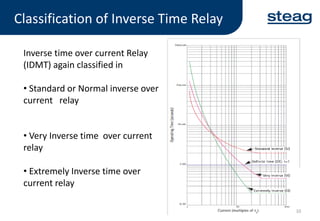
Classification of Inverse Time Relay
Inverse time over current Relay
(IDMT) again classified in
• Standard or Normal inverse over
current relay
• Very Inverse time over current
relay
• Extremely Inverse time over
current relay
10
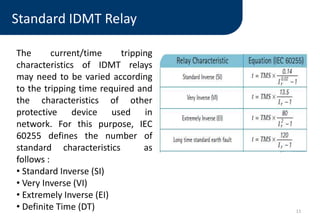
Standard IDMT Relay
The current/time tripping
characteristics of IDMT relays
may need to be varied according
to the tripping time required and
the characteristics of other
protective device used in
network. For this purpose, IEC
60255 defines the number of
standard characteristics as
follows :
• Standard Inverse (SI)
• Very Inverse (VI)
• Extremely Inverse (EI)
• Definite Time (DT) 11
Application of Overcurrent Relay
Overcurrent relay are used for protection of electrical equipments
such as :
• Transformer
• Generator
• HT & LT breaker Failure Protection
• Motors
• HT Lines
• EHT Lines (Directional Overcurrent & E/F relay )
• Capacitor Bank
• Natural Displacement relay in capacitor banks
12
Thank You
3/14/2019 13

Overcurrent Protection

  • 1.
  • 2.
    Introduction : Overcurrentits cause and effects Overcurrent : • In an electrical power system overcurrent or excess current is a situation where a larger than intended electric current exists through a conductor, leading to excessive generation of heat, and the risk of fire or damage to equipment. Cause : • Short Circuit • Excessive Loading • Incorrect Design • Ground fault Effects • Equipment overloading and Equipment damage 2
  • 3.
    Overcurrent Relay Overcurrent Relay: • A protective relay which operates when the load current exceeds a preset value, is called an Overcurrent relay. • The value of the preset current above which relay operate is know as pickup value. • Overcurrent relay offer a cheapest and simplest form of protection. • These relays are used for the protection of distribution lines, large motor , Power equipments and industrial system. 3
  • 4.
    Working Principle • Inan over current relay , there would be essentially a current coil. When normal current flows through this coil, the magnetic effect generated by the coil is not sufficient to move the moving element of the relay, as in this condition the restraining force is grater than deflecting force. • When the current through the coil increased, the magnetic effect increases and after certain level of current the deflecting force generated by the magnetic effect of the coil, crosses the restraining force, as a result the moving element starts moving to change the contact position in the relay. 4
  • 5.
    Overcurrent Protection • OvercurrentRelay are fed from Current transformer. • Whenever the current through the relay exceeds the preset value the relay operate and actuates the trip coil of the circuit breaker and isolate the faulty network . 5
  • 6.
    Types of Overcurrentrelay Depending upon the operating time of the overcurrent relay • Instantaneous Overcurrent Relay • Definite time Overcurrent Relay • Inverse time Overcurrent Relay 6
  • 7.
    Instantaneous Overcurrent Relay •Instantaneous over current relay operate as soon as the current in the coil gets higher than the per set value(Ip). • There is no internal time delay set. • There is always an inherent time delay in order of a few millisecond (ms). (A)Current Time (sec) No Trip Trip Ip 7
  • 8.
    Definite Time OverCurrent Relay • Definite time over current relay is created by applying intentional time delay after crossing pick up value of the current. • A definite time over current relay can be adjusted to issue a trip time after its picks up.Thus , it has a time setting adjustment and pick up adjustment. I(A) Time Sec t1 t 8 Ip
  • 9.
    Inverse Time OverCurrent Relay • Inverse Time is a natural character of any inductive type rotating device. This means that , the time of relay operation inversely varies with input current . • This characteristic of electromechanical induction disc relay is very suitable for over current protection. • In this relay if the fault is more severe, it would be cleared more faster. Time Sec I(A) Inverse Time 9
  • 10.
    Classification of InverseTime Relay Inverse time over current Relay (IDMT) again classified in • Standard or Normal inverse over current relay • Very Inverse time over current relay • Extremely Inverse time over current relay 10
  • 11.
    Standard IDMT Relay Thecurrent/time tripping characteristics of IDMT relays may need to be varied according to the tripping time required and the characteristics of other protective device used in network. For this purpose, IEC 60255 defines the number of standard characteristics as follows : • Standard Inverse (SI) • Very Inverse (VI) • Extremely Inverse (EI) • Definite Time (DT) 11
  • 12.
    Application of OvercurrentRelay Overcurrent relay are used for protection of electrical equipments such as : • Transformer • Generator • HT & LT breaker Failure Protection • Motors • HT Lines • EHT Lines (Directional Overcurrent & E/F relay ) • Capacitor Bank • Natural Displacement relay in capacitor banks 12
  • 13.