VOLTAGE SAG AND IT’S
MITIGATION
By –
Mayur Dilip Dhande
B.E. Electrical
Government College of
Engineering, Jalgaon
mayurdhande11@gmail.com
GUIDED BY :
Prof. D. P. YAVALKAR
CONTENTS
 Voltage sag
 Sources of voltage sag
 General causes of voltage sag
 Characteristics of voltage sag
 Effects of voltage sag on commercial installations
 Measurement and characterization of voltage sag
 Impact and cost of voltage sag
 Mitigation of voltage sag
 Conclusion
 References
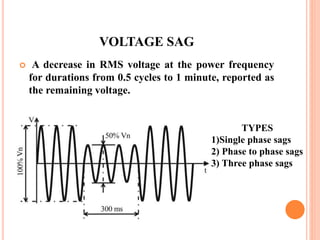
VOLTAGE SAG
 A decrease in RMS voltage at the power frequency
for durations from 0.5 cycles to 1 minute, reported as
the remaining voltage.
TYPES
1)Single phase sags
2) Phase to phase sags
3) Three phase sags
SOURCES OF SAGS AND SHORT
INTERRUPTIONS
 Power systems have non-zero impedances, so every
increase in current causes a corresponding reduction in
voltage.
 There are two sources of voltage sags:
 1) Large increases in current.
 2) Increases in system impedance.
 Think of the power system as a tree
 Facility-sourced voltage sags
 Utility-sourced voltage sags
GENERAL CAUSES OF VOLTAGE SAGS
 VOLTAGE SAGS DUE TO FAULTS
 May be symmetrical or unsymmetrical in nature
 VOLTAGE SAGS DUE TO MOTOR STARTING
 symmetrical in nature
 VOLTAGE SAGS DUE TO TRANSFORMER ENERGIZING
 Unsymmetrical in nature
CHARACTERISTICS OF VOLTAGE SAG
 MAGNITUDE OF SAG:
• Type of fault
• Fault impedance
• System Configuration
• Distance of the fault from the point of consideration
 DURATION OF SAG:
 PHASE-ANGLE JUMP: affects power electronic convertors
 POINT-ON-WAVE: phase angle at which the sag occurs
EFFECTS OF VOLTAGE SAG ON
COMMERCIAL INSTALLATIONS
 CHILLER SYSTEM
o causing the trip
 LIGHTING CIRCUITS
o flickering of the lights (HID)
 ESCALATORS
o control contactors and PLC of the escalator may drop off
 GENERAL CIRCUITS
o Tripping of MCB and RCD
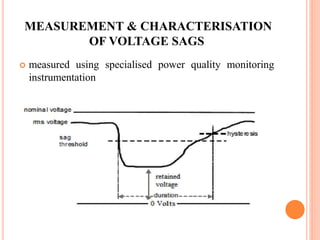
MEASUREMENT & CHARACTERISATION
OF VOLTAGE SAGS
 measured using specialised power quality monitoring
instrumentation
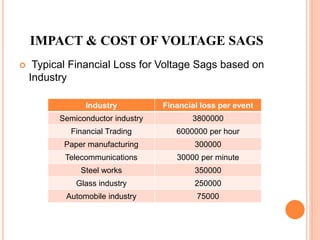
IMPACT & COST OF VOLTAGE SAGS
 Typical Financial Loss for Voltage Sags based on
Industry
Industry Financial loss per event
Semiconductor industry 3800000
Financial Trading 6000000 per hour
Paper manufacturing 300000
Telecommunications 30000 per minute
Steel works 350000
Glass industry 250000
Automobile industry 75000
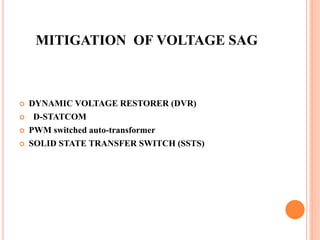
MITIGATION OF VOLTAGE SAG
 DYNAMIC VOLTAGE RESTORER (DVR)
 D-STATCOM
 PWM switched auto-transformer
 SOLID STATE TRANSFER SWITCH (SSTS)
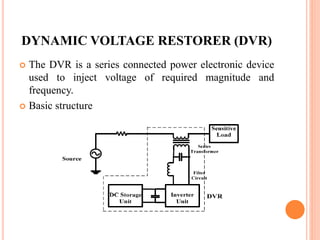
DYNAMIC VOLTAGE RESTORER (DVR)
 The DVR is a series connected power electronic device
used to inject voltage of required magnitude and
frequency.
 Basic structure
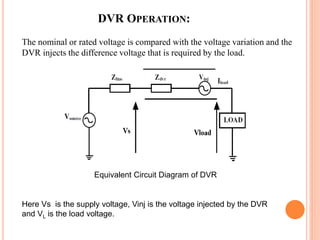
DVR OPERATION:
The nominal or rated voltage is compared with the voltage variation and the
DVR injects the difference voltage that is required by the load.
Here Vs is the supply voltage, Vinj is the voltage injected by the DVR
and VL is the load voltage.
Equivalent Circuit Diagram of DVR
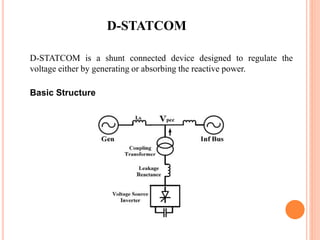
D-STATCOM
D-STATCOM is a shunt connected device designed to regulate the
voltage either by generating or absorbing the reactive power.
Basic Structure
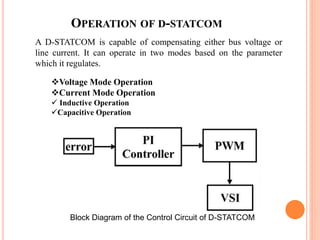
OPERATION OF D-STATCOM
A D-STATCOM is capable of compensating either bus voltage or
line current. It can operate in two modes based on the parameter
which it regulates.
Voltage Mode Operation
Current Mode Operation
 Inductive Operation
Capacitive Operation
Block Diagram of the Control Circuit of D-STATCOM
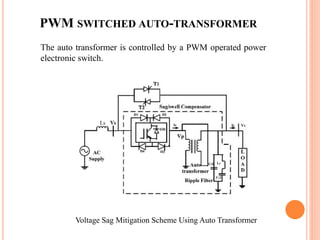
PWM SWITCHED AUTO-TRANSFORMER
The auto transformer is controlled by a PWM operated power
electronic switch.
Voltage Sag Mitigation Scheme Using Auto Transformer
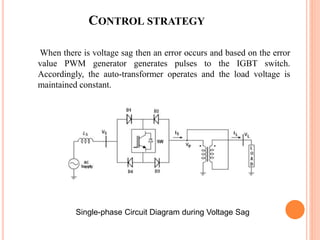
CONTROL STRATEGY
When there is voltage sag then an error occurs and based on the error
value PWM generator generates pulses to the IGBT switch.
Accordingly, the auto-transformer operates and the load voltage is
maintained constant.
Single-phase Circuit Diagram during Voltage Sag
CONCLUSION
Among the different methods to mitigate the voltage sag, the use of FACT
devices is the best method
The FACT devices like DVR, D-STATCOM are helpful in overcoming the
voltage unbalance problems in power system
D-STATCOM is a shunt connected device and injects current into the system
These devices are connected to the power network at the point of interest
protect the critical loads
These devices also have other advantages like harmonic reduction, power
factor correction
The amount of apparent power infusion required by D-STATCOM is higher
than that of DVR for a given voltage sag
DVR acts slowly but is good in reducing the harmonic content
Both DVR and D-STATCOM require more number of power electronic
switches and storage devices for their operation. To overcome this problem,
PWM switched auto-transformer is used for mitigating the voltage sag
Here the number of switches required are less and hence the switching losses
are also reduced
REFERENCES
[1] R.C. Dugan, M.F. McGranaghan, and H.W. Beaty, “Electric Power Systems Quality,” McGraw-
Hill, 1996.
[2] “IEEE Recommended Practice for the Design of Reliable Industrial and Commercial Power
Systems,” IEEE Std. 493-1997, December 1997.
[3] IEEE Standards Board (1995), “IEEE Std. 1159-1995”, IEEE Recommended Practice for
Monitoring Electric Power Quality”. IEEE Inc. NewYork
[4] AmbraSannino. Mitigation of voltage sags and short interruptions through distribution system
design. Dept. of Electrical Engineering University of Palermo, pp 1-6,2000.
[5] David Chapman, Power Quality Application Guide - The Cost of Poor Power Quality, Copper
Development Association, 2001.
[6].Haque, M. H., "Compensation of distribution system voltage sag by DVR and
DSTATCOM,"Power Tech Proceedings, 2001 IEEE Porto , vol.1, no., pp.5 pp. vol.1,, 2001.
[7]Venkatesh, C.; Reddy, V.P.; Siva Sarma, D.V.S.S., "Mitigation of voltage sags/swells using PWM
switched autotransformer," Harmonics and Quality ofPower, 2008. ICHQP 2008. 13th
International Conference on , vol., no., pp.1,6, Sept. 28 2008-Oct. 1 2008.
[8] K. Chan, A. Kara, and G. Kieboom, “Power quality improvement with solid state transfer
switches,” in Proc. 8th ICHQP 1998, Athens, Greece, Oct. 1998, pp. 210-215

Voltage sag and it’s mitigation

  • 1.
    VOLTAGE SAG ANDIT’S MITIGATION By – Mayur Dilip Dhande B.E. Electrical Government College of Engineering, Jalgaon mayurdhande11@gmail.com GUIDED BY : Prof. D. P. YAVALKAR
  • 2.
    CONTENTS  Voltage sag Sources of voltage sag  General causes of voltage sag  Characteristics of voltage sag  Effects of voltage sag on commercial installations  Measurement and characterization of voltage sag  Impact and cost of voltage sag  Mitigation of voltage sag  Conclusion  References
  • 3.
    VOLTAGE SAG  Adecrease in RMS voltage at the power frequency for durations from 0.5 cycles to 1 minute, reported as the remaining voltage. TYPES 1)Single phase sags 2) Phase to phase sags 3) Three phase sags
  • 4.
    SOURCES OF SAGSAND SHORT INTERRUPTIONS  Power systems have non-zero impedances, so every increase in current causes a corresponding reduction in voltage.  There are two sources of voltage sags:  1) Large increases in current.  2) Increases in system impedance.  Think of the power system as a tree  Facility-sourced voltage sags  Utility-sourced voltage sags
  • 5.
    GENERAL CAUSES OFVOLTAGE SAGS  VOLTAGE SAGS DUE TO FAULTS  May be symmetrical or unsymmetrical in nature  VOLTAGE SAGS DUE TO MOTOR STARTING  symmetrical in nature  VOLTAGE SAGS DUE TO TRANSFORMER ENERGIZING  Unsymmetrical in nature
  • 6.
    CHARACTERISTICS OF VOLTAGESAG  MAGNITUDE OF SAG: • Type of fault • Fault impedance • System Configuration • Distance of the fault from the point of consideration  DURATION OF SAG:  PHASE-ANGLE JUMP: affects power electronic convertors  POINT-ON-WAVE: phase angle at which the sag occurs
  • 7.
    EFFECTS OF VOLTAGESAG ON COMMERCIAL INSTALLATIONS  CHILLER SYSTEM o causing the trip  LIGHTING CIRCUITS o flickering of the lights (HID)  ESCALATORS o control contactors and PLC of the escalator may drop off  GENERAL CIRCUITS o Tripping of MCB and RCD
  • 8.
    MEASUREMENT & CHARACTERISATION OFVOLTAGE SAGS  measured using specialised power quality monitoring instrumentation
  • 9.
    IMPACT & COSTOF VOLTAGE SAGS  Typical Financial Loss for Voltage Sags based on Industry Industry Financial loss per event Semiconductor industry 3800000 Financial Trading 6000000 per hour Paper manufacturing 300000 Telecommunications 30000 per minute Steel works 350000 Glass industry 250000 Automobile industry 75000
  • 10.
    MITIGATION OF VOLTAGESAG  DYNAMIC VOLTAGE RESTORER (DVR)  D-STATCOM  PWM switched auto-transformer  SOLID STATE TRANSFER SWITCH (SSTS)
  • 11.
    DYNAMIC VOLTAGE RESTORER(DVR)  The DVR is a series connected power electronic device used to inject voltage of required magnitude and frequency.  Basic structure
  • 12.
    DVR OPERATION: The nominalor rated voltage is compared with the voltage variation and the DVR injects the difference voltage that is required by the load. Here Vs is the supply voltage, Vinj is the voltage injected by the DVR and VL is the load voltage. Equivalent Circuit Diagram of DVR
  • 13.
    D-STATCOM D-STATCOM is ashunt connected device designed to regulate the voltage either by generating or absorbing the reactive power. Basic Structure
  • 14.
    OPERATION OF D-STATCOM AD-STATCOM is capable of compensating either bus voltage or line current. It can operate in two modes based on the parameter which it regulates. Voltage Mode Operation Current Mode Operation  Inductive Operation Capacitive Operation Block Diagram of the Control Circuit of D-STATCOM
  • 15.
    PWM SWITCHED AUTO-TRANSFORMER Theauto transformer is controlled by a PWM operated power electronic switch. Voltage Sag Mitigation Scheme Using Auto Transformer
  • 16.
    CONTROL STRATEGY When thereis voltage sag then an error occurs and based on the error value PWM generator generates pulses to the IGBT switch. Accordingly, the auto-transformer operates and the load voltage is maintained constant. Single-phase Circuit Diagram during Voltage Sag
  • 17.
    CONCLUSION Among the differentmethods to mitigate the voltage sag, the use of FACT devices is the best method The FACT devices like DVR, D-STATCOM are helpful in overcoming the voltage unbalance problems in power system D-STATCOM is a shunt connected device and injects current into the system These devices are connected to the power network at the point of interest protect the critical loads These devices also have other advantages like harmonic reduction, power factor correction The amount of apparent power infusion required by D-STATCOM is higher than that of DVR for a given voltage sag DVR acts slowly but is good in reducing the harmonic content Both DVR and D-STATCOM require more number of power electronic switches and storage devices for their operation. To overcome this problem, PWM switched auto-transformer is used for mitigating the voltage sag Here the number of switches required are less and hence the switching losses are also reduced
  • 18.
    REFERENCES [1] R.C. Dugan,M.F. McGranaghan, and H.W. Beaty, “Electric Power Systems Quality,” McGraw- Hill, 1996. [2] “IEEE Recommended Practice for the Design of Reliable Industrial and Commercial Power Systems,” IEEE Std. 493-1997, December 1997. [3] IEEE Standards Board (1995), “IEEE Std. 1159-1995”, IEEE Recommended Practice for Monitoring Electric Power Quality”. IEEE Inc. NewYork [4] AmbraSannino. Mitigation of voltage sags and short interruptions through distribution system design. Dept. of Electrical Engineering University of Palermo, pp 1-6,2000. [5] David Chapman, Power Quality Application Guide - The Cost of Poor Power Quality, Copper Development Association, 2001. [6].Haque, M. H., "Compensation of distribution system voltage sag by DVR and DSTATCOM,"Power Tech Proceedings, 2001 IEEE Porto , vol.1, no., pp.5 pp. vol.1,, 2001. [7]Venkatesh, C.; Reddy, V.P.; Siva Sarma, D.V.S.S., "Mitigation of voltage sags/swells using PWM switched autotransformer," Harmonics and Quality ofPower, 2008. ICHQP 2008. 13th International Conference on , vol., no., pp.1,6, Sept. 28 2008-Oct. 1 2008. [8] K. Chan, A. Kara, and G. Kieboom, “Power quality improvement with solid state transfer switches,” in Proc. 8th ICHQP 1998, Athens, Greece, Oct. 1998, pp. 210-215