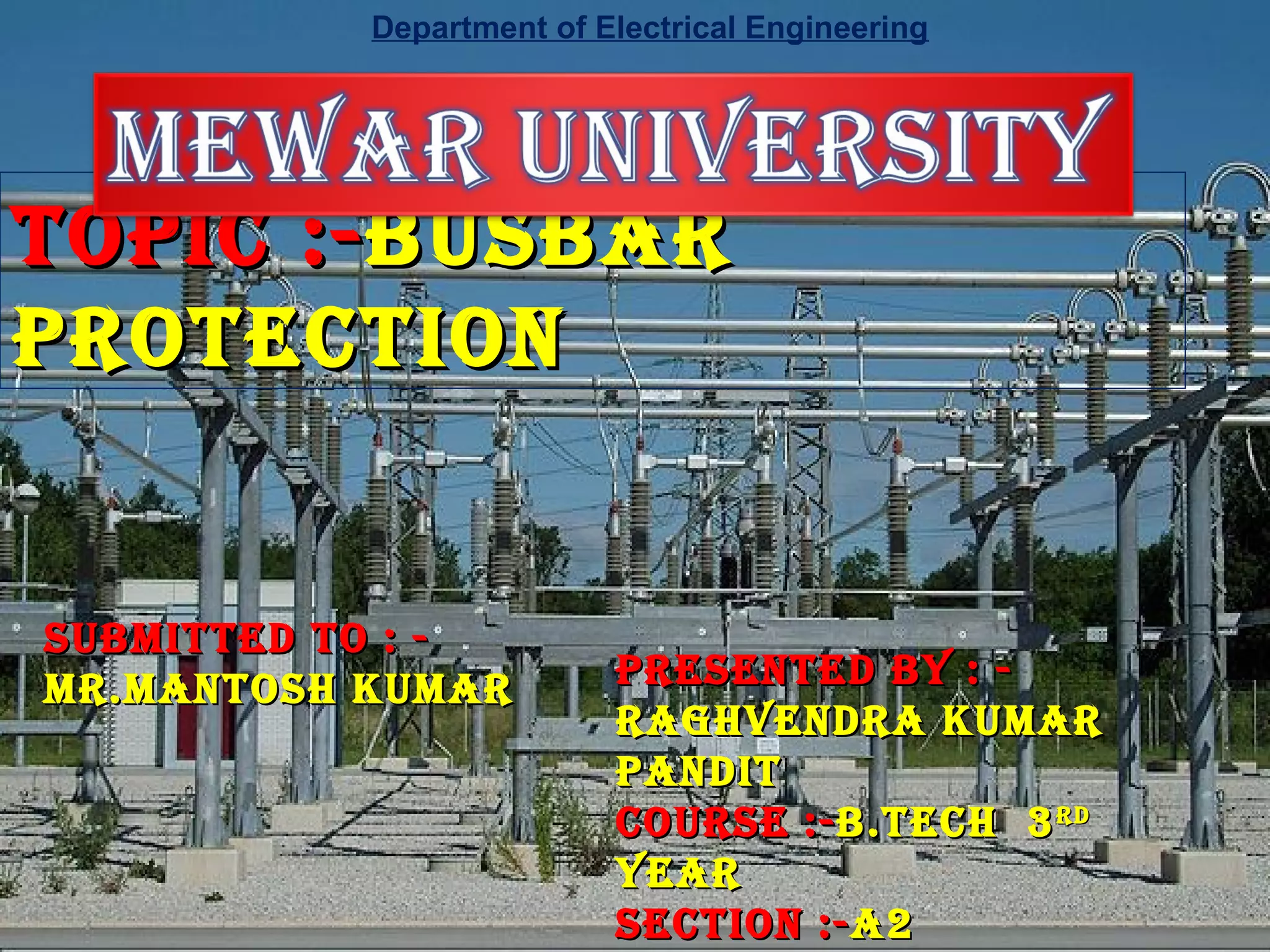
TOPIC :-TOPIC :-BUSBARBUSBAR
PROTECTIONPROTECTION
SUBMITTED TO : -SUBMITTED TO : -
MR.MANTOSH KUMARMR.MANTOSH KUMAR PRESENTED BY : -PRESENTED BY : -
RAGHVENDRA KUMARRAGHVENDRA KUMAR
PANDITPANDIT
COURSE :-COURSE :-B.TECH 3B.TECH 3RDRD
YEARYEAR
SECTION :-SECTION :-A2A2
Department of Electrical Engineering
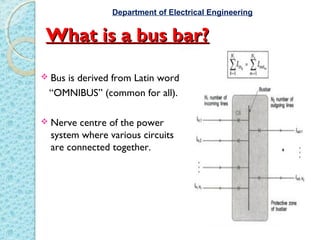
What is a bus bar?What is a bus bar?
 Bus is derived from Latin word
“OMNIBUS” (common for all).
 Nerve centre of the power
system where various circuits
are connected together.
Department of Electrical Engineering
Cause of FaultCause of Fault
Breakdown of insulation because of over
voltages, foreign objects, etc
Weakening of insulation because of ageing
,corrosion ,salty water,etc.
Department of Electrical Engineering
Suitable ProtectionSuitable Protection
Differential protection
Why differential protection?
Terminals of the system are near to each other.
Hence by installing CT’s on the two sides of the
bus, comparison can be made between the
current entering it & leaving it. Any difference in
current will immediately signal an internal fault.
The difference in current can be used to excite
the coil of a differential relay via CT secondary
and thus issue trip commands to CB on both
sides of the bus to isolate it.
Department of Electrical Engineering
Selection of CT RatiosSelection of CT Ratios
 That means the method of selecting CT ratio
on the basis of maximum primary current seen
by an individual feeder is not correct.
CT ratios for all CT’s in bus differential schemes
is = (max out of all feeder currents/1Aor 5A)
Department of Electrical Engineering
Types of FaultsTypes of Faults
Faults may be broadly classified as : -
a) External Fault(through fault) &
b)Internal Fault.
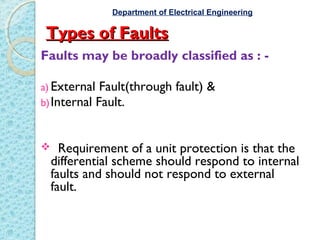
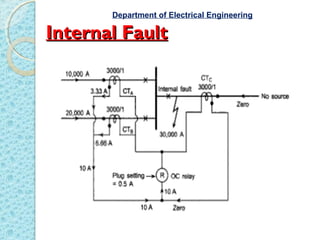
 Requirement of a unit protection is that the
differential scheme should respond to internal
faults and should not respond to external
fault.
Department of Electrical Engineering
Internal FaultInternal Fault
Department of Electrical Engineering
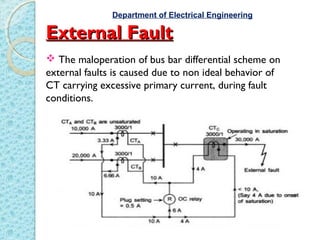
External FaultExternal Fault
 The maloperation of bus bar differential scheme on
external faults is caused due to non ideal behavior of
CT carrying excessive primary current, during fault
conditions.
Department of Electrical Engineering
CorrectionCorrection
 when due to external faults one of the CT’s get
saturated, the differential relay coil needs to be
restrained from tripping.
 We can easily accomplish this by connecting a high
resistance known as stabilizing resistance in series with
the differential relay coil
 The stabilizing resistance should be of such a value,that
under the worst case of maximum external fault and full
saturation of CT,the current through differential coil is
less than its pick up value and at the same time it should
respond to minimum internal fault current.
Department of Electrical Engineering
Dot ConventionDot Convention
Dot markings are used to know the direction of
circulating current in the CT secondary circuit.
Rule of dot convention says that :-
“When current enters the dot mark on the
primary side of a CT, the current must leave the
similarly marked dot mark on the secondary side
& vice versa”.
Department of Electrical Engineering
Why PS Class Only ?Why PS Class Only ?
Protection class CT’S such as 5P10,5P20 may produce
undesired difference current in the CT secondary due to
following reasons -
1. Two or more CT’S of class 5P10 may have different
accuracy (in this case for 10 times the rated current)
2. Even if the CT’S are identically manufactured, deterioration
of core properties over time may differ & they may behave
differently over time.
Department of Electrical Engineering
ConclusionConclusion
Thus it is concluded that the bus bar protection is
an important part of the power system, as the
system voltage has been increasing and short
circuit capacities are building up.
So, it is not advisable to leave the bus bars
unprotected on a primary basis.
Department of Electrical Engineering
THANK
THANK
YOYO
UU
Department of Electrical Engineering

BUS BAR PROTECTION PPT BY:-R.K.PANDIT

  • 1.
    TOPIC :-TOPIC :-BUSBARBUSBAR PROTECTIONPROTECTION SUBMITTEDTO : -SUBMITTED TO : - MR.MANTOSH KUMARMR.MANTOSH KUMAR PRESENTED BY : -PRESENTED BY : - RAGHVENDRA KUMARRAGHVENDRA KUMAR PANDITPANDIT COURSE :-COURSE :-B.TECH 3B.TECH 3RDRD YEARYEAR SECTION :-SECTION :-A2A2 Department of Electrical Engineering
  • 2.
    What is abus bar?What is a bus bar?  Bus is derived from Latin word “OMNIBUS” (common for all).  Nerve centre of the power system where various circuits are connected together. Department of Electrical Engineering
  • 3.
    Cause of FaultCauseof Fault Breakdown of insulation because of over voltages, foreign objects, etc Weakening of insulation because of ageing ,corrosion ,salty water,etc. Department of Electrical Engineering
  • 4.
    Suitable ProtectionSuitable Protection Differentialprotection Why differential protection? Terminals of the system are near to each other. Hence by installing CT’s on the two sides of the bus, comparison can be made between the current entering it & leaving it. Any difference in current will immediately signal an internal fault. The difference in current can be used to excite the coil of a differential relay via CT secondary and thus issue trip commands to CB on both sides of the bus to isolate it. Department of Electrical Engineering
  • 5.
    Selection of CTRatiosSelection of CT Ratios  That means the method of selecting CT ratio on the basis of maximum primary current seen by an individual feeder is not correct. CT ratios for all CT’s in bus differential schemes is = (max out of all feeder currents/1Aor 5A) Department of Electrical Engineering
  • 6.
    Types of FaultsTypesof Faults Faults may be broadly classified as : - a) External Fault(through fault) & b)Internal Fault.  Requirement of a unit protection is that the differential scheme should respond to internal faults and should not respond to external fault. Department of Electrical Engineering
  • 7.
    Internal FaultInternal Fault Departmentof Electrical Engineering
  • 8.
    External FaultExternal Fault The maloperation of bus bar differential scheme on external faults is caused due to non ideal behavior of CT carrying excessive primary current, during fault conditions. Department of Electrical Engineering
  • 9.
    CorrectionCorrection  when dueto external faults one of the CT’s get saturated, the differential relay coil needs to be restrained from tripping.  We can easily accomplish this by connecting a high resistance known as stabilizing resistance in series with the differential relay coil  The stabilizing resistance should be of such a value,that under the worst case of maximum external fault and full saturation of CT,the current through differential coil is less than its pick up value and at the same time it should respond to minimum internal fault current. Department of Electrical Engineering
  • 10.
    Dot ConventionDot Convention Dotmarkings are used to know the direction of circulating current in the CT secondary circuit. Rule of dot convention says that :- “When current enters the dot mark on the primary side of a CT, the current must leave the similarly marked dot mark on the secondary side & vice versa”. Department of Electrical Engineering
  • 11.
    Why PS ClassOnly ?Why PS Class Only ? Protection class CT’S such as 5P10,5P20 may produce undesired difference current in the CT secondary due to following reasons - 1. Two or more CT’S of class 5P10 may have different accuracy (in this case for 10 times the rated current) 2. Even if the CT’S are identically manufactured, deterioration of core properties over time may differ & they may behave differently over time. Department of Electrical Engineering
  • 12.
    ConclusionConclusion Thus it isconcluded that the bus bar protection is an important part of the power system, as the system voltage has been increasing and short circuit capacities are building up. So, it is not advisable to leave the bus bars unprotected on a primary basis. Department of Electrical Engineering
  • 13.