CHAPTER IV
Distribution System Voltage Drop and Power Loss
Calculation
1Dr.A.Arunagiri
D.C. Distribution
It is a common knowledge that electric power is almost exclusively
generated, transmitted and distributed as a.c. However, for certain
applications, d.c. supply is absolutely necessary.
For instance, d.c. supply is required for the operation of variable
speed machinery (i.e., d.c. motors), for electrochemical work and for
congested areas where storage battery reserves are necessary.
For this purpose, a.c. power is converted into d.c. power at the
substation by using converting machinery e.g.,mercury arc rectifiers,
rotary converters and motor-generator sets. The d.c. supply from the
substation may be obtained in the form of :
(i) 2-wire or
(ii) 3-wire for distribution.
2Dr.A.Arunagiri
2-wire d.c. system
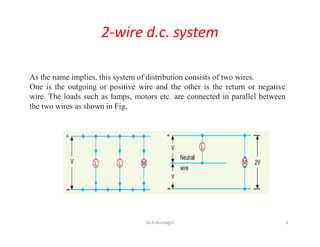
As the name implies, this system of distribution consists of two wires.
One is the outgoing or positive wire and the other is the return or negative
wire. The loads such as lamps, motors etc. are connected in parallel between
the two wires as shown in Fig.
3Dr.A.Arunagiri
Three wire DC system
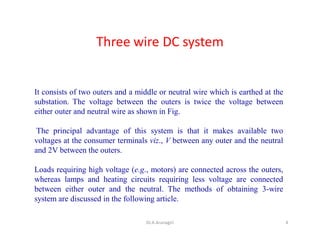
It consists of two outers and a middle or neutral wire which is earthed at the
substation. The voltage between the outers is twice the voltage between
either outer and neutral wire as shown in Fig.
The principal advantage of this system is that it makes available two
voltages at the consumer terminals viz., V between any outer and the neutral
and 2V between the outers.
Loads requiring high voltage (e.g., motors) are connected across the outers,
whereas lamps and heating circuits requiring less voltage are connected
between either outer and the neutral. The methods of obtaining 3-wire
system are discussed in the following article.
4Dr.A.Arunagiri
Methods of Obtaining 3-wire D.C. System
(i) Two generator method.
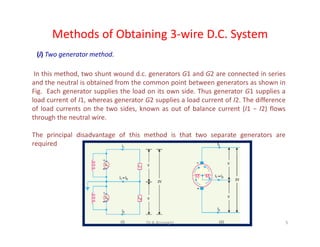
In this method, two shunt wound d.c. generators G1 and G2 are connected in series
and the neutral is obtained from the common point between generators as shown in
Fig. Each generator supplies the load on its own side. Thus generator G1 supplies a
load current of I1, whereas generator G2 supplies a load current of I2. The difference
of load currents on the two sides, known as out of balance current (I1 − I2) flows
through the neutral wire.
The principal disadvantage of this method is that two separate generators are
required
5Dr.A.Arunagiri
(ii) 3-wire d.c. generator.
The previous method is costly on account of the necessity of two generators.
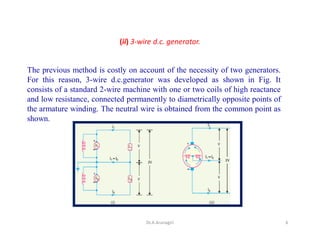
For this reason, 3-wire d.c.generator was developed as shown in Fig. It
consists of a standard 2-wire machine with one or two coils of high reactance
and low resistance, connected permanently to diametrically opposite points of
the armature winding. The neutral wire is obtained from the common point as
shown.
6Dr.A.Arunagiri
Comparison of Overhead Versus Underground System
The distribution system can be overhead or underground.
Overhead lines are generally mounted on wooden, concrete or
steel poles which are arranged to carry distribution transformers in
addition to the conductors.
The underground system uses conduits, cables and manholes under
the surface of streets and sidewalks. The choice between overhead
and underground system depends upon a number of widely
differing factors. Therefore, it is desirable to make a comparison
between the two.
7Dr.A.Arunagiri
(i) Public safety. The underground system is more safe than overhead system
because all distribution wiring is placed underground and there are little
chances of any hazard.
(ii) Initial cost. The underground system is more expensive due to the high cost
of trenching, conduits, cables, manholes and other special equipment. The
initial cost of an underground system may be five to ten times than that of an
overhead system.
(iii) Flexibility. The overhead system is much more flexible than the
underground system. In the latter case, manholes, duct lines etc., are
permanently placed once installed and the load expansion can only be met by
laying new lines. However, on an overhead system, poles, wires, transformers
etc., can be easily shifted to meet the changes in load conditions.
8Dr.A.Arunagiri
(iv) Faults. The chances of faults in underground system are very rare as
the cables are laid underground and are generally provided with better
insulation.
(v) Appearance. The general appearance of an underground system is
better as all the distribution lines are invisible. This factor is exerting
considerable public pressure on electric supply companies to switch over to
underground system.
(vi) Fault location and repairs. In general, there are little chances of faults
in an underground system. However, if a fault does occur, it is difficult to
locate and repair on this system. On an overhead system, the conductors
are visible and easily accessible so that fault locations and repairs can be
easily made.
9Dr.A.Arunagiri
(vii) Current carrying capacity and voltage drop. An overhead
distribution conductor has a considerably higher current carrying
capacity than an underground cable conductor of the same material and
cross-section. On the other hand, underground cable conductor has
much lower inductive reactance than that of an overhead conductor
because of closer spacing of conductors.
(viii) Useful life. The useful life of underground system is much longer
than that of an overhead system. An overhead system may have a useful
life of 25 years, whereas an underground system may have a useful life
of more than 50 years.
10Dr.A.Arunagiri
(ix) Maintenance cost. The maintenance cost of underground system is
very low as compared with that of overhead system because of less
chances of faults and service interruptions from wind, ice, lightning as
well as from traffic hazards.
(x) Interference with communication circuits. An overhead system causes
electromagnetic interference with the telephone lines. The power line
currents are superimposed on speech currents, resulting in the potential of
the communication channel being raised to an undesirable level.
However, there is no such interference with the underground system.
11Dr.A.Arunagiri
It is clear from the above comparison that each system has its own
advantages and disadvantages. However, comparative economics (i.e.,
annual cost of operation) is the most powerful factor influencing the
choice between underground and overhead system. The greater capital
cost of underground system prohibits its use for distribution. But
sometimes non-economic factors (e.g., general appearance, public safety
etc.) exert considerable influence on choosing underground system.
12Dr.A.Arunagiri
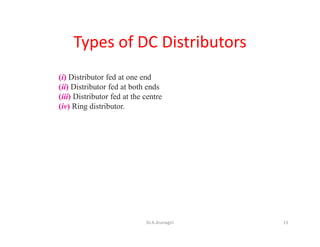
Types of DC Distributors
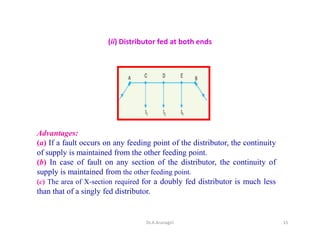
(i) Distributor fed at one end
(ii) Distributor fed at both ends
(iii) Distributor fed at the centre
(iv) Ring distributor.
13Dr.A.Arunagiri
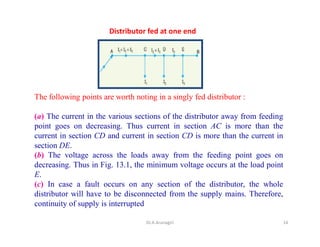
The following points are worth noting in a singly fed distributor :
(a) The current in the various sections of the distributor away from feeding
point goes on decreasing. Thus current in section AC is more than the
current in section CD and current in section CD is more than the current in
section DE.
(b) The voltage across the loads away from the feeding point goes on
decreasing. Thus in Fig. 13.1, the minimum voltage occurs at the load point
E.
(c) In case a fault occurs on any section of the distributor, the whole
distributor will have to be disconnected from the supply mains. Therefore,
continuity of supply is interrupted
Distributor fed at one end
14Dr.A.Arunagiri
(ii) Distributor fed at both ends
Advantages:
(a) If a fault occurs on any feeding point of the distributor, the continuity
of supply is maintained from the other feeding point.
(b) In case of fault on any section of the distributor, the continuity of
supply is maintained from the other feeding point.
(c) The area of X-section required for a doubly fed distributor is much less
than that of a singly fed distributor.
15Dr.A.Arunagiri
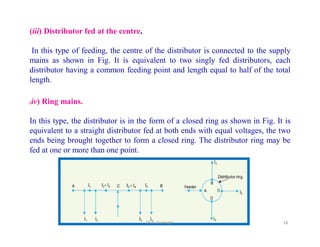
(iii) Distributor fed at the centre.
In this type of feeding, the centre of the distributor is connected to the supply
mains as shown in Fig. It is equivalent to two singly fed distributors, each
distributor having a common feeding point and length equal to half of the total
length.
(iv) Ring mains.
In this type, the distributor is in the form of a closed ring as shown in Fig. It is
equivalent to a straight distributor fed at both ends with equal voltages, the two
ends being brought together to form a closed ring. The distributor ring may be
fed at one or more than one point.
16Dr.A.Arunagiri
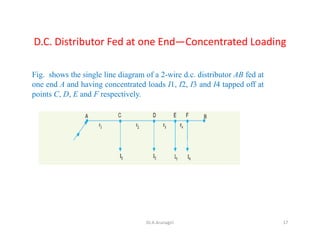
D.C. Distributor Fed at one End—Concentrated Loading
Fig. shows the single line diagram of a 2-wire d.c. distributor AB fed at
one end A and having concentrated loads I1, I2, I3 and I4 tapped off at
points C, D, E and F respectively.
17Dr.A.Arunagiri
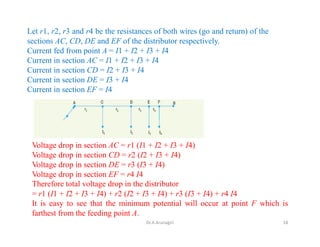
Let r1, r2, r3 and r4 be the resistances of both wires (go and return) of the
sections AC, CD, DE and EF of the distributor respectively.
Current fed from point A = I1 + I2 + I3 + I4
Current in section AC = I1 + I2 + I3 + I4
Current in section CD = I2 + I3 + I4
Current in section DE = I3 + I4
Current in section EF = I4
Voltage drop in section AC = r1 (I1 + I2 + I3 + I4)
Voltage drop in section CD = r2 (I2 + I3 + I4)
Voltage drop in section DE = r3 (I3 + I4)
Voltage drop in section EF = r4 I4
Therefore total voltage drop in the distributor
= r1 (I1 + I2 + I3 + I4) + r2 (I2 + I3 + I4) + r3 (I3 + I4) + r4 I4
It is easy to see that the minimum potential will occur at point F which is
farthest from the feeding point A.
18Dr.A.Arunagiri
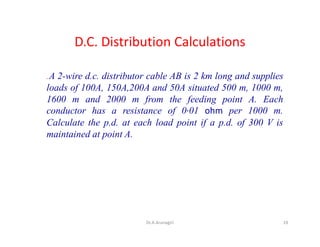
D.C. Distribution Calculations
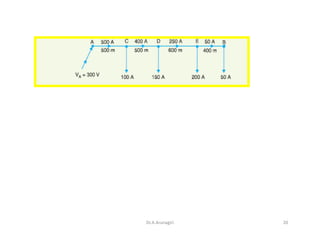
. A 2-wire d.c. distributor cable AB is 2 km long and supplies
loads of 100A, 150A,200A and 50A situated 500 m, 1000 m,
1600 m and 2000 m from the feeding point A. Each
conductor has a resistance of 0·01 ohm per 1000 m.
Calculate the p.d. at each load point if a p.d. of 300 V is
maintained at point A.
19Dr.A.Arunagiri
20Dr.A.Arunagiri
21Dr.A.Arunagiri
22Dr.A.Arunagiri
Solution
23Dr.A.Arunagiri
24Dr.A.Arunagiri
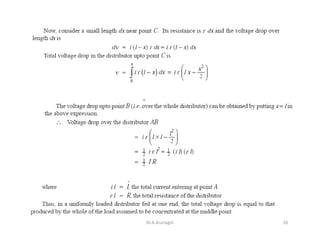
Uniformly Loaded Distributor Fed at One End
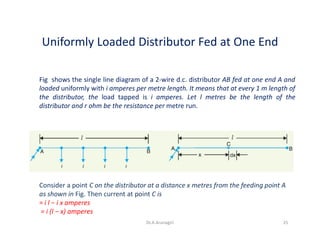
Fig shows the single line diagram of a 2-wire d.c. distributor AB fed at one end A and
loaded uniformly with i amperes per metre length. It means that at every 1 m length of
the distributor, the load tapped is i amperes. Let l metres be the length of the
distributor and r ohm be the resistance per metre run.
Consider a point C on the distributor at a distance x metres from the feeding point A
as shown in Fig. Then current at point C is
= i l − i x amperes
= i (l − x) amperes
25Dr.A.Arunagiri
26Dr.A.Arunagiri
Example
A 2-wire d.c. distributor 200 metres long is uniformly loaded with
2A/metre.Resistance of single wire is 0·3 Ω/km. If the distributor is
fed at one end, calculate :
(i) the voltage drop upto a distance of 150 m from the feeding
point
(ii) the maximum voltage drop
27Dr.A.Arunagiri
28Dr.A.Arunagiri
29Dr.A.Arunagiri
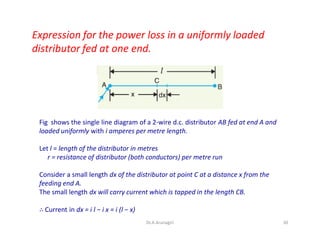
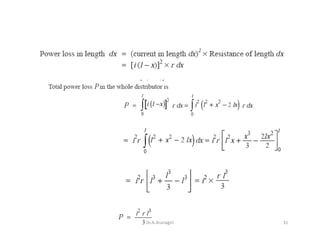
Expression for the power loss in a uniformly loaded
distributor fed at one end.
Fig shows the single line diagram of a 2-wire d.c. distributor AB fed at end A and
loaded uniformly with i amperes per metre length.
Let l = length of the distributor in metres
r = resistance of distributor (both conductors) per metre run
Consider a small length dx of the distributor at point C at a distance x from the
feeding end A.
The small length dx will carry current which is tapped in the length CB.
∴ Current in dx = i l − i x = i (l − x)
30Dr.A.Arunagiri
31Dr.A.Arunagiri
Problem
Calculate the voltage at a distance of 200 m of a 300 m long distributor uniformly
loaded at the rate of 0.75 A per metre. The distributor is fed at one end at 250 V. The
resistance of the distributor (go and return) per metre is 0·00018 Ω. Also find the
power loss in the distributor.
32Dr.A.Arunagiri
33Dr.A.Arunagiri
Distributor Fed at Both Ends — Concentrated
Loading
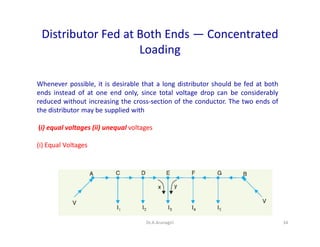
Whenever possible, it is desirable that a long distributor should be fed at both
ends instead of at one end only, since total voltage drop can be considerably
reduced without increasing the cross-section of the conductor. The two ends of
the distributor may be supplied with
(i) equal voltages (ii) unequal voltages
(i) Equal Voltages
34Dr.A.Arunagiri
Two ends fed with equal voltages.
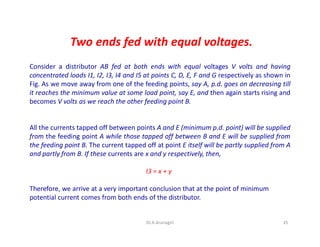
Consider a distributor AB fed at both ends with equal voltages V volts and having
concentrated loads I1, I2, I3, I4 and I5 at points C, D, E, F and G respectively as shown in
Fig. As we move away from one of the feeding points, say A, p.d. goes on decreasing till
it reaches the minimum value at some load point, say E, and then again starts rising and
becomes V volts as we reach the other feeding point B.
All the currents tapped off between points A and E (minimum p.d. point) will be supplied
from the feeding point A while those tapped off between B and E will be supplied from
the feeding point B. The current tapped off at point E itself will be partly supplied from A
and partly from B. If these currents are x and y respectively, then,
I3 = x + y
Therefore, we arrive at a very important conclusion that at the point of minimum
potential current comes from both ends of the distributor.
35Dr.A.Arunagiri
(ii) Two ends fed with unequal voltages
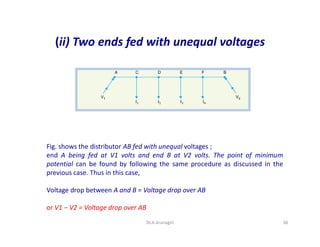
Fig. shows the distributor AB fed with unequal voltages ;
end A being fed at V1 volts and end B at V2 volts. The point of minimum
potential can be found by following the same procedure as discussed in the
previous case. Thus in this case,
Voltage drop between A and B = Voltage drop over AB
or V1 − V2 = Voltage drop over AB
36Dr.A.Arunagiri
Problem
A 2-wire d.c. street mains AB, 600 m long is fed from both ends at 220 V.
Loads of 20 A, 40 A, 50 A and 30 A are tapped at distances of 100m, 250m, 400m
and 500 m from the end A respectively. If the area of X-section of distributor
conductor is 1cm2, find the minimum consumer voltage. Take ρ = 1·7 × 10−6 Ω cm.
37DrA.Arunagiri
38Dr.A.Arunagiri
A 2-wire d.c. distributor AB is fed from both ends. At feeding point A, the voltage is
maintained as at 230 V and at B 235 V. The total length of the distributor is 200 metres
and loads are tapped off as under :
25 A at 50 metres from A ; 50 A at 75 metres from A
30 A at 100 metres from A ; 40 A at 150 metres from A
The resistance per kilometre of one conductor is 0·3 Ω. Calculate :
(i) currents in various sections of the distributor
(ii) minimum voltage and the point at which it occurs
Problem
39Dr.A.Arunagiri
40Dr.A.Arunagiri
41Dr.A.Arunagiri
Ring Distributor
A distributor arranged to form a closed loop and fed
at one or more points is called a ring distributor.
Such a distributor starts from one point, makes a loop
through the area to be served, and returns to the
original point.
42Dr.A.Arunagiri
Problem
A 2-wire d.c. ring distributor is 300 m long and is fed at
240 V at point A. At point B, 150 m from A, a load of
120 A is taken and at C, 100 m in the opposite
direction, a load of 80 A is taken. If the resistance per
100 m of single conductor is 0·03 Ω, find :
(i) current in each section of distributor
(ii) voltage at points B and C
43Dr.A.Arunagiri
Solution
44Dr.A.Arunagiri
45Dr.A.Arunagiri
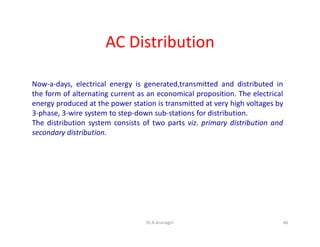
AC Distribution
Now-a-days, electrical energy is generated,transmitted and distributed in
the form of alternating current as an economical proposition. The electrical
energy produced at the power station is transmitted at very high voltages by
3-phase, 3-wire system to step-down sub-stations for distribution.
The distribution system consists of two parts viz. primary distribution and
secondary distribution.
46Dr.A.Arunagiri
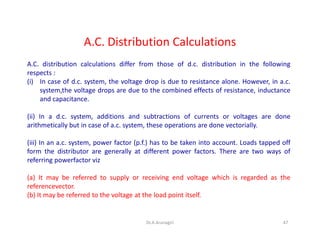
A.C. Distribution Calculations
A.C. distribution calculations differ from those of d.c. distribution in the following
respects :
(i) In case of d.c. system, the voltage drop is due to resistance alone. However, in a.c.
system,the voltage drops are due to the combined effects of resistance, inductance
and capacitance.
(ii) In a d.c. system, additions and subtractions of currents or voltages are done
arithmetically but in case of a.c. system, these operations are done vectorially.
(iii) In an a.c. system, power factor (p.f.) has to be taken into account. Loads tapped off
form the distributor are generally at different power factors. There are two ways of
referring powerfactor viz
(a) It may be referred to supply or receiving end voltage which is regarded as the
referencevector.
(b) It may be referred to the voltage at the load point itself.
47Dr.A.Arunagiri
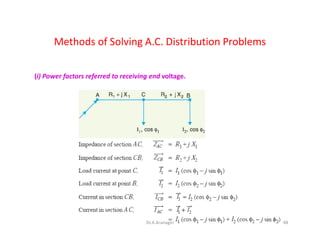
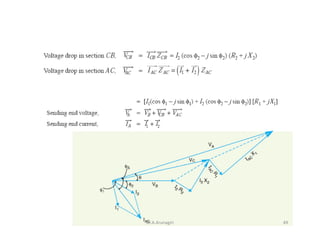
Methods of Solving A.C. Distribution Problems
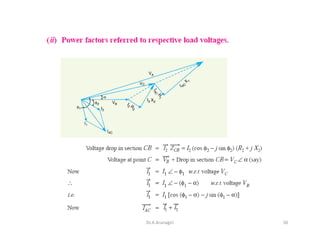
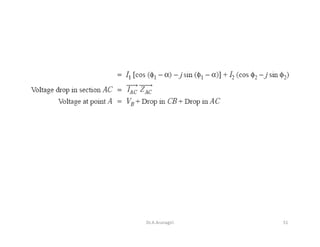
(i) Power factors referred to receiving end voltage.
48Dr.A.Arunagiri
49Dr.A.Arunagiri
50Dr.A.Arunagiri
51Dr.A.Arunagiri
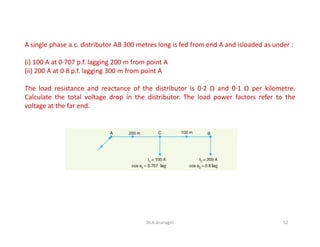
A single phase a.c. distributor AB 300 metres long is fed from end A and isloaded as under :
(i) 100 A at 0·707 p.f. lagging 200 m from point A
(ii) 200 A at 0·8 p.f. lagging 300 m from point A
The load resistance and reactance of the distributor is 0·2 Ω and 0·1 Ω per kilometre.
Calculate the total voltage drop in the distributor. The load power factors refer to the
voltage at the far end.
52Dr.A.Arunagiri
53Dr.A.Arunagiri

Distribution System Voltage Drop and Power Loss Calculation

  • 1.
    CHAPTER IV Distribution SystemVoltage Drop and Power Loss Calculation 1Dr.A.Arunagiri
  • 2.
    D.C. Distribution It isa common knowledge that electric power is almost exclusively generated, transmitted and distributed as a.c. However, for certain applications, d.c. supply is absolutely necessary. For instance, d.c. supply is required for the operation of variable speed machinery (i.e., d.c. motors), for electrochemical work and for congested areas where storage battery reserves are necessary. For this purpose, a.c. power is converted into d.c. power at the substation by using converting machinery e.g.,mercury arc rectifiers, rotary converters and motor-generator sets. The d.c. supply from the substation may be obtained in the form of : (i) 2-wire or (ii) 3-wire for distribution. 2Dr.A.Arunagiri
  • 3.
    2-wire d.c. system Asthe name implies, this system of distribution consists of two wires. One is the outgoing or positive wire and the other is the return or negative wire. The loads such as lamps, motors etc. are connected in parallel between the two wires as shown in Fig. 3Dr.A.Arunagiri
  • 4.
    Three wire DCsystem It consists of two outers and a middle or neutral wire which is earthed at the substation. The voltage between the outers is twice the voltage between either outer and neutral wire as shown in Fig. The principal advantage of this system is that it makes available two voltages at the consumer terminals viz., V between any outer and the neutral and 2V between the outers. Loads requiring high voltage (e.g., motors) are connected across the outers, whereas lamps and heating circuits requiring less voltage are connected between either outer and the neutral. The methods of obtaining 3-wire system are discussed in the following article. 4Dr.A.Arunagiri
  • 5.
    Methods of Obtaining3-wire D.C. System (i) Two generator method. In this method, two shunt wound d.c. generators G1 and G2 are connected in series and the neutral is obtained from the common point between generators as shown in Fig. Each generator supplies the load on its own side. Thus generator G1 supplies a load current of I1, whereas generator G2 supplies a load current of I2. The difference of load currents on the two sides, known as out of balance current (I1 − I2) flows through the neutral wire. The principal disadvantage of this method is that two separate generators are required 5Dr.A.Arunagiri
  • 6.
    (ii) 3-wire d.c.generator. The previous method is costly on account of the necessity of two generators. For this reason, 3-wire d.c.generator was developed as shown in Fig. It consists of a standard 2-wire machine with one or two coils of high reactance and low resistance, connected permanently to diametrically opposite points of the armature winding. The neutral wire is obtained from the common point as shown. 6Dr.A.Arunagiri
  • 7.
    Comparison of OverheadVersus Underground System The distribution system can be overhead or underground. Overhead lines are generally mounted on wooden, concrete or steel poles which are arranged to carry distribution transformers in addition to the conductors. The underground system uses conduits, cables and manholes under the surface of streets and sidewalks. The choice between overhead and underground system depends upon a number of widely differing factors. Therefore, it is desirable to make a comparison between the two. 7Dr.A.Arunagiri
  • 8.
    (i) Public safety.The underground system is more safe than overhead system because all distribution wiring is placed underground and there are little chances of any hazard. (ii) Initial cost. The underground system is more expensive due to the high cost of trenching, conduits, cables, manholes and other special equipment. The initial cost of an underground system may be five to ten times than that of an overhead system. (iii) Flexibility. The overhead system is much more flexible than the underground system. In the latter case, manholes, duct lines etc., are permanently placed once installed and the load expansion can only be met by laying new lines. However, on an overhead system, poles, wires, transformers etc., can be easily shifted to meet the changes in load conditions. 8Dr.A.Arunagiri
  • 9.
    (iv) Faults. Thechances of faults in underground system are very rare as the cables are laid underground and are generally provided with better insulation. (v) Appearance. The general appearance of an underground system is better as all the distribution lines are invisible. This factor is exerting considerable public pressure on electric supply companies to switch over to underground system. (vi) Fault location and repairs. In general, there are little chances of faults in an underground system. However, if a fault does occur, it is difficult to locate and repair on this system. On an overhead system, the conductors are visible and easily accessible so that fault locations and repairs can be easily made. 9Dr.A.Arunagiri
  • 10.
    (vii) Current carryingcapacity and voltage drop. An overhead distribution conductor has a considerably higher current carrying capacity than an underground cable conductor of the same material and cross-section. On the other hand, underground cable conductor has much lower inductive reactance than that of an overhead conductor because of closer spacing of conductors. (viii) Useful life. The useful life of underground system is much longer than that of an overhead system. An overhead system may have a useful life of 25 years, whereas an underground system may have a useful life of more than 50 years. 10Dr.A.Arunagiri
  • 11.
    (ix) Maintenance cost.The maintenance cost of underground system is very low as compared with that of overhead system because of less chances of faults and service interruptions from wind, ice, lightning as well as from traffic hazards. (x) Interference with communication circuits. An overhead system causes electromagnetic interference with the telephone lines. The power line currents are superimposed on speech currents, resulting in the potential of the communication channel being raised to an undesirable level. However, there is no such interference with the underground system. 11Dr.A.Arunagiri
  • 12.
    It is clearfrom the above comparison that each system has its own advantages and disadvantages. However, comparative economics (i.e., annual cost of operation) is the most powerful factor influencing the choice between underground and overhead system. The greater capital cost of underground system prohibits its use for distribution. But sometimes non-economic factors (e.g., general appearance, public safety etc.) exert considerable influence on choosing underground system. 12Dr.A.Arunagiri
  • 13.
    Types of DCDistributors (i) Distributor fed at one end (ii) Distributor fed at both ends (iii) Distributor fed at the centre (iv) Ring distributor. 13Dr.A.Arunagiri
  • 14.
    The following pointsare worth noting in a singly fed distributor : (a) The current in the various sections of the distributor away from feeding point goes on decreasing. Thus current in section AC is more than the current in section CD and current in section CD is more than the current in section DE. (b) The voltage across the loads away from the feeding point goes on decreasing. Thus in Fig. 13.1, the minimum voltage occurs at the load point E. (c) In case a fault occurs on any section of the distributor, the whole distributor will have to be disconnected from the supply mains. Therefore, continuity of supply is interrupted Distributor fed at one end 14Dr.A.Arunagiri
  • 15.
    (ii) Distributor fedat both ends Advantages: (a) If a fault occurs on any feeding point of the distributor, the continuity of supply is maintained from the other feeding point. (b) In case of fault on any section of the distributor, the continuity of supply is maintained from the other feeding point. (c) The area of X-section required for a doubly fed distributor is much less than that of a singly fed distributor. 15Dr.A.Arunagiri
  • 16.
    (iii) Distributor fedat the centre. In this type of feeding, the centre of the distributor is connected to the supply mains as shown in Fig. It is equivalent to two singly fed distributors, each distributor having a common feeding point and length equal to half of the total length. (iv) Ring mains. In this type, the distributor is in the form of a closed ring as shown in Fig. It is equivalent to a straight distributor fed at both ends with equal voltages, the two ends being brought together to form a closed ring. The distributor ring may be fed at one or more than one point. 16Dr.A.Arunagiri
  • 17.
    D.C. Distributor Fedat one End—Concentrated Loading Fig. shows the single line diagram of a 2-wire d.c. distributor AB fed at one end A and having concentrated loads I1, I2, I3 and I4 tapped off at points C, D, E and F respectively. 17Dr.A.Arunagiri
  • 18.
    Let r1, r2,r3 and r4 be the resistances of both wires (go and return) of the sections AC, CD, DE and EF of the distributor respectively. Current fed from point A = I1 + I2 + I3 + I4 Current in section AC = I1 + I2 + I3 + I4 Current in section CD = I2 + I3 + I4 Current in section DE = I3 + I4 Current in section EF = I4 Voltage drop in section AC = r1 (I1 + I2 + I3 + I4) Voltage drop in section CD = r2 (I2 + I3 + I4) Voltage drop in section DE = r3 (I3 + I4) Voltage drop in section EF = r4 I4 Therefore total voltage drop in the distributor = r1 (I1 + I2 + I3 + I4) + r2 (I2 + I3 + I4) + r3 (I3 + I4) + r4 I4 It is easy to see that the minimum potential will occur at point F which is farthest from the feeding point A. 18Dr.A.Arunagiri
  • 19.
    D.C. Distribution Calculations .A 2-wire d.c. distributor cable AB is 2 km long and supplies loads of 100A, 150A,200A and 50A situated 500 m, 1000 m, 1600 m and 2000 m from the feeding point A. Each conductor has a resistance of 0·01 ohm per 1000 m. Calculate the p.d. at each load point if a p.d. of 300 V is maintained at point A. 19Dr.A.Arunagiri
  • 20.
  • 21.
  • 22.
  • 23.
  • 24.
  • 25.
    Uniformly Loaded DistributorFed at One End Fig shows the single line diagram of a 2-wire d.c. distributor AB fed at one end A and loaded uniformly with i amperes per metre length. It means that at every 1 m length of the distributor, the load tapped is i amperes. Let l metres be the length of the distributor and r ohm be the resistance per metre run. Consider a point C on the distributor at a distance x metres from the feeding point A as shown in Fig. Then current at point C is = i l − i x amperes = i (l − x) amperes 25Dr.A.Arunagiri
  • 26.
  • 27.
    Example A 2-wire d.c.distributor 200 metres long is uniformly loaded with 2A/metre.Resistance of single wire is 0·3 Ω/km. If the distributor is fed at one end, calculate : (i) the voltage drop upto a distance of 150 m from the feeding point (ii) the maximum voltage drop 27Dr.A.Arunagiri
  • 28.
  • 29.
  • 30.
    Expression for thepower loss in a uniformly loaded distributor fed at one end. Fig shows the single line diagram of a 2-wire d.c. distributor AB fed at end A and loaded uniformly with i amperes per metre length. Let l = length of the distributor in metres r = resistance of distributor (both conductors) per metre run Consider a small length dx of the distributor at point C at a distance x from the feeding end A. The small length dx will carry current which is tapped in the length CB. ∴ Current in dx = i l − i x = i (l − x) 30Dr.A.Arunagiri
  • 31.
  • 32.
    Problem Calculate the voltageat a distance of 200 m of a 300 m long distributor uniformly loaded at the rate of 0.75 A per metre. The distributor is fed at one end at 250 V. The resistance of the distributor (go and return) per metre is 0·00018 Ω. Also find the power loss in the distributor. 32Dr.A.Arunagiri
  • 33.
  • 34.
    Distributor Fed atBoth Ends — Concentrated Loading Whenever possible, it is desirable that a long distributor should be fed at both ends instead of at one end only, since total voltage drop can be considerably reduced without increasing the cross-section of the conductor. The two ends of the distributor may be supplied with (i) equal voltages (ii) unequal voltages (i) Equal Voltages 34Dr.A.Arunagiri
  • 35.
    Two ends fedwith equal voltages. Consider a distributor AB fed at both ends with equal voltages V volts and having concentrated loads I1, I2, I3, I4 and I5 at points C, D, E, F and G respectively as shown in Fig. As we move away from one of the feeding points, say A, p.d. goes on decreasing till it reaches the minimum value at some load point, say E, and then again starts rising and becomes V volts as we reach the other feeding point B. All the currents tapped off between points A and E (minimum p.d. point) will be supplied from the feeding point A while those tapped off between B and E will be supplied from the feeding point B. The current tapped off at point E itself will be partly supplied from A and partly from B. If these currents are x and y respectively, then, I3 = x + y Therefore, we arrive at a very important conclusion that at the point of minimum potential current comes from both ends of the distributor. 35Dr.A.Arunagiri
  • 36.
    (ii) Two endsfed with unequal voltages Fig. shows the distributor AB fed with unequal voltages ; end A being fed at V1 volts and end B at V2 volts. The point of minimum potential can be found by following the same procedure as discussed in the previous case. Thus in this case, Voltage drop between A and B = Voltage drop over AB or V1 − V2 = Voltage drop over AB 36Dr.A.Arunagiri
  • 37.
    Problem A 2-wire d.c.street mains AB, 600 m long is fed from both ends at 220 V. Loads of 20 A, 40 A, 50 A and 30 A are tapped at distances of 100m, 250m, 400m and 500 m from the end A respectively. If the area of X-section of distributor conductor is 1cm2, find the minimum consumer voltage. Take ρ = 1·7 × 10−6 Ω cm. 37DrA.Arunagiri
  • 38.
  • 39.
    A 2-wire d.c.distributor AB is fed from both ends. At feeding point A, the voltage is maintained as at 230 V and at B 235 V. The total length of the distributor is 200 metres and loads are tapped off as under : 25 A at 50 metres from A ; 50 A at 75 metres from A 30 A at 100 metres from A ; 40 A at 150 metres from A The resistance per kilometre of one conductor is 0·3 Ω. Calculate : (i) currents in various sections of the distributor (ii) minimum voltage and the point at which it occurs Problem 39Dr.A.Arunagiri
  • 40.
  • 41.
  • 42.
    Ring Distributor A distributorarranged to form a closed loop and fed at one or more points is called a ring distributor. Such a distributor starts from one point, makes a loop through the area to be served, and returns to the original point. 42Dr.A.Arunagiri
  • 43.
    Problem A 2-wire d.c.ring distributor is 300 m long and is fed at 240 V at point A. At point B, 150 m from A, a load of 120 A is taken and at C, 100 m in the opposite direction, a load of 80 A is taken. If the resistance per 100 m of single conductor is 0·03 Ω, find : (i) current in each section of distributor (ii) voltage at points B and C 43Dr.A.Arunagiri
  • 44.
  • 45.
  • 46.
    AC Distribution Now-a-days, electricalenergy is generated,transmitted and distributed in the form of alternating current as an economical proposition. The electrical energy produced at the power station is transmitted at very high voltages by 3-phase, 3-wire system to step-down sub-stations for distribution. The distribution system consists of two parts viz. primary distribution and secondary distribution. 46Dr.A.Arunagiri
  • 47.
    A.C. Distribution Calculations A.C.distribution calculations differ from those of d.c. distribution in the following respects : (i) In case of d.c. system, the voltage drop is due to resistance alone. However, in a.c. system,the voltage drops are due to the combined effects of resistance, inductance and capacitance. (ii) In a d.c. system, additions and subtractions of currents or voltages are done arithmetically but in case of a.c. system, these operations are done vectorially. (iii) In an a.c. system, power factor (p.f.) has to be taken into account. Loads tapped off form the distributor are generally at different power factors. There are two ways of referring powerfactor viz (a) It may be referred to supply or receiving end voltage which is regarded as the referencevector. (b) It may be referred to the voltage at the load point itself. 47Dr.A.Arunagiri
  • 48.
    Methods of SolvingA.C. Distribution Problems (i) Power factors referred to receiving end voltage. 48Dr.A.Arunagiri
  • 49.
  • 50.
  • 51.
  • 52.
    A single phasea.c. distributor AB 300 metres long is fed from end A and isloaded as under : (i) 100 A at 0·707 p.f. lagging 200 m from point A (ii) 200 A at 0·8 p.f. lagging 300 m from point A The load resistance and reactance of the distributor is 0·2 Ω and 0·1 Ω per kilometre. Calculate the total voltage drop in the distributor. The load power factors refer to the voltage at the far end. 52Dr.A.Arunagiri
  • 53.