06/04/35
1
EEET 426
ELECTRICAL DISTRIBUTION
TECHNOLOGY
Dr.A.Arunagiri
Distribution System Planning
Chapter 1
06/04/35
2
Chapter Outline
Introduction
Factors affecting distribution system planning
Present distribution system planning techniques
Distribution system planning models
Computer central role in distribution planning
Impact of dispersed storage and generation
Renewable resources of generation
Dr.A.Arunagiri
Introduction
Dr.A.Arunagiri
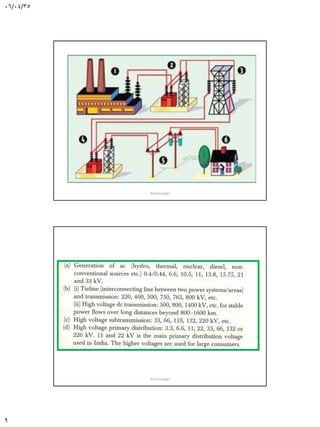
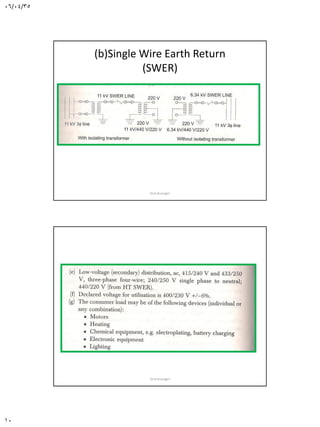
The electrical power system is very complex system.
Distribution is about 50% of the capital cost of the power system.
The power system consists of three main parts Generation plants,
Transmission and Distribution.
The electrical distribution system is a part of the system between
the transmission and the consumer service point.
The electrical distribution system is divided into primary and secondary
distribution.
06/04/35
3
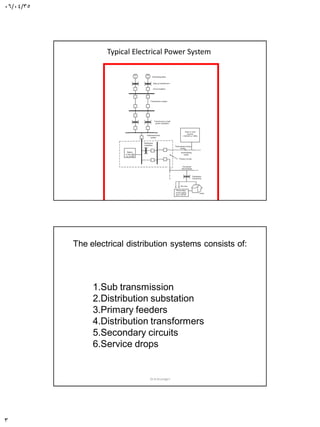
Typical Electrical Power System
Dr.A.Arunagiri
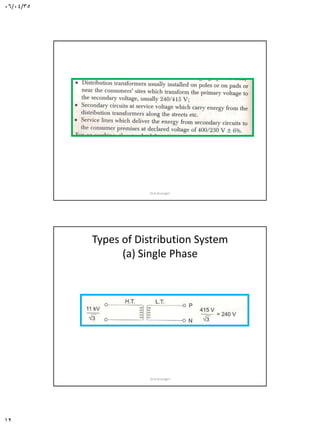
The electrical distribution systems consists of:
Dr.A.Arunagiri
1.Sub transmission
2.Distribution substation
3.Primary feeders
4.Distribution transformers
5.Secondary circuits
6.Service drops
06/04/35
4
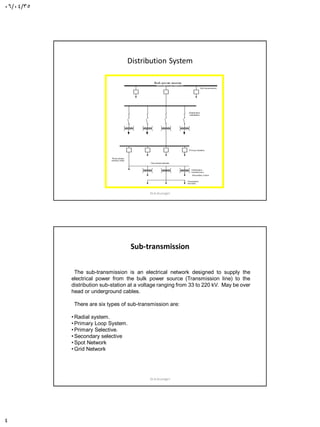
Distribution System
Dr.A.Arunagiri
Sub-transmission
Dr.A.Arunagiri
The sub-transmission is an electrical network designed to supply the
electrical power from the bulk power source (Transmission line) to the
distribution sub-station at a voltage ranging from 33 to 220 kV. May be over
head or underground cables.
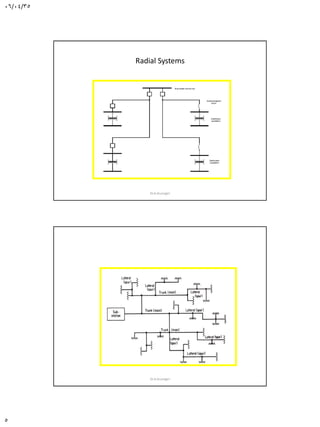
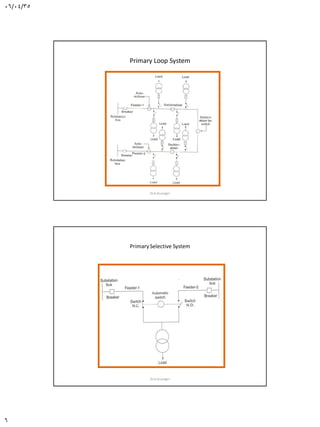
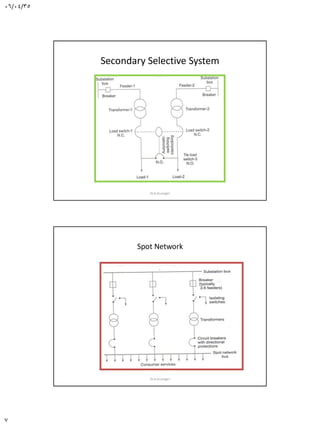
There are six types of sub-transmission are:
• Radial system.
• Primary Loop System.
• Primary Selective.
•Secondary selective
• Spot Network
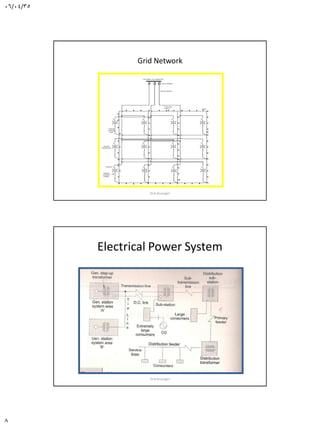
• Grid Network
06/04/35
5
Radial Systems
Dr.A.Arunagiri
Dr.A.Arunagiri
06/04/35
6
Primary Loop System
Dr.A.Arunagiri
PrimarySelective System
Dr.A.Arunagiri
06/04/35
7
Secondary Selective System
Dr.A.Arunagiri
Spot Network
Dr.A.Arunagiri
06/04/35
8
Grid Network
Dr.A.Arunagiri
Electrical Power System
Dr.A.Arunagiri
06/04/35
9
Dr.A.Arunagiri
Dr.A.Arunagiri
06/04/35
10
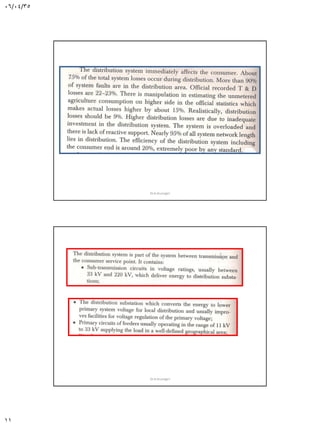
(b)Single Wire Earth Return
(SWER)
Dr.A.Arunagiri
Dr.A.Arunagiri
06/04/35
11
Dr.A.Arunagiri
Dr.A.Arunagiri
06/04/35
12
Dr.A.Arunagiri
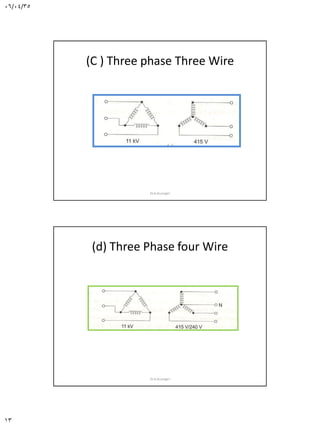
Types of Distribution System
(a) Single Phase
Dr.A.Arunagiri
06/04/35
13
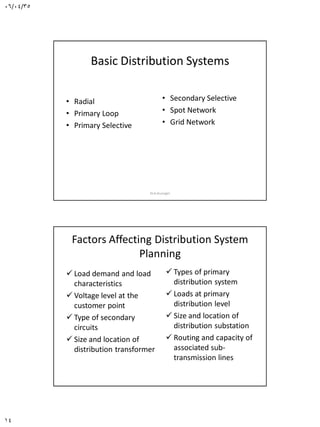
(C ) Three phase Three Wire
Dr.A.Arunagiri
(d) Three Phase four Wire
Dr.A.Arunagiri
06/04/35
14
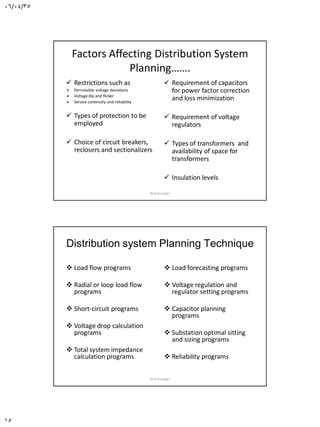
Basic Distribution Systems
• Radial
• Primary Loop
• Primary Selective
• Secondary Selective
• Spot Network
• Grid Network
Dr.A.Arunagiri
Factors Affecting Distribution System
Planning
 Load demand and load
characteristics
 Voltage level at the
customer point
 Type of secondary
circuits
 Size and location of
distribution transformer
 Types of primary
distribution system
 Loads at primary
distribution level
 Size and location of
distribution substation
 Routing and capacity of
associated sub-
transmission lines
Dr.A.Arunagiri
06/04/35
15
Factors Affecting Distribution System
Planning…….
 Restrictions such as
 Permissible voltage deviations
 Voltage dip and flicker
 Service continuity and reliability
 Types of protection to be
employed
 Choice of circuit breakers,
reclosers and sectionalizers
 Requirement of capacitors
for power factor correction
and loss minimization
 Requirement of voltage
regulators
 Types of transformers and
availability of space for
transformers
 Insulation levels
Dr.A.Arunagiri
Distribution system Planning Technique
 Load flow programs
 Radial or loop load flow
programs
 Short-circuit programs
 Voltage drop calculation
programs
 Total system impedance
calculation programs
 Load forecasting programs
 Voltage regulation and
regulator setting programs
 Capacitor planning
programs
 Substation optimal sitting
and sizing programs
 Reliability programs
Dr.A.Arunagiri
06/04/35
16
However, in general, the overall concept of
automatically using output of each program as
input for the next program is not in use.
Engineering judgment and trial and error method
are used in system planning. In this chapter, we
shall discuss some of the distribution planning and
operation techniques.
Dr.A.Arunagiri
Future Distribution System Planning
Components
Vision:
A clear vision for the future
communicates a sense of the kind of
organization, power utility needs to
become, and outlines the kind of
results it must achieve. The vision
provides a continuing focus and
constantly reminds the employees
and consumers of what the company
trying to change.
 Mission:
For particular task there can be a
mission statement such as Electricity
for all KSA by the end of next decade
 Values:
The power utility leadership must
create values such as consumer
satisfaction, environmental
responsibility.
Dr.A.Arunagiri
06/04/35
17
Distribution system planning models
Traditional-Least cost
model:
It is a process by which utilities
minimize the cost of supplying a
given amount of power. The
existing system inadequacies are
identified as:
• Poor voltage regulation
• Higher system loss
• Higher equipment
failure/breakdown
• Bad quality of power supply
• No scope for future growth.
Dr.A.Arunagiri
The initial system improvement can be very cost effective in
removing the above system inadequacies as compared to the other
alternatives of laying a new extended system.
Thus there are two options:
 System improvement
 Expansion of the existing network
Dr.A.Arunagiri
06/04/35
18
(a) System Improvement
Augmentation and strengthening of the existing system
Improving the reliability and quality of supply
Reduction of commercial and technical loss and / or
Dr.A.Arunagiri
b)Expansion of the existing network
When augmentation and strengthening of existing system are
involved the benefits of saving in losses (kw and energy), net
revenue increase due to additional sale of power and energy
after adjusting the expenditure incurred on generation of the
additional energy must be maximized.
Dr.A.Arunagiri
06/04/35
19
2. Demand Side Planning(DSP)
It is the process by which power utilities quantify and assess the
programmes to alter the load pattern and level of their consumer’s
demand for electricity.
This is planning at the consumer level and often has a long planning
period, much longer than distribution system planning. It can take years
of slow progress to obtain meaningful levels of participation.
Dr.A.Arunagiri
The low cost demand side option can be :
Implementing energy conservation programmes
Providing vigilance and detection of theft.
Dr.A.Arunagiri
06/04/35
20
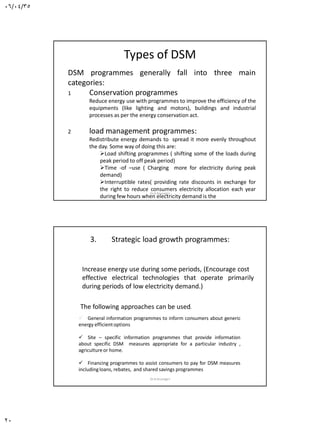
DSM programmes generally fall into three main
categories:
1 Conservation programmes
Reduce energy use with programmes to improve the efficiency of the
equipments (like lighting and motors), buildings and industrial
processes as per the energy conservation act.
2 load management programmes:
Redistribute energy demands to spread it more evenly throughout
the day. Some way of doing this are:
Load shifting programmes ( shifting some of the loads during
peak period to off peak period)
Time -of –use ( Charging more for electricity during peak
demand)
Interruptible rates( providing rate discounts in exchange for
the right to reduce consumers electricity allocation each year
during few hours when electricity demand is the highest
Types of DSM
Dr.A.Arunagiri
3. Strategic load growth programmes:
Increase energy use during some periods, (Encourage cost
effective electrical technologies that operate primarily
during periods of low electricity demand.)
The following approaches can be used.
 General information programmes to inform consumers about generic
energy efficientoptions
 Site – specific information programmes that provide information
about specific DSM measures appropriate for a particular industry ,
agricultureor home.
 Financing programmes to assist consumers to pay for DSM measures
includingloans, rebates, and shared savings programmes
Dr.A.Arunagiri
06/04/35
21
 Direct installation programmes that provide complete
services to design, finance and install a package of efficiency
measures.
 Alternative tariff programmes including time-of-use tariff,
interruptible tariff, and load shifting tariff. ( These programmes
usually do not save energy but they are effective ways to shift
loads to off peak periods.
 Bidding programmes in which utility solicits bids from
consumers and energy service companies.
 Load limiters are effective in demand side management , as
they limit the maximum power that the consumer draws from
the supply.
Dr.A.Arunagiri
The process of designing and implementing DSM programmes
generally consists of the following steps.
 Identifying the sectors, end -uses and efficiency
measures to target
 Developing programme design
 Conducting cost-effective screening
 Preparing an implementation plan
 Implementing programmes and
 Evaluating programmes.
Dr.A.Arunagiri
06/04/35
22
Benefits of DSM
• Reduces consumers energy bills
• Reduces the need for the new
plant, transmission and distribution
construction
• Stimulates economic development
• Creates long time jobs that benefits
the economy
• Increases the competitiveness of the
local enterprises
• Can reduce maintenance and
equipment replacement cost
• Reduces local air pollution
• Reduces emission s that contribute
to national and international
environmental problems such as acid
rain and global warming
• Enhances national security by easing
dependence on foreign energy
sources
Dr.A.Arunagiri
Computer central role in distribution planning
 Software needs:
generally is selected on the basis of the
least life cycle cost or least ownership
costs (hiring or purchase + training +
maintenance costs). The software must
be.
– Bestoverallperformance
– Bestsolution
– Bestopen architecture system
 Analysis of the system
computer aided power flow studies in
improving the performance of the existing
sub-transmission and distribution systems
and proposed expansion of network up to
the meter point (Consumers). Studies
will provide
– Active and reactive power flows as
well as the locations of capacitors
– Voltage variation (at each node or
bus, percent variation)
– Peak power losses and energy losses
– Computation of commercial losses of
feeder
– Overloading of transformers
:
Dr.A.Arunagiri
06/04/35
23
Computer central role in distribution planning
 Data:
success of any information
technology system is highly
dependent on the accurate, up to
date field data for improvement in
the network and system.
Information must be clear and up-
dated on:
Nodes
Single line diagram
Distribution substation
Primary feeder
Distribution transformer
and secondary feeder
Consumer data
Load data
Dr.A.Arunagiri
Elements of the distribution system
 Distribution Transformer
 Primary distribution feeder
 Secondary distribution
feeder
 Protection devices and
instrumentation
Dr.A.Arunagiri
06/04/35
24
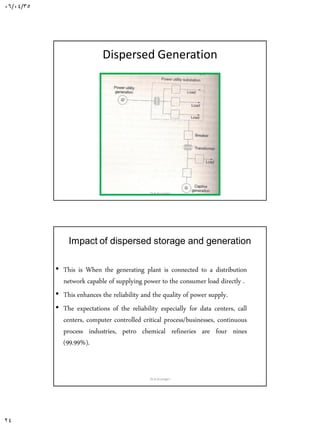
Dispersed Generation
Dr.A.Arunagiri
Impact of dispersed storage and generation
• This is When the generating plant is connected to a distribution
network capable of supplying power to the consumer load directly .
• This enhances the reliability and the quality of power supply.
• The expectations of the reliability especially for data centers, call
centers, computer controlled critical process/businesses, continuous
process industries, petro chemical refineries are four nines
(99.99%).
Dr.A.Arunagiri
06/04/35
25
Impact of dispersed generation….
For dispersed generations line losses will be nominal since there is
no transmission system is required.
Dispersed generation with local radial distribution network will
play an important role in the 21st century.
Dispersed generation is generally from local renewable sources.
This saves environment degradation compared to conventional
thermal generation.
Dr.A.Arunagiri
Renewable resources of generation
 Fuel cells
 Solar photovoltaic
 Wind energy
 Tidal wave energy from
ocean
 Small hydro (up to 25 MW
capacity, pumped
storage)
 Geo-thermal
 Bio-mass
 Municipal and industrial
west
Dr.A.Arunagiri
06/04/35
26
Net Metering
The kilo watt hour meter(import – export meter) can be used to
accurately register the flow of electricity in either direction. This
means the ‘netting’ process associated with net metering happens
automatically
Dr.A.Arunagiri
Assignment 1
Q.1
Draw the one line diagram of the electrical power system
available in KSA.. Indicate the voltage levels for
Generation
Transmission
Sub transmission
Primary Feeder
Secondary Feeder
Q2
Mention and discuss the different types of the renewable resources of
generation available in the KSA.
Dr.A.Arunagiri

ELECTRICAL DISTRIBUTION TECHNOLOGY

  • 1.
  • 2.
    06/04/35 2 Chapter Outline Introduction Factors affectingdistribution system planning Present distribution system planning techniques Distribution system planning models Computer central role in distribution planning Impact of dispersed storage and generation Renewable resources of generation Dr.A.Arunagiri Introduction Dr.A.Arunagiri The electrical power system is very complex system. Distribution is about 50% of the capital cost of the power system. The power system consists of three main parts Generation plants, Transmission and Distribution. The electrical distribution system is a part of the system between the transmission and the consumer service point. The electrical distribution system is divided into primary and secondary distribution.
  • 3.
    06/04/35 3 Typical Electrical PowerSystem Dr.A.Arunagiri The electrical distribution systems consists of: Dr.A.Arunagiri 1.Sub transmission 2.Distribution substation 3.Primary feeders 4.Distribution transformers 5.Secondary circuits 6.Service drops
  • 4.
    06/04/35 4 Distribution System Dr.A.Arunagiri Sub-transmission Dr.A.Arunagiri The sub-transmissionis an electrical network designed to supply the electrical power from the bulk power source (Transmission line) to the distribution sub-station at a voltage ranging from 33 to 220 kV. May be over head or underground cables. There are six types of sub-transmission are: • Radial system. • Primary Loop System. • Primary Selective. •Secondary selective • Spot Network • Grid Network
  • 5.
  • 6.
  • 7.
  • 8.
  • 9.
  • 10.
    06/04/35 10 (b)Single Wire EarthReturn (SWER) Dr.A.Arunagiri Dr.A.Arunagiri
  • 11.
  • 12.
    06/04/35 12 Dr.A.Arunagiri Types of DistributionSystem (a) Single Phase Dr.A.Arunagiri
  • 13.
    06/04/35 13 (C ) Threephase Three Wire Dr.A.Arunagiri (d) Three Phase four Wire Dr.A.Arunagiri
  • 14.
    06/04/35 14 Basic Distribution Systems •Radial • Primary Loop • Primary Selective • Secondary Selective • Spot Network • Grid Network Dr.A.Arunagiri Factors Affecting Distribution System Planning  Load demand and load characteristics  Voltage level at the customer point  Type of secondary circuits  Size and location of distribution transformer  Types of primary distribution system  Loads at primary distribution level  Size and location of distribution substation  Routing and capacity of associated sub- transmission lines Dr.A.Arunagiri
  • 15.
    06/04/35 15 Factors Affecting DistributionSystem Planning…….  Restrictions such as  Permissible voltage deviations  Voltage dip and flicker  Service continuity and reliability  Types of protection to be employed  Choice of circuit breakers, reclosers and sectionalizers  Requirement of capacitors for power factor correction and loss minimization  Requirement of voltage regulators  Types of transformers and availability of space for transformers  Insulation levels Dr.A.Arunagiri Distribution system Planning Technique  Load flow programs  Radial or loop load flow programs  Short-circuit programs  Voltage drop calculation programs  Total system impedance calculation programs  Load forecasting programs  Voltage regulation and regulator setting programs  Capacitor planning programs  Substation optimal sitting and sizing programs  Reliability programs Dr.A.Arunagiri
  • 16.
    06/04/35 16 However, in general,the overall concept of automatically using output of each program as input for the next program is not in use. Engineering judgment and trial and error method are used in system planning. In this chapter, we shall discuss some of the distribution planning and operation techniques. Dr.A.Arunagiri Future Distribution System Planning Components Vision: A clear vision for the future communicates a sense of the kind of organization, power utility needs to become, and outlines the kind of results it must achieve. The vision provides a continuing focus and constantly reminds the employees and consumers of what the company trying to change.  Mission: For particular task there can be a mission statement such as Electricity for all KSA by the end of next decade  Values: The power utility leadership must create values such as consumer satisfaction, environmental responsibility. Dr.A.Arunagiri
  • 17.
    06/04/35 17 Distribution system planningmodels Traditional-Least cost model: It is a process by which utilities minimize the cost of supplying a given amount of power. The existing system inadequacies are identified as: • Poor voltage regulation • Higher system loss • Higher equipment failure/breakdown • Bad quality of power supply • No scope for future growth. Dr.A.Arunagiri The initial system improvement can be very cost effective in removing the above system inadequacies as compared to the other alternatives of laying a new extended system. Thus there are two options:  System improvement  Expansion of the existing network Dr.A.Arunagiri
  • 18.
    06/04/35 18 (a) System Improvement Augmentationand strengthening of the existing system Improving the reliability and quality of supply Reduction of commercial and technical loss and / or Dr.A.Arunagiri b)Expansion of the existing network When augmentation and strengthening of existing system are involved the benefits of saving in losses (kw and energy), net revenue increase due to additional sale of power and energy after adjusting the expenditure incurred on generation of the additional energy must be maximized. Dr.A.Arunagiri
  • 19.
    06/04/35 19 2. Demand SidePlanning(DSP) It is the process by which power utilities quantify and assess the programmes to alter the load pattern and level of their consumer’s demand for electricity. This is planning at the consumer level and often has a long planning period, much longer than distribution system planning. It can take years of slow progress to obtain meaningful levels of participation. Dr.A.Arunagiri The low cost demand side option can be : Implementing energy conservation programmes Providing vigilance and detection of theft. Dr.A.Arunagiri
  • 20.
    06/04/35 20 DSM programmes generallyfall into three main categories: 1 Conservation programmes Reduce energy use with programmes to improve the efficiency of the equipments (like lighting and motors), buildings and industrial processes as per the energy conservation act. 2 load management programmes: Redistribute energy demands to spread it more evenly throughout the day. Some way of doing this are: Load shifting programmes ( shifting some of the loads during peak period to off peak period) Time -of –use ( Charging more for electricity during peak demand) Interruptible rates( providing rate discounts in exchange for the right to reduce consumers electricity allocation each year during few hours when electricity demand is the highest Types of DSM Dr.A.Arunagiri 3. Strategic load growth programmes: Increase energy use during some periods, (Encourage cost effective electrical technologies that operate primarily during periods of low electricity demand.) The following approaches can be used.  General information programmes to inform consumers about generic energy efficientoptions  Site – specific information programmes that provide information about specific DSM measures appropriate for a particular industry , agricultureor home.  Financing programmes to assist consumers to pay for DSM measures includingloans, rebates, and shared savings programmes Dr.A.Arunagiri
  • 21.
    06/04/35 21  Direct installationprogrammes that provide complete services to design, finance and install a package of efficiency measures.  Alternative tariff programmes including time-of-use tariff, interruptible tariff, and load shifting tariff. ( These programmes usually do not save energy but they are effective ways to shift loads to off peak periods.  Bidding programmes in which utility solicits bids from consumers and energy service companies.  Load limiters are effective in demand side management , as they limit the maximum power that the consumer draws from the supply. Dr.A.Arunagiri The process of designing and implementing DSM programmes generally consists of the following steps.  Identifying the sectors, end -uses and efficiency measures to target  Developing programme design  Conducting cost-effective screening  Preparing an implementation plan  Implementing programmes and  Evaluating programmes. Dr.A.Arunagiri
  • 22.
    06/04/35 22 Benefits of DSM •Reduces consumers energy bills • Reduces the need for the new plant, transmission and distribution construction • Stimulates economic development • Creates long time jobs that benefits the economy • Increases the competitiveness of the local enterprises • Can reduce maintenance and equipment replacement cost • Reduces local air pollution • Reduces emission s that contribute to national and international environmental problems such as acid rain and global warming • Enhances national security by easing dependence on foreign energy sources Dr.A.Arunagiri Computer central role in distribution planning  Software needs: generally is selected on the basis of the least life cycle cost or least ownership costs (hiring or purchase + training + maintenance costs). The software must be. – Bestoverallperformance – Bestsolution – Bestopen architecture system  Analysis of the system computer aided power flow studies in improving the performance of the existing sub-transmission and distribution systems and proposed expansion of network up to the meter point (Consumers). Studies will provide – Active and reactive power flows as well as the locations of capacitors – Voltage variation (at each node or bus, percent variation) – Peak power losses and energy losses – Computation of commercial losses of feeder – Overloading of transformers : Dr.A.Arunagiri
  • 23.
    06/04/35 23 Computer central rolein distribution planning  Data: success of any information technology system is highly dependent on the accurate, up to date field data for improvement in the network and system. Information must be clear and up- dated on: Nodes Single line diagram Distribution substation Primary feeder Distribution transformer and secondary feeder Consumer data Load data Dr.A.Arunagiri Elements of the distribution system  Distribution Transformer  Primary distribution feeder  Secondary distribution feeder  Protection devices and instrumentation Dr.A.Arunagiri
  • 24.
    06/04/35 24 Dispersed Generation Dr.A.Arunagiri Impact ofdispersed storage and generation • This is When the generating plant is connected to a distribution network capable of supplying power to the consumer load directly . • This enhances the reliability and the quality of power supply. • The expectations of the reliability especially for data centers, call centers, computer controlled critical process/businesses, continuous process industries, petro chemical refineries are four nines (99.99%). Dr.A.Arunagiri
  • 25.
    06/04/35 25 Impact of dispersedgeneration…. For dispersed generations line losses will be nominal since there is no transmission system is required. Dispersed generation with local radial distribution network will play an important role in the 21st century. Dispersed generation is generally from local renewable sources. This saves environment degradation compared to conventional thermal generation. Dr.A.Arunagiri Renewable resources of generation  Fuel cells  Solar photovoltaic  Wind energy  Tidal wave energy from ocean  Small hydro (up to 25 MW capacity, pumped storage)  Geo-thermal  Bio-mass  Municipal and industrial west Dr.A.Arunagiri
  • 26.
    06/04/35 26 Net Metering The kilowatt hour meter(import – export meter) can be used to accurately register the flow of electricity in either direction. This means the ‘netting’ process associated with net metering happens automatically Dr.A.Arunagiri Assignment 1 Q.1 Draw the one line diagram of the electrical power system available in KSA.. Indicate the voltage levels for Generation Transmission Sub transmission Primary Feeder Secondary Feeder Q2 Mention and discuss the different types of the renewable resources of generation available in the KSA. Dr.A.Arunagiri