Process Capability Analysis
Introduction
• “Practice makes man perfect”, but not even a skilled person can do the job
perfectly without error.
• There is always scope for error, which is inherent to the part/component.
• So there is a term, called as tolerance, which is defined as we go on through
the presentation.
Tolerances
• Tolerance is the maximum error, that can be accepted for a particular
component.
• They are denoted in % or dimension.
• For example: diameter of a shaft should be (50 +/- 1%)mm.This indicates
that the all the shafts in the diameter range (49.5mm,50.5mm) are
accepted.
Causes
for error
Common
causes
Special
Causes
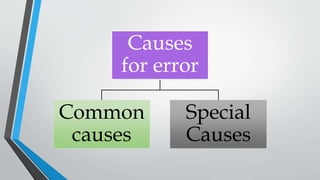
Causes for error
• Common causes can be reduced by using improved machinery, skilled
persons.
• Special causes have to addressed when they occur, they cannot be
predicted, so cannot be reduced or eliminated.
Data Collection
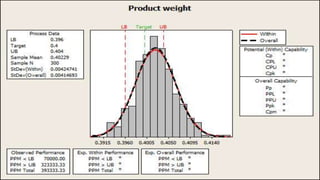
• In our search, we have found that food and drugs industry has the most
extensive quality control techniques.
• So we approached one company (name not to be revealed).
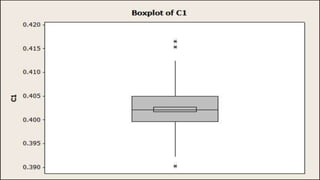
• They have shown us the process testing and statistics of one of their
products.
• The charts are shown, as we are not in liberty to divulge the data.
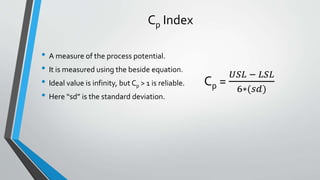
Cp Index
• A measure of the process potential.
• It is measured using the beside equation.
• Ideal value is infinity, but Cp > 1 is reliable.
• Here “sd” is the standard deviation.
Cp =
𝑈𝑆𝐿 − 𝐿𝑆𝐿
6∗(𝑠𝑑)
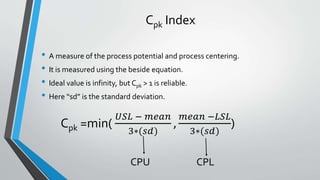
Cpk Index
• A measure of the process potential and process centering.
• It is measured using the beside equation.
• Ideal value is infinity, but Cpk > 1 is reliable.
• Here “sd” is the standard deviation.
Cpk =min(
𝑈𝑆𝐿 − 𝑚𝑒𝑎𝑛
3∗(𝑠𝑑)
,
𝑚𝑒𝑎𝑛 −𝐿𝑆𝐿
3∗(𝑠𝑑)
)
CPU CPL
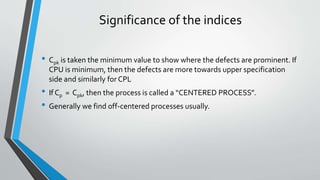
Significance of the indices
• Cpk is taken the minimum value to show where the defects are prominent. If
CPU is minimum, then the defects are more towards upper specification
side and similarly for CPL
• If Cp = Cpk, then the process is called a “CENTERED PROCESS”.
• Generally we find off-centered processes usually.
ThankYou
B S V P Surya Teja, 2012A4PS039H
K Rohit, 2012A4PS377H

Process capability analysis

  • 1.
  • 2.
    Introduction • “Practice makesman perfect”, but not even a skilled person can do the job perfectly without error. • There is always scope for error, which is inherent to the part/component. • So there is a term, called as tolerance, which is defined as we go on through the presentation.
  • 3.
    Tolerances • Tolerance isthe maximum error, that can be accepted for a particular component. • They are denoted in % or dimension. • For example: diameter of a shaft should be (50 +/- 1%)mm.This indicates that the all the shafts in the diameter range (49.5mm,50.5mm) are accepted.
  • 4.
  • 5.
    Causes for error •Common causes can be reduced by using improved machinery, skilled persons. • Special causes have to addressed when they occur, they cannot be predicted, so cannot be reduced or eliminated.
  • 6.
    Data Collection • Inour search, we have found that food and drugs industry has the most extensive quality control techniques. • So we approached one company (name not to be revealed). • They have shown us the process testing and statistics of one of their products. • The charts are shown, as we are not in liberty to divulge the data.
  • 9.
    Cp Index • Ameasure of the process potential. • It is measured using the beside equation. • Ideal value is infinity, but Cp > 1 is reliable. • Here “sd” is the standard deviation. Cp = 𝑈𝑆𝐿 − 𝐿𝑆𝐿 6∗(𝑠𝑑)
  • 10.
    Cpk Index • Ameasure of the process potential and process centering. • It is measured using the beside equation. • Ideal value is infinity, but Cpk > 1 is reliable. • Here “sd” is the standard deviation. Cpk =min( 𝑈𝑆𝐿 − 𝑚𝑒𝑎𝑛 3∗(𝑠𝑑) , 𝑚𝑒𝑎𝑛 −𝐿𝑆𝐿 3∗(𝑠𝑑) ) CPU CPL
  • 11.
    Significance of theindices • Cpk is taken the minimum value to show where the defects are prominent. If CPU is minimum, then the defects are more towards upper specification side and similarly for CPL • If Cp = Cpk, then the process is called a “CENTERED PROCESS”. • Generally we find off-centered processes usually.
  • 12.
    ThankYou B S VP Surya Teja, 2012A4PS039H K Rohit, 2012A4PS377H