Understanding Process Capability
in Manufacturing: A Key to
Consistent Quality
Introduction
In the world of manufacturing, the pursuit of consistent quality is
paramount. Businesses rely on their products meeting specific
standards and specifications to satisfy customers and remain
competitive. Process capability is a crucial concept in manufacturing
that enables organizations to assess and control the inherent variability
in their production processes, ensuring that products consistently meet
desired quality levels. In this article, we will delve into the significance
of process capability, its calculation, and how it aids manufacturers in
achieving high-quality, reliable products.
What is Process Capability?
Process capability is a statistical measure that assesses the ability of a
manufacturing process to consistently produce products that meet
predefined quality specifications. It helps organizations identify
whether their processes are capable of meeting customer
requirements and maintaining quality standards over time. In essence,
process capability provides a quantitative understanding of how well a
process performs in terms of producing products within specified
tolerances.
The Importance of Process
Capability
Quality Assurance: Ensuring product quality is a top priority for
manufacturers. Process capability analysis allows businesses to
identify potential issues in their production processes that may result
in defects or variations, helping them take corrective actions before
products reach the customer.
Cost Reduction: By identifying and addressing process variations,
manufacturers can reduce scrap, rework, and warranty costs. A
capable process produces fewer defects, leading to less waste and
lower production expenses.
Customer Satisfaction: Meeting or exceeding customer expectations is
crucial for business success. A process that consistently delivers
products within specification limits enhances customer satisfaction
and builds brand reputation.
Competitive Advantage: Companies that can consistently deliver high-
quality products gain a competitive edge in the market. Process
capability is a valuable tool for achieving and maintaining this
advantage.
Calculating Process Capability
Process capability is typically
assessed using two key indices:
Cp and Cpk.
Cp (Process Capability Index): Cp
measures the inherent variability
of a process compared to the
specified tolerance limits. It is
calculated as follows:
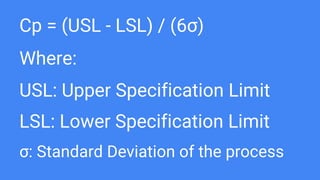
Cp = (USL - LSL) / (6σ)
Where:
USL: Upper Specification Limit
LSL: Lower Specification Limit
σ: Standard Deviation of the process
A Cp value greater than 1
indicates that the process can fit
within the specified tolerance
limits.
Cpk (Process Capability Index for
Centering): Cpk takes into
account both the capability of the
process and its centering within
the tolerance limits. It is
calculated as follows:
Cpk = Min [(USL - μ) / (3σ), (μ - LSL) / (3σ)]
Where:
USL: Upper Specification Limit
LSL: Lower Specification Limit
μ: Mean of the process
σ: Standard Deviation of the process
A Cpk value greater than 1
indicates that the process is
centered within the tolerance
limits and is capable of producing
products meeting specifications.
Interpreting Process Capability
Indices
Cp > 1 and Cpk > 1: The process
is capable of producing products
within specification limits and is
centered within those limits. This
is the ideal scenario for
manufacturers.
Cp > 1 and Cpk < 1: The process
is capable, but it is not centered
within the specification limits.
Adjustments are needed to bring
the process back into alignment
with customer requirements.
Cp < 1: The process is not
capable of consistently producing
products within specification
limits. Significant process
improvements are required.
Conclusion
Process capability is an invaluable tool for manufacturers striving to
maintain consistent product quality. By calculating indices such as Cp
and Cpk, businesses can assess their processes' ability to meet
customer requirements and identify areas for improvement. Achieving
a capable process not only ensures product quality but also reduces
costs, enhances customer satisfaction, and provides a competitive
advantage in the market. As manufacturing continues to evolve,
process capability will remain a cornerstone of quality management,
helping companies deliver reliable and high-quality products to their
customers.
Understanding Process Capability in Manufacturing: A Key to Consistent Quality

Understanding Process Capability in Manufacturing: A Key to Consistent Quality

  • 1.
    Understanding Process Capability inManufacturing: A Key to Consistent Quality
  • 2.
  • 3.
    In the worldof manufacturing, the pursuit of consistent quality is paramount. Businesses rely on their products meeting specific standards and specifications to satisfy customers and remain competitive. Process capability is a crucial concept in manufacturing that enables organizations to assess and control the inherent variability in their production processes, ensuring that products consistently meet desired quality levels. In this article, we will delve into the significance of process capability, its calculation, and how it aids manufacturers in achieving high-quality, reliable products.
  • 4.
    What is ProcessCapability?
  • 5.
    Process capability isa statistical measure that assesses the ability of a manufacturing process to consistently produce products that meet predefined quality specifications. It helps organizations identify whether their processes are capable of meeting customer requirements and maintaining quality standards over time. In essence, process capability provides a quantitative understanding of how well a process performs in terms of producing products within specified tolerances.
  • 6.
    The Importance ofProcess Capability
  • 7.
    Quality Assurance: Ensuringproduct quality is a top priority for manufacturers. Process capability analysis allows businesses to identify potential issues in their production processes that may result in defects or variations, helping them take corrective actions before products reach the customer.
  • 8.
    Cost Reduction: Byidentifying and addressing process variations, manufacturers can reduce scrap, rework, and warranty costs. A capable process produces fewer defects, leading to less waste and lower production expenses.
  • 9.
    Customer Satisfaction: Meetingor exceeding customer expectations is crucial for business success. A process that consistently delivers products within specification limits enhances customer satisfaction and builds brand reputation.
  • 10.
    Competitive Advantage: Companiesthat can consistently deliver high- quality products gain a competitive edge in the market. Process capability is a valuable tool for achieving and maintaining this advantage.
  • 11.
  • 12.
    Process capability istypically assessed using two key indices: Cp and Cpk.
  • 13.
    Cp (Process CapabilityIndex): Cp measures the inherent variability of a process compared to the specified tolerance limits. It is calculated as follows:
  • 14.
    Cp = (USL- LSL) / (6σ) Where: USL: Upper Specification Limit LSL: Lower Specification Limit σ: Standard Deviation of the process
  • 15.
    A Cp valuegreater than 1 indicates that the process can fit within the specified tolerance limits.
  • 16.
    Cpk (Process CapabilityIndex for Centering): Cpk takes into account both the capability of the process and its centering within the tolerance limits. It is calculated as follows:
  • 17.
    Cpk = Min[(USL - μ) / (3σ), (μ - LSL) / (3σ)] Where: USL: Upper Specification Limit LSL: Lower Specification Limit μ: Mean of the process σ: Standard Deviation of the process
  • 18.
    A Cpk valuegreater than 1 indicates that the process is centered within the tolerance limits and is capable of producing products meeting specifications.
  • 19.
  • 20.
    Cp > 1and Cpk > 1: The process is capable of producing products within specification limits and is centered within those limits. This is the ideal scenario for manufacturers.
  • 21.
    Cp > 1and Cpk < 1: The process is capable, but it is not centered within the specification limits. Adjustments are needed to bring the process back into alignment with customer requirements.
  • 22.
    Cp < 1:The process is not capable of consistently producing products within specification limits. Significant process improvements are required.
  • 23.
  • 24.
    Process capability isan invaluable tool for manufacturers striving to maintain consistent product quality. By calculating indices such as Cp and Cpk, businesses can assess their processes' ability to meet customer requirements and identify areas for improvement. Achieving a capable process not only ensures product quality but also reduces costs, enhances customer satisfaction, and provides a competitive advantage in the market. As manufacturing continues to evolve, process capability will remain a cornerstone of quality management, helping companies deliver reliable and high-quality products to their customers.