STATISTICAL PROCESS CONTROL
(SPC)
A.VALARMADHI
M.Pharm(Quality Assurance)
2021-2023
Department of pharmacy
Annamalai University.
CONTENTS
• Definition
• Importance of SPC
• Quality Measurement in Manufacturing
• Statistical control chart
• Types of variation
• Essential of SPC Chart
• Control chart
• Examples of Control Chart
• Process Capability
• Advantages of SPC
• Use of process Capability
information
• Standardized formula
• Relationship to product
Specification
• Capability index
• Estimating Inherent Capability
from a control chart analysis
DEFINITION
• Statistical process control as the application of statistical method to the
measurement and analysis of variation in a process.
• This technique applies to both -in- process parameter and end- of –
process parameters.
• A process is a collection of activities that converts inputs into outputs or
result.
• More specifically a process is a unique combination of machine,tools,
methods, materials and people that attain an output in goods, software
or services.
IMPORTANCES OF SPC
• Reduce inspection cost
• Reduction in the time which is required to produce the Product.
• Detecting error at inspection.
• More uniform quality of production.
• Saves cost of material by reducing number of rejects.
• Reduce waste
IMPORTANCE OF SPC
• It is stable process and operates with less variability.
• Customer Satisfaction
• It provides direction for long term reduction in process variability.
• Maximized productivity
• Improved resource utilisation
• Extensive analytics and reporting.
QUALITY MEASUREMENT IN MANUFACTURING
• Quality measurements central to the process of quality control:“What gets measured
,gets done.”
• Measurement is a basic for all 3 operational quality process and for Strategic
measurement.
1. Quality control measurement – provides feedback and early warnings of problems.
2. Operational quality planning measurement- quantifies customer needs and product
and process Capabilities.
3. Quality improvement measurements – can motivate people, priorities improvement
opportunities ,and help in diagnosing causes.
STATISTICAL CONTROL CHART
• A statistical control chart compares process performance data to computed “
Statistical control limits” drawn as limit lines on the chart .
• Prime objective of control chart is – detecting special causes of variation in a
process by analysing data from both the past and the future.
• Knowing the meaning of “ special causes” is essential to understanding the
control chart concept.
• The process performance data usually consist of groups of measurements (
rational sub groups) from the regular sequence of the production while
preserving the order of the data.
• Process variation is the naturally occurring variation in the attributes of
transistors(length, widths,oxide thickness) when integrated circuits are
fabricated.
• Process variations have two kinds of cause
1. Common( random or chance)
2. Special ( Assignable)
• This Two kinds of variations occur in all manufacturing processes.
PROCESS VARIATION AND ITS TYPES
TYPES OF VARIATION
1. Common cause variation or Random cause variation
• It consists of the variation inherent in process as it is designed .
• It may include variation in temperature , properties of raw materials ,
strength of an electrical current etc.
• Common cause is the only type of variation that exists in the process and
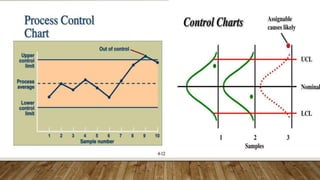
process is said to be “in Control” and stable.
2.Special cause variation or Assignable cause variation
• With sufficient investigation ,a specific cause,such as abnormal raw
material or incorrect set- up parameters,can be found for special cause
variation.
• Special cause variation exist within the process and process is said to
be”Out of control” and unstable.
• Is non random in nature can be reduced or eliminated.
ESSENTIALS OF SPC CHART
• SPC contol chart is one of the method to identify the types of variation.
• Simple graphical tools that enables process performance monitoring.
• Designed to identify which type of variation exit within the process.
• Designed to highlight areas that may require further investigation .
• Easy to construct and interpret.
TOOLS OF SPC
• Run chart
• Control chart
• SPC Chart can be applied to both dynamic
process and static processes.
CONTROL CHART
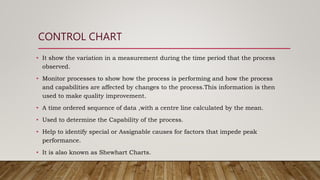
• It show the variation in a measurement during the time period that the process
observed.
• Monitor processes to show how the process is performing and how the process
and capabilities are affected by changes to the process.This information is then
used to make quality improvement.
• A time ordered sequence of data ,with a centre line calculated by the mean.
• Used to determine the Capability of the process.
• Help to identify special or Assignable causes for factors that impede peak
performance.
• It is also known as Shewhart Charts.
FOUR KEY FEATURES OF CONTROL CHART
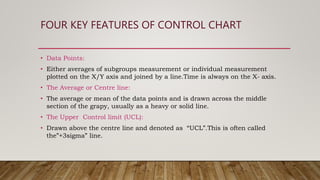
• Data Points:
• Either averages of subgroups measurement or individual measurement
plotted on the X/Y axis and joined by a line.Time is always on the X- axis.
• The Average or Centre line:
• The average or mean of the data points and is drawn across the middle
section of the grapy, usually as a heavy or solid line.
• The Upper Control limit (UCL):
• Drawn above the centre line and denoted as “UCL”.This is often called
the”+3sigma” line.
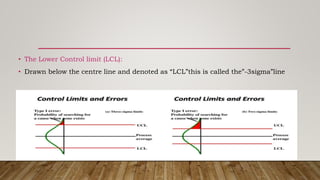
• The Lower Control limit (LCL):
• Drawn below the centre line and denoted as “LCL”this is called the”-3sigma”line
CONTROL LIMIT
• Control limits define the zone where the observed data for the stable and
consistent process occurs viturally all of the time (99.7%).
• Any fluctuations within these limits come from common causes inherent
to the system,such as choice of equipment, scheduled maintenance are
the pericision of the Operation that results from the design.
• An outcome beyond the control limit results from a special causes.
• The automatic control limits have been set at 3- sigma limits.
ZONES OF CONTROL LIMIT
• The area between each control limit and the centre line is divided into 3
zone namely;
• ZoneA – “1-sigma zone”
• ZoneB _”2-sigma zone”
• ZoneC_”3-sigmazone”
TYPES OF CONTROL CHART
• Variable chart
• R Chart( The Range )
• X Chart (The mean)
• Attributes chart
• P Chart (A proportion)
• C Chart (Attribute measures)
TYPES OF DATA
VARIABLES CHART
• Characteristics that can take any
real value.
• It may be whole or in fractional
numbers
• Continuous random variables
ATTRIBUTES CHART
• Defect-related Characteristic .
• Classify products as either good
or bad or count defects.
• Categorical or discrete random
variables.
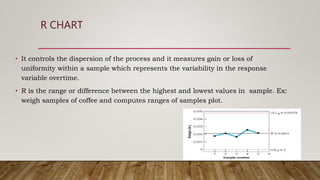
R CHART
• It controls the dispersion of the process and it measures gain or loss of
uniformity within a sample which represents the variability in the response
variable overtime.
• R is the range or difference between the highest and lowest values in sample. Ex:
weigh samples of coffee and computes ranges of samples plot.
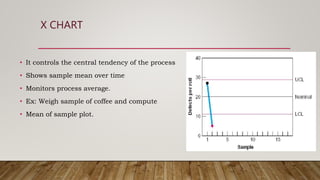
X CHART
• It controls the central tendency of the process
• Shows sample mean over time
• Monitors process average.
• Ex: Weigh sample of coffee and compute
• Mean of sample plot.
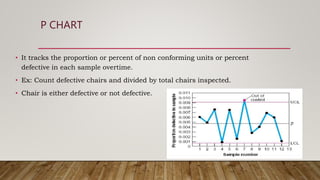
P CHART
• It tracks the proportion or percent of non conforming units or percent
defective in each sample overtime.
• Ex: Count defective chairs and divided by total chairs inspected.
• Chair is either defective or not defective.
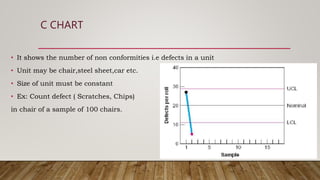
C CHART
• It shows the number of non conformities i.e defects in a unit
• Unit may be chair,steel sheet,car etc.
• Size of unit must be constant
• Ex: Count defect ( Scratches, Chips)
in chair of a sample of 100 chairs.
ADVANTAGES OF STATISTICAL CONTROL
• It determines the capability of the manufacturing process .
• Provides mean of detecting error at inspection
• It reduce the number of rejects and saves the cost of material
• Improves the relationship with the customer
• It reduce cost
• Leads to more uniform quality of production
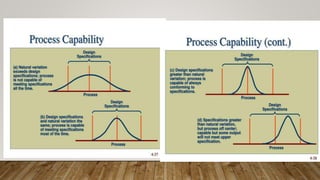
PROCESS CAPABILITY
• Process Capability studies distinguish between conformance to control
limits and conformance to specification limits ( it also called as Tolerance
Limits).
• If the process means is in control,then virtually all points will remain
within control limits.
• Staying within control limits doesn’t necessarily mean that specification
limit are satisfied
• Specification limit are usually dictated by customer.
USE OF PROCESS CAPABILITY INFORMATION
• Predicting the extent of variability that process will exhibit.
• Choose most appropriate process to meet the tolerance
• Planning the interrelationship of sequentical process
• Assign the machine to work for which they are best suited.
• Testing causing of defect during quality improvement programs.
STANDARDIZED FORMULA
• The most widely used formula for process Capability is
• Process Capability= +- 3 SD
• If the process is centred and follows normal probability 99.37%product
will fall within +-3SD of the normal specification.
RELATIONSHIP TO PRODUCT SPECIFICATION
• The major reason for qualifying process Capability is to compute the
ability of the process to hold the specification.
• Planner try to select process within the 6SD process Capability well
within the specification width.
• A measure of these relationship is capability ratio.
CAPABILITY INDEX (CPK)
• Cp index measures potential capability assuming that the process
average is equal to midpoint of the specification limit and the process
operating in statiscal control because the average often not at the
midpoint it is useful to have capability index that reflects both variation
and the location of process average,such index is the Capability
Index(CPk).
• If actual average = midpoint of the specification range.
• A capability index can also be calculated around a target value rather
than actual average.
• Higher the Cp lower the amount of product outside specification limit.
• Krishna moorthy and khatwani (2000) process Capability index for
handling normal and non – normal characteristics.
• This index also known as Taguchi index(Cpm).
TYPES OF PROCESS CAPABILITY STUDIES
1. Study of process potential:
• An estimation is obtained of what the process can do under certain
conditions.
• The Cp in process method.
2. Study of process performance:
• An estimation of capability provides the picture of what the process is
doing over an extended period of time.
• The Cpk index estimate performance process Capability.
ASSUMPTION OF STATISTICAL CONTROL AND ITS
EFFECT ON PROCESS CAPABILITY
1.Process Stability:
• Statistical validity requires a state of statistical Control with no drift or oscillation.
2. Normality of the characteristics being measured:
• Normality is needed to draw statistical inference about the population.
3. Sufficient Data: It is necessary to minimise the sampling error for the capability index.
4.Representativeness Of samples and independence Measurement:
• It must include random sample and consecutive measurement cannot be co related.
ESTIMATING INHERENT CAPABILITY FORMA
CONTROL CHART ANALYSIS
• In process potential study data are collected from process operating
without changes in :
• - material batches.
• - workers, tools
• - process setting
• This short time evaluation uses consecutive production over time period.
• Such analysis should be preceded by control chart analysis in which any
assignable causes have been detected and eliminated from process.
• Control limit for sample average cannot compares to specification limit.
REFERENCE
1. Jurans Quality Planning and analysis 5 th edition,Tata Mc Graw hill
education PVT .LTD (pg.no:689-705).
2. https://SlideShare.com/slide/7956730
3. https://www.slideshare.net/anubijis/statistical-processcontrol-
16017031
4. https://www.slideshare.net/Raviraj-Jadeja/statistical-quality control-
19754262
5. Data Analysis with excel,Berkand carey, Duxbury 2000 chapter
12(pgno:475-488)
6. https://www.slideshare.net/ranasigh0820/Statistical
quality control-5773201
7. https://www.slideshare.net/100002907643874/Stati
stical quality control-48812952
8. https://www.slideshare.net/hussain-761/sqccharts
9. https://www.slideshare.net/anubhavgrover7/Statisti
cal-quality control-21931110.
10.Quality Assurance and quality Management in
pharmaceutical industry- Y..Anjaneyulu,R.Marayya.(
pg.no-(169,265).
Thank you...

SATISTICAL PROCESS CONTROL(SPC)

  • 1.
    STATISTICAL PROCESS CONTROL (SPC) A.VALARMADHI M.Pharm(QualityAssurance) 2021-2023 Department of pharmacy Annamalai University.
  • 2.
    CONTENTS • Definition • Importanceof SPC • Quality Measurement in Manufacturing • Statistical control chart • Types of variation • Essential of SPC Chart • Control chart • Examples of Control Chart • Process Capability • Advantages of SPC • Use of process Capability information • Standardized formula • Relationship to product Specification • Capability index • Estimating Inherent Capability from a control chart analysis
  • 3.
    DEFINITION • Statistical processcontrol as the application of statistical method to the measurement and analysis of variation in a process. • This technique applies to both -in- process parameter and end- of – process parameters. • A process is a collection of activities that converts inputs into outputs or result. • More specifically a process is a unique combination of machine,tools, methods, materials and people that attain an output in goods, software or services.
  • 4.
    IMPORTANCES OF SPC •Reduce inspection cost • Reduction in the time which is required to produce the Product. • Detecting error at inspection. • More uniform quality of production. • Saves cost of material by reducing number of rejects. • Reduce waste
  • 5.
    IMPORTANCE OF SPC •It is stable process and operates with less variability. • Customer Satisfaction • It provides direction for long term reduction in process variability. • Maximized productivity • Improved resource utilisation • Extensive analytics and reporting.
  • 6.
    QUALITY MEASUREMENT INMANUFACTURING • Quality measurements central to the process of quality control:“What gets measured ,gets done.” • Measurement is a basic for all 3 operational quality process and for Strategic measurement. 1. Quality control measurement – provides feedback and early warnings of problems. 2. Operational quality planning measurement- quantifies customer needs and product and process Capabilities. 3. Quality improvement measurements – can motivate people, priorities improvement opportunities ,and help in diagnosing causes.
  • 7.
    STATISTICAL CONTROL CHART •A statistical control chart compares process performance data to computed “ Statistical control limits” drawn as limit lines on the chart . • Prime objective of control chart is – detecting special causes of variation in a process by analysing data from both the past and the future. • Knowing the meaning of “ special causes” is essential to understanding the control chart concept. • The process performance data usually consist of groups of measurements ( rational sub groups) from the regular sequence of the production while preserving the order of the data.
  • 8.
    • Process variationis the naturally occurring variation in the attributes of transistors(length, widths,oxide thickness) when integrated circuits are fabricated. • Process variations have two kinds of cause 1. Common( random or chance) 2. Special ( Assignable) • This Two kinds of variations occur in all manufacturing processes. PROCESS VARIATION AND ITS TYPES
  • 9.
    TYPES OF VARIATION 1.Common cause variation or Random cause variation • It consists of the variation inherent in process as it is designed . • It may include variation in temperature , properties of raw materials , strength of an electrical current etc. • Common cause is the only type of variation that exists in the process and process is said to be “in Control” and stable.
  • 10.
    2.Special cause variationor Assignable cause variation • With sufficient investigation ,a specific cause,such as abnormal raw material or incorrect set- up parameters,can be found for special cause variation. • Special cause variation exist within the process and process is said to be”Out of control” and unstable. • Is non random in nature can be reduced or eliminated.
  • 11.
    ESSENTIALS OF SPCCHART • SPC contol chart is one of the method to identify the types of variation. • Simple graphical tools that enables process performance monitoring. • Designed to identify which type of variation exit within the process. • Designed to highlight areas that may require further investigation . • Easy to construct and interpret.
  • 12.
    TOOLS OF SPC •Run chart • Control chart • SPC Chart can be applied to both dynamic process and static processes.
  • 13.
    CONTROL CHART • Itshow the variation in a measurement during the time period that the process observed. • Monitor processes to show how the process is performing and how the process and capabilities are affected by changes to the process.This information is then used to make quality improvement. • A time ordered sequence of data ,with a centre line calculated by the mean. • Used to determine the Capability of the process. • Help to identify special or Assignable causes for factors that impede peak performance. • It is also known as Shewhart Charts.
  • 15.
    FOUR KEY FEATURESOF CONTROL CHART • Data Points: • Either averages of subgroups measurement or individual measurement plotted on the X/Y axis and joined by a line.Time is always on the X- axis. • The Average or Centre line: • The average or mean of the data points and is drawn across the middle section of the grapy, usually as a heavy or solid line. • The Upper Control limit (UCL): • Drawn above the centre line and denoted as “UCL”.This is often called the”+3sigma” line.

  • 16.
    • The LowerControl limit (LCL): • Drawn below the centre line and denoted as “LCL”this is called the”-3sigma”line
  • 17.
    CONTROL LIMIT • Controllimits define the zone where the observed data for the stable and consistent process occurs viturally all of the time (99.7%). • Any fluctuations within these limits come from common causes inherent to the system,such as choice of equipment, scheduled maintenance are the pericision of the Operation that results from the design. • An outcome beyond the control limit results from a special causes. • The automatic control limits have been set at 3- sigma limits.
  • 18.
    ZONES OF CONTROLLIMIT • The area between each control limit and the centre line is divided into 3 zone namely; • ZoneA – “1-sigma zone” • ZoneB _”2-sigma zone” • ZoneC_”3-sigmazone”
  • 19.
    TYPES OF CONTROLCHART • Variable chart • R Chart( The Range ) • X Chart (The mean) • Attributes chart • P Chart (A proportion) • C Chart (Attribute measures)
  • 20.
    TYPES OF DATA VARIABLESCHART • Characteristics that can take any real value. • It may be whole or in fractional numbers • Continuous random variables ATTRIBUTES CHART • Defect-related Characteristic . • Classify products as either good or bad or count defects. • Categorical or discrete random variables.
  • 21.
    R CHART • Itcontrols the dispersion of the process and it measures gain or loss of uniformity within a sample which represents the variability in the response variable overtime. • R is the range or difference between the highest and lowest values in sample. Ex: weigh samples of coffee and computes ranges of samples plot.
  • 22.
    X CHART • Itcontrols the central tendency of the process • Shows sample mean over time • Monitors process average. • Ex: Weigh sample of coffee and compute • Mean of sample plot.
  • 23.
    P CHART • Ittracks the proportion or percent of non conforming units or percent defective in each sample overtime. • Ex: Count defective chairs and divided by total chairs inspected. • Chair is either defective or not defective.
  • 24.
    C CHART • Itshows the number of non conformities i.e defects in a unit • Unit may be chair,steel sheet,car etc. • Size of unit must be constant • Ex: Count defect ( Scratches, Chips) in chair of a sample of 100 chairs.
  • 25.
    ADVANTAGES OF STATISTICALCONTROL • It determines the capability of the manufacturing process . • Provides mean of detecting error at inspection • It reduce the number of rejects and saves the cost of material • Improves the relationship with the customer • It reduce cost • Leads to more uniform quality of production
  • 26.
    PROCESS CAPABILITY • ProcessCapability studies distinguish between conformance to control limits and conformance to specification limits ( it also called as Tolerance Limits). • If the process means is in control,then virtually all points will remain within control limits. • Staying within control limits doesn’t necessarily mean that specification limit are satisfied • Specification limit are usually dictated by customer.
  • 28.
    USE OF PROCESSCAPABILITY INFORMATION • Predicting the extent of variability that process will exhibit. • Choose most appropriate process to meet the tolerance • Planning the interrelationship of sequentical process • Assign the machine to work for which they are best suited. • Testing causing of defect during quality improvement programs.
  • 29.
    STANDARDIZED FORMULA • Themost widely used formula for process Capability is • Process Capability= +- 3 SD • If the process is centred and follows normal probability 99.37%product will fall within +-3SD of the normal specification.
  • 30.
    RELATIONSHIP TO PRODUCTSPECIFICATION • The major reason for qualifying process Capability is to compute the ability of the process to hold the specification. • Planner try to select process within the 6SD process Capability well within the specification width. • A measure of these relationship is capability ratio.
  • 31.
    CAPABILITY INDEX (CPK) •Cp index measures potential capability assuming that the process average is equal to midpoint of the specification limit and the process operating in statiscal control because the average often not at the midpoint it is useful to have capability index that reflects both variation and the location of process average,such index is the Capability Index(CPk). • If actual average = midpoint of the specification range.
  • 32.
    • A capabilityindex can also be calculated around a target value rather than actual average. • Higher the Cp lower the amount of product outside specification limit. • Krishna moorthy and khatwani (2000) process Capability index for handling normal and non – normal characteristics. • This index also known as Taguchi index(Cpm).
  • 33.
    TYPES OF PROCESSCAPABILITY STUDIES 1. Study of process potential: • An estimation is obtained of what the process can do under certain conditions. • The Cp in process method. 2. Study of process performance: • An estimation of capability provides the picture of what the process is doing over an extended period of time. • The Cpk index estimate performance process Capability.
  • 34.
    ASSUMPTION OF STATISTICALCONTROL AND ITS EFFECT ON PROCESS CAPABILITY 1.Process Stability: • Statistical validity requires a state of statistical Control with no drift or oscillation. 2. Normality of the characteristics being measured: • Normality is needed to draw statistical inference about the population. 3. Sufficient Data: It is necessary to minimise the sampling error for the capability index. 4.Representativeness Of samples and independence Measurement: • It must include random sample and consecutive measurement cannot be co related.
  • 35.
    ESTIMATING INHERENT CAPABILITYFORMA CONTROL CHART ANALYSIS • In process potential study data are collected from process operating without changes in : • - material batches. • - workers, tools • - process setting • This short time evaluation uses consecutive production over time period. • Such analysis should be preceded by control chart analysis in which any assignable causes have been detected and eliminated from process. • Control limit for sample average cannot compares to specification limit.
  • 36.
    REFERENCE 1. Jurans QualityPlanning and analysis 5 th edition,Tata Mc Graw hill education PVT .LTD (pg.no:689-705). 2. https://SlideShare.com/slide/7956730 3. https://www.slideshare.net/anubijis/statistical-processcontrol- 16017031 4. https://www.slideshare.net/Raviraj-Jadeja/statistical-quality control- 19754262 5. Data Analysis with excel,Berkand carey, Duxbury 2000 chapter 12(pgno:475-488)
  • 37.
    6. https://www.slideshare.net/ranasigh0820/Statistical quality control-5773201 7.https://www.slideshare.net/100002907643874/Stati stical quality control-48812952 8. https://www.slideshare.net/hussain-761/sqccharts 9. https://www.slideshare.net/anubhavgrover7/Statisti cal-quality control-21931110. 10.Quality Assurance and quality Management in pharmaceutical industry- Y..Anjaneyulu,R.Marayya.( pg.no-(169,265).
  • 38.