Process Capability
Julian Kalac, P.Eng
Lean Six Sigma Master Black Belt
2
Normal Distribution
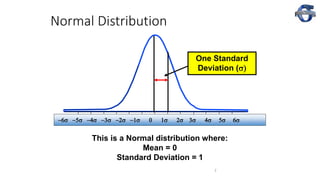
-6s -5s -4s -3s -2s -1s 0 1s 2s 3s 4s 5s 6s
One Standard
Deviation (s)
This is a Normal distribution where:
Mean = 0
Standard Deviation = 1
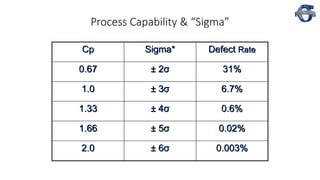
Process Capability & “Sigma”
Cp Sigma* Defect Rate
0.67 ± 2σ 31%
1.0 ± 3σ 6.7%
1.33 ± 4σ 0.6%
1.66 ± 5σ 0.02%
2.0 ± 6σ 0.003%
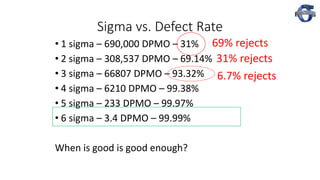
Sigma vs. Defect Rate
• 1 sigma – 690,000 DPMO – 31%
• 2 sigma – 308,537 DPMO – 69.14%
• 3 sigma – 66807 DPMO – 93.32%
• 4 sigma – 6210 DPMO – 99.38%
• 5 sigma – 233 DPMO – 99.97%
• 6 sigma – 3.4 DPMO – 99.99%
When is good is good enough?
6.7% rejects
69% rejects
31% rejects
6
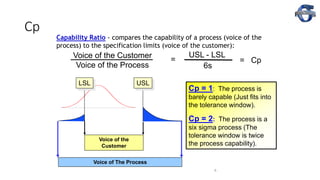
Cp
USLLSL
Voice of the
Customer
Voice of The Process
Voice of the Customer
Voice of the Process
Capability Ratio - compares the capability of a process (voice of the
process) to the specification limits (voice of the customer):
=
USL - LSL
6s
= Cp
Cp = 1: The process is
barely capable (Just fits into
the tolerance window).
Cp = 2: The process is a
six sigma process (The
tolerance window is twice
the process capability).
7
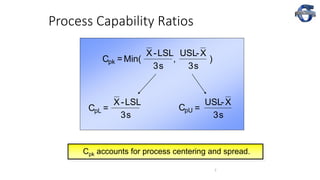
C Min(
X-LSL
3
USL-X
3
pk =
s s
, )
C
X-LSL
3
pL =
s
USL-X
3s
CpU =
Cpk accounts for process centering and spread.
Process Capability Ratios
8
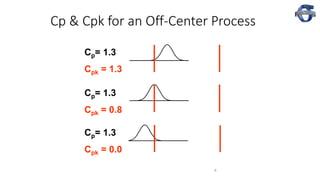
Cp & Cpk for an Off-Center Process
Cp= 1.3
Cpk = 1.3
Cp= 1.3
Cpk = 0.8
Cp= 1.3
Cpk = 0.0
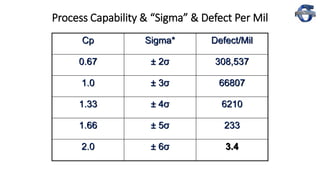
Process Capability & “Sigma” & Defect Per Mil
Cp Sigma* Defect/Mil
0.67 ± 2σ 308,537
1.0 ± 3σ 66807
1.33 ± 4σ 6210
1.66 ± 5σ 233
2.0 ± 6σ 3.4
10
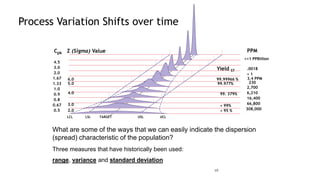
Cpk
4.5
3.0
2.0
1.67
1.33
1.0
0.9
0.8
0.67
0.5
TARGET USL UCLLCL LSL
Z (Sigma) Value
6.0
5.0
4.0
3.0
2.0
PPM
<<1 PPBillion
.0018
< 1
230
2,700
6,210
16,400
66,800
308,000
3.4 PPM
Yield ST
99.99966 %
99.977%
99. 379%
≈ 99%
≈ 95 %
Process Variation Shifts over time
What are some of the ways that we can easily indicate the dispersion
(spread) characteristic of the population?
Three measures that have historically been used:
range, variance and standard deviation
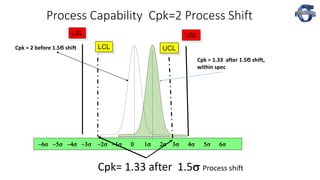
-6s -5s -4s -3s -2s -1s 0 1s 2s 3s 4s 5s 6s
Process Capability Cpk=2 Process Shift
Cpk= 1.33 after 1.5s Process shift
USLLSL
LCL UCLCpk = 2 before 1.5Ϭ shift
Cpk = 1.33 after 1.5Ϭ shift,
within spec
-6s -5s -4s -3s -2s -1s 0 1s 2s 3s 4s 5s 6s
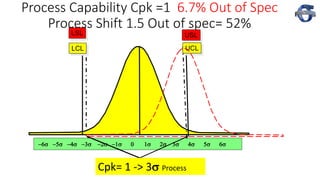
Process Capability Cpk =1 6.7% Out of Spec
Process Shift 1.5 Out of spec= 52%
Control LimitsCpk= 1 -> 3s Process
LSL USL
LCL UCL
-6s -5s -4s -3s -2s -1s 0 1s 2s 3s 4s 5s 6s
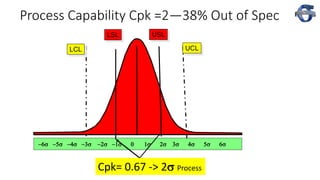
Process Capability Cpk =2—38% Out of Spec
Control LimitsCpk= 0.67 -> 2s Process
LSL USL
LCL UCL
14
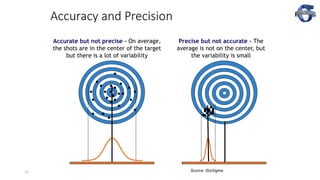
Accuracy and Precision
Accurate but not precise - On average,
the shots are in the center of the target
but there is a lot of variability
Precise but not accurate - The
average is not on the center, but
the variability is small
Source: iSixSigma
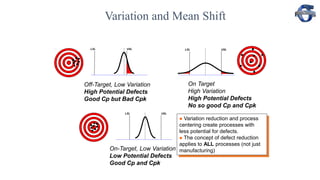
Variation and Mean Shift
LSL USL LSL USL
LSL USL
Off-Target, Low Variation
High Potential Defects
Good Cp but Bad Cpk
On Target
High Variation
High Potential Defects
No so good Cp and Cpk
On-Target, Low Variation
Low Potential Defects
Good Cp and Cpk
 Variation reduction and process
centering create processes with
less potential for defects.
 The concept of defect reduction
applies to ALL processes (not just
manufacturing)

Process Capability shift over time

  • 1.
    Process Capability Julian Kalac,P.Eng Lean Six Sigma Master Black Belt
  • 2.
    2 Normal Distribution -6s -5s-4s -3s -2s -1s 0 1s 2s 3s 4s 5s 6s One Standard Deviation (s) This is a Normal distribution where: Mean = 0 Standard Deviation = 1
  • 4.
    Process Capability &“Sigma” Cp Sigma* Defect Rate 0.67 ± 2σ 31% 1.0 ± 3σ 6.7% 1.33 ± 4σ 0.6% 1.66 ± 5σ 0.02% 2.0 ± 6σ 0.003%
  • 5.
    Sigma vs. DefectRate • 1 sigma – 690,000 DPMO – 31% • 2 sigma – 308,537 DPMO – 69.14% • 3 sigma – 66807 DPMO – 93.32% • 4 sigma – 6210 DPMO – 99.38% • 5 sigma – 233 DPMO – 99.97% • 6 sigma – 3.4 DPMO – 99.99% When is good is good enough? 6.7% rejects 69% rejects 31% rejects
  • 6.
    6 Cp USLLSL Voice of the Customer Voiceof The Process Voice of the Customer Voice of the Process Capability Ratio - compares the capability of a process (voice of the process) to the specification limits (voice of the customer): = USL - LSL 6s = Cp Cp = 1: The process is barely capable (Just fits into the tolerance window). Cp = 2: The process is a six sigma process (The tolerance window is twice the process capability).
  • 7.
    7 C Min( X-LSL 3 USL-X 3 pk = ss , ) C X-LSL 3 pL = s USL-X 3s CpU = Cpk accounts for process centering and spread. Process Capability Ratios
  • 8.
    8 Cp & Cpkfor an Off-Center Process Cp= 1.3 Cpk = 1.3 Cp= 1.3 Cpk = 0.8 Cp= 1.3 Cpk = 0.0
  • 9.
    Process Capability &“Sigma” & Defect Per Mil Cp Sigma* Defect/Mil 0.67 ± 2σ 308,537 1.0 ± 3σ 66807 1.33 ± 4σ 6210 1.66 ± 5σ 233 2.0 ± 6σ 3.4
  • 10.
    10 Cpk 4.5 3.0 2.0 1.67 1.33 1.0 0.9 0.8 0.67 0.5 TARGET USL UCLLCLLSL Z (Sigma) Value 6.0 5.0 4.0 3.0 2.0 PPM <<1 PPBillion .0018 < 1 230 2,700 6,210 16,400 66,800 308,000 3.4 PPM Yield ST 99.99966 % 99.977% 99. 379% ≈ 99% ≈ 95 % Process Variation Shifts over time What are some of the ways that we can easily indicate the dispersion (spread) characteristic of the population? Three measures that have historically been used: range, variance and standard deviation
  • 11.
    -6s -5s -4s-3s -2s -1s 0 1s 2s 3s 4s 5s 6s Process Capability Cpk=2 Process Shift Cpk= 1.33 after 1.5s Process shift USLLSL LCL UCLCpk = 2 before 1.5Ϭ shift Cpk = 1.33 after 1.5Ϭ shift, within spec
  • 12.
    -6s -5s -4s-3s -2s -1s 0 1s 2s 3s 4s 5s 6s Process Capability Cpk =1 6.7% Out of Spec Process Shift 1.5 Out of spec= 52% Control LimitsCpk= 1 -> 3s Process LSL USL LCL UCL
  • 13.
    -6s -5s -4s-3s -2s -1s 0 1s 2s 3s 4s 5s 6s Process Capability Cpk =2—38% Out of Spec Control LimitsCpk= 0.67 -> 2s Process LSL USL LCL UCL
  • 14.
    14 Accuracy and Precision Accuratebut not precise - On average, the shots are in the center of the target but there is a lot of variability Precise but not accurate - The average is not on the center, but the variability is small Source: iSixSigma
  • 15.
    Variation and MeanShift LSL USL LSL USL LSL USL Off-Target, Low Variation High Potential Defects Good Cp but Bad Cpk On Target High Variation High Potential Defects No so good Cp and Cpk On-Target, Low Variation Low Potential Defects Good Cp and Cpk  Variation reduction and process centering create processes with less potential for defects.  The concept of defect reduction applies to ALL processes (not just manufacturing)