Measurement System Analysis
MSA
1
MEASUREMENT PROCESS
‘Measurement ‘ is defined as the assignment of
numbers to Material things to represent the
relation ship with respect to particular properties.
Measurement system is the collection of
operations ,gages,personnel used to assign a
number to the characteristic being measured.
Measurement process should be viewed as
manufacturing process that produces numbers
(data) for its output
2
WHY MSA IS REQUIRED
• The decision to adjust a manufacturing
process or not based on measurement
data.If quality the of the measured data is
low then wrong judgment can be made.
• Example: 1.Allowing the process without
adjustment or premature adjustment
3
To better understand the sources of
variation that can influence the result
produced by the system.
To assess the Quality of
Measurement system
PURPOSE
4
MSA CAN BE USED
To assess(accept/reject/improve) new
measuring equipment/measuring process.
A comparison of one measuring device
with other
A comparison for measuring equipment
before and after repair
5
MEASUREMENT SYSTEM ERRORS
1. BIAS
2. REPEATABILITY
3. REPRODUCIBILITY
4. STABILITY AND
5. LINEARITY
6
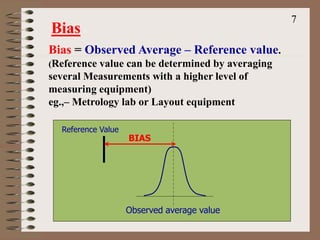
Bias
Bias = Observed Average – Reference value.
(Reference value can be determined by averaging
several Measurements with a higher level of
measuring equipment)
eg.,– Metrology lab or Layout equipment
Reference Value
Observed average value
BIAS
7
If the Bias is relatively large,
Look for these possible causes.
1. Error in the master.
2. Worn master.
3. Instrument made to the wrong
dimension.
4. Instrument measuring the wrong
characteristics.
5. Instrument not calibrate properly.
6. Instrument used improperly by
appraiser.
8
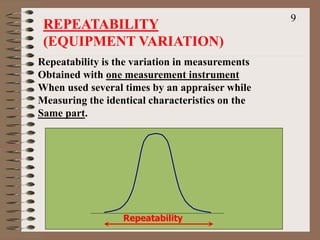
REPEATABILITY
(EQUIPMENT VARIATION)
Repeatability is the variation in measurements
Obtained with one measurement instrument
When used several times by an appraiser while
Measuring the identical characteristics on the
Same part.
Repeatability
9
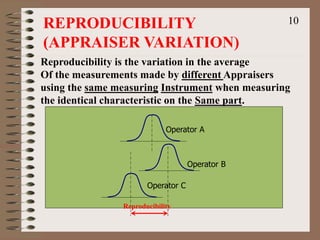
REPRODUCIBILITY
(APPRAISER VARIATION)
Reproducibility is the variation in the average
Of the measurements made by different Appraisers
using the same measuring Instrument when measuring
the identical characteristic on the Same part.
Reproducibility
Operator B
Operator A
Operator C
10
STABILITY
Stability ( or drift ) is the total variation in the
Measurement obtained with a measurement
System on the same master or parts when measuring a
single characteristics over an extended time period.
Stability
Time 2
Time 1
11
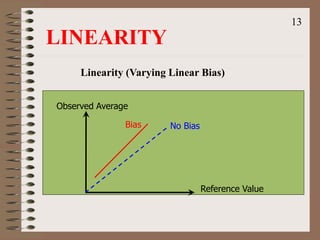
LINEARITY
Linearity is the difference in the bias values through the
expected operating range.
Reference Value
Observed average
value
Smaller
Bias
( Lower part of range )
Reference Value
Observed average value
Larger
Bias
( Higher part of range )
12
LINEARITY
Linearity (Varying Linear Bias)
Observed Average
Reference Value
No BiasBias
13
PREPARATION FOR THE STUDY TO ESTIMATE R&R
1.Optimum condition for MSA – 3Appraiser,3Trails,10Parts
(Condition for MSA (no.of appraisers) * (no.of parts) > 15)
2.The no.of parts chosen must represent the entire operating
Range
3.Appraisers are those who normally operate the gage
4.One observer should appointed to record the measurements
5.Each must be identified .
6.Instrument should have the L.C of 1/10th of the expected
process variation or the Tolerance
14
Important points during the study
1.Measurement should be done in random
order
2.The appraiser should be unaware which
numbered part is being checked to avoid
any Knowledge Bias.
3.Each appraiser must use the same method
to obtain the measurements.
15
Conducting the study
16
 Please refer Gage R & R Data Sheet.
Slide Number:17 & 18
A
B
C
PART
1 2 3 4 5 6 7 8 9 10
1 9.490 9.490 9.490 9.480 9.480 9.470 9.480 9.470 9.490 9.480 9.482
2 9.490 9.480 9.490 9.490 9.480 9.480 9.490 9.490 9.490 9.490 9.487
3 9.490 9.480 9.490 9.490 9.480 9.480 9.490 9.490 9.490 9.490 9.487
9.490 9.483 9.490 9.487 9.480 9.477 9.487 9.483 9.490 9.487 Xa= 9.4853
0.000 0.010 0.000 0.010 0.000 0.010 0.010 0.020 0.000 0.010 Ra= 0.0070
1 9.470 9.470 9.480 9.470 9.460 9.480 9.490 9.480 9.480 9.470 9.475
2 9.490 9.470 9.470 9.490 9.480 9.490 9.480 9.480 9.480 9.480 9.481
3 9.470 9.470 9.490 9.470 9.480 9.480 9.490 9.470 9.480 9.490 9.479
9.477 9.470 9.480 9.477 9.473 9.483 9.487 9.477 9.480 9.480 Xb= 9.4783
0.020 0.000 0.020 0.020 0.020 0.010 0.010 0.010 0.000 0.020 Rb= 0.0130
1 9.470 9.470 9.480 9.480 9.470 9.480 9.470 9.470 9.470 9.460 9.472
2 9.480 9.460 9.470 9.470 9.470 9.480 9.470 9.470 9.480 9.480 9.473
3 9.480 9.480 9.470 9.480 9.470 9.470 9.480 9.480 9.470 9.470 9.475
AVERAGE 9.477 9.470 9.473 9.477 9.470 9.477 9.473 9.473 9.473 9.470 Xc= 9.4733
RANGE 0.010 0.020 0.010 0.010 0.000 0.010 0.010 0.010 0.010 0.020 Rc= 0.0110
PART AVERAGE (Xp) 9.481 9.474 9.481 9.480 9.474 9.479 9.482 9.478 9.481 9.479 Rp= 0.0078
Xp = 9.4790
R = 0.0103
X Diff = Max X - Min X X Diff= 0.0120
UCL (R) = D4 X R D4 = 2.575 0.0266
LCL (R) = D3 X R D3 = 0.000 0
UCL (x ) = [Xp + A2R] A2 = 1.023 9.4896
LCL (x ) = [Xp - A2R] 9.4684
AVERAGE
RANGE
C
Xp = [ Xa + Xb +Xc] / 3
A
AVERAGE
RANGE
B
OPERATOR TRIAL NO. AVERAGE
Specification Gauge Least Count 0.02mm
Characteristic Gauge Type -----
Part Name Fuel pump Gauge Name V.C
GAUGE REPEATABILITY AND REPRODUCIBILITY DATA SHEET
Part No. HA196100-3101 Gauge No. XXXXX Operator Name (s)
R = [ Ra + Rb +Rc] / 3
17
Doc. No. Written
Line Name
Date YYYY MM DD
No. of Trials 3 3 10
1
2
3
R
REPEATABILITY - EQUIPMENT VARIATION (EV)
R = 0.0103 % EV = 100 [EV/TV]
K1 = 3.05 Trials K1
EV = R X K1 2 4.56 = 68%
= 0.031517 3 3.05
REPRODUCIBILITY - APPRAISAR VARIATION (AV)
X Diff = 0.012 % AV = 100[AV/TV]
K2 = 2.70
= 68%
AV = SQRT OF [(X Diff X K2) - (EV / n x r) ]
= 0.032
Note: n = number of parts; r = no. of trials
2 3
3.65 2.70
REPRODUCIBILITY & REPEATABILITY (R&R)
%R&R = 100[R&R/TV]
R&R = SQRT OF ( EV + AV )
= 0.045 = 96%
PART VARIATION (PV) Parts (n) K 3
2 3.65 % PV = 100[PV/TV]
Rp = 0.008 3 2.70
K3 = 1.62 4 2.30 = 27%
5 2.08
PV = Rp X K3 6 1.93
= 0.0126 7 1.82
8 1.74
9 1.67
10 1.62
TOTAL VARIATION (TV)
TV = SQRT OF (R&R + PV )
= 0.0466
PERFORMED BY : DATE :
MEASUREMENT UNIT ANALYSIS % PROCESS VARIATION
No. of Operators
K 2
From Data Sheet:
0.0103 X diff 0.012 Rp 0.008
Specification 0.6 ~ 1.0mm
Characteristic Gauge Type
Operator Name (s)
Part Name Gauge Name
Part No. Gauge No.
No. of operators No. of Parts
GAUGE REPEATABILITY AND REPRODUCIBILITY ANALYSIS REPORT
Rev. No. Approved Checked
22
22
2 2
18
MSA STUDY FOR ATTRIBUTE STUDY
S.NO
1 G G G G
2 NG NG NG NG
3 G G G G
4 G G G G
5 G G G G
6 G G G G
7 G G G G
8 NG NG NG G
9 G G G G
10 G G G G
11 G G G G
12 G G G G
13 G G NG NG
14 G G G G
15 G G G G
16 G G G G
17 G G G G
18 NG NG NG NG
19 G G G G
20 G G G G
Appraiser A Appraiser B
19

Msa training

  • 1.
  • 2.
    MEASUREMENT PROCESS ‘Measurement ‘is defined as the assignment of numbers to Material things to represent the relation ship with respect to particular properties. Measurement system is the collection of operations ,gages,personnel used to assign a number to the characteristic being measured. Measurement process should be viewed as manufacturing process that produces numbers (data) for its output 2
  • 3.
    WHY MSA ISREQUIRED • The decision to adjust a manufacturing process or not based on measurement data.If quality the of the measured data is low then wrong judgment can be made. • Example: 1.Allowing the process without adjustment or premature adjustment 3
  • 4.
    To better understandthe sources of variation that can influence the result produced by the system. To assess the Quality of Measurement system PURPOSE 4
  • 5.
    MSA CAN BEUSED To assess(accept/reject/improve) new measuring equipment/measuring process. A comparison of one measuring device with other A comparison for measuring equipment before and after repair 5
  • 6.
    MEASUREMENT SYSTEM ERRORS 1.BIAS 2. REPEATABILITY 3. REPRODUCIBILITY 4. STABILITY AND 5. LINEARITY 6
  • 7.
    Bias Bias = ObservedAverage – Reference value. (Reference value can be determined by averaging several Measurements with a higher level of measuring equipment) eg.,– Metrology lab or Layout equipment Reference Value Observed average value BIAS 7
  • 8.
    If the Biasis relatively large, Look for these possible causes. 1. Error in the master. 2. Worn master. 3. Instrument made to the wrong dimension. 4. Instrument measuring the wrong characteristics. 5. Instrument not calibrate properly. 6. Instrument used improperly by appraiser. 8
  • 9.
    REPEATABILITY (EQUIPMENT VARIATION) Repeatability isthe variation in measurements Obtained with one measurement instrument When used several times by an appraiser while Measuring the identical characteristics on the Same part. Repeatability 9
  • 10.
    REPRODUCIBILITY (APPRAISER VARIATION) Reproducibility isthe variation in the average Of the measurements made by different Appraisers using the same measuring Instrument when measuring the identical characteristic on the Same part. Reproducibility Operator B Operator A Operator C 10
  • 11.
    STABILITY Stability ( ordrift ) is the total variation in the Measurement obtained with a measurement System on the same master or parts when measuring a single characteristics over an extended time period. Stability Time 2 Time 1 11
  • 12.
    LINEARITY Linearity is thedifference in the bias values through the expected operating range. Reference Value Observed average value Smaller Bias ( Lower part of range ) Reference Value Observed average value Larger Bias ( Higher part of range ) 12
  • 13.
    LINEARITY Linearity (Varying LinearBias) Observed Average Reference Value No BiasBias 13
  • 14.
    PREPARATION FOR THESTUDY TO ESTIMATE R&R 1.Optimum condition for MSA – 3Appraiser,3Trails,10Parts (Condition for MSA (no.of appraisers) * (no.of parts) > 15) 2.The no.of parts chosen must represent the entire operating Range 3.Appraisers are those who normally operate the gage 4.One observer should appointed to record the measurements 5.Each must be identified . 6.Instrument should have the L.C of 1/10th of the expected process variation or the Tolerance 14
  • 15.
    Important points duringthe study 1.Measurement should be done in random order 2.The appraiser should be unaware which numbered part is being checked to avoid any Knowledge Bias. 3.Each appraiser must use the same method to obtain the measurements. 15
  • 16.
    Conducting the study 16 Please refer Gage R & R Data Sheet. Slide Number:17 & 18
  • 17.
    A B C PART 1 2 34 5 6 7 8 9 10 1 9.490 9.490 9.490 9.480 9.480 9.470 9.480 9.470 9.490 9.480 9.482 2 9.490 9.480 9.490 9.490 9.480 9.480 9.490 9.490 9.490 9.490 9.487 3 9.490 9.480 9.490 9.490 9.480 9.480 9.490 9.490 9.490 9.490 9.487 9.490 9.483 9.490 9.487 9.480 9.477 9.487 9.483 9.490 9.487 Xa= 9.4853 0.000 0.010 0.000 0.010 0.000 0.010 0.010 0.020 0.000 0.010 Ra= 0.0070 1 9.470 9.470 9.480 9.470 9.460 9.480 9.490 9.480 9.480 9.470 9.475 2 9.490 9.470 9.470 9.490 9.480 9.490 9.480 9.480 9.480 9.480 9.481 3 9.470 9.470 9.490 9.470 9.480 9.480 9.490 9.470 9.480 9.490 9.479 9.477 9.470 9.480 9.477 9.473 9.483 9.487 9.477 9.480 9.480 Xb= 9.4783 0.020 0.000 0.020 0.020 0.020 0.010 0.010 0.010 0.000 0.020 Rb= 0.0130 1 9.470 9.470 9.480 9.480 9.470 9.480 9.470 9.470 9.470 9.460 9.472 2 9.480 9.460 9.470 9.470 9.470 9.480 9.470 9.470 9.480 9.480 9.473 3 9.480 9.480 9.470 9.480 9.470 9.470 9.480 9.480 9.470 9.470 9.475 AVERAGE 9.477 9.470 9.473 9.477 9.470 9.477 9.473 9.473 9.473 9.470 Xc= 9.4733 RANGE 0.010 0.020 0.010 0.010 0.000 0.010 0.010 0.010 0.010 0.020 Rc= 0.0110 PART AVERAGE (Xp) 9.481 9.474 9.481 9.480 9.474 9.479 9.482 9.478 9.481 9.479 Rp= 0.0078 Xp = 9.4790 R = 0.0103 X Diff = Max X - Min X X Diff= 0.0120 UCL (R) = D4 X R D4 = 2.575 0.0266 LCL (R) = D3 X R D3 = 0.000 0 UCL (x ) = [Xp + A2R] A2 = 1.023 9.4896 LCL (x ) = [Xp - A2R] 9.4684 AVERAGE RANGE C Xp = [ Xa + Xb +Xc] / 3 A AVERAGE RANGE B OPERATOR TRIAL NO. AVERAGE Specification Gauge Least Count 0.02mm Characteristic Gauge Type ----- Part Name Fuel pump Gauge Name V.C GAUGE REPEATABILITY AND REPRODUCIBILITY DATA SHEET Part No. HA196100-3101 Gauge No. XXXXX Operator Name (s) R = [ Ra + Rb +Rc] / 3 17
  • 18.
    Doc. No. Written LineName Date YYYY MM DD No. of Trials 3 3 10 1 2 3 R REPEATABILITY - EQUIPMENT VARIATION (EV) R = 0.0103 % EV = 100 [EV/TV] K1 = 3.05 Trials K1 EV = R X K1 2 4.56 = 68% = 0.031517 3 3.05 REPRODUCIBILITY - APPRAISAR VARIATION (AV) X Diff = 0.012 % AV = 100[AV/TV] K2 = 2.70 = 68% AV = SQRT OF [(X Diff X K2) - (EV / n x r) ] = 0.032 Note: n = number of parts; r = no. of trials 2 3 3.65 2.70 REPRODUCIBILITY & REPEATABILITY (R&R) %R&R = 100[R&R/TV] R&R = SQRT OF ( EV + AV ) = 0.045 = 96% PART VARIATION (PV) Parts (n) K 3 2 3.65 % PV = 100[PV/TV] Rp = 0.008 3 2.70 K3 = 1.62 4 2.30 = 27% 5 2.08 PV = Rp X K3 6 1.93 = 0.0126 7 1.82 8 1.74 9 1.67 10 1.62 TOTAL VARIATION (TV) TV = SQRT OF (R&R + PV ) = 0.0466 PERFORMED BY : DATE : MEASUREMENT UNIT ANALYSIS % PROCESS VARIATION No. of Operators K 2 From Data Sheet: 0.0103 X diff 0.012 Rp 0.008 Specification 0.6 ~ 1.0mm Characteristic Gauge Type Operator Name (s) Part Name Gauge Name Part No. Gauge No. No. of operators No. of Parts GAUGE REPEATABILITY AND REPRODUCIBILITY ANALYSIS REPORT Rev. No. Approved Checked 22 22 2 2 18
  • 19.
    MSA STUDY FORATTRIBUTE STUDY S.NO 1 G G G G 2 NG NG NG NG 3 G G G G 4 G G G G 5 G G G G 6 G G G G 7 G G G G 8 NG NG NG G 9 G G G G 10 G G G G 11 G G G G 12 G G G G 13 G G NG NG 14 G G G G 15 G G G G 16 G G G G 17 G G G G 18 NG NG NG NG 19 G G G G 20 G G G G Appraiser A Appraiser B 19