8-1
Is
Process
Capable
?
Is
Process
Capable
?
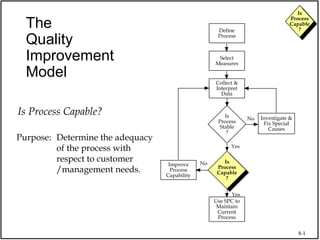
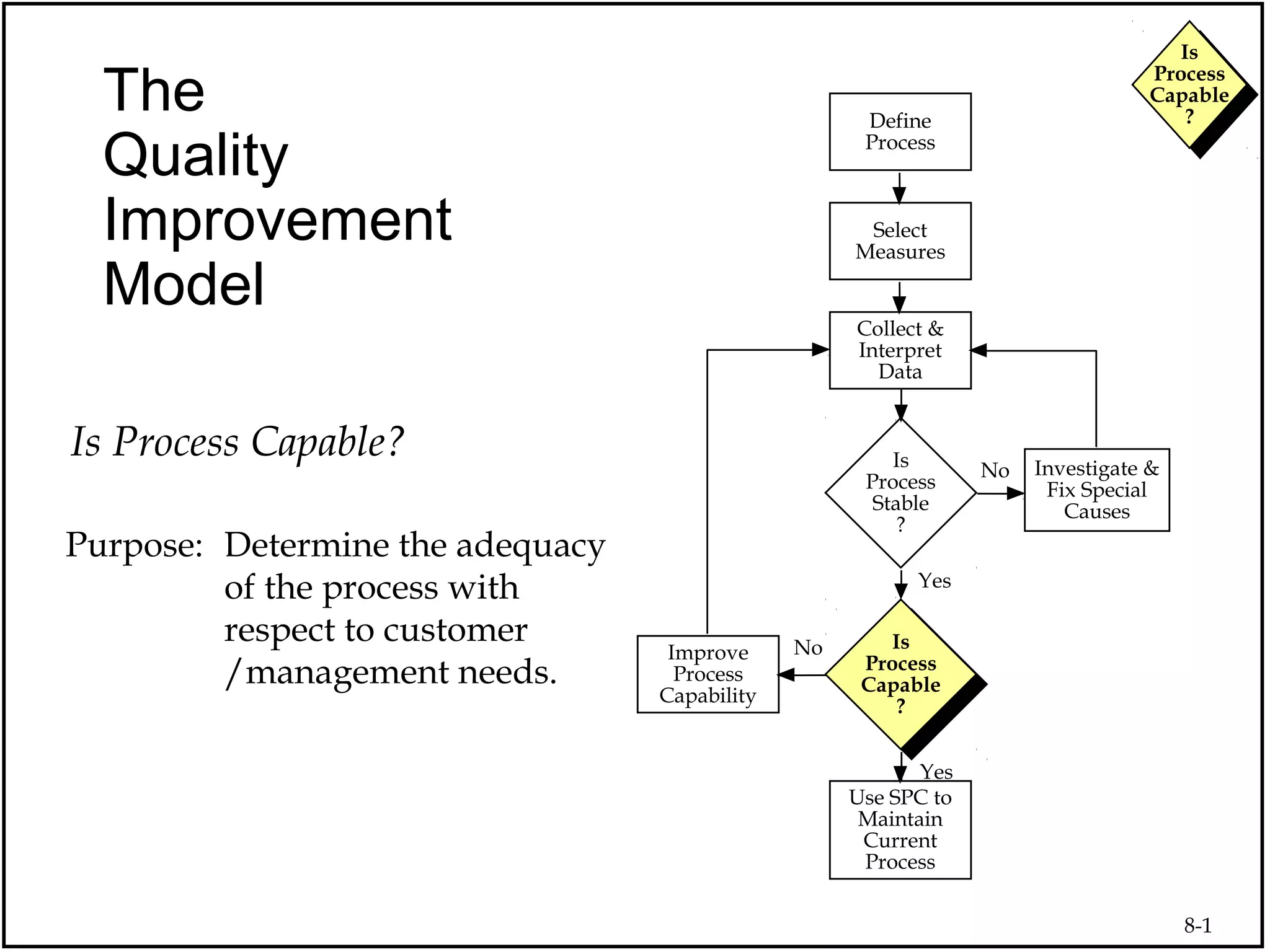
The
Quality
Improvement
Model
Use SPC to
Maintain
Current
Process
Collect &
Interpret
Data
Select
Measures
Define
Process
Is
Process
Capable
?
Is
Process
Capable
?
Improve
Process
Capability
Is
Process
Stable
?
Investigate &
Fix Special
Causes
No
Yes
No
Yes
Is Process Capable?
Purpose: Determine the adequacy
of the process with
respect to customer
/management needs.
8-2
Is
Process
Capable
?
Is
Process
Capable
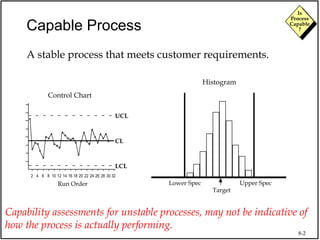
?Capable Process
A stable process that meets customer requirements.
8 22 242 4 6 10 12 14 16 18 20 26 28 30 32
Run Order
UCL
CL
LCL
Control Chart
Lower Spec Upper Spec
Target
Histogram
Capability assessments for unstable processes, may not be indicative of
how the process is actually performing.
8-3
Is
Process
Capable
?
Is
Process
Capable
?
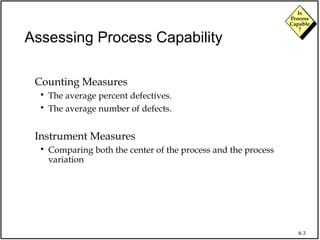
Assessing Process Capability
Counting Measures
 The average percent defectives.
 The average number of defects.
Instrument Measures
 Comparing both the center of the process and the process
variation
8-4
Is
Process
Capable
?
Is
Process
Capable
?
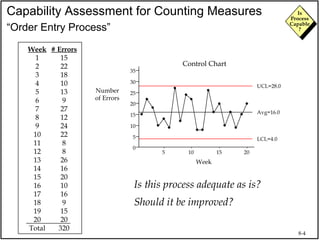
Capability Assessment for Counting Measures
“Order Entry Process”
Is this process adequate as is?
Should it be improved?
Week
1
2
3
4
5
6
7
8
9
10
11
12
13
14
15
16
17
18
19
20
Total
# Errors
15
22
18
10
13
9
27
12
24
22
8
8
26
16
20
10
16
9
15
20
320
0
5
10
15
20
25
30
35
5 10 15 20
Avg=16.0
LCL=4.0
UCL=28.0
Week
Number
of Errors
Control Chart
8-5
Is
Process
Capable
?
Is
Process
Capable
?
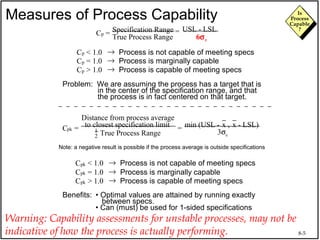
Measures of Process Capability
Cp = Specification Range
True Process Range
= USL - LSL
6σc
Cpk =
Distance from process average
to closest specification limit
1
2 True Process Range
= min (USL - x , x - LSL)
3σc
Problem: We are assuming the process has a target that is
in the center of the specification range, and that
the process is in fact centered on that target.
Note: a negative result is possible if the process average is outside specifications
Benefits: • Optimal values are attained by running exactly
between specs.
• Can (must) be used for 1-sided specifications
Cp < 1.0 → Process is not capable of meeting specs
Cp = 1.0 → Process is marginally capable
Cp > 1.0 → Process is capable of meeting specs
Cpk < 1.0 → Process is not capable of meeting specs
Cpk = 1.0 → Process is marginally capable
Cpk > 1.0 → Process is capable of meeting specs
Warning: Capability assessments for unstable processes, may not be
indicative of how the process is actually performing.
8-6
Is
Process
Capable
?
Is
Process
Capable
?
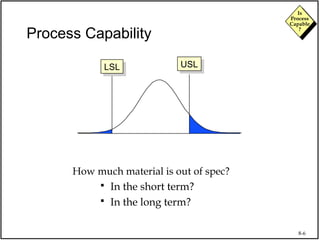
How much material is out of spec?
 In the short term?
 In the long term?
USLUSL
LSLLSL
Process Capability
8-7
Is
Process
Capable
?
Is
Process
Capable
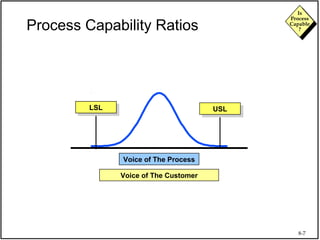
?Process Capability Ratios
Voice of The Customer
Voice of The Process
USLUSLLSLLSL
8-8
Is
Process
Capable
?
Is
Process
Capable
?
8-9
Is
Process
Capable
?
Is
Process
Capable
?
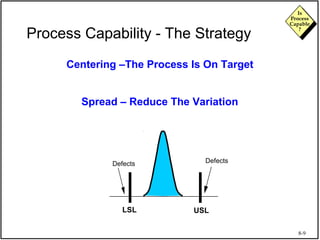
Process Capability - The Strategy
Centering –The Process Is On Target
Spread – Reduce The Variation
LSL USL
DefectsDefects
8-10
Is
Process
Capable
?
Is
Process
Capable
?
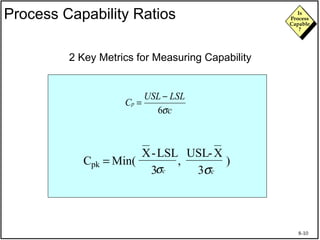
2 Key Metrics for Measuring Capability
C Min(
X-LSL
3
USL-X
3
pk = , )
c
LSLUSL
Cp
σ6
−
=
cσ cσ
Process Capability Ratios
8-11
Is
Process
Capable
?
Is
Process
Capable
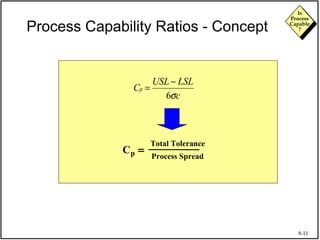
?Process Capability Ratios - Concept
Total Tolerance
C
Process Spreadp =
c
LSLUSL
Cp
σ6
−
=
8-12
Is
Process
Capable
?
Is
Process
Capable
?
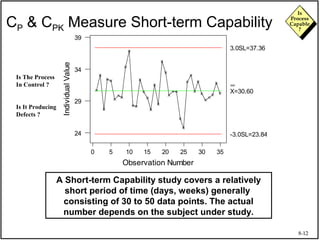
A Short-term Capability study covers a relatively
short period of time (days, weeks) generally
consisting of 30 to 50 data points. The actual
number depends on the subject under study.
Is The Process
In Control ?
Is It Producing
Defects ?
35302520151050
39
34
29
24
Observation Number
IndividualValue
I Chart for C1
X=30.60
3.0SL=37.36
-3.0SL=23.84
CP & CPK Measure Short-term Capability
8-13
Is
Process
Capable
?
Is
Process
Capable
?
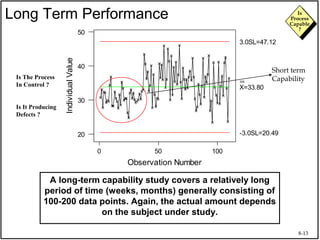
A long-term capability study covers a relatively long
period of time (weeks, months) generally consisting of
100-200 data points. Again, the actual amount depends
on the subject under study.
Is The Process
In Control ?
Is It Producing
Defects ?
100500
50
40
30
20
Observation Number
IndividualValue
I Chart for C3
X=33.80
3.0SL=47.12
-3.0SL=20.49
Long Term Performance
Short term
Capability
8-14
Is
Process
Capable
?
Is
Process
Capable
?
A Further Look at Capability
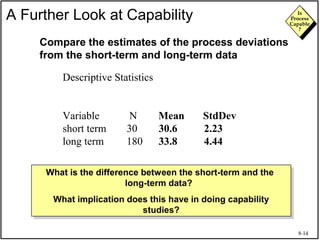
Compare the estimates of the process deviations
from the short-term and long-term data
What is the difference between the short-term and the
long-term data?
What implication does this have in doing capability
studies?
What is the difference between the short-term and the
long-term data?
What implication does this have in doing capability
studies?
Descriptive Statistics
Variable N Mean StdDev
short term 30 30.6 2.23
long term 180 33.8 4.44
8-15
Is
Process
Capable
?
Is
Process
Capable
?
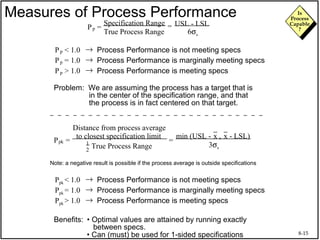
Measures of Process Performance
Pp =
Specification Range
True Process Range
= USL - LSL
6σs
Ppk =
Distance from process average
to closest specification limit
1
2
True Process Range
=
min (USL - x , x - LSL)
3σs
Problem: We are assuming the process has a target that is
in the center of the specification range, and that
the process is in fact centered on that target.
Note: a negative result is possible if the process average is outside specifications
Benefits: • Optimal values are attained by running exactly
between specs.
• Can (must) be used for 1-sided specifications
Pp < 1.0 → Process Performance is not meeting specs
Pp = 1.0 → Process Performance is marginally meeting specs
Pp > 1.0 → Process Performance is meeting specs
Ppk < 1.0 → Process Performance is not meeting specs
Ppk = 1.0 → Process Performance is marginally meeting specs
Ppk > 1.0 → Process Performance is meeting specs
8-16
Is
Process
Capable
?
Is
Process
Capable
?
Performance vs. Capability
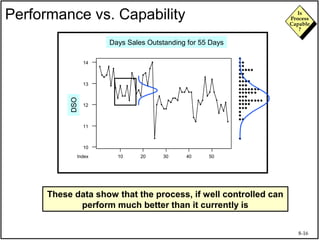
These data show that the process, if well controlled can
perform much better than it currently is
5040302010
14
13
12
11
10
Index
CO2-Shrt
CO2 Levels for 55 Time PointsDays Sales Outstanding for 55 Days
DSO
8-17
Is
Process
Capable
?
Is
Process
Capable
?
Capability vs. Performance
5040302010
14
13
12
11
10
Index
CO2-Shrt
CO2 Levels for 55 Time PointsDays Sales Outstanding for 55 Days
DSO
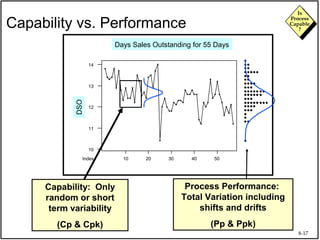
Process Performance:
Total Variation including
shifts and drifts
(Pp & Ppk)
Capability: Only
random or short
term variability
(Cp & Cpk)
8-18
Is
Process
Capable
?
Is
Process
Capable
?
Process Performance Ratios
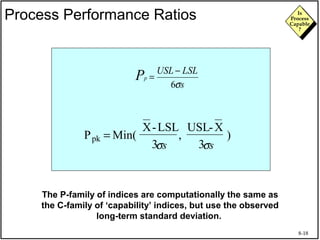
The P-family of indices are computationally the same as
the C-family of ‘capability’ indices, but use the observed
long-term standard deviation.
P Min(
X-LSL
3
USL-X
3
pk = , )
s
LSLUSL
pP
σ6
−
=
sσ sσ
8-19
Is
Process
Capable
?
Is
Process
Capable
?
WARNING!!!WARNING!!!
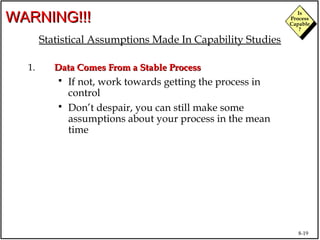
Statistical Assumptions Made In Capability Studies
1. Data Comes From a Stable ProcessData Comes From a Stable Process
 If not, work towards getting the process in
control
 Don’t despair, you can still make some
assumptions about your process in the mean
time

Basics of Process Capability