S tatistical   P rocess  C ontrol
SPC STATISTICAL A mathematical technique to  interpret and organise numerical  data PROCESS A set of linked activities that add value or produce an item. It will comprise of the 5Ms and 1E CONTROL A regulatory mechanism to ensure correct characteristic performance
Statistical Process Control SPC exists because there is variation in the characteristics of all machines, people, materials, methods, measurements and environments. SPC has as its aim “Zero Defect” through the application of defect prevention. SPC has as its foundation a philosophy which reduces external inspection, turning the focus on encouraging individuals to  manage the process to allow their efforts to concentrate on eradicating sources of process variability. SPC seeks to ensure the consistent performance of a process over a long duration
VARIATION C ommon  C ause   is a source of variation that is  always present , part of  the  random variation inherent in the process itself S pecial  C ause is a source of variation which is unpredictable or intermittent. It is sometimes called an assignable cause There are two main types of variability in a process :-
DATA VARIABLE This data is a measurement of a characteristic along a scale ATTRIBUTE This data has only two possibilities Pass / Fail Yes / No There is no measurement. A judgement is made
HISTOGRAM Sub- Groups Quantity
BELL SHAPE CURVE
BELL SHAPE CURVE T he Curve is Symmetrical either side is a Mirror Image. T he highest point of the Bell indicates the most common occurrence. This is called the “Arithmetic Average” Arithmetic   Average X
AVERAGES Mean: Arithmetic Average of group of  Measurements. The symbol for a sample is  and for a batch is Median: The middle value in a group of measurements  when arranged in ascending or descending  order. Mode: The most frequently occurring number in a  group of measurements. X X
STANDARD DEVIATION SIGMA This indicates an area of deviation from a standard position.  For sample size data this Greek symbol is used  s  For batch size data this symbol is used
STANDARD DEVIATION Standard Deviation Formula :-   (n - 1) (x-x) 2
STANDARD DEVIATION Mean 99.73 %       +/-  3 
STANDARD DEVIATION 99.73 % 13.59% 13.59%   34.13 % 34.13 %     0.13 % 0.13 % 2.14 % 2.14 %   Mean 8 8
DISTRIBUTION CURVES N ormal Distribution Process Performs around a Central Mean Repeatable. Predictable. B inomial Distribution Process has 2 means caused by: Resetting of Process. Changes in Operator. 2 Like processes measured as one. Spread X
PROCESS CAPABILITY Repeatability: The ability of a measuring device to  duplicate measurements when used  several times by one individual and  measuring  the identical characteristic. Reproducibility: The difference in the average of the  measurements made by different  persons using the same or different  measuring device when measuring  the identical characteristic
DISTRIBUTION CURVES   F lat Top - Process Mean has Gradually shifted. Tool Wear. Too Many measurables in the Process. S kew - Mean of process Biased to one side. Biased Inspection.
C APABILITY  is a Comparison between Actual Performance  & A Defined Specification
PROCESS CAPABILITY Process Capability is a measure of the variation of a process and its ability to produce components consistently within specifications Process Capability can only be defined when a process is in statistical control; this occurs only when special cause variation has been eliminated
PROCESS CAPABILITY Cp   is the theoretical Capability index of a process. This index quantifies the spread of the process relative to the specified limits 6   Cp = USL - LSL Cp > 1 Cp = 1 Cp < 1
PROCESS CAPABILITY C pk Is the  actual  capability  index of a process. The  Cpk index quantifies both the spread and the centring of the process in relation to the specified limits. Cpk = Minimum value of :- USL - X or X - LSL 3   3   Upper Tolerance Lower Tolerance High Cp, High  Cpk High Cp, Very Low  Cpk High Cp,  Very Low  Cpk Low  Cp, Low Cpk
PROCESS CAPABILITY I f the process variability is wider than the Limits, it is not capable,and will produce  Scrap   Cpk < 1 LSL USL
PROCESS CAPABILITY I f a process is capable, it is able to produce nearly 100% within the specified Limits. But this Process is NOT  ROBUST Cpk = 1 LSL USL
PROCESS CAPABILITY If the process variability is within the specified limits, the process is very capable, and will produce all good parts. This Process has  ROBUSTNESS! Cpk > 1 LSL USL
PROCESS CAPABILITY Accurate:(Cpk) A tight cluster of measurements that  lie within pre-determined limits. Precision:(Cp) A tight cluster of measurements that lie  outside pre-determined limits.
PROCESS CAPABILITY Precise Accurate
PROCESS CAPABILITY
Variable Control Charts Variable Data X  Sample Average Identify trends within the  process. R Sample Range Identify changes in  process variation. -5 -3 -1 1 3 5 0 1 2 3 4 s1 s2 s3 s4 s5 s6 s7 s8 s9 s10 X R
SIX SIGMA PROCESS LSL     X USL Cp = 2 Cpk  = 1.5 3.4 ppm Rejects
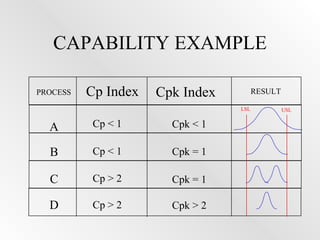
CAPABILITY EXAMPLE LSL USL PROCESS Cp Index Cpk Index A B C D Cp < 1 Cp < 1 Cp > 2 Cp > 2 Cpk < 1 Cpk = 1 Cpk = 1 Cpk > 2 RESULT
N ever ending improvement is Reflected in an  Increasing  Cpk value!

SPC WithAdrian Adrian Beale

  • 1.
    S tatistical P rocess C ontrol
  • 2.
    SPC STATISTICAL Amathematical technique to interpret and organise numerical data PROCESS A set of linked activities that add value or produce an item. It will comprise of the 5Ms and 1E CONTROL A regulatory mechanism to ensure correct characteristic performance
  • 3.
    Statistical Process ControlSPC exists because there is variation in the characteristics of all machines, people, materials, methods, measurements and environments. SPC has as its aim “Zero Defect” through the application of defect prevention. SPC has as its foundation a philosophy which reduces external inspection, turning the focus on encouraging individuals to manage the process to allow their efforts to concentrate on eradicating sources of process variability. SPC seeks to ensure the consistent performance of a process over a long duration
  • 4.
    VARIATION C ommon C ause is a source of variation that is always present , part of the random variation inherent in the process itself S pecial C ause is a source of variation which is unpredictable or intermittent. It is sometimes called an assignable cause There are two main types of variability in a process :-
  • 5.
    DATA VARIABLE Thisdata is a measurement of a characteristic along a scale ATTRIBUTE This data has only two possibilities Pass / Fail Yes / No There is no measurement. A judgement is made
  • 6.
  • 7.
  • 8.
    BELL SHAPE CURVET he Curve is Symmetrical either side is a Mirror Image. T he highest point of the Bell indicates the most common occurrence. This is called the “Arithmetic Average” Arithmetic Average X
  • 9.
    AVERAGES Mean: ArithmeticAverage of group of Measurements. The symbol for a sample is and for a batch is Median: The middle value in a group of measurements when arranged in ascending or descending order. Mode: The most frequently occurring number in a group of measurements. X X
  • 10.
    STANDARD DEVIATION SIGMAThis indicates an area of deviation from a standard position.  For sample size data this Greek symbol is used  s  For batch size data this symbol is used
  • 11.
    STANDARD DEVIATION StandardDeviation Formula :-   (n - 1) (x-x) 2
  • 12.
    STANDARD DEVIATION Mean99.73 %       +/- 3 
  • 13.
    STANDARD DEVIATION 99.73% 13.59% 13.59%   34.13 % 34.13 %     0.13 % 0.13 % 2.14 % 2.14 %   Mean 8 8
  • 14.
    DISTRIBUTION CURVES Normal Distribution Process Performs around a Central Mean Repeatable. Predictable. B inomial Distribution Process has 2 means caused by: Resetting of Process. Changes in Operator. 2 Like processes measured as one. Spread X
  • 15.
    PROCESS CAPABILITY Repeatability:The ability of a measuring device to duplicate measurements when used several times by one individual and measuring the identical characteristic. Reproducibility: The difference in the average of the measurements made by different persons using the same or different measuring device when measuring the identical characteristic
  • 16.
    DISTRIBUTION CURVES F lat Top - Process Mean has Gradually shifted. Tool Wear. Too Many measurables in the Process. S kew - Mean of process Biased to one side. Biased Inspection.
  • 17.
    C APABILITY is a Comparison between Actual Performance & A Defined Specification
  • 18.
    PROCESS CAPABILITY ProcessCapability is a measure of the variation of a process and its ability to produce components consistently within specifications Process Capability can only be defined when a process is in statistical control; this occurs only when special cause variation has been eliminated
  • 19.
    PROCESS CAPABILITY Cp is the theoretical Capability index of a process. This index quantifies the spread of the process relative to the specified limits 6  Cp = USL - LSL Cp > 1 Cp = 1 Cp < 1
  • 20.
    PROCESS CAPABILITY Cpk Is the actual capability index of a process. The Cpk index quantifies both the spread and the centring of the process in relation to the specified limits. Cpk = Minimum value of :- USL - X or X - LSL 3  3  Upper Tolerance Lower Tolerance High Cp, High Cpk High Cp, Very Low Cpk High Cp, Very Low Cpk Low Cp, Low Cpk
  • 21.
    PROCESS CAPABILITY If the process variability is wider than the Limits, it is not capable,and will produce Scrap Cpk < 1 LSL USL
  • 22.
    PROCESS CAPABILITY If a process is capable, it is able to produce nearly 100% within the specified Limits. But this Process is NOT ROBUST Cpk = 1 LSL USL
  • 23.
    PROCESS CAPABILITY Ifthe process variability is within the specified limits, the process is very capable, and will produce all good parts. This Process has ROBUSTNESS! Cpk > 1 LSL USL
  • 24.
    PROCESS CAPABILITY Accurate:(Cpk)A tight cluster of measurements that lie within pre-determined limits. Precision:(Cp) A tight cluster of measurements that lie outside pre-determined limits.
  • 25.
  • 26.
  • 27.
    Variable Control ChartsVariable Data X Sample Average Identify trends within the process. R Sample Range Identify changes in process variation. -5 -3 -1 1 3 5 0 1 2 3 4 s1 s2 s3 s4 s5 s6 s7 s8 s9 s10 X R
  • 28.
    SIX SIGMA PROCESSLSL     X USL Cp = 2 Cpk = 1.5 3.4 ppm Rejects
  • 29.
    CAPABILITY EXAMPLE LSLUSL PROCESS Cp Index Cpk Index A B C D Cp < 1 Cp < 1 Cp > 2 Cp > 2 Cpk < 1 Cpk = 1 Cpk = 1 Cpk > 2 RESULT
  • 30.
    N ever endingimprovement is Reflected in an Increasing Cpk value!

Editor's Notes

  • #5 Common and Special Causes. Shewhart identified that there are two types of variation, common cause and special cause . Common Cause variation is one which is contained within a natural process which is in a state of statistical control. This variation is inherent in the process and requires fundamental action to reduce it. In the process of a journey with the aim of getting to work this will mean things like waiting time at fixed traffic lights, only fundamental action on the process like changing route or removing the traffic lights will remove the cause of the variation. Special Cause Variation is one which stems from a change which is outside the system or process and is seen as additional variation. In the journey to work example this would include Roadwork&apos;s and Breakdowns. In most cases action can be taken to achieve a reduction in the future effect of these causes by better maintenance to avoid the breakdown.
  • #7 The histogram is used to show graphically the relative number of occurrences of a range of events. It uses vertical bars…..It plots frequency on the vertical axis against events one after the other on the horizontal axis
  • #9 10
  • #14 The Diagram above shows the relationship between Standard Deviation and probability. Most of the time1 we relate to +/- 3 standard deviations, between which we can be sure that 99.73 % of our measured sample will fall between.
  • #15 Normal A normal distribution is repeatable and predictable. It defines a stable process The majority of measurements will fall around the mean and occasionally they will fall away from the mean, this is due to natural variation in the process. The natural variation is due to “Common Causes - these are causes common to the process and are always present. Bi - Modal distribution is a process that varies about 2 means. It is possible that 2 processes are being measured or a process has been stopped, reset and continued with the data being continuously collected. The process may also be effected by changes in people or materials. These are all “Special Causes” and can be controlled with relative ease.
  • #17 A flat Top distribution is usually due to a process that has drifted. The process could have drifted as a result of tooling wear, temperature change or continuous incremental adjustments or changes to a system. These are Special Causes and action should be taken to identify them. A Skewed distribution is a process where a bias may be present. Faulty measurement process or biased system operators could cause it. There could also be an incremental change in the process under certain conditions. These are also Special Causes.
  • #22 Lower Specified Limit = LSL Upper Specified Limit = USL