Safkat Sultana Suchana
PRAN HRM
It is a quality
philosophy and
a management
technique.
It is a
methodology for
continuous
improvement
It is a methodology for
creating products
processes that perform
at high standards.
It is a set of
statistical and other
quality tools
arranged in unique
way.
It is a way of
knowing where you
are and where you
could be
History of Six Sigma
Bill Smith
Motorola company that invented Six Sigma
 The term “Six Sigma” was coined by Bill Smith, an engineer with
Motorola
 Late 1970s – Motorola started experimenting with problem solving
through statistical analysis
 1987 – Motorola officially launched it’s Six Sigma program
 Motorola saved more than $15 billion in the first 10 years of its Six
Sigma effort
Six Sigma at GE
Jack Welch (former CEO of General
Electric) launched six sigma at GE, in
Jan, 1996.
1998-1999 green belt exam
certification became the criteria for
management promotions.
Saved $750 million by the end of 1998
Cut invoice defects and disputes by 98 percent, speeding
payment, and creating better productivity.
Definition – Six Sigma
Six Sigma is a rigorous, focused and effective implementation of proven
principles and techniques which aims at virtually error free business
performance. It refers to 3.4 defects per million opportunities.
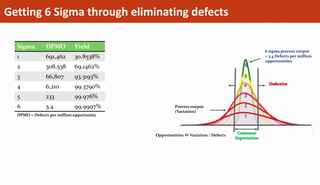
Getting 6 Sigma through eliminating defects
6 sigma process output
= 3.4 Defects per million
opportunities
Process output
(Variation)
Sigma DPMO Yield
1 691,462 30.8538%
2 308,538 69.1462%
3 66,807 93.3193%
4 6,210 99.3790%
5 233 99.976%
6 3.4 99.9997%
DPMO = Defects per million opportunity
Opportunities  Variation / Defects
Common Cause of Variation
Benefits of Six Sigma
What is Lean?
Lean is a structured approach focusing on
simplifying processes by eliminating the tasks
that do not bring value for the end customer.
This approach was mostly derived form the Toyota Production System in the
beginning of the 20th century and identified as “Lean” only in the 1990s.
Simplifying and Perfecting
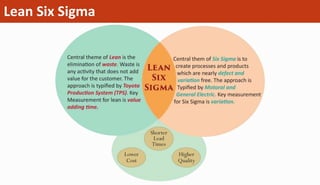
Lean Six Sigma
Unnecessary movements
Of products and materials
Defects
Making more than is
Immediately required
Over Production
Waiting
Transport Inventory Motion
Over processing Unutilized Skills
Unnecessary movements
By People
Waiting for the previous
Step in the process to
complete
Storing parts, pieces,
Documentation ahead
Of requirements
Performing any activities
That is not necessary
Making mistakes that
Cause products to fail
Customer requirements
Not utilizing human
Talent within the
Workforce
Lean Manufacturing Eliminating the waste - Muda
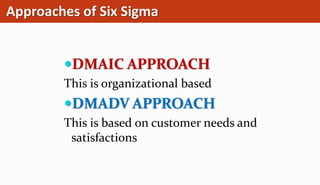
Approaches of Six Sigma
DMAIC APPROACH
This is organizational based
DMADV APPROACH
This is based on customer needs and
satisfactions
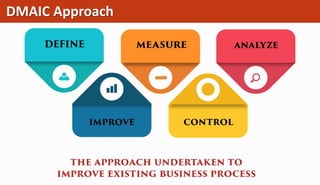
DMAIC Approach
DMAIC Continued….
1. Define: high-level project goals and the current process.
1. Measure: Key aspects of the current process and collect relevant data.
2. Analyze: the data to verify cause and effect relationships. Determine what
the relationships are, and attempt to ensure that all factors have
considered.
3. Improve: optimize the process based upon data analysis using various
tools.
4. Control: to ensure that any deviations from target are corrected before they
result in defects.
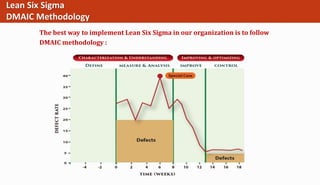
Lean Six Sigma
DMAIC Methodology
The best way to implement Lean Six Sigma in our organization is to follow
DMAIC methodology :
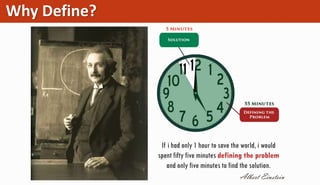
Why Define?
Define
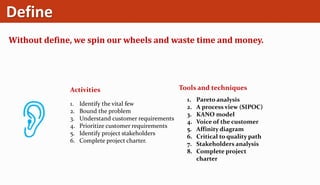
Without define, we spin our wheels and waste time and money.
Activities Tools and techniques
1. Identify the vital few
2. Bound the problem
3. Understand customer requirements
4. Prioritize customer requirements
5. Identify project stakeholders
6. Complete project charter.
1. Pareto analysis
2. A process view (SIPOC)
3. KANO model
4. Voice of the customer
5. Affinity diagram
6. Critical to quality path
7. Stakeholders analysis
8. Complete project
charter
A Process View
A SIPOC diagram is a tool used by a team to identify all relevant elements of a
process improvement project before work begins.
 Everything is a process.
 The quality of a product or service is directly related to the quality of the process
 As change agents, we must address the process as a whole in order to deliver real change
 We start with SIOPC - a higher level view of the process
SIPOC Diagram
Looking
for new
customer
Find
customer
needs
Identify
critical
needs
Develop
prototype
Test prototype
& go to
Production
Suppliers Inputs Process Outputs Customers Requirements
• Raw materials
• Sources
• Manufacturers
• Suppliers
• Manpower
• Resources
• Equipment
• Product
• Timely delivery
• Increased
quality
• Young people
• Students
• Service holders
• Customer satisfaction
• Expected quality
• Reduced backlog
Voice Of Customer (VOC)
The voice of the customer is a Six Sigma strategy used to capture requirements and feedback from the customer
and to meet their requirements.
There are two approaches we gather Voice of Customer
• Looks at historical data to determine issues,
unmet needs, problems and interests of
former customers.
 Customer complaints
 Customer service calls
 Product return information
 Warranty claims
 Web page activity
Verify conclusions of reactive research.
• Determine interests and unmet needs of future
customers
 Surveys
 Interviews
 Market research
 Benchmarking
 Observe customer
Reactive Approach Proactive Approach
VOC Technique
Critical to Quality (CTQ)
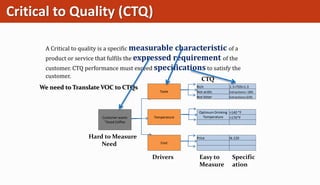
A Critical to quality is a specific measurable characteristic of a
product or service that fulfils the expressed requirement of the
customer. CTQ performance must exceed specifications to satisfy the
customer.
Taste
Rich 1.1<TDS>1.3
Not acidic Extractions> 18%
Not bitter Extractions<22%
Customer wants
"Good Coffee
Temperature
Optimum Drinking
Temperature
>140 *F
<176*F
Cost
Price tk.120
We need to Translate VOC to CTQs
Hard to Measure
Need
Drivers Easy to
Measure
Specific
ation
CTQ
Project Charter
In the Define phases of DMAIC we need to have all the team members are agreed
to the project and the approval and sponsor from the top management.
We do put all the
details of the project
and planning for the
project in the
project charter
which shows the
overall activities at a
glance.
Project Charter is a good executive communication tool
Measure
The goal of the measure phase of a Six Sigma DMAIC project is to get as much information as
possible on the current process so as to fully Understand both how it works and how well it works.
This entails three key tasks: creating a detailed process map, gathering baseline data and
summarizing and analyzing the date .
Activities
1 Ensure Good Measurement System
2 Measure Current Performance
3 Map the process and identify all variables
that can effect performance
4 Prioritize process inputs
5 Basic Statistics
6 Determine current process capability
Tools and Techniques
1 Process Map
2 Value Stream Map
3 Defect per million opportunity
4 Interrelation Diagram
5 Activity network diagram
6 Matrix Diagram
7 Tree Diagram
8 DPU, DPMO, PPM and RYT
Process Mapping
What is process mapping ?
Graphical illustration of the work process.
What does process map do ?
1. Listing activities in sequential order.
2. Assigning activities to people in the company.
What are benefits of process mapping?
 Identify major tasks
 Identify sequence of tasks
 Identify accountability of task
 Identify process inputs that affect process output
SIPOC
Flow
chart
Process
map
Value Stream Mapping
Flow Chart Symbols
Flow Chart Examples
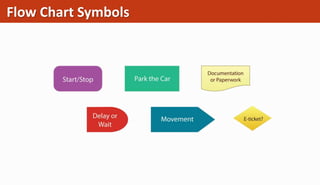
List + Sequence of Actions, Delays, Decisions and Movement
Value Stream Mapping
(Important part of Lean six sigma let’s study it)
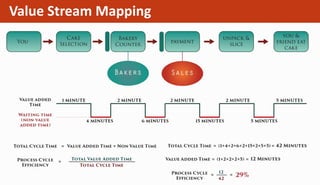
 Value Stream Mapping (VSM) is a tool used to examine a
PROCESS for the presence of unnecessary and wasteful activities.
 It provides visibility of Material Flow & Information Flow in a
process.
 On one diagram the team can visualize the EIGHT forms of waste
(i.e., Defects, Overproduction, Waiting, Non-utilized Talent,
Transportation, Inventory, Motion, Extra Processing)
 A Value Stream Map is all about learning to see the WASTE in a
process.
Analyzing
In the analyze phase, data collected during the measure phase is reviewed.
Both the data and the process are analyzed , in a n effort to narrow down and
verify the root causes of waste and defects.
Activities
1. Define performance objectives
2. Identify value/non-value added
process steps
3. Identify source of variation
4. Determine root causes
5. Identify significant process
inputs.
Tools and techniques
1. Histogram
2. Root cause analysis (fishbone
diagram )
3. 5 whys
4. 5w’s and H method
5. Regression analysis
6. Hypothesis analysis
7. Run chart
8. ANOVA analysis
9. Fault tree diagram
Root Cause Analysis
Root cause analysis is a useful process for understanding and solving a problem,. Figure
out what negative events are occurring. Then, look at the complex systems around those
problems, and identify key points of failure. Finally, determine solution to address
those key points, or root causes.
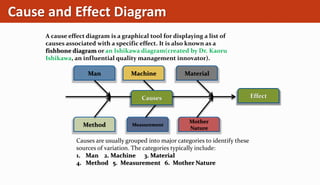
Cause and Effect Diagram
A cause effect diagram is a graphical tool for displaying a list of
causes associated with a specific effect. It is also known as a
fishbone diagram or an Ishikawa diagram(created by Dr. Kaoru
Ishikawa, an influential quality management innovator).
Man Machine Material
Method Measurement
Mother
Nature
Causes Effect
Causes are usually grouped into major categories to identify these
sources of variation. The categories typically include:
1. Man 2. Machine 3. Material
4. Method 5. Measurement 6. Mother Nature
Fishbone Diagram
From the example we can
see that ,
There are many reasons
for missing the bus we did
the fishbone analysis to
find out the possible
reasons behind the effects
and we know the causes of
missing bus.
This is how we can find
out the reasons behind the
effects.
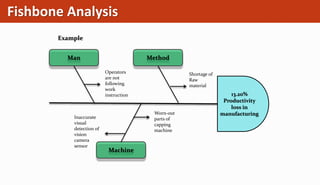
Fishbone Analysis
13.20%
Productivity
loss in
manufacturing
Method
Machine
Man
Operators
are not
following
work
instruction
Shortage of
Raw
material
Worn-out
parts of
capping
machine
Inaccurate
visual
detection of
vision
camera
sensor
Example
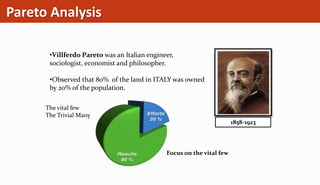
Pareto Analysis
•Villferdo Pareto was an Italian engineer,
sociologist, economist and philosopher.
•Observed that 80% of the land in ITALY was owned
by 20% of the population.
1858-1923
Focus on the vital few
The vital few
The Trivial Many
Pareto Chart Analysis
Pareto chart helps to find out the 20% factors that cause 80% problems. Through the Pareto chart we can
focus on that 20% factors and can improve the process.
5 Whys Analysis
To solve a problem effectively , we need to drill down to identify
the underline cause so Sakichi Toyoda 5 why’s techniques is the
simple but very powerful tool for quickly uncovering the root of
a problem.
Sakichi Toyoda, one of the fathers of the Japanese
industrial revolution, developed the technique in
the 1930s. He was an industrialist, inventor and
founder of Toyota Industries. His technique
became popular in the 1970s and Toyota still
uses it to solve problems today.
Sakichi Toyoda
5 Why’s Example
To use it we start with the problem we are facing then keep
asking why until we discover the root cause .
Why ?
Forget to
replace
them
Improve Phase
The goal of the DMAIC improve Phase is to indentify a solution
to the problem that the project aims to address. In this phase we
will be trying to look for solution of the problem that was
identified in the analysis phase.
Activities
1. Consolidate our analysis.
2. Generate solutions
3. Create an implementation plan.
4. Implement the solutions.
Tools and Techniques
1. Brainstorming
2. Kaizen
3. 5s
4. Mistake proving Poke Yoke
5. Failure mood and effects
analysis (FEME).
Brainstorming
Brainstorming is group creativity technique by which
efforts are made to find a conclusion for a specific
problem by gathering a list of ideas spontaneously
contributed by its members.
Effective Brainstorming includes
• Collect as many ideas as possible.
• All ideas are welcome no matter how silly it is.
• No Discussion during Brainstorming.
• Do not criticize or judge. Do not even groan, frown, or laugh.
• Do “Piggyback” or build on other ideas.
• Go for quantity over quality- the ore creative ideas the better.
5S Improvement System
5s is the name of a workplace organization method that uses a list of
five Japanese words: seiri, seiton, seiso, seiketsu, and shitsuke.
Better visual management
Improved safety
Improved quality
Improved Productivity
Boosted Morale
Improved Company Image
5S Explanation
It is a system to reduce waste and optimize productivity through maintaining
an orderly workplace and using visual cues to achieve more consistent
operational results.
Sort Straighten Shine Standardize Sustain
Eliminate
Unnecess
ary
Items
from the
workplace
Arrange
items so
that they
are easy
to use,
find and
put away
Keep the
items and
work area
neat and
clean
Create a
consistent
approach
to tasks
and
procedures
Make a
habit of
maintainin
g the
correct
procedures
Kaizen (Continuous Improvement)
Kaizen is a Japanese philosophy that focuses on continual improvement
throughout all aspects of life. Kaizen aims to eliminate waste in all systems
of an organization through improving standardized activities and
processes.
The continuous cycle of Kaizen activities has seven phases
1. Identify an opportunity
2. Analyze the process
3. Develop an optimal
solution
4. Implement the solution
5. Study the results
6. Standardize the solution
7. Plan for the future
14 Rules of Kaizen
1. Keep an open mind to change
2. Maintain a positive attitude
3. Create a blameless environment
4. Encourage non judgmental thinking
5. Be aware of multiple alternatives
6. Treat other as you would want to be treated
7. Respect and involve all team members
8. One person, one vote
9. Create a team environment
10.No such thing as a dumb question
11. Create a bias for action
12. Creativity before capital
13. Never leave in silent agreement
14. Have fun doing it
Zero Defect Policy
The goal is to understand like concept and practice of zero
defects and how to develop Poke – Yoke to eliminate these
defects .
Typically defect rates are tracked by
1. The point at which defect is discovered
2. The point at which defect occurred.
Attitude toward defects should be
1. I do not accept defects
2. I do not make defects
3. I do not pass on defects.
Poka-yoke Technique
Poka-yoke is a technique for avoiding simple human error in the workplace. It is also know
as mistake-proofing and fail-safe work methods. Poka-yoke helps preventing errors
obviously improves quality, but it also plays a major role in improving productivity with no
rework, and easier production, cycle times and lead times both become much shorter. And,
of course, faster production with fewer defects means lower cost.
Potential Benefits for using Poka-yoke
1. Elimination of set-up errors and improved quality
2. Simplified and improved housekeeping
3. Increased safety
4. Lower costs
5. Lower skill requirements
6. Increased production flexibility
7. Improved operator attitudes
Example of Poka-yoke
Failure Modes and Effects Analysis (FMEA)
Goals :
1. Reduce risk of failure
2. Ensure failures are detectible
3. Prevent failure from happing
Failure Mode and Effects Analysis (FMEA) is a structured approach to
discovering potential failures that may exist within the design of a product or
process. Failure Mode and Effects Analysis is designed to identify, prioritize
and limit these failure modes.
Why?
Keep track of potential failure and
countermeasures to reduce the risk
Failure Mood and Effect Analysis Process
Item /
Function
Potential
Failure Mode(s)
Potential
Effect(s) of
Failure
Potential Cause(s)/
Mechanism(s) of
Failure
Probabi
lity
Sever
ity
Detecta
bility
RPN
(Packing
Recovery
Note)
Recommended Action(s)
Electric
bend
Flush Problem
Rejection Parameter setting 8 6 4 192
Validation of Parameter
(Pressure, Speed, Cycle Time)
Rejection Mould Problem 8 8 2 128
Mould send for repairing to
TOOLROOM
Customer
Complain
Operator
Problem
9 8 5 360 Awareness training
RPN Calculation
Suggestion:
For flush problem operator problem will be given first priority for high RPN. Then need to work with parameter setting,
finally mold problem will be given last priority for lower RPN.For removing bad effects all the problems must be solved,
RPN determine only priorities of work sequence.
Occurance Rank Severity Rank Detection Rank
10 – 100 per 1,000
9 – 50 per 1,000
8 – 20 per 1,000
7 – 10 per 1,000
6 – 5 per 1,000
5 – 2 per 1,000
4 – 1 per 1,000
3 – 0.5 per 1,000
2 – 0.1 per 1,000
1 – 0.01 per 1,000
10 – Hazardous, without warning
9 – Hazardous, with warning
8 – Very High
7 – High
6 – Moderate
5 – Low
4 – Very Low
3 – Minor
2 – Very Minor
1 – None
10 – Absolutely Impossible
9 – Very Difficult
8 – Difficult
7 – Somewhat difficult
6 – Little difficult
5 – Somewhat easy
4 – Easy
3 – Very Easy
2 – Very very easy
1 – Absolutely Easy
Control Phase
The control phase is the final phase of lean six sigma. The team focuses on how to sustain
newly achieved improvements by passing it onto other employees .
Activities Tools and techniques
• Process control plan
• Monitoring and response plan
• Documentation and story board.
• Integrate and manage solutions in
daily work processes
• Integrate lessons learned
• Control chart
• Standard operating procedures
• Visual process control
• Total productive management
• Lean accounting
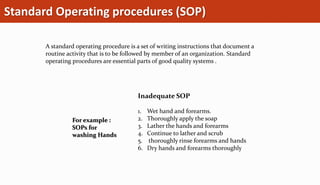
Standard Operating procedures (SOP)
A standard operating procedure is a set of writing instructions that document a
routine activity that is to be followed by member of an organization. Standard
operating procedures are essential parts of good quality systems .
For example :
SOPs for
washing Hands
Inadequate SOP
1. Wet hand and forearms.
2. Thoroughly apply the soap
3. Lather the hands and forearms
4. Continue to lather and scrub
5. thoroughly rinse forearms and hands
6. Dry hands and forearms thoroughly
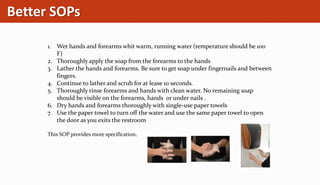
Better SOPs
1. Wet hands and forearms whit warm, running water (temperature should be 100
F)
2. Thoroughly apply the soap from the forearms to the hands
3. Lather the hands and forearms. Be sure to get soap under fingernails and between
fingers.
4. Continue to lather and scrub for at lease 10 seconds.
5. Thoroughly rinse forearms and hands with clean water. No remaining soap
should be visible on the forearms, hands or under nails .
6. Dry hands and forearms thoroughly with single-use paper towels
7. Use the paper towel to turn off the water and use the same paper towel to open
the door as you exits the restroom
This SOP provides more specification.
Single Minute Exchange of Die (SMED)
 SMED : Single Minute Exchange of Dies
 Meaning: No set-up should last for more than nine minutes
 Achieve SMED by “Working Smarter”, not by increased investment or
automation
 SMED is a systematic approach that reduces disturbances and problem
 SMED needs teamwork and creativity
SMED
Single-Minute Exchange of Die (SMED) is used to reduce changeover or setup time, which
is the time needed between the completion of one procedure and the start of the next
procedure.
•1960s SMED starts to develop
•1970 Dr. Shingeo Shingo cut the set up time for a 3000-ton sheet metal stamping
press form 4 hours to three minutes
•1983 Dr. Shingo wrote “ A revolution in manufacturing: the SMED system”
It consists of three main subcomponents
Dr. Shingeo Shingo
Shutdown
Cleaning
Startup
Categorized activities
Internal activities
Changeover activities that must be completed when the machine is down
for the safety of the operator, equipment, or product. These are activities
that happen inside the danger zone of the machine.
External Activities
Changeover activities that can be completed while the machine is in a run
state without causing harm to the operator, equipment or products.
Typical Setup Process
Set up Process % of Set up
Time
Gathering necessary items 25%
Exchanging parts 10%
Positioning parts 20%
Making adjustments 45%
The biggest opportunity for improvement is in
reducing the look time for gathering items and
eliminating the need to make adjustments.
Gemb
a
Go See
Ask Why?
Show
Respect
Wal
k
Benefits of Gemba Walk
Do it right
• Chance to observe the process and learn how it is working
• It is not an opportunity to deal with problems or to record complaints from workers
Look closer
• Give project teams a chance to observe the process in action
• Quite and attentive observation helps to understand the process better
• It breeds new and innovative ideas
Not MBWA
• MBWA (Management By Walking Around means randomly wandering the factory floor and be able
to solve the problems.
• The Gemba Walk is different is different it starts with purpose and team members know why they
are observing and what they are trying to learn.
DMADV is a Six Sigma framework that focuses primarily on the development
of a new service, product or process as opposed to improving a previously
existing one. This approach – Define, Measure, Analyze, Design, Verify – is
especially useful when implementing new strategies and initiatives because
of its basis in data, early identification of success and thorough analysis.
 The DMADV Methodology should be applied:
 when a non-existent product or process needs to be developed at a
company and…
 when an existing process or product already exists but still needs to meet a
Six Sigma Level or customer specification
DMADV Approach
DMADV Approach
Six sigma

Six sigma

  • 1.
  • 2.
    It is aquality philosophy and a management technique. It is a methodology for continuous improvement It is a methodology for creating products processes that perform at high standards. It is a set of statistical and other quality tools arranged in unique way. It is a way of knowing where you are and where you could be
  • 3.
    History of SixSigma Bill Smith Motorola company that invented Six Sigma  The term “Six Sigma” was coined by Bill Smith, an engineer with Motorola  Late 1970s – Motorola started experimenting with problem solving through statistical analysis  1987 – Motorola officially launched it’s Six Sigma program  Motorola saved more than $15 billion in the first 10 years of its Six Sigma effort
  • 4.
    Six Sigma atGE Jack Welch (former CEO of General Electric) launched six sigma at GE, in Jan, 1996. 1998-1999 green belt exam certification became the criteria for management promotions. Saved $750 million by the end of 1998 Cut invoice defects and disputes by 98 percent, speeding payment, and creating better productivity.
  • 5.
    Definition – SixSigma Six Sigma is a rigorous, focused and effective implementation of proven principles and techniques which aims at virtually error free business performance. It refers to 3.4 defects per million opportunities.
  • 6.
    Getting 6 Sigmathrough eliminating defects 6 sigma process output = 3.4 Defects per million opportunities Process output (Variation) Sigma DPMO Yield 1 691,462 30.8538% 2 308,538 69.1462% 3 66,807 93.3193% 4 6,210 99.3790% 5 233 99.976% 6 3.4 99.9997% DPMO = Defects per million opportunity Opportunities  Variation / Defects
  • 7.
    Common Cause ofVariation
  • 9.
  • 10.
    What is Lean? Leanis a structured approach focusing on simplifying processes by eliminating the tasks that do not bring value for the end customer. This approach was mostly derived form the Toyota Production System in the beginning of the 20th century and identified as “Lean” only in the 1990s.
  • 11.
  • 12.
  • 13.
    Unnecessary movements Of productsand materials Defects Making more than is Immediately required Over Production Waiting Transport Inventory Motion Over processing Unutilized Skills Unnecessary movements By People Waiting for the previous Step in the process to complete Storing parts, pieces, Documentation ahead Of requirements Performing any activities That is not necessary Making mistakes that Cause products to fail Customer requirements Not utilizing human Talent within the Workforce Lean Manufacturing Eliminating the waste - Muda
  • 14.
    Approaches of SixSigma DMAIC APPROACH This is organizational based DMADV APPROACH This is based on customer needs and satisfactions
  • 15.
  • 16.
    DMAIC Continued…. 1. Define:high-level project goals and the current process. 1. Measure: Key aspects of the current process and collect relevant data. 2. Analyze: the data to verify cause and effect relationships. Determine what the relationships are, and attempt to ensure that all factors have considered. 3. Improve: optimize the process based upon data analysis using various tools. 4. Control: to ensure that any deviations from target are corrected before they result in defects.
  • 17.
    Lean Six Sigma DMAICMethodology The best way to implement Lean Six Sigma in our organization is to follow DMAIC methodology :
  • 18.
  • 19.
    Define Without define, wespin our wheels and waste time and money. Activities Tools and techniques 1. Identify the vital few 2. Bound the problem 3. Understand customer requirements 4. Prioritize customer requirements 5. Identify project stakeholders 6. Complete project charter. 1. Pareto analysis 2. A process view (SIPOC) 3. KANO model 4. Voice of the customer 5. Affinity diagram 6. Critical to quality path 7. Stakeholders analysis 8. Complete project charter
  • 20.
    A Process View ASIPOC diagram is a tool used by a team to identify all relevant elements of a process improvement project before work begins.  Everything is a process.  The quality of a product or service is directly related to the quality of the process  As change agents, we must address the process as a whole in order to deliver real change  We start with SIOPC - a higher level view of the process
  • 21.
    SIPOC Diagram Looking for new customer Find customer needs Identify critical needs Develop prototype Testprototype & go to Production Suppliers Inputs Process Outputs Customers Requirements • Raw materials • Sources • Manufacturers • Suppliers • Manpower • Resources • Equipment • Product • Timely delivery • Increased quality • Young people • Students • Service holders • Customer satisfaction • Expected quality • Reduced backlog
  • 23.
    Voice Of Customer(VOC) The voice of the customer is a Six Sigma strategy used to capture requirements and feedback from the customer and to meet their requirements. There are two approaches we gather Voice of Customer • Looks at historical data to determine issues, unmet needs, problems and interests of former customers.  Customer complaints  Customer service calls  Product return information  Warranty claims  Web page activity Verify conclusions of reactive research. • Determine interests and unmet needs of future customers  Surveys  Interviews  Market research  Benchmarking  Observe customer Reactive Approach Proactive Approach
  • 24.
  • 25.
    Critical to Quality(CTQ) A Critical to quality is a specific measurable characteristic of a product or service that fulfils the expressed requirement of the customer. CTQ performance must exceed specifications to satisfy the customer. Taste Rich 1.1<TDS>1.3 Not acidic Extractions> 18% Not bitter Extractions<22% Customer wants "Good Coffee Temperature Optimum Drinking Temperature >140 *F <176*F Cost Price tk.120 We need to Translate VOC to CTQs Hard to Measure Need Drivers Easy to Measure Specific ation CTQ
  • 26.
    Project Charter In theDefine phases of DMAIC we need to have all the team members are agreed to the project and the approval and sponsor from the top management. We do put all the details of the project and planning for the project in the project charter which shows the overall activities at a glance. Project Charter is a good executive communication tool
  • 27.
    Measure The goal ofthe measure phase of a Six Sigma DMAIC project is to get as much information as possible on the current process so as to fully Understand both how it works and how well it works. This entails three key tasks: creating a detailed process map, gathering baseline data and summarizing and analyzing the date . Activities 1 Ensure Good Measurement System 2 Measure Current Performance 3 Map the process and identify all variables that can effect performance 4 Prioritize process inputs 5 Basic Statistics 6 Determine current process capability Tools and Techniques 1 Process Map 2 Value Stream Map 3 Defect per million opportunity 4 Interrelation Diagram 5 Activity network diagram 6 Matrix Diagram 7 Tree Diagram 8 DPU, DPMO, PPM and RYT
  • 29.
    Process Mapping What isprocess mapping ? Graphical illustration of the work process. What does process map do ? 1. Listing activities in sequential order. 2. Assigning activities to people in the company. What are benefits of process mapping?  Identify major tasks  Identify sequence of tasks  Identify accountability of task  Identify process inputs that affect process output SIPOC Flow chart Process map
  • 30.
  • 31.
  • 32.
    Flow Chart Examples List+ Sequence of Actions, Delays, Decisions and Movement
  • 33.
    Value Stream Mapping (Importantpart of Lean six sigma let’s study it)  Value Stream Mapping (VSM) is a tool used to examine a PROCESS for the presence of unnecessary and wasteful activities.  It provides visibility of Material Flow & Information Flow in a process.  On one diagram the team can visualize the EIGHT forms of waste (i.e., Defects, Overproduction, Waiting, Non-utilized Talent, Transportation, Inventory, Motion, Extra Processing)  A Value Stream Map is all about learning to see the WASTE in a process.
  • 34.
    Analyzing In the analyzephase, data collected during the measure phase is reviewed. Both the data and the process are analyzed , in a n effort to narrow down and verify the root causes of waste and defects. Activities 1. Define performance objectives 2. Identify value/non-value added process steps 3. Identify source of variation 4. Determine root causes 5. Identify significant process inputs. Tools and techniques 1. Histogram 2. Root cause analysis (fishbone diagram ) 3. 5 whys 4. 5w’s and H method 5. Regression analysis 6. Hypothesis analysis 7. Run chart 8. ANOVA analysis 9. Fault tree diagram
  • 35.
    Root Cause Analysis Rootcause analysis is a useful process for understanding and solving a problem,. Figure out what negative events are occurring. Then, look at the complex systems around those problems, and identify key points of failure. Finally, determine solution to address those key points, or root causes.
  • 36.
    Cause and EffectDiagram A cause effect diagram is a graphical tool for displaying a list of causes associated with a specific effect. It is also known as a fishbone diagram or an Ishikawa diagram(created by Dr. Kaoru Ishikawa, an influential quality management innovator). Man Machine Material Method Measurement Mother Nature Causes Effect Causes are usually grouped into major categories to identify these sources of variation. The categories typically include: 1. Man 2. Machine 3. Material 4. Method 5. Measurement 6. Mother Nature
  • 37.
    Fishbone Diagram From theexample we can see that , There are many reasons for missing the bus we did the fishbone analysis to find out the possible reasons behind the effects and we know the causes of missing bus. This is how we can find out the reasons behind the effects.
  • 38.
    Fishbone Analysis 13.20% Productivity loss in manufacturing Method Machine Man Operators arenot following work instruction Shortage of Raw material Worn-out parts of capping machine Inaccurate visual detection of vision camera sensor Example
  • 39.
    Pareto Analysis •Villferdo Paretowas an Italian engineer, sociologist, economist and philosopher. •Observed that 80% of the land in ITALY was owned by 20% of the population. 1858-1923 Focus on the vital few The vital few The Trivial Many
  • 40.
    Pareto Chart Analysis Paretochart helps to find out the 20% factors that cause 80% problems. Through the Pareto chart we can focus on that 20% factors and can improve the process.
  • 41.
    5 Whys Analysis Tosolve a problem effectively , we need to drill down to identify the underline cause so Sakichi Toyoda 5 why’s techniques is the simple but very powerful tool for quickly uncovering the root of a problem. Sakichi Toyoda, one of the fathers of the Japanese industrial revolution, developed the technique in the 1930s. He was an industrialist, inventor and founder of Toyota Industries. His technique became popular in the 1970s and Toyota still uses it to solve problems today. Sakichi Toyoda
  • 42.
    5 Why’s Example Touse it we start with the problem we are facing then keep asking why until we discover the root cause . Why ? Forget to replace them
  • 43.
    Improve Phase The goalof the DMAIC improve Phase is to indentify a solution to the problem that the project aims to address. In this phase we will be trying to look for solution of the problem that was identified in the analysis phase. Activities 1. Consolidate our analysis. 2. Generate solutions 3. Create an implementation plan. 4. Implement the solutions. Tools and Techniques 1. Brainstorming 2. Kaizen 3. 5s 4. Mistake proving Poke Yoke 5. Failure mood and effects analysis (FEME).
  • 44.
    Brainstorming Brainstorming is groupcreativity technique by which efforts are made to find a conclusion for a specific problem by gathering a list of ideas spontaneously contributed by its members. Effective Brainstorming includes • Collect as many ideas as possible. • All ideas are welcome no matter how silly it is. • No Discussion during Brainstorming. • Do not criticize or judge. Do not even groan, frown, or laugh. • Do “Piggyback” or build on other ideas. • Go for quantity over quality- the ore creative ideas the better.
  • 45.
    5S Improvement System 5sis the name of a workplace organization method that uses a list of five Japanese words: seiri, seiton, seiso, seiketsu, and shitsuke. Better visual management Improved safety Improved quality Improved Productivity Boosted Morale Improved Company Image
  • 46.
    5S Explanation It isa system to reduce waste and optimize productivity through maintaining an orderly workplace and using visual cues to achieve more consistent operational results. Sort Straighten Shine Standardize Sustain Eliminate Unnecess ary Items from the workplace Arrange items so that they are easy to use, find and put away Keep the items and work area neat and clean Create a consistent approach to tasks and procedures Make a habit of maintainin g the correct procedures
  • 47.
    Kaizen (Continuous Improvement) Kaizenis a Japanese philosophy that focuses on continual improvement throughout all aspects of life. Kaizen aims to eliminate waste in all systems of an organization through improving standardized activities and processes. The continuous cycle of Kaizen activities has seven phases 1. Identify an opportunity 2. Analyze the process 3. Develop an optimal solution 4. Implement the solution 5. Study the results 6. Standardize the solution 7. Plan for the future
  • 48.
    14 Rules ofKaizen 1. Keep an open mind to change 2. Maintain a positive attitude 3. Create a blameless environment 4. Encourage non judgmental thinking 5. Be aware of multiple alternatives 6. Treat other as you would want to be treated 7. Respect and involve all team members 8. One person, one vote 9. Create a team environment 10.No such thing as a dumb question 11. Create a bias for action 12. Creativity before capital 13. Never leave in silent agreement 14. Have fun doing it
  • 49.
    Zero Defect Policy Thegoal is to understand like concept and practice of zero defects and how to develop Poke – Yoke to eliminate these defects . Typically defect rates are tracked by 1. The point at which defect is discovered 2. The point at which defect occurred. Attitude toward defects should be 1. I do not accept defects 2. I do not make defects 3. I do not pass on defects.
  • 50.
    Poka-yoke Technique Poka-yoke isa technique for avoiding simple human error in the workplace. It is also know as mistake-proofing and fail-safe work methods. Poka-yoke helps preventing errors obviously improves quality, but it also plays a major role in improving productivity with no rework, and easier production, cycle times and lead times both become much shorter. And, of course, faster production with fewer defects means lower cost. Potential Benefits for using Poka-yoke 1. Elimination of set-up errors and improved quality 2. Simplified and improved housekeeping 3. Increased safety 4. Lower costs 5. Lower skill requirements 6. Increased production flexibility 7. Improved operator attitudes
  • 51.
  • 52.
    Failure Modes andEffects Analysis (FMEA) Goals : 1. Reduce risk of failure 2. Ensure failures are detectible 3. Prevent failure from happing Failure Mode and Effects Analysis (FMEA) is a structured approach to discovering potential failures that may exist within the design of a product or process. Failure Mode and Effects Analysis is designed to identify, prioritize and limit these failure modes. Why? Keep track of potential failure and countermeasures to reduce the risk
  • 53.
    Failure Mood andEffect Analysis Process
  • 54.
    Failure Mood andEffect Analysis Process Item / Function Potential Failure Mode(s) Potential Effect(s) of Failure Potential Cause(s)/ Mechanism(s) of Failure Probabi lity Sever ity Detecta bility RPN (Packing Recovery Note) Recommended Action(s) Electric bend Flush Problem Rejection Parameter setting 8 6 4 192 Validation of Parameter (Pressure, Speed, Cycle Time) Rejection Mould Problem 8 8 2 128 Mould send for repairing to TOOLROOM Customer Complain Operator Problem 9 8 5 360 Awareness training RPN Calculation Suggestion: For flush problem operator problem will be given first priority for high RPN. Then need to work with parameter setting, finally mold problem will be given last priority for lower RPN.For removing bad effects all the problems must be solved, RPN determine only priorities of work sequence.
  • 55.
    Occurance Rank SeverityRank Detection Rank 10 – 100 per 1,000 9 – 50 per 1,000 8 – 20 per 1,000 7 – 10 per 1,000 6 – 5 per 1,000 5 – 2 per 1,000 4 – 1 per 1,000 3 – 0.5 per 1,000 2 – 0.1 per 1,000 1 – 0.01 per 1,000 10 – Hazardous, without warning 9 – Hazardous, with warning 8 – Very High 7 – High 6 – Moderate 5 – Low 4 – Very Low 3 – Minor 2 – Very Minor 1 – None 10 – Absolutely Impossible 9 – Very Difficult 8 – Difficult 7 – Somewhat difficult 6 – Little difficult 5 – Somewhat easy 4 – Easy 3 – Very Easy 2 – Very very easy 1 – Absolutely Easy
  • 56.
    Control Phase The controlphase is the final phase of lean six sigma. The team focuses on how to sustain newly achieved improvements by passing it onto other employees . Activities Tools and techniques • Process control plan • Monitoring and response plan • Documentation and story board. • Integrate and manage solutions in daily work processes • Integrate lessons learned • Control chart • Standard operating procedures • Visual process control • Total productive management • Lean accounting
  • 57.
    Standard Operating procedures(SOP) A standard operating procedure is a set of writing instructions that document a routine activity that is to be followed by member of an organization. Standard operating procedures are essential parts of good quality systems . For example : SOPs for washing Hands Inadequate SOP 1. Wet hand and forearms. 2. Thoroughly apply the soap 3. Lather the hands and forearms 4. Continue to lather and scrub 5. thoroughly rinse forearms and hands 6. Dry hands and forearms thoroughly
  • 58.
    Better SOPs 1. Wethands and forearms whit warm, running water (temperature should be 100 F) 2. Thoroughly apply the soap from the forearms to the hands 3. Lather the hands and forearms. Be sure to get soap under fingernails and between fingers. 4. Continue to lather and scrub for at lease 10 seconds. 5. Thoroughly rinse forearms and hands with clean water. No remaining soap should be visible on the forearms, hands or under nails . 6. Dry hands and forearms thoroughly with single-use paper towels 7. Use the paper towel to turn off the water and use the same paper towel to open the door as you exits the restroom This SOP provides more specification.
  • 59.
    Single Minute Exchangeof Die (SMED)  SMED : Single Minute Exchange of Dies  Meaning: No set-up should last for more than nine minutes  Achieve SMED by “Working Smarter”, not by increased investment or automation  SMED is a systematic approach that reduces disturbances and problem  SMED needs teamwork and creativity
  • 60.
    SMED Single-Minute Exchange ofDie (SMED) is used to reduce changeover or setup time, which is the time needed between the completion of one procedure and the start of the next procedure. •1960s SMED starts to develop •1970 Dr. Shingeo Shingo cut the set up time for a 3000-ton sheet metal stamping press form 4 hours to three minutes •1983 Dr. Shingo wrote “ A revolution in manufacturing: the SMED system” It consists of three main subcomponents Dr. Shingeo Shingo Shutdown Cleaning Startup
  • 61.
    Categorized activities Internal activities Changeoveractivities that must be completed when the machine is down for the safety of the operator, equipment, or product. These are activities that happen inside the danger zone of the machine. External Activities Changeover activities that can be completed while the machine is in a run state without causing harm to the operator, equipment or products. Typical Setup Process Set up Process % of Set up Time Gathering necessary items 25% Exchanging parts 10% Positioning parts 20% Making adjustments 45% The biggest opportunity for improvement is in reducing the look time for gathering items and eliminating the need to make adjustments.
  • 62.
  • 63.
    Benefits of GembaWalk Do it right • Chance to observe the process and learn how it is working • It is not an opportunity to deal with problems or to record complaints from workers Look closer • Give project teams a chance to observe the process in action • Quite and attentive observation helps to understand the process better • It breeds new and innovative ideas Not MBWA • MBWA (Management By Walking Around means randomly wandering the factory floor and be able to solve the problems. • The Gemba Walk is different is different it starts with purpose and team members know why they are observing and what they are trying to learn.
  • 64.
    DMADV is aSix Sigma framework that focuses primarily on the development of a new service, product or process as opposed to improving a previously existing one. This approach – Define, Measure, Analyze, Design, Verify – is especially useful when implementing new strategies and initiatives because of its basis in data, early identification of success and thorough analysis.  The DMADV Methodology should be applied:  when a non-existent product or process needs to be developed at a company and…  when an existing process or product already exists but still needs to meet a Six Sigma Level or customer specification DMADV Approach
  • 65.

Editor's Notes

  • #56 Failure Modes and Effects Analysis (FMEA) is a systematic, proactive method for evaluating a process to identify where and how it might fail and to assess the relative impact of different failures, in order to identify the parts of the process that are most in need of change. FMEA includes review of the following: Steps in the process Failure modes (What could go wrong?) Failure causes (Why would the failure happen?) Failure effects (What would be the consequences of each failure?) Teams use FMEA to evaluate processes for possible failures and to prevent them by correcting the processes proactively rather than reacting to adverse events after failures have occurred. This emphasis on prevention may reduce risk of harm to both patients and staff. FMEA is particularly useful in evaluating a new process prior to implementation and in assessing the impact of a proposed change to an existing process