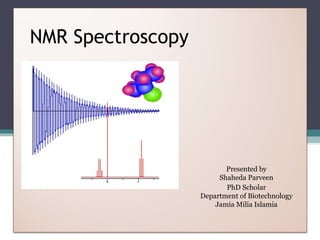
NMR Spectroscopy
Presented by
Shaheda Parveen
PhD Scholar
Department of Biotechnology
Jamia Milia Islamia
Introduction
• NMR was first experimentally observed by Bloch and Purcell in 1946 (received
Nobel Prize in 1952)
• Nuclear magnetic resonance spectroscopy (NMR) is a powerful analytical
technique used to characterize organic molecules by identifying carbon-hydrogen
frameworks within molecules.
• exploits the magnetic properties of certain atomic nuclei.
• It is a branch of spectroscopy in which radio frequency waves induce transitions
between magnetic energy levels of nuclei of a molecule.
• NMR is concerned with change in the direction of spin orientation as the result of
the absorption of radiofrequency radiation.
Magnetic phenomena
• Magnetism arises from the motion of charged particles.
• The nuclei of atoms are composed of protons and neutrons. Like electrons, these
particle also have the properties to spin on their own axis and each of them
possesses angular momentum 1/2(h/2π)
• The net resultant of the angular momentum of all nuclear particles is called nuclear
spin
• Each spin-active nucleus has a number of spins defined by its spin quantum
number, I.
• The number of Spin states = 2I + 1
Principle of NMR
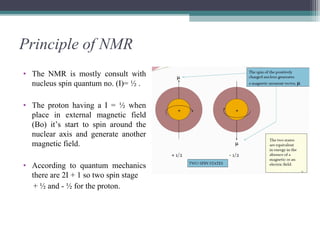
• The NMR is mostly consult with
nucleus spin quantum no. (I)= ½ .
• The proton having a I = ½ when
place in external magnetic field
(Bo) it’s start to spin around the
nuclear axis and generate another
magnetic field.
• According to quantum mechanics
there are 2I + 1 so two spin stage
+ ½ and - ½ for the proton.
If a nucleus having a magnetic moment is introduced into a magnetic field , B0, the
two energy levels become separate corresponding to mI = -1/2 and mI = +1/2
For a nucleus with I = 1/2, the energies E1 and E2 for the two states with mI = +1/2
and mI = -1/2 , respectively, are
E1 = -1/2 [ γ h / 2π ] B0
E2 = + 1/2 [ γ h / 2π ] B0
Gyromagnetic ratio, γ, is a constant for each nucleus (26,753 s-1
gauss-1
for H).
relationship:
ν = E2 – E1 / h
ν = 1/2 [ γ h / 2π ] B0 + 1/2 [ γ h / 2π] B0 / h ( or )
ν= γ / 2πB0
This is the Larmor equation
From Larmor equation
The frequency of absorbed electromagnetic radiation is
proportional to the energy difference between two
nuclear spin states which is proportional to the applied
magnetic field
Magnetic nuclei are in resonance with external
magnetic field if they absorb energy and “spin-flip”
from low energy state (+1/2) to high energy state (-1/2)
Larmor frequency
• When a spin-active hydrogen atom is placed in a strong magnetic field it begins to
precess with larmor frequency.
• May be defined as revolutions per second made by the magnetic moment vector of
the nucleus around the external magnetic field Bo
• Directly proportional to the strength of applied magnetic field.
• Magnetic nuclei of different atoms have different characteristic precessional
frequency.
• according to Larmor precessional theory
ω = γB0 ………………
where, ω= 2 πV, Larmor precessional frequency.
Relaxation Time
• After a certain time-span, the spins will return from the higher to the lower energy
level, a process that is known as relaxation.
• There are two principle modes of relaxation,
Longitudinal relaxation /spin lattice:- when energy released during the transition of
a nuclear spin from the higher to the lower energy state, it can be emitted as heat
into the environment and is called spin– lattice relaxation. This process termed as
T1.
Transverse relaxation /spin spin:- The transverse magnetization of the nuclei is also
subject to change over time, due to interactions between different nuclei.
Here, An excited nucleus may transfer its energy to an unexcited nucleus of a similar
molecules that is nearby. There is no net change in energy of the system, but the
length of the time that one nucleus stays excited is shortened. This process, which
is called transverse relaxation T2.
Types of NMR
Two common types of NMR spectroscopy are used to characterize organic structure:
• 1
H NMR
• 13
C NMR
Types of samples
• Both liquid and solid
• In solid samples, the number of spin–spin interactions is greatly enhanced due to
intermolecular interactions. As a result, the resonance signals broaden significantly.
However, high-resolution spectra can be obtained by spinning the solid sample at
an angle of 54.7˚ (magic angle spinning)
• Usually, deuterated solvents such as CDCl3 are used for sample preparation of
organic compounds.
• For peptides and proteins , solvent D2O
Interpreting Proton NMR Spectra
TYPES OF INFORMATION FROM THE NMR SPECTRUM
1. Different type of hydrogen gives a peak or group of peaks (multiplet).
2. The integral gives the relative numbers of each type of hydrogen.
3. The chemical shift or position of a signal (δ, ppm) gives a clue as to the type of
hydrogen generating the peak (alkane, alkene, benzene, aldehyde, etc.)
4. Spin-spin splitting gives the number of hydrogens on adjacent carbons.
5. The coupling constant ‘J’ also gives information about the arrangement of the
atoms involved.
Chemical shift (δ)
• The molecular environment
of a proton governs the value
of the applied external field
at which the nucleus
resonates, called chemical
shift.
• TMS at 0.5% concentration
is used as internal standard.
• Rather than measure the
exact resonance position of a
peak, we measure how far
downfield it is shifted from
TMS.
δ = shift in Hz
spectrometer frequency in MHz
τ (tau) = 10 - δ
Shielding and deshielding
Chemical shift depends on electronegativity
IT IS USUALLY SUFFICIENT TO KNOW WHAT TYPES OF HYDROGENS COME IN
SELECTED AREAS OF THE NMR CHART
Approximate chemical shift ranges (ppm) for
selected types of protons
Number of signals
• A set of protons of identical environments are known as equivalent protons while
the protons with different environments are known as non-equivalent protons.
• The number of signals in a NMR spectrum tells us how many kinds of protons are
present in a given molecule.
• Shift reagents are used in case of overlapping peaks.
Acetone –(1) Benzene – (1) Methyl acetate- (2) Ethyl Benzene-
(3)
Propane 2-ol – (3)
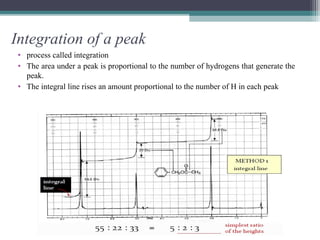
Integration of a peak
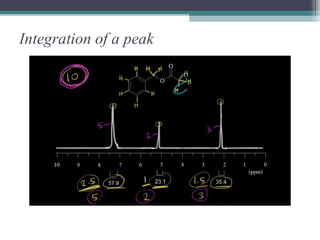
• process called integration
• The area under a peak is proportional to the number of hydrogens that generate the
peak.
• The integral line rises an amount proportional to the number of H in each peak
Integration of a peak
Spin-spin splitting
• Often a group of hydrogens will appear as a
multiplet rather than as a single peak because of
interaction with neighboring hydrogen.
• The sub peaks are due to spin-spin splitting and
are predicted by the n+1 rule
• Each type of proton senses the number of
equivalent protons (n) on the carbon atom(s) next
to the one to which it is bonded, and its
resonance peak is split into (n+1) components.
• Protons that are equivalent by symmetry usually
do not split one another
Multiplet
Singlet
Quintet
Doublet
Septet
Triplet
Octet
Quartet
Nonet
n +1= 3
Triplet
n +1= 2
Duplet
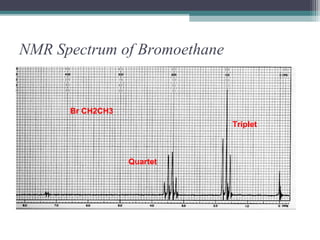
NMR Spectrum of Bromoethane
Br CH2CH3
Triplet
Quartet
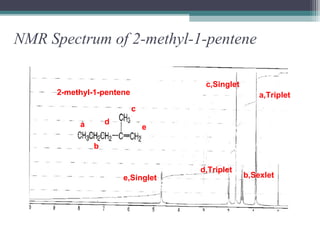
NMR Spectrum of 2-methyl-1-pentene
e,Singlet
a e
d
b
d,Triplet
a,Triplet
b,Sexlet
c,Singlet
2-methyl-1-pentene
c
NMR Spectrum of α-chloro-p-xylene
c
a, singlet
c, multiplet
b, singlet
α-chloro-p-xylene
a
b
NMR Spectrum of Phenacetin (C10H13NO2)
ba c e
d
a
b
c
d
e
Coupling Constant ‘J’
• The coupling constant is the distance J (in Hz) between the peaks in a simple
multiplet.
• J is a measure of the amount of interaction between the two sets of hydrogens
creating the multiplet.
Isotope exchange
• Deuterium (2H or D), has been used extensively in proton NMR spectroscopy for two
reasons. First it is easily introduced into a molecule. Second, the presence of deuterium
in a molecule is not detected in the proton NMR spectrum.
• Deuterium has a much smaller magnetic dipole moment than hydrogen & therefore, it
absorbs at different field strengths.
• In case of ethylbromide the deuterium replaces the methyl hydrogens & the following
changes occurs.
13
C NMR Spectroscopy
• Carbon-13: only carbon isotope with a nuclear spin
• Natural abundance 1.1% of C’s in molecules
• Sample is thus very dilute in this isotope
• Sample is measured using repeated accumulation of data and averaging of signals,
incorporating pulse and the operation of Fourier transform (FTNMR).
• All signals are obtained simultaneously using a broad pulse of energy and resonance recorded.
• Multiplicities in these spectra cannot be observed
13C NMR spectra of 1-pentanol,CH3CH2CH2CH2CH2OH
The Pulsed Fourier Transform (ft )
• An alternative approach, uses a powerful but short burst of energy called a pulse that excites
all of the magnetic nuclei in the molecule simultaneously and all the signals are collected at
the same time with a computer.
• because the measured signal in NMR is the re-emission of energy as the nuclei return from
their high-energy into their low-energy states, the recorded radiation will decay with time, as
fewer and fewer nuclei will return to the ground state. The signal measured is thus called the
free induction decay (FID).
• FT-NMR can be obtained with less than 0.5 mg of compound Pulsed FT-NMR is therefore
especially suitable for the examination of nuclei that are magnetic or very dilute samples.
2-D NMR
• Gives data plotted in a space defined by two frequency rather than one
• show chemical shifts on both axes
• Suitable for more complex and large molecules
Instrumentation
• The sample (2-10 mg ) is dissolved in a solvent containing no interfering protons
usually CCl4 or CdCl3 0.5 ml and a small amount of TMS is added to serve as an
internal reference.
• The sample cell is a small cylindrical glass tube that is suspended in the gap
between the faces of the pole pieces of the magnet. The sample cell is rotated
around its axis to ensure that all parts of the solution experience a relatively
uniform B
• Also in the magnetic gap, the radio frequency oscillator coil is installed
perpendicular (90˚) to the applied magnetic field.
• This coil supplies the electromagnetic energy used to change the spin orientations
of the protons.
• Detector coil is arranged perpendicular to the RF oscillator coil. As the magnetic
field strength is increased, the precessional frequencies of all the nucleus increases
• As the magnetic field strength is increased linearly, a pen travels from left to the
right on a recording chart.
• As each chemically distinct type of proton comes into resonance, it is record as a
peak on the chart..
Working
Comparison between 13
C and 1
H NMR
Application of NMR
• Molecular structure determination
• Solution structure of proteins and peptides The structures of proteins up to a mass
of about 50 kDa can be determined with NMR spectroscopy.
• Magnetic resonance imaging
• Protein folding The most powerful tool for determining the residual structures of
unfolded proteins and the structures of folding intermediates.
• Material science A powerful tool in the research of polymer chemistry and physics.
Thanking you

NMR (Nuclear Magnetic Resonance)

  • 1.
    NMR Spectroscopy Presented by ShahedaParveen PhD Scholar Department of Biotechnology Jamia Milia Islamia
  • 2.
    Introduction • NMR wasfirst experimentally observed by Bloch and Purcell in 1946 (received Nobel Prize in 1952) • Nuclear magnetic resonance spectroscopy (NMR) is a powerful analytical technique used to characterize organic molecules by identifying carbon-hydrogen frameworks within molecules. • exploits the magnetic properties of certain atomic nuclei. • It is a branch of spectroscopy in which radio frequency waves induce transitions between magnetic energy levels of nuclei of a molecule. • NMR is concerned with change in the direction of spin orientation as the result of the absorption of radiofrequency radiation.
  • 3.
    Magnetic phenomena • Magnetismarises from the motion of charged particles. • The nuclei of atoms are composed of protons and neutrons. Like electrons, these particle also have the properties to spin on their own axis and each of them possesses angular momentum 1/2(h/2π) • The net resultant of the angular momentum of all nuclear particles is called nuclear spin • Each spin-active nucleus has a number of spins defined by its spin quantum number, I. • The number of Spin states = 2I + 1
  • 4.
    Principle of NMR •The NMR is mostly consult with nucleus spin quantum no. (I)= ½ . • The proton having a I = ½ when place in external magnetic field (Bo) it’s start to spin around the nuclear axis and generate another magnetic field. • According to quantum mechanics there are 2I + 1 so two spin stage + ½ and - ½ for the proton.
  • 5.
    If a nucleushaving a magnetic moment is introduced into a magnetic field , B0, the two energy levels become separate corresponding to mI = -1/2 and mI = +1/2 For a nucleus with I = 1/2, the energies E1 and E2 for the two states with mI = +1/2 and mI = -1/2 , respectively, are E1 = -1/2 [ γ h / 2π ] B0 E2 = + 1/2 [ γ h / 2π ] B0 Gyromagnetic ratio, γ, is a constant for each nucleus (26,753 s-1 gauss-1 for H). relationship: ν = E2 – E1 / h ν = 1/2 [ γ h / 2π ] B0 + 1/2 [ γ h / 2π] B0 / h ( or ) ν= γ / 2πB0 This is the Larmor equation
  • 6.
    From Larmor equation Thefrequency of absorbed electromagnetic radiation is proportional to the energy difference between two nuclear spin states which is proportional to the applied magnetic field Magnetic nuclei are in resonance with external magnetic field if they absorb energy and “spin-flip” from low energy state (+1/2) to high energy state (-1/2)
  • 7.
    Larmor frequency • Whena spin-active hydrogen atom is placed in a strong magnetic field it begins to precess with larmor frequency. • May be defined as revolutions per second made by the magnetic moment vector of the nucleus around the external magnetic field Bo • Directly proportional to the strength of applied magnetic field. • Magnetic nuclei of different atoms have different characteristic precessional frequency. • according to Larmor precessional theory ω = γB0 ……………… where, ω= 2 πV, Larmor precessional frequency.
  • 8.
    Relaxation Time • Aftera certain time-span, the spins will return from the higher to the lower energy level, a process that is known as relaxation. • There are two principle modes of relaxation, Longitudinal relaxation /spin lattice:- when energy released during the transition of a nuclear spin from the higher to the lower energy state, it can be emitted as heat into the environment and is called spin– lattice relaxation. This process termed as T1. Transverse relaxation /spin spin:- The transverse magnetization of the nuclei is also subject to change over time, due to interactions between different nuclei. Here, An excited nucleus may transfer its energy to an unexcited nucleus of a similar molecules that is nearby. There is no net change in energy of the system, but the length of the time that one nucleus stays excited is shortened. This process, which is called transverse relaxation T2.
  • 9.
    Types of NMR Twocommon types of NMR spectroscopy are used to characterize organic structure: • 1 H NMR • 13 C NMR Types of samples • Both liquid and solid • In solid samples, the number of spin–spin interactions is greatly enhanced due to intermolecular interactions. As a result, the resonance signals broaden significantly. However, high-resolution spectra can be obtained by spinning the solid sample at an angle of 54.7˚ (magic angle spinning) • Usually, deuterated solvents such as CDCl3 are used for sample preparation of organic compounds. • For peptides and proteins , solvent D2O
  • 10.
    Interpreting Proton NMRSpectra TYPES OF INFORMATION FROM THE NMR SPECTRUM 1. Different type of hydrogen gives a peak or group of peaks (multiplet). 2. The integral gives the relative numbers of each type of hydrogen. 3. The chemical shift or position of a signal (δ, ppm) gives a clue as to the type of hydrogen generating the peak (alkane, alkene, benzene, aldehyde, etc.) 4. Spin-spin splitting gives the number of hydrogens on adjacent carbons. 5. The coupling constant ‘J’ also gives information about the arrangement of the atoms involved.
  • 11.
    Chemical shift (δ) •The molecular environment of a proton governs the value of the applied external field at which the nucleus resonates, called chemical shift. • TMS at 0.5% concentration is used as internal standard. • Rather than measure the exact resonance position of a peak, we measure how far downfield it is shifted from TMS. δ = shift in Hz spectrometer frequency in MHz τ (tau) = 10 - δ
  • 12.
  • 13.
    Chemical shift dependson electronegativity IT IS USUALLY SUFFICIENT TO KNOW WHAT TYPES OF HYDROGENS COME IN SELECTED AREAS OF THE NMR CHART
  • 14.
    Approximate chemical shiftranges (ppm) for selected types of protons
  • 15.
    Number of signals •A set of protons of identical environments are known as equivalent protons while the protons with different environments are known as non-equivalent protons. • The number of signals in a NMR spectrum tells us how many kinds of protons are present in a given molecule. • Shift reagents are used in case of overlapping peaks. Acetone –(1) Benzene – (1) Methyl acetate- (2) Ethyl Benzene- (3) Propane 2-ol – (3)
  • 16.
    Integration of apeak • process called integration • The area under a peak is proportional to the number of hydrogens that generate the peak. • The integral line rises an amount proportional to the number of H in each peak
  • 17.
  • 18.
    Spin-spin splitting • Oftena group of hydrogens will appear as a multiplet rather than as a single peak because of interaction with neighboring hydrogen. • The sub peaks are due to spin-spin splitting and are predicted by the n+1 rule • Each type of proton senses the number of equivalent protons (n) on the carbon atom(s) next to the one to which it is bonded, and its resonance peak is split into (n+1) components. • Protons that are equivalent by symmetry usually do not split one another Multiplet Singlet Quintet Doublet Septet Triplet Octet Quartet Nonet n +1= 3 Triplet n +1= 2 Duplet
  • 19.
    NMR Spectrum ofBromoethane Br CH2CH3 Triplet Quartet
  • 20.
    NMR Spectrum of2-methyl-1-pentene e,Singlet a e d b d,Triplet a,Triplet b,Sexlet c,Singlet 2-methyl-1-pentene c
  • 21.
    NMR Spectrum ofα-chloro-p-xylene c a, singlet c, multiplet b, singlet α-chloro-p-xylene a b
  • 22.
    NMR Spectrum ofPhenacetin (C10H13NO2) ba c e d a b c d e
  • 23.
    Coupling Constant ‘J’ •The coupling constant is the distance J (in Hz) between the peaks in a simple multiplet. • J is a measure of the amount of interaction between the two sets of hydrogens creating the multiplet.
  • 24.
    Isotope exchange • Deuterium(2H or D), has been used extensively in proton NMR spectroscopy for two reasons. First it is easily introduced into a molecule. Second, the presence of deuterium in a molecule is not detected in the proton NMR spectrum. • Deuterium has a much smaller magnetic dipole moment than hydrogen & therefore, it absorbs at different field strengths. • In case of ethylbromide the deuterium replaces the methyl hydrogens & the following changes occurs.
  • 25.
    13 C NMR Spectroscopy •Carbon-13: only carbon isotope with a nuclear spin • Natural abundance 1.1% of C’s in molecules • Sample is thus very dilute in this isotope • Sample is measured using repeated accumulation of data and averaging of signals, incorporating pulse and the operation of Fourier transform (FTNMR). • All signals are obtained simultaneously using a broad pulse of energy and resonance recorded. • Multiplicities in these spectra cannot be observed 13C NMR spectra of 1-pentanol,CH3CH2CH2CH2CH2OH
  • 26.
    The Pulsed FourierTransform (ft ) • An alternative approach, uses a powerful but short burst of energy called a pulse that excites all of the magnetic nuclei in the molecule simultaneously and all the signals are collected at the same time with a computer. • because the measured signal in NMR is the re-emission of energy as the nuclei return from their high-energy into their low-energy states, the recorded radiation will decay with time, as fewer and fewer nuclei will return to the ground state. The signal measured is thus called the free induction decay (FID). • FT-NMR can be obtained with less than 0.5 mg of compound Pulsed FT-NMR is therefore especially suitable for the examination of nuclei that are magnetic or very dilute samples.
  • 27.
    2-D NMR • Givesdata plotted in a space defined by two frequency rather than one • show chemical shifts on both axes • Suitable for more complex and large molecules
  • 28.
  • 29.
    • The sample(2-10 mg ) is dissolved in a solvent containing no interfering protons usually CCl4 or CdCl3 0.5 ml and a small amount of TMS is added to serve as an internal reference. • The sample cell is a small cylindrical glass tube that is suspended in the gap between the faces of the pole pieces of the magnet. The sample cell is rotated around its axis to ensure that all parts of the solution experience a relatively uniform B • Also in the magnetic gap, the radio frequency oscillator coil is installed perpendicular (90˚) to the applied magnetic field. • This coil supplies the electromagnetic energy used to change the spin orientations of the protons. • Detector coil is arranged perpendicular to the RF oscillator coil. As the magnetic field strength is increased, the precessional frequencies of all the nucleus increases • As the magnetic field strength is increased linearly, a pen travels from left to the right on a recording chart. • As each chemically distinct type of proton comes into resonance, it is record as a peak on the chart.. Working
  • 30.
  • 31.
    Application of NMR •Molecular structure determination • Solution structure of proteins and peptides The structures of proteins up to a mass of about 50 kDa can be determined with NMR spectroscopy. • Magnetic resonance imaging • Protein folding The most powerful tool for determining the residual structures of unfolded proteins and the structures of folding intermediates. • Material science A powerful tool in the research of polymer chemistry and physics.
  • 32.