DYNAMIC
NMR
V.SANTHANAM
Department Of Chemistry
SCSVMV, Enathur
DNMR(dynamic nmr)
• A branch of NMR dealing with effects of
chemical environmental change on NMR
spectra.
• The change may be due to exchange of sites
with different chemical shifts / different
coupling constants.
• NMR spectrum is affected by many time
dependent processes.
• The most important information got from
this effect is the rates of the exchange
processes.
• If the rates are within the range of 10-1
to 106
S-1
• Besides this very large span DNMR is having
some other advantages too.
• DNMR probes which part of the molecule is
undergoing change
• Even the degenerate intramolecular changes
which form an indistinguishable species from
the original can also be studied.
• The changes observed in the spectrum
depends on the relative time scale of the
NMR experiment and the molecular
rearrangement.
• Other spectral techniques like UV,IR and
Raman take times only 10-13
to 10-15
S, which is
not sufficient for any molecular changes.
• For NMR the interaction time is fairly larger
10-1
to 10-9
S, so NMR becomes an unavoidable
tool in studying molecular dynamics
• Variable temperature NMR is versatile in
studying different kinds of exchanges
processes
• When the activation energies of the
exchange processes are 25 -100 KJ/mol, the
rates of them can be brought in to the range
of 10 – 106
S-1
at the temperature range of
-150 - +200 °C
• By controlling temperature, the rates are
made visible to NMR detector.
• The vast majority of DNMR studies, kinetic
informations got by “Band shape analysis”
Types of Processes Studied in DNMR
• Symmetrical two-site exchange
– Slow exchange
– Intermediate exchange
– Fast exchange
– Internal rotation across a barrier
• Unsymmetrical two site exchange
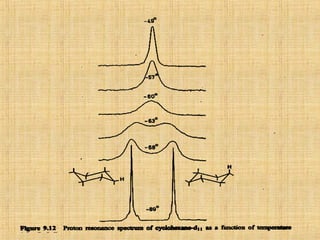
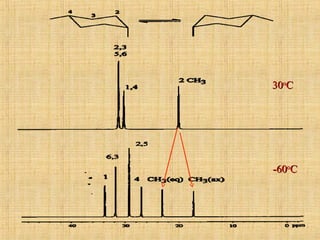
• Ring inversion
• Fluxionality of molecules
• Inter and intra molecular exchanges
Symmetrical two-site exchange
• Compounds that exist as a mixture of rapidly
interconverting stereoisomers are often
conveniently, albeit inaccurately, viewed as one
average structure.
• A close look reveals that organic compounds are
generally fluxional and adopt more than one
conformation or configuration.
• The low energy barrier to interconversion is often
difficult to distinguish between the individual
isomers of stereolabile compounds,.
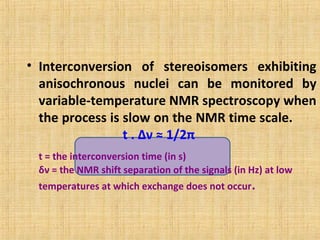
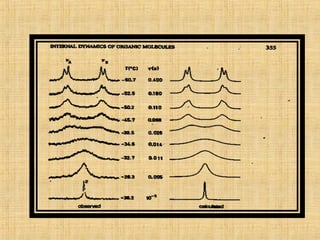
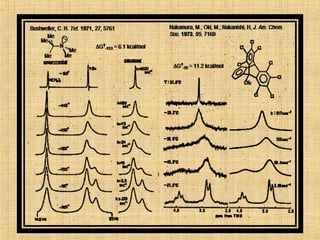
• Interconversion of stereoisomers exhibiting
anisochronous nuclei can be monitored by
variable-temperature NMR spectroscopy when
the process is slow on the NMR time scale.
t . Δν ≈ 1/2π
t = the interconversion time (in s)
δν = the NMR shift separation of the signals (in Hz) at low
temperatures at which exchange does not occur.
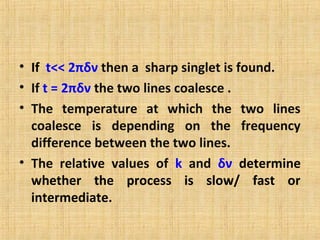
• If t<< 2πδν then a sharp singlet is found.
• If t = 2πδν the two lines coalesce .
• The temperature at which the two lines
coalesce is depending on the frequency
difference between the two lines.
• The relative values of k and δν determine
whether the process is slow/ fast or
intermediate.
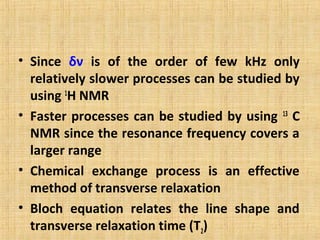
• Since δν is of the order of few kHz only
relatively slower processes can be studied by
using 1
H NMR
• Faster processes can be studied by using 13
C
NMR since the resonance frequency covers a
larger range
• Chemical exchange process is an effective
method of transverse relaxation
• Bloch equation relates the line shape and
transverse relaxation time (T2)
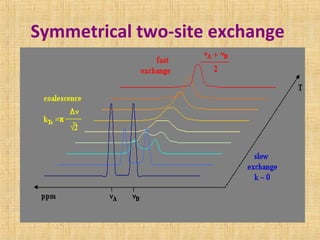
Symmetrical two-site exchange
Slow Exchanges
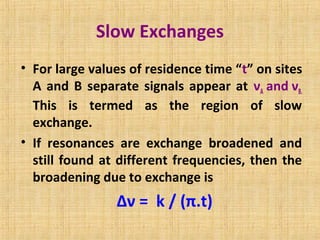
• For large values of residence time “t” on sites
A and B separate signals appear at νA and νB.
This is termed as the region of slow
exchange.
• If resonances are exchange broadened and
still found at different frequencies, then the
broadening due to exchange is
Δν = k / (π.t)
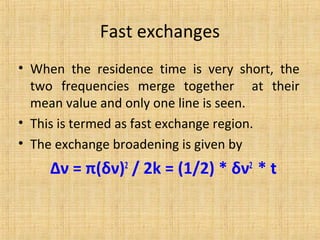
Fast exchanges
• When the residence time is very short, the
two frequencies merge together at their
mean value and only one line is seen.
• This is termed as fast exchange region.
• The exchange broadening is given by
Δν = π(δν)2
/ 2k = (1/2) * δν2
* t
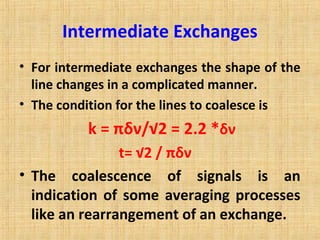
Intermediate Exchanges
• For intermediate exchanges the shape of the
line changes in a complicated manner.
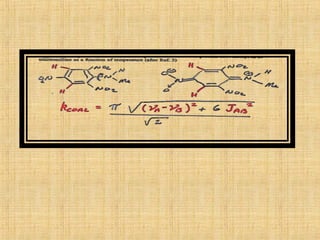
• The condition for the lines to coalesce is
k = πδν/√2 = 2.2 *δν
t= √2 / πδν
• The coalescence of signals is an
indication of some averaging processes
like an rearrangement of an exchange.
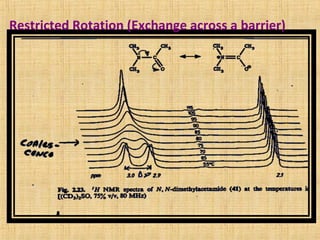
Restricted Rotation (Exchange across a barrier)
Activation and Thermodynamic
Parameters from NMR data
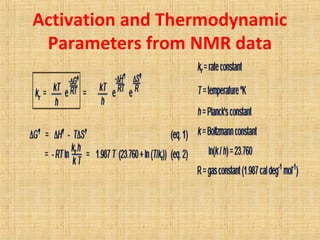
Eyring Equation
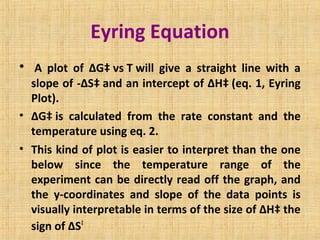
•  A plot of ΔG‡ vs T will give a straight line with a
slope of -ΔS‡ and an intercept of ΔH‡ (eq. 1, Eyring
Plot).
• ΔG‡ is calculated from the rate constant and the
temperature using eq. 2.
• This kind of plot is easier to interpret than the one
below since the temperature range of the
experiment can be directly read off the graph, and
the y-coordinates and slope of the data points is
visually interpretable in terms of the size of ΔH‡ the
sign of ΔS‡
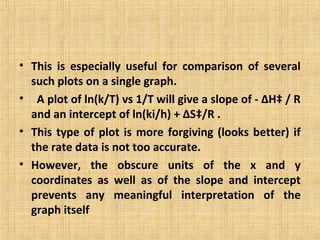
• This is especially useful for comparison of several
such plots on a single graph.
• A plot of ln(k/T) vs 1/T will give a slope of - ΔH‡ / R
and an intercept of ln(ki/h) + ΔS‡/R .
• This type of plot is more forgiving (looks better) if
the rate data is not too accurate.
• However, the obscure units of the x and y
coordinates as well as of the slope and intercept
prevents any meaningful interpretation of the
graph itself
Unsymmetrical Two Site Exchange
• When a exchange is occurring with sites
which greatly differ in population, the two
forms may have any concentration
depending on the conditions maintained.
• The rates of inter conversion of them into
each other also differs.
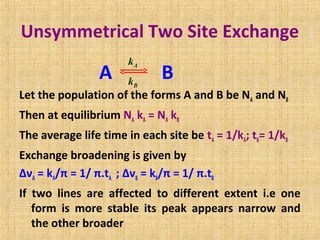
Unsymmetrical Two Site Exchange
A B
Let the population of the forms A and B be NA and NB
Then at equilibrium NA kA = NA kB
The average life time in each site be tA = 1/kA; tB= 1/kB
Exchange broadening is given by
ΔνA = kA/π = 1/ π.tA ; ΔνB = kB/π = 1/ π.tB
If two lines are affected to different extent i.e one
form is more stable its peak appears narrow and
the other broader
kA
kB
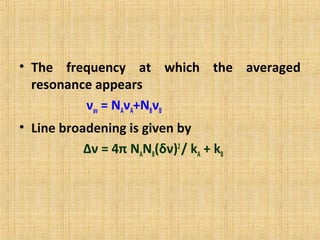
• The frequency at which the averaged
resonance appears
νav = NAνA+NBνB
• Line broadening is given by
Δν = 4π NANB(δν)2
/ kA + kB
3030oo
CC
-60-60oo
CC
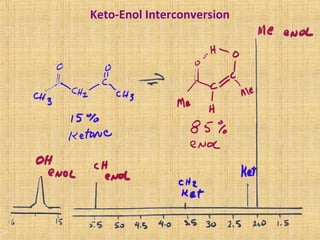
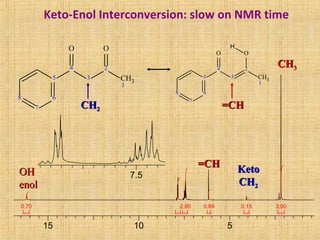
Keto-Enol Interconversion
15 10 5
3.002.80 0.890.70 0.15
4
3
O
5
2
6
CH3
1
O
7
8
7.5
4
3
O
5
2
6
CH3
1
O
7
8
H
KetoKeto
CHCH22
CHCH33
=CH=CH
Keto-Enol Interconversion: slow on NMR time
OHOH
enolenol
CHCH22 =CH=CH
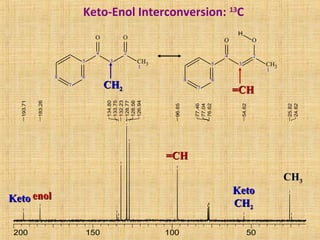
200 150 100 50
24.62
25.82
54.62
76.62
77.04
77.46
96.65
126.94
128.56
128.77
132.23
133.75
134.80
183.26
193.71
4
3
O
5
2
6
CH3
1
O
7
8
H
4
3
O
5
2
6
CH3
1
O
7
8
Keto-Enol Interconversion: 13
C
KetoKeto
CHCH22
CHCH33
=CH=CH
KetoKeto enolenol
CHCH22 =CH=CH
•Fluxional molecules are molecules that
undergo dynamics such that some or all of
their atoms interchange between
symmetry-equivalent positions.
•Because virtually all molecules are fluxional
in some respects, e.g. bond rotations in
most organic compounds, the term fluxional
depends on the context and the method
used to assess the dynamics.
FLUXIONAL MOLECULESFLUXIONAL MOLECULES
• Often, a molecule is considered fluxional if its
spectroscopic signature exhibits line-
broadening (beyond that dictated by
the Heisenberg Uncertainty Principle) due to
chemical exchange.
• In some cases, where the rates are slow,
fluxionality is not detected spectroscopically,
but by isotopic labeling
FLUXIONAL MOLECULESFLUXIONAL MOLECULES
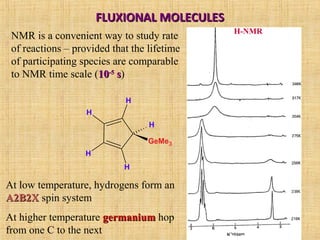
NMR is a convenient way to study rate
of reactions – provided that the lifetime
of participating species are comparable
to NMR time scale (1010-5-5
ss)
H
H
H
H
H
GeMe3
At low temperature, hydrogens form an
A2B2XA2B2X spin system
At higher temperature germaniumgermanium hop
from one C to the next
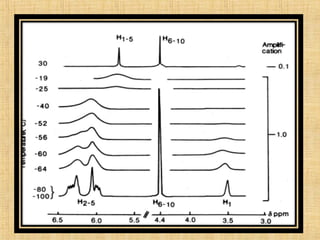
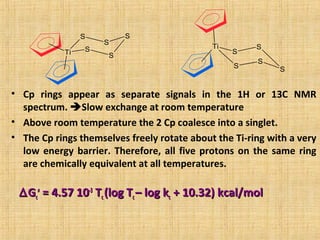
• Cp rings appear as separate signals in the 1H or 13C NMR
spectrum. Slow exchange at room temperature
• Above room temperature the 2 Cp coalesce into a singlet.
• The Cp rings themselves freely rotate about the Ti-ring with a very
low energy barrier. Therefore, all five protons on the same ring
are chemically equivalent at all temperatures.
∆∆GGcc
≠≠
= 4.57 10= 4.57 10-3-3
TTcc (log T(log Tcc – log k– log kcc + 10.32) kcal/mol+ 10.32) kcal/mol
Ti
S
S
S
S
S Ti
S
S
S
S
S
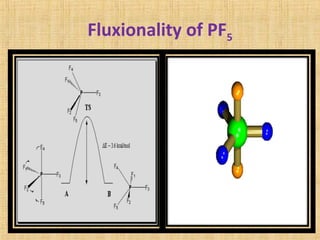
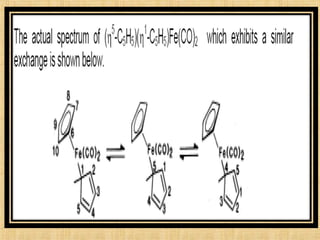
Fluxionality of PF5
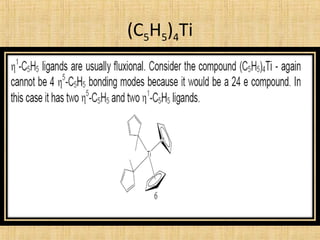
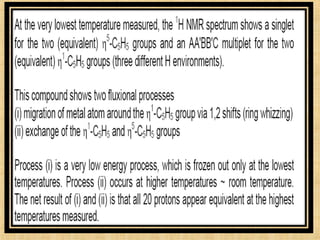
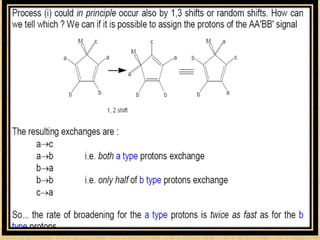
(C5H5)4Ti
Interpreting Dynamic NMR dataInterpreting Dynamic NMR data
• Start at the low-TStart at the low-T:
Find the static structures that are consistent with the
data. Use your knowledge of the system, integrals,
multiplicities, coupling constants, decoupling data,
and chemical shifts
• Look at the high-TLook at the high-T.
to understand which groups are interconverting on
NMR time scale
• Find a chemically reasonable pathway for theFind a chemically reasonable pathway for the
interconversioninterconversion
Pathways for InterconversionPathways for Interconversion
• Dissociation and re-coordination of a ligand.Dissociation and re-coordination of a ligand.
To probe for such behavior, add some of the free
ligand to the solution. If the fluxional process
involves dissociation of that species, the chemical
shift of the free ligand and bound species will
come at the weighted average
• Rotation about a hindered bondRotation about a hindered bond (for large
groups)
• Opening/closing of bridgesOpening/closing of bridges.
In dinuclear systems, a carbonyl or alkoxide
ligand can switch between a bridging and
terminal position
• Monomer-dimer or dimer-tetramer equilibriumMonomer-dimer or dimer-tetramer equilibrium.
To probe such equilibria, try decreasing or
increasing the concentration. This should modify the
ratio of the equilibrating species.
similarly, high T should favor the dissociated form
and low T the more associated form
• 5-coordinate systems are quite notorious for5-coordinate systems are quite notorious for
fluxional behaviorfluxional behavior as the energy barrier between
trigonal bipyramid (TBP) and square pyramidal (SP)
geometries is often quite low. Such interconversions
can occur through a Berry pseudorotation or
turnstile mechanism.
ExampleExample
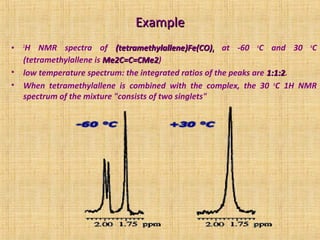
• 1
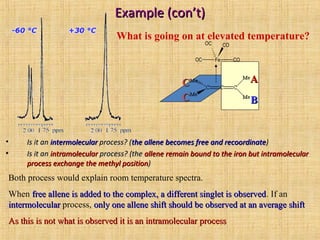
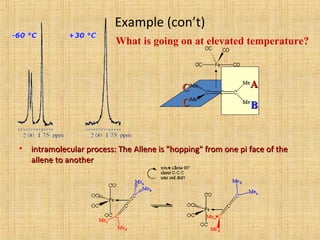
H NMR spectra of (tetramethylallene)Fe(CO)(tetramethylallene)Fe(CO)44 at -60 o
C and 30 o
C
(tetramethylallene is Me2C=C=CMe2Me2C=C=CMe2)
• low temperature spectrum: the integrated ratios of the peaks are 1:1:21:1:2.
• When tetramethylallene is combined with the complex, the 30 o
C 1H NMR
spectrum of the mixture "consists of two singlets"
Example (con’t)Example (con’t)
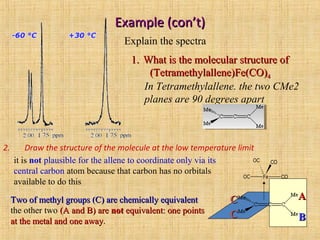
2. Draw the structure of the molecule at the low temperature limit
Explain the spectra
1.1. What is the molecular structure ofWhat is the molecular structure of
(Tetramethylallene)Fe(CO)(Tetramethylallene)Fe(CO)44
In Tetramethylallene. the two CMe2
planes are 90 degrees apart
Fe COOC
OC CO
AA
BB
CC
CC
it is not plausible for the allene to coordinate only via its
central carbon atom because that carbon has no orbitals
available to do this
Two of methyl groups (C) are chemically equivalentTwo of methyl groups (C) are chemically equivalent
the other two (A and B) are(A and B) are notnot equivalent: one pointsequivalent: one points
at the metal and one awayat the metal and one away.
Example (con’t)Example (con’t)
• Is it anIs it an intermolecularintermolecular process? (process? (the allene becomes free and recoordinatethe allene becomes free and recoordinate))
• Is it anIs it an intramolecularintramolecular process? (theprocess? (the allene remain bound to the iron but intramolecularallene remain bound to the iron but intramolecular
process exchange the methyl positionprocess exchange the methyl position))
What is going on at elevated temperature?
Fe COOC
OC CO
AA
BB
CC
CC
Both process would explain room temperature spectra.
When free allene is added to the complex, a different singlet is observedfree allene is added to the complex, a different singlet is observed. If an
intermolecularintermolecular process, only one allene shift should be observed at an average shiftonly one allene shift should be observed at an average shift
As this is not what is observed it is an intramolecular processAs this is not what is observed it is an intramolecular process
Example (con’t)
What is going on at elevated temperature?
Fe COOC
OC CO
AA
BB
CC
CC
• intramolecular process: The Allene is "hopping" from one pi face of theintramolecular process: The Allene is "hopping" from one pi face of the
allene to anotherallene to another
Example 2Example 2
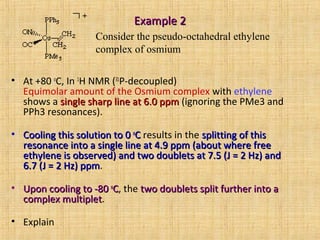
• At +80 o
C, In 1
H NMR (31
P-decoupled)
Equimolar amount of the Osmium complex with ethylene
shows a single sharp line at 6.0 ppmsingle sharp line at 6.0 ppm (ignoring the PMe3 and
PPh3 resonances).
• Cooling this solution to 0Cooling this solution to 0 oo
CC results in the splitting of thissplitting of this
resonance into a single line at 4.9 ppm (about where freeresonance into a single line at 4.9 ppm (about where free
ethylene is observed) and two doublets at 7.5 (J = 2 Hz) andethylene is observed) and two doublets at 7.5 (J = 2 Hz) and
6.7 (J = 2 Hz) ppm6.7 (J = 2 Hz) ppm.
• Upon cooling to -80Upon cooling to -80 oo
CC, the two doublets split further into atwo doublets split further into a
complex multipletcomplex multiplet.
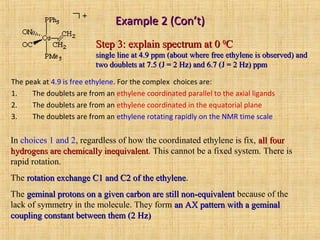
• Explain
Consider the pseudo-octahedral ethylene
complex of osmium
Example 2 (Con’t)Example 2 (Con’t)
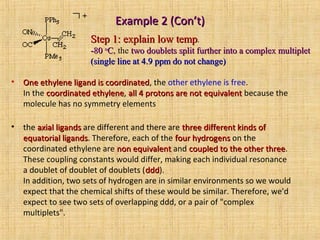
• One ethylene ligand is coordinatedOne ethylene ligand is coordinated, the other ethylene is free.
In the coordinated ethylenecoordinated ethylene, all 4 protons are not equivalentall 4 protons are not equivalent because the
molecule has no symmetry elements
• the axial ligandsaxial ligands are different and there are three different kinds ofthree different kinds of
equatorial ligandsequatorial ligands. Therefore, each of the four hydrogensfour hydrogens on the
coordinated ethylene are non equivalentnon equivalent and coupled to the other threecoupled to the other three.
These coupling constants would differ, making each individual resonance
a doublet of doublet of doublets (dddddd).
In addition, two sets of hydrogen are in similar environments so we would
expect that the chemical shifts of these would be similar. Therefore, we'd
expect to see two sets of overlapping ddd, or a pair of "complex
multiplets".
Step 1: explain low tempStep 1: explain low temp.
-80-80 oo
CC, the two doublets split further into a complex multiplettwo doublets split further into a complex multiplet
(single line at 4.9 ppm do not change)(single line at 4.9 ppm do not change)
Example 2 (Con’t)Example 2 (Con’t)
• Observed data is consistent with exchange with free ethylenewith exchange with free ethylene and
rapid rotation in the complexrapid rotation in the complex. We observe an averaged peak atan averaged peak at
6.0 ppm6.0 ppm.
There is an equimolar amount ofequimolar amount of complexcomplex andand free ethylenefree ethylene:
Complex: 2 H at 7.5 ppm, 2H at 6.7 ppm
Free ethylene: 4 H at 4.9 ppm.
The weighted average of these isThe weighted average of these is
[(2)(7.57.5) + 2(6.76.7) + 4(4.94.9)]/8 = 6.0 ppm, exactly where we see our6.0 ppm, exactly where we see our
peakpeak.
Step 2: explain high tempStep 2: explain high temp.
single sharp line at 6.0 ppmsingle sharp line at 6.0 ppm
Example 2 (Con’t)Example 2 (Con’t)
The peak at 4.9 is free ethylene. For the complex choices are:
1. The doublets are from an ethylene coordinated parallel to the axial ligands
2. The doublets are from an ethylene coordinated in the equatorial plane
3. The doublets are from an ethylene rotating rapidly on the NMR time scale
In choices 1 and 2, regardless of how the coordinated ethylene is fix, all fourall four
hydrogens are chemically inequivalenthydrogens are chemically inequivalent. This cannot be a fixed system. There is
rapid rotation.
The rotation exchange C1 and C2 of the ethylenerotation exchange C1 and C2 of the ethylene.
The geminal protons on a given carbon are still non-equivalentgeminal protons on a given carbon are still non-equivalent because of the
lack of symmetry in the molecule. They form an AX pattern with a geminalan AX pattern with a geminal
coupling constant between them (2 Hz)coupling constant between them (2 Hz)
Step 3: explain spectrum at 0Step 3: explain spectrum at 0 00
CC
single line at 4.9 ppm (about where free ethylene is observed) andsingle line at 4.9 ppm (about where free ethylene is observed) and
two doublets at 7.5 (J = 2 Hz) and 6.7 (J = 2 Hz) ppmtwo doublets at 7.5 (J = 2 Hz) and 6.7 (J = 2 Hz) ppm
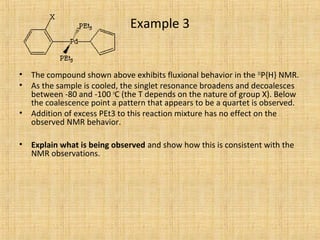
Example 3
• The compound shown above exhibits fluxional behavior in the 31
P{H} NMR.
• As the sample is cooled, the singlet resonance broadens and decoalesces
between -80 and -100 o
C (the T depends on the nature of group X). Below
the coalescence point a pattern that appears to be a quartet is observed.
• Addition of excess PEt3 to this reaction mixture has no effect on the
observed NMR behavior.
• Explain what is being observed and show how this is consistent with the
NMR observations.
Example 3 (con’t)
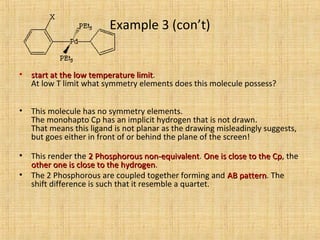
• start at the low temperature limitstart at the low temperature limit.
At low T limit what symmetry elements does this molecule possess?
• This molecule has no symmetry elements.
The monohapto Cp has an implicit hydrogen that is not drawn.
That means this ligand is not planar as the drawing misleadingly suggests,
but goes either in front of or behind the plane of the screen!
• This render the 2 Phosphorous non-equivalent2 Phosphorous non-equivalent. One is close to the CpOne is close to the Cp, the
other one is close to the hydrogenother one is close to the hydrogen.
• The 2 Phosphorous are coupled together forming and AB patternAB pattern. The
shift difference is such that it resemble a quartet.
Example 3 (con’t)
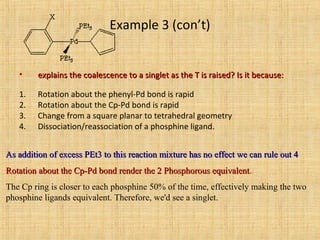
• explains the coalescence to a singlet as the T is raised? Is it because:explains the coalescence to a singlet as the T is raised? Is it because:
1. Rotation about the phenyl-Pd bond is rapid
2. Rotation about the Cp-Pd bond is rapid
3. Change from a square planar to tetrahedral geometry
4. Dissociation/reassociation of a phosphine ligand.
As addition of excess PEt3 to this reaction mixture has no effect we can rule out 4As addition of excess PEt3 to this reaction mixture has no effect we can rule out 4
Rotation about the Cp-Pd bond render the 2 Phosphorous equivalentRotation about the Cp-Pd bond render the 2 Phosphorous equivalent.
The Cp ring is closer to each phosphine 50% of the time, effectively making the two
phosphine ligands equivalent. Therefore, we'd see a singlet.
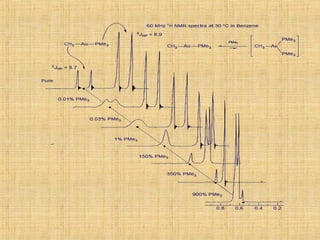
• In the series of spectra below, increments of
PMe3 ligand were added, which initiates a bimolecular
exchange between bound and free ligands, causing
loss of 3
J coupling between the CH3-Au protons and P.
• Initially no change is detectable in the PMe3 protons
because the fraction of free ligand is <1%. When a
significant fraction of PMe3 has been added, however,
the PMe3 signals move downfield because of
averaging between free and bound ligand.
• The apparent coupling also decreases, and
becomes 0 at 350% PMe3. Coupling between
H and P reappears when 9 equivalents of
PMe3 have been added, with J close to that of
the pure ligand (2.6 Hz).
• This shows that 2
JHP has opposite signs in the
free and bound ligands
Dynamic NMR

Dynamic NMR

  • 1.
  • 2.
    DNMR(dynamic nmr) • Abranch of NMR dealing with effects of chemical environmental change on NMR spectra. • The change may be due to exchange of sites with different chemical shifts / different coupling constants. • NMR spectrum is affected by many time dependent processes.
  • 3.
    • The mostimportant information got from this effect is the rates of the exchange processes. • If the rates are within the range of 10-1 to 106 S-1 • Besides this very large span DNMR is having some other advantages too. • DNMR probes which part of the molecule is undergoing change
  • 4.
    • Even thedegenerate intramolecular changes which form an indistinguishable species from the original can also be studied. • The changes observed in the spectrum depends on the relative time scale of the NMR experiment and the molecular rearrangement.
  • 5.
    • Other spectraltechniques like UV,IR and Raman take times only 10-13 to 10-15 S, which is not sufficient for any molecular changes. • For NMR the interaction time is fairly larger 10-1 to 10-9 S, so NMR becomes an unavoidable tool in studying molecular dynamics • Variable temperature NMR is versatile in studying different kinds of exchanges processes
  • 6.
    • When theactivation energies of the exchange processes are 25 -100 KJ/mol, the rates of them can be brought in to the range of 10 – 106 S-1 at the temperature range of -150 - +200 °C • By controlling temperature, the rates are made visible to NMR detector. • The vast majority of DNMR studies, kinetic informations got by “Band shape analysis”
  • 7.
    Types of ProcessesStudied in DNMR • Symmetrical two-site exchange – Slow exchange – Intermediate exchange – Fast exchange – Internal rotation across a barrier • Unsymmetrical two site exchange • Ring inversion • Fluxionality of molecules • Inter and intra molecular exchanges
  • 8.
    Symmetrical two-site exchange •Compounds that exist as a mixture of rapidly interconverting stereoisomers are often conveniently, albeit inaccurately, viewed as one average structure. • A close look reveals that organic compounds are generally fluxional and adopt more than one conformation or configuration. • The low energy barrier to interconversion is often difficult to distinguish between the individual isomers of stereolabile compounds,.
  • 9.
    • Interconversion ofstereoisomers exhibiting anisochronous nuclei can be monitored by variable-temperature NMR spectroscopy when the process is slow on the NMR time scale. t . Δν ≈ 1/2π t = the interconversion time (in s) δν = the NMR shift separation of the signals (in Hz) at low temperatures at which exchange does not occur.
  • 10.
    • If t<<2πδν then a sharp singlet is found. • If t = 2πδν the two lines coalesce . • The temperature at which the two lines coalesce is depending on the frequency difference between the two lines. • The relative values of k and δν determine whether the process is slow/ fast or intermediate.
  • 11.
    • Since δνis of the order of few kHz only relatively slower processes can be studied by using 1 H NMR • Faster processes can be studied by using 13 C NMR since the resonance frequency covers a larger range • Chemical exchange process is an effective method of transverse relaxation • Bloch equation relates the line shape and transverse relaxation time (T2)
  • 12.
  • 13.
    Slow Exchanges • Forlarge values of residence time “t” on sites A and B separate signals appear at νA and νB. This is termed as the region of slow exchange. • If resonances are exchange broadened and still found at different frequencies, then the broadening due to exchange is Δν = k / (π.t)
  • 14.
    Fast exchanges • Whenthe residence time is very short, the two frequencies merge together at their mean value and only one line is seen. • This is termed as fast exchange region. • The exchange broadening is given by Δν = π(δν)2 / 2k = (1/2) * δν2 * t
  • 15.
    Intermediate Exchanges • Forintermediate exchanges the shape of the line changes in a complicated manner. • The condition for the lines to coalesce is k = πδν/√2 = 2.2 *δν t= √2 / πδν • The coalescence of signals is an indication of some averaging processes like an rearrangement of an exchange.
  • 16.
  • 20.
  • 21.
    Eyring Equation •  Aplot of ΔG‡ vs T will give a straight line with a slope of -ΔS‡ and an intercept of ΔH‡ (eq. 1, Eyring Plot). • ΔG‡ is calculated from the rate constant and the temperature using eq. 2. • This kind of plot is easier to interpret than the one below since the temperature range of the experiment can be directly read off the graph, and the y-coordinates and slope of the data points is visually interpretable in terms of the size of ΔH‡ the sign of ΔS‡
  • 22.
    • This isespecially useful for comparison of several such plots on a single graph. • A plot of ln(k/T) vs 1/T will give a slope of - ΔH‡ / R and an intercept of ln(ki/h) + ΔS‡/R . • This type of plot is more forgiving (looks better) if the rate data is not too accurate. • However, the obscure units of the x and y coordinates as well as of the slope and intercept prevents any meaningful interpretation of the graph itself
  • 23.
    Unsymmetrical Two SiteExchange • When a exchange is occurring with sites which greatly differ in population, the two forms may have any concentration depending on the conditions maintained. • The rates of inter conversion of them into each other also differs.
  • 24.
    Unsymmetrical Two SiteExchange A B Let the population of the forms A and B be NA and NB Then at equilibrium NA kA = NA kB The average life time in each site be tA = 1/kA; tB= 1/kB Exchange broadening is given by ΔνA = kA/π = 1/ π.tA ; ΔνB = kB/π = 1/ π.tB If two lines are affected to different extent i.e one form is more stable its peak appears narrow and the other broader kA kB
  • 25.
    • The frequencyat which the averaged resonance appears νav = NAνA+NBνB • Line broadening is given by Δν = 4π NANB(δν)2 / kA + kB
  • 27.
  • 28.
  • 29.
    15 10 5 3.002.800.890.70 0.15 4 3 O 5 2 6 CH3 1 O 7 8 7.5 4 3 O 5 2 6 CH3 1 O 7 8 H KetoKeto CHCH22 CHCH33 =CH=CH Keto-Enol Interconversion: slow on NMR time OHOH enolenol CHCH22 =CH=CH
  • 30.
    200 150 10050 24.62 25.82 54.62 76.62 77.04 77.46 96.65 126.94 128.56 128.77 132.23 133.75 134.80 183.26 193.71 4 3 O 5 2 6 CH3 1 O 7 8 H 4 3 O 5 2 6 CH3 1 O 7 8 Keto-Enol Interconversion: 13 C KetoKeto CHCH22 CHCH33 =CH=CH KetoKeto enolenol CHCH22 =CH=CH
  • 31.
    •Fluxional molecules aremolecules that undergo dynamics such that some or all of their atoms interchange between symmetry-equivalent positions. •Because virtually all molecules are fluxional in some respects, e.g. bond rotations in most organic compounds, the term fluxional depends on the context and the method used to assess the dynamics. FLUXIONAL MOLECULESFLUXIONAL MOLECULES
  • 32.
    FLUXIONAL MOLECULESFLUXIONAL MOLECULES •Often, a molecule is considered fluxional if its spectroscopic signature exhibits line- broadening (beyond that dictated by the Heisenberg Uncertainty Principle) due to chemical exchange. • In some cases, where the rates are slow, fluxionality is not detected spectroscopically, but by isotopic labeling
  • 33.
    FLUXIONAL MOLECULESFLUXIONAL MOLECULES NMRis a convenient way to study rate of reactions – provided that the lifetime of participating species are comparable to NMR time scale (1010-5-5 ss) H H H H H GeMe3 At low temperature, hydrogens form an A2B2XA2B2X spin system At higher temperature germaniumgermanium hop from one C to the next
  • 34.
    • Cp ringsappear as separate signals in the 1H or 13C NMR spectrum. Slow exchange at room temperature • Above room temperature the 2 Cp coalesce into a singlet. • The Cp rings themselves freely rotate about the Ti-ring with a very low energy barrier. Therefore, all five protons on the same ring are chemically equivalent at all temperatures. ∆∆GGcc ≠≠ = 4.57 10= 4.57 10-3-3 TTcc (log T(log Tcc – log k– log kcc + 10.32) kcal/mol+ 10.32) kcal/mol Ti S S S S S Ti S S S S S
  • 35.
  • 36.
  • 41.
    Interpreting Dynamic NMRdataInterpreting Dynamic NMR data • Start at the low-TStart at the low-T: Find the static structures that are consistent with the data. Use your knowledge of the system, integrals, multiplicities, coupling constants, decoupling data, and chemical shifts • Look at the high-TLook at the high-T. to understand which groups are interconverting on NMR time scale • Find a chemically reasonable pathway for theFind a chemically reasonable pathway for the interconversioninterconversion
  • 42.
    Pathways for InterconversionPathwaysfor Interconversion • Dissociation and re-coordination of a ligand.Dissociation and re-coordination of a ligand. To probe for such behavior, add some of the free ligand to the solution. If the fluxional process involves dissociation of that species, the chemical shift of the free ligand and bound species will come at the weighted average • Rotation about a hindered bondRotation about a hindered bond (for large groups) • Opening/closing of bridgesOpening/closing of bridges. In dinuclear systems, a carbonyl or alkoxide ligand can switch between a bridging and terminal position
  • 43.
    • Monomer-dimer ordimer-tetramer equilibriumMonomer-dimer or dimer-tetramer equilibrium. To probe such equilibria, try decreasing or increasing the concentration. This should modify the ratio of the equilibrating species. similarly, high T should favor the dissociated form and low T the more associated form • 5-coordinate systems are quite notorious for5-coordinate systems are quite notorious for fluxional behaviorfluxional behavior as the energy barrier between trigonal bipyramid (TBP) and square pyramidal (SP) geometries is often quite low. Such interconversions can occur through a Berry pseudorotation or turnstile mechanism.
  • 44.
    ExampleExample • 1 H NMRspectra of (tetramethylallene)Fe(CO)(tetramethylallene)Fe(CO)44 at -60 o C and 30 o C (tetramethylallene is Me2C=C=CMe2Me2C=C=CMe2) • low temperature spectrum: the integrated ratios of the peaks are 1:1:21:1:2. • When tetramethylallene is combined with the complex, the 30 o C 1H NMR spectrum of the mixture "consists of two singlets"
  • 45.
    Example (con’t)Example (con’t) 2.Draw the structure of the molecule at the low temperature limit Explain the spectra 1.1. What is the molecular structure ofWhat is the molecular structure of (Tetramethylallene)Fe(CO)(Tetramethylallene)Fe(CO)44 In Tetramethylallene. the two CMe2 planes are 90 degrees apart Fe COOC OC CO AA BB CC CC it is not plausible for the allene to coordinate only via its central carbon atom because that carbon has no orbitals available to do this Two of methyl groups (C) are chemically equivalentTwo of methyl groups (C) are chemically equivalent the other two (A and B) are(A and B) are notnot equivalent: one pointsequivalent: one points at the metal and one awayat the metal and one away.
  • 46.
    Example (con’t)Example (con’t) •Is it anIs it an intermolecularintermolecular process? (process? (the allene becomes free and recoordinatethe allene becomes free and recoordinate)) • Is it anIs it an intramolecularintramolecular process? (theprocess? (the allene remain bound to the iron but intramolecularallene remain bound to the iron but intramolecular process exchange the methyl positionprocess exchange the methyl position)) What is going on at elevated temperature? Fe COOC OC CO AA BB CC CC Both process would explain room temperature spectra. When free allene is added to the complex, a different singlet is observedfree allene is added to the complex, a different singlet is observed. If an intermolecularintermolecular process, only one allene shift should be observed at an average shiftonly one allene shift should be observed at an average shift As this is not what is observed it is an intramolecular processAs this is not what is observed it is an intramolecular process
  • 47.
    Example (con’t) What isgoing on at elevated temperature? Fe COOC OC CO AA BB CC CC • intramolecular process: The Allene is "hopping" from one pi face of theintramolecular process: The Allene is "hopping" from one pi face of the allene to anotherallene to another
  • 48.
    Example 2Example 2 •At +80 o C, In 1 H NMR (31 P-decoupled) Equimolar amount of the Osmium complex with ethylene shows a single sharp line at 6.0 ppmsingle sharp line at 6.0 ppm (ignoring the PMe3 and PPh3 resonances). • Cooling this solution to 0Cooling this solution to 0 oo CC results in the splitting of thissplitting of this resonance into a single line at 4.9 ppm (about where freeresonance into a single line at 4.9 ppm (about where free ethylene is observed) and two doublets at 7.5 (J = 2 Hz) andethylene is observed) and two doublets at 7.5 (J = 2 Hz) and 6.7 (J = 2 Hz) ppm6.7 (J = 2 Hz) ppm. • Upon cooling to -80Upon cooling to -80 oo CC, the two doublets split further into atwo doublets split further into a complex multipletcomplex multiplet. • Explain Consider the pseudo-octahedral ethylene complex of osmium
  • 49.
    Example 2 (Con’t)Example2 (Con’t) • One ethylene ligand is coordinatedOne ethylene ligand is coordinated, the other ethylene is free. In the coordinated ethylenecoordinated ethylene, all 4 protons are not equivalentall 4 protons are not equivalent because the molecule has no symmetry elements • the axial ligandsaxial ligands are different and there are three different kinds ofthree different kinds of equatorial ligandsequatorial ligands. Therefore, each of the four hydrogensfour hydrogens on the coordinated ethylene are non equivalentnon equivalent and coupled to the other threecoupled to the other three. These coupling constants would differ, making each individual resonance a doublet of doublet of doublets (dddddd). In addition, two sets of hydrogen are in similar environments so we would expect that the chemical shifts of these would be similar. Therefore, we'd expect to see two sets of overlapping ddd, or a pair of "complex multiplets". Step 1: explain low tempStep 1: explain low temp. -80-80 oo CC, the two doublets split further into a complex multiplettwo doublets split further into a complex multiplet (single line at 4.9 ppm do not change)(single line at 4.9 ppm do not change)
  • 50.
    Example 2 (Con’t)Example2 (Con’t) • Observed data is consistent with exchange with free ethylenewith exchange with free ethylene and rapid rotation in the complexrapid rotation in the complex. We observe an averaged peak atan averaged peak at 6.0 ppm6.0 ppm. There is an equimolar amount ofequimolar amount of complexcomplex andand free ethylenefree ethylene: Complex: 2 H at 7.5 ppm, 2H at 6.7 ppm Free ethylene: 4 H at 4.9 ppm. The weighted average of these isThe weighted average of these is [(2)(7.57.5) + 2(6.76.7) + 4(4.94.9)]/8 = 6.0 ppm, exactly where we see our6.0 ppm, exactly where we see our peakpeak. Step 2: explain high tempStep 2: explain high temp. single sharp line at 6.0 ppmsingle sharp line at 6.0 ppm
  • 51.
    Example 2 (Con’t)Example2 (Con’t) The peak at 4.9 is free ethylene. For the complex choices are: 1. The doublets are from an ethylene coordinated parallel to the axial ligands 2. The doublets are from an ethylene coordinated in the equatorial plane 3. The doublets are from an ethylene rotating rapidly on the NMR time scale In choices 1 and 2, regardless of how the coordinated ethylene is fix, all fourall four hydrogens are chemically inequivalenthydrogens are chemically inequivalent. This cannot be a fixed system. There is rapid rotation. The rotation exchange C1 and C2 of the ethylenerotation exchange C1 and C2 of the ethylene. The geminal protons on a given carbon are still non-equivalentgeminal protons on a given carbon are still non-equivalent because of the lack of symmetry in the molecule. They form an AX pattern with a geminalan AX pattern with a geminal coupling constant between them (2 Hz)coupling constant between them (2 Hz) Step 3: explain spectrum at 0Step 3: explain spectrum at 0 00 CC single line at 4.9 ppm (about where free ethylene is observed) andsingle line at 4.9 ppm (about where free ethylene is observed) and two doublets at 7.5 (J = 2 Hz) and 6.7 (J = 2 Hz) ppmtwo doublets at 7.5 (J = 2 Hz) and 6.7 (J = 2 Hz) ppm
  • 52.
    Example 3 • Thecompound shown above exhibits fluxional behavior in the 31 P{H} NMR. • As the sample is cooled, the singlet resonance broadens and decoalesces between -80 and -100 o C (the T depends on the nature of group X). Below the coalescence point a pattern that appears to be a quartet is observed. • Addition of excess PEt3 to this reaction mixture has no effect on the observed NMR behavior. • Explain what is being observed and show how this is consistent with the NMR observations.
  • 53.
    Example 3 (con’t) •start at the low temperature limitstart at the low temperature limit. At low T limit what symmetry elements does this molecule possess? • This molecule has no symmetry elements. The monohapto Cp has an implicit hydrogen that is not drawn. That means this ligand is not planar as the drawing misleadingly suggests, but goes either in front of or behind the plane of the screen! • This render the 2 Phosphorous non-equivalent2 Phosphorous non-equivalent. One is close to the CpOne is close to the Cp, the other one is close to the hydrogenother one is close to the hydrogen. • The 2 Phosphorous are coupled together forming and AB patternAB pattern. The shift difference is such that it resemble a quartet.
  • 54.
    Example 3 (con’t) •explains the coalescence to a singlet as the T is raised? Is it because:explains the coalescence to a singlet as the T is raised? Is it because: 1. Rotation about the phenyl-Pd bond is rapid 2. Rotation about the Cp-Pd bond is rapid 3. Change from a square planar to tetrahedral geometry 4. Dissociation/reassociation of a phosphine ligand. As addition of excess PEt3 to this reaction mixture has no effect we can rule out 4As addition of excess PEt3 to this reaction mixture has no effect we can rule out 4 Rotation about the Cp-Pd bond render the 2 Phosphorous equivalentRotation about the Cp-Pd bond render the 2 Phosphorous equivalent. The Cp ring is closer to each phosphine 50% of the time, effectively making the two phosphine ligands equivalent. Therefore, we'd see a singlet.
  • 56.
    • In theseries of spectra below, increments of PMe3 ligand were added, which initiates a bimolecular exchange between bound and free ligands, causing loss of 3 J coupling between the CH3-Au protons and P. • Initially no change is detectable in the PMe3 protons because the fraction of free ligand is <1%. When a significant fraction of PMe3 has been added, however, the PMe3 signals move downfield because of averaging between free and bound ligand.
  • 57.
    • The apparentcoupling also decreases, and becomes 0 at 350% PMe3. Coupling between H and P reappears when 9 equivalents of PMe3 have been added, with J close to that of the pure ligand (2.6 Hz). • This shows that 2 JHP has opposite signs in the free and bound ligands