Downloaded 632 times


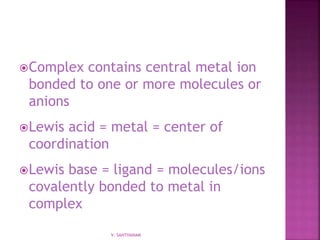
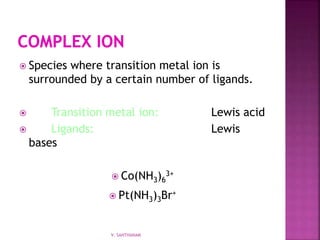
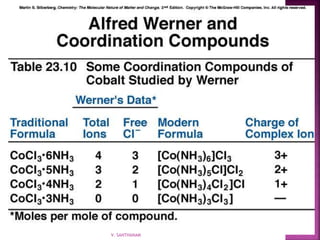
![ Consist of a complex ion and necessary counter ions
[Co(NH3)5Cl]Cl2
Complex ion: [Co(NH3)5Cl]2+
Co3+ + 5 NH3 + Cl-
1(3+) + 5 (0) + 1(1-)
2+
Counter ions: 2 Cl-
V. SANTHANAM](https://image.slidesharecdn.com/sancomplex-1-150108203404-conversion-gate02/85/Coordination-chemistry-introduction-5-320.jpg)

![Complex ion remains intact upon dissolution in water
[Co(NH3)6]Cl3 [Pt(NH3)4]Br2
V. SANTHANAM](https://image.slidesharecdn.com/sancomplex-1-150108203404-conversion-gate02/85/Coordination-chemistry-introduction-8-320.jpg)
![ 1. Cation then anion
2. Total charges must balance to zero
3. Complex ion in brackets
K2[Co(NH3)2Cl4]
[Co(NH3)4Cl2]Cl
V. SANTHANAM](https://image.slidesharecdn.com/sancomplex-1-150108203404-conversion-gate02/85/Coordination-chemistry-introduction-13-320.jpg)
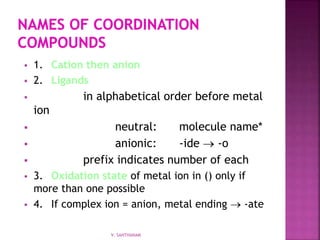
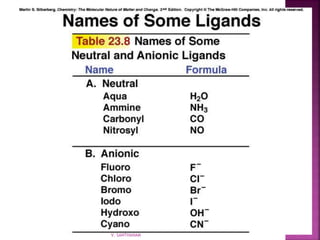
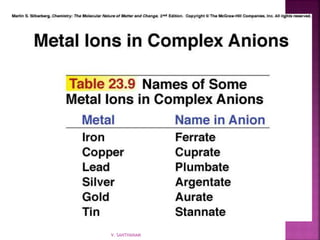
![ K2[Co(NH3)2Cl4]
potassium
diamminetetrachlorocobaltate(II)
[Co(NH3)4Cl2]Cl
tetraamminedichlorocobalt(III) chloride
V. SANTHANAM](https://image.slidesharecdn.com/sancomplex-1-150108203404-conversion-gate02/85/Coordination-chemistry-introduction-17-320.jpg)
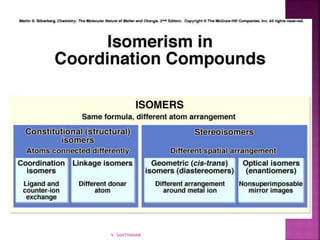
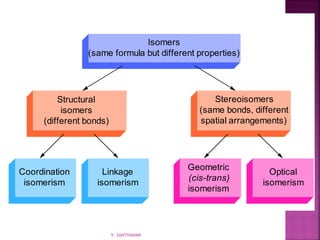
![ Coordination isomerism
Composition of the complex ion varies.
[Cr(NH3)5SO4]Br
and [Cr(NH3)5Br]SO4
V. SANTHANAM](https://image.slidesharecdn.com/sancomplex-1-150108203404-conversion-gate02/85/Coordination-chemistry-introduction-21-320.jpg)
![ Ligand isomerism:
Same complex ion structure but point of
attachment of at least one of the ligands differs.
[Co(NH3)4(NO2)Cl]Cl
and [Co(NH3)4(ONO)Cl]Cl
V. SANTHANAM](https://image.slidesharecdn.com/sancomplex-1-150108203404-conversion-gate02/85/Coordination-chemistry-introduction-22-320.jpg)
![[Co(NH3)5(NO2)]Cl2
Pentaamminenitrocobalt(III)
chloride
[Co(NH3)5(ONO)]Cl2
Pentaamminenitritocobalt(III)
chloride
V. SANTHANAM](https://image.slidesharecdn.com/sancomplex-1-150108203404-conversion-gate02/85/Coordination-chemistry-introduction-23-320.jpg)
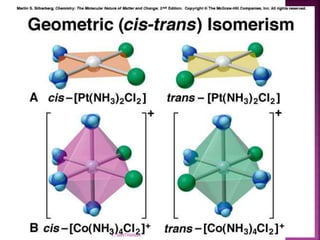
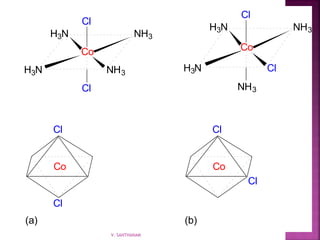
![ Geometric isomerism (cis-trans):
Atoms or groups arranged differently
spatially relative to metal ion
[Pt(NH3)2Cl2]
V. SANTHANAM](https://image.slidesharecdn.com/sancomplex-1-150108203404-conversion-gate02/85/Coordination-chemistry-introduction-24-320.jpg)


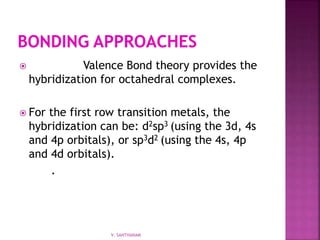

1. The document discusses transition metal complexes, including their properties and bonding models. 2. Key topics covered include ligand field theory, isomerism in complexes, naming complexes using IUPAC rules, and the electronic spectra and magnetic properties used to evaluate bonding models. 3. Several bonding models are mentioned, including Werner's theory, Sidgwick's theory, crystal field theory, and ligand field theory.


