2D NMR-HETCOR
Presented by,
D.Keerthana - M.pharm 1st yr,
Dept.of pharmaceuticalchemistry
2D-NMR
2D NMR is a set of nuclear magnetic resonance spectroscopy (NMR)
methods which give data plotted in a space defined by two frequency axes
rather than one.
2D NMR spectra provide more information about a molecule than one-
dimensional NMR spectra.
PRINCIPLE:
 2D NMR is Nuclear magnetic resonance spectroscopy in which we provide a
90 degree pulse to our sample which is placed in uniform magnetic field then
we wait for (0ms-5ms) depending upon the experiment type then again we
provide again 90 degree pulse and this time we measure signal as FID.
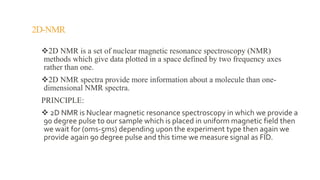
 As a result we get Two FID signals which are plotted with respect to time domain.
 To get a meaningful data , we apply Fourier transform program on FIDs to get
frequency in terms of ppm.
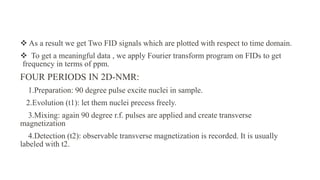
FOUR PERIODS IN 2D-NMR:
1.Preparation: 90 degree pulse excite nuclei in sample.
2.Evolution (t1): let them nuclei precess freely.
3.Mixing: again 90 degree r.f. pulses are applied and create transverse
magnetization
4.Detection (t2): observable transverse magnetization is recorded. It is usually
labeled with t2.
HETCOR
Types of 2D NMR
• Homonuclear Experiment : In this experiment we provide two frequency to
same nuclei in sample. i.e. H-H Correlation spectroscopy (COSY) Actually in it
we basically see homonuclear connectivity between same nuclei.
• Heteronuclear Experiment : In this experiment we provides two frequency to
different nuclei in the sample i.e. H-C Heteronuclear Correlation (HETCOR).
HETCOR
Heteronuclear through-bond correlation methods (HETCOR):
 Heteronuclear correlation spectroscopy gives signal based upon coupling
between nuclei between two different types. Often the two nuclei are protons
and another nucleus (called a "heteronucleus"). For historical reasons,
experiments which record the proton rather than the heteronucleus spectrum
during the detection period are called "inverse" experiments.
This is because the low natural abundance of most heteronuclei would result in
the proton spectrum being overwhelmed with signals from molecules with no
active heteronuclei, making it useless for observing the desired, coupled signals.
With the advent of techniques for suppressing these undesired signals, inverse
correlation experiments such as HSQC, HMQC, and HMBC are actually much
more common today. "Normal" heteronuclear correlation spectroscopy, in which
the heteronucleus spectrum is recorded, is known as HETCOR.
HETCOR Spectrum of 2-D NMR spectra that show 13C-1H shift correlation are
called HETCOR (from heteronuclear correlation) spectra.
 HETCOR spectra indicate coupling between protons and the carbon to which they
are attached.
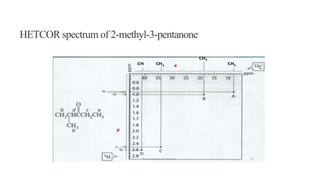
Example: 2-methyl-3-pentanone The 13C NMR spectrum is shown on the x-axis
and the 1H NMR spectrum is shown on the y-axis.
The cross peaks in a HETCOR spectrum identify which hydrogens are attached to
which carbons.
For example, cross peak A indicates that the hydrogens that shows a signal at ~
0.9 ppm in the 1H NMR are bonded to the carbon that shows a signal at ~ 6 ppm in
the 13CNMR spectrum. Cross peak C shows that the hydrogens that show a signal at
~ 2.5 ppm are bonded to the carbon that shows a signal at ~ 34ppm.
HETCOR spectrum of 2-methyl-3-pentanone
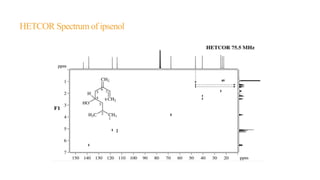
HETCOR Spectrum of ipsenol
HSQC
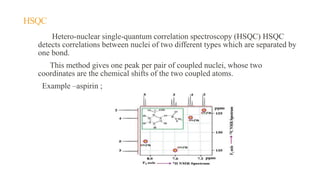
Hetero-nuclear single-quantum correlation spectroscopy (HSQC) HSQC
detects correlations between nuclei of two different types which are separated by
one bond.
This method gives one peak per pair of coupled nuclei, whose two
coordinates are the chemical shifts of the two coupled atoms.
Example –aspirin ;
HMBC
Hetero-nuclear multiple-bond correlation spectroscopy (HMBC) .HMBC
detects hetero-nuclear correlations over longer ranges of about 2–4 bonds.
In HMBC, this difficulty is overcome by omitting one of these delays from
an HMQC sequence.
This increases the range of coupling constants that can be detected, and
also reduces signal loss from relaxation. The cost is that this eliminates the
possibility of decoupling the spectrum, and introduces phase distortions into
the signal.
There is a modification of the HMBC method which suppresses one-bond
signals, leaving only the multiple-bond signals
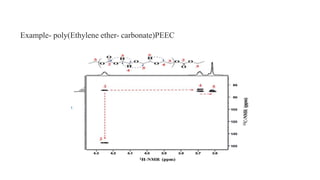
Example- poly(Ethylene ether- carbonate)PEEC
REFERENCE
1.Instrumental methods of chemical analysis by Chatwal
2.Instrumental methods of analysis by Willard
3.https://en.wikipedia.org/wiki/Two dimensional nuclear magnetic
resonance spectroscopy.
4.Organic spectroscopy by - Y.R.SHARMA Pharmaceutical Analysis
5.Spectrometric Identification of Organic compounds (six edition):
Robert M. Silverstein and Francis X. Webster.
6.Spectroscopic Methods in Organic Chemistry (fifth edition): Dudley H.
Williams and Ian Fleming ,Wikipedia.org Pharmaceutical Analysis.
THANKYOU

Hetcor

  • 1.
    2D NMR-HETCOR Presented by, D.Keerthana- M.pharm 1st yr, Dept.of pharmaceuticalchemistry
  • 2.
    2D-NMR 2D NMR isa set of nuclear magnetic resonance spectroscopy (NMR) methods which give data plotted in a space defined by two frequency axes rather than one. 2D NMR spectra provide more information about a molecule than one- dimensional NMR spectra. PRINCIPLE:  2D NMR is Nuclear magnetic resonance spectroscopy in which we provide a 90 degree pulse to our sample which is placed in uniform magnetic field then we wait for (0ms-5ms) depending upon the experiment type then again we provide again 90 degree pulse and this time we measure signal as FID.
  • 3.
     As aresult we get Two FID signals which are plotted with respect to time domain.  To get a meaningful data , we apply Fourier transform program on FIDs to get frequency in terms of ppm. FOUR PERIODS IN 2D-NMR: 1.Preparation: 90 degree pulse excite nuclei in sample. 2.Evolution (t1): let them nuclei precess freely. 3.Mixing: again 90 degree r.f. pulses are applied and create transverse magnetization 4.Detection (t2): observable transverse magnetization is recorded. It is usually labeled with t2.
  • 4.
    HETCOR Types of 2DNMR • Homonuclear Experiment : In this experiment we provide two frequency to same nuclei in sample. i.e. H-H Correlation spectroscopy (COSY) Actually in it we basically see homonuclear connectivity between same nuclei. • Heteronuclear Experiment : In this experiment we provides two frequency to different nuclei in the sample i.e. H-C Heteronuclear Correlation (HETCOR).
  • 5.
    HETCOR Heteronuclear through-bond correlationmethods (HETCOR):  Heteronuclear correlation spectroscopy gives signal based upon coupling between nuclei between two different types. Often the two nuclei are protons and another nucleus (called a "heteronucleus"). For historical reasons, experiments which record the proton rather than the heteronucleus spectrum during the detection period are called "inverse" experiments. This is because the low natural abundance of most heteronuclei would result in the proton spectrum being overwhelmed with signals from molecules with no active heteronuclei, making it useless for observing the desired, coupled signals. With the advent of techniques for suppressing these undesired signals, inverse correlation experiments such as HSQC, HMQC, and HMBC are actually much more common today. "Normal" heteronuclear correlation spectroscopy, in which the heteronucleus spectrum is recorded, is known as HETCOR.
  • 6.
    HETCOR Spectrum of2-D NMR spectra that show 13C-1H shift correlation are called HETCOR (from heteronuclear correlation) spectra.  HETCOR spectra indicate coupling between protons and the carbon to which they are attached. Example: 2-methyl-3-pentanone The 13C NMR spectrum is shown on the x-axis and the 1H NMR spectrum is shown on the y-axis. The cross peaks in a HETCOR spectrum identify which hydrogens are attached to which carbons. For example, cross peak A indicates that the hydrogens that shows a signal at ~ 0.9 ppm in the 1H NMR are bonded to the carbon that shows a signal at ~ 6 ppm in the 13CNMR spectrum. Cross peak C shows that the hydrogens that show a signal at ~ 2.5 ppm are bonded to the carbon that shows a signal at ~ 34ppm.
  • 7.
    HETCOR spectrum of2-methyl-3-pentanone
  • 8.
  • 9.
    HSQC Hetero-nuclear single-quantum correlationspectroscopy (HSQC) HSQC detects correlations between nuclei of two different types which are separated by one bond. This method gives one peak per pair of coupled nuclei, whose two coordinates are the chemical shifts of the two coupled atoms. Example –aspirin ;
  • 10.
    HMBC Hetero-nuclear multiple-bond correlationspectroscopy (HMBC) .HMBC detects hetero-nuclear correlations over longer ranges of about 2–4 bonds. In HMBC, this difficulty is overcome by omitting one of these delays from an HMQC sequence. This increases the range of coupling constants that can be detected, and also reduces signal loss from relaxation. The cost is that this eliminates the possibility of decoupling the spectrum, and introduces phase distortions into the signal. There is a modification of the HMBC method which suppresses one-bond signals, leaving only the multiple-bond signals
  • 11.
  • 12.
    REFERENCE 1.Instrumental methods ofchemical analysis by Chatwal 2.Instrumental methods of analysis by Willard 3.https://en.wikipedia.org/wiki/Two dimensional nuclear magnetic resonance spectroscopy. 4.Organic spectroscopy by - Y.R.SHARMA Pharmaceutical Analysis 5.Spectrometric Identification of Organic compounds (six edition): Robert M. Silverstein and Francis X. Webster. 6.Spectroscopic Methods in Organic Chemistry (fifth edition): Dudley H. Williams and Ian Fleming ,Wikipedia.org Pharmaceutical Analysis.
  • 13.