ION- EXCLUSION
CHROMATOGRAPHY
INTRODUCTION…
 Useful technique for the separation of ionic and nonionic
substances.
 Ion exchange stationary phase.
 Separation by partition.
 Ionic substances - pass quickly through the column.
 Nonionic (molecular) or partially ionized substances are held
up and are eluted more slowly.
Alternative names…
 Ion Exclusion Partition Chromatography
 Ion Chromatography-Exclusion Mode
 Donnan Exclusion Chromatography
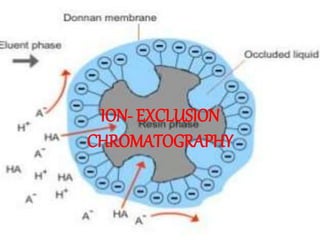
Principle
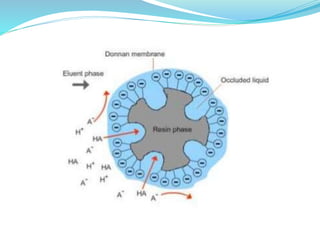
 A poly(styrene}divinylbenzene) (PS-DVB) based strongly acidic
cation exchange resin in the hydrogen form.
 3 distinct components:
1. A solid resin network with charged functional groups (the
membrane).
2. Occluded liquid within the resin beads (the stationary phase).
3. The mobile liquid between the resin beads (the mobile phase or
eluent).
 Molecules that are partially dissociated will show retention between
that of fully ionized and non-polar solutes.
 Analytes are separated by
 (i) exclusion or repulsion if they are ionized and have the same
charge as the resin, or
 (ii) adsorption if they are non-polar or partially ionized.
 The ratio of the concentrations of ionized to neutral forms
of an analysed compound is determined by its dissociation
constant and is equivalent to the solute effective charge.
 Strong acids that are completely dissociated are
electrostatically repulsed.
 Eluted unseparated in the column dead volume (Vm),
which corresponds to the volume of the mobile phase in
the column.
 Undissociated molecules are able to enter the resin
network.
 Eluted together with a retention volume equal to the sum
of the inner and dead column volumes.
 The inner column volume means the volume of its
stationary phase.
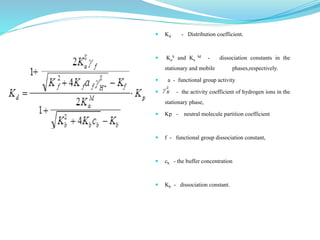
 Kd - Distribution coefficient.
 Ka
S and Ka
M - dissociation constants in the
stationary and mobile phases,respectively.
 a - functional group activity
 - the activity coefficient of hydrogen ions in the
stationary phase,
 Kp - neutral molecule partition coefficient
 f - functional group dissociation constant,
 cb - the buffer concentration
 Kb - dissociation constant.
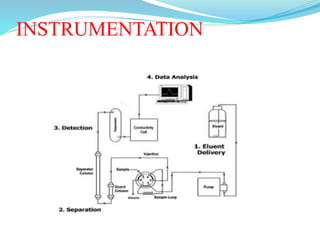
INSTRUMENTATION
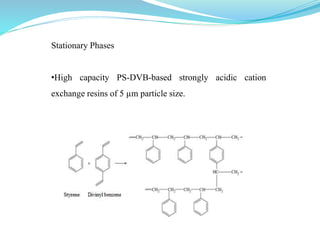
Stationary Phases
•High capacity PS-DVB-based strongly acidic cation
exchange resins of 5 µm particle size.
 Polymethacrylate based weakly acidic cation exchange resin.
 Unfunctionalized silica gel.
Mobile phases:
 Methanol
 Ethanol
 Butanol
 Glycerol
 Acetonitrile.
SUPPRESSOR
Reduce the background conductivity of the eluent and enhance
the conductivity of the analytes.
Minimizes baseline noise
Increases the detection sensitivity of the measurement system
Optimizes the signal-to-noise ratio
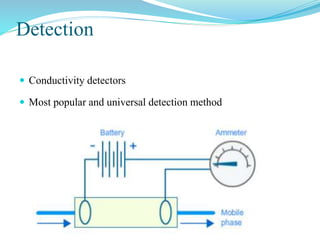
Detection
 Conductivity detectors
 Most popular and universal detection method
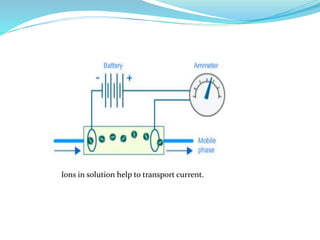
Ions in solution help to transport current.
 Detectors with UV-Visible spectrophotometry
 Used in cases where the component is absorbed in the UV-
Visible range.
 Eg: iodide, nitrite, nitrate, iodate or chromate ions.
 Detector is photodiode and the cell is a quartz cuvette.
 Deuterium and tungsten lamps are used as a source of
light.
Fluorescence-based detectors
 Components of the sample are excited by a given
wavelength light and the components emit light.
 Detection of biological samples.
APPLICATIONS
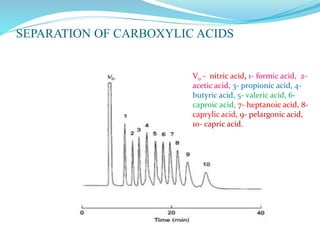
V0 - nitric acid, 1- formic acid, 2-
acetic acid, 3- propionic acid, 4-
butyric acid, 5- valeric acid, 6-
caproic acid, 7- heptanoic acid, 8-
caprylic acid, 9- pelargonic acid,
10- capric acid.
SEPARATION OF CARBOXYLIC ACIDS
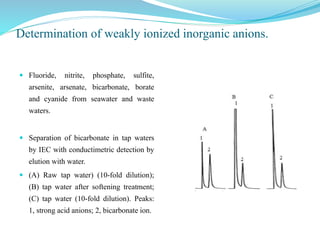
Determination of weakly ionized inorganic anions.
 Fluoride, nitrite, phosphate, sulfite,
arsenite, arsenate, bicarbonate, borate
and cyanide from seawater and waste
waters.
 Separation of bicarbonate in tap waters
by IEC with conductimetric detection by
elution with water.
 (A) Raw tap water) (10-fold dilution);
(B) tap water after softening treatment;
(C) tap water (10-fold dilution). Peaks:
1, strong acid anions; 2, bicarbonate ion.
Strong Inorganic Acids
 Sulfate, nitrate and chloride ions, and strong base cations such
as sodium, ammonium potassium, magnesium and calcium ions
commonly found in acid rainwater.
Neutral Compounds
 Neutral compounds such as sugars and alcohols can be
separated by IEC.
Determination of water in some organic solvents.
 PS-DVB based cation exchange resin in the hydrogen
form.
 Eluent - methanol containing a small amount of strong
acid.
 Spectrophotometric detection.
 Peak at at 310nm.
Amino acids and amino acid derivatives.
 Hippuric and orotic acid were determined using
photodiode array detection.
 The two peaks of hippuric and orotic acids were
monitored at 210 and 280 nm.
REFERENCE
 Instrumental analysis – Doglas A skoog, F. James Holler, Timothy A. Nieman, 5th
edition, page no:
 Instrumental methods of chemical analysis- H.Kaur, page no: 1139
 R.E. Smith, ‘Ion Chromatography Applications’, CRC Press, Boca Raton, 1988.
 http://www.chromacademy.com/lms/sco111/theory_of_hplc_ion-
chromatography.pdf.
 https://www.researchgate.net/publication/233910695_Principles_and_Applications_
of_Ion_Exclusion_Chromatography.
 https://academic.oup.com/chromsci/article/51/7/655/472405.

ION-EXCLUSION CHROMATOGRAPHY

  • 1.
  • 2.
    INTRODUCTION…  Useful techniquefor the separation of ionic and nonionic substances.  Ion exchange stationary phase.  Separation by partition.  Ionic substances - pass quickly through the column.  Nonionic (molecular) or partially ionized substances are held up and are eluted more slowly.
  • 3.
    Alternative names…  IonExclusion Partition Chromatography  Ion Chromatography-Exclusion Mode  Donnan Exclusion Chromatography
  • 4.
    Principle  A poly(styrene}divinylbenzene)(PS-DVB) based strongly acidic cation exchange resin in the hydrogen form.  3 distinct components: 1. A solid resin network with charged functional groups (the membrane). 2. Occluded liquid within the resin beads (the stationary phase). 3. The mobile liquid between the resin beads (the mobile phase or eluent).
  • 6.
     Molecules thatare partially dissociated will show retention between that of fully ionized and non-polar solutes.  Analytes are separated by  (i) exclusion or repulsion if they are ionized and have the same charge as the resin, or  (ii) adsorption if they are non-polar or partially ionized.
  • 7.
     The ratioof the concentrations of ionized to neutral forms of an analysed compound is determined by its dissociation constant and is equivalent to the solute effective charge.  Strong acids that are completely dissociated are electrostatically repulsed.  Eluted unseparated in the column dead volume (Vm), which corresponds to the volume of the mobile phase in the column.
  • 8.
     Undissociated moleculesare able to enter the resin network.  Eluted together with a retention volume equal to the sum of the inner and dead column volumes.  The inner column volume means the volume of its stationary phase.
  • 9.
     Kd -Distribution coefficient.  Ka S and Ka M - dissociation constants in the stationary and mobile phases,respectively.  a - functional group activity  - the activity coefficient of hydrogen ions in the stationary phase,  Kp - neutral molecule partition coefficient  f - functional group dissociation constant,  cb - the buffer concentration  Kb - dissociation constant.
  • 10.
  • 11.
    Stationary Phases •High capacityPS-DVB-based strongly acidic cation exchange resins of 5 µm particle size.
  • 12.
     Polymethacrylate basedweakly acidic cation exchange resin.  Unfunctionalized silica gel. Mobile phases:  Methanol  Ethanol  Butanol  Glycerol  Acetonitrile.
  • 13.
    SUPPRESSOR Reduce the backgroundconductivity of the eluent and enhance the conductivity of the analytes. Minimizes baseline noise Increases the detection sensitivity of the measurement system Optimizes the signal-to-noise ratio
  • 14.
    Detection  Conductivity detectors Most popular and universal detection method
  • 15.
    Ions in solutionhelp to transport current.
  • 16.
     Detectors withUV-Visible spectrophotometry  Used in cases where the component is absorbed in the UV- Visible range.  Eg: iodide, nitrite, nitrate, iodate or chromate ions.  Detector is photodiode and the cell is a quartz cuvette.  Deuterium and tungsten lamps are used as a source of light.
  • 17.
    Fluorescence-based detectors  Componentsof the sample are excited by a given wavelength light and the components emit light.  Detection of biological samples.
  • 18.
  • 19.
    V0 - nitricacid, 1- formic acid, 2- acetic acid, 3- propionic acid, 4- butyric acid, 5- valeric acid, 6- caproic acid, 7- heptanoic acid, 8- caprylic acid, 9- pelargonic acid, 10- capric acid. SEPARATION OF CARBOXYLIC ACIDS
  • 20.
    Determination of weaklyionized inorganic anions.  Fluoride, nitrite, phosphate, sulfite, arsenite, arsenate, bicarbonate, borate and cyanide from seawater and waste waters.  Separation of bicarbonate in tap waters by IEC with conductimetric detection by elution with water.  (A) Raw tap water) (10-fold dilution); (B) tap water after softening treatment; (C) tap water (10-fold dilution). Peaks: 1, strong acid anions; 2, bicarbonate ion.
  • 21.
    Strong Inorganic Acids Sulfate, nitrate and chloride ions, and strong base cations such as sodium, ammonium potassium, magnesium and calcium ions commonly found in acid rainwater.
  • 22.
    Neutral Compounds  Neutralcompounds such as sugars and alcohols can be separated by IEC.
  • 23.
    Determination of waterin some organic solvents.  PS-DVB based cation exchange resin in the hydrogen form.  Eluent - methanol containing a small amount of strong acid.  Spectrophotometric detection.  Peak at at 310nm.
  • 24.
    Amino acids andamino acid derivatives.  Hippuric and orotic acid were determined using photodiode array detection.  The two peaks of hippuric and orotic acids were monitored at 210 and 280 nm.
  • 25.
    REFERENCE  Instrumental analysis– Doglas A skoog, F. James Holler, Timothy A. Nieman, 5th edition, page no:  Instrumental methods of chemical analysis- H.Kaur, page no: 1139  R.E. Smith, ‘Ion Chromatography Applications’, CRC Press, Boca Raton, 1988.  http://www.chromacademy.com/lms/sco111/theory_of_hplc_ion- chromatography.pdf.  https://www.researchgate.net/publication/233910695_Principles_and_Applications_ of_Ion_Exclusion_Chromatography.  https://academic.oup.com/chromsci/article/51/7/655/472405.