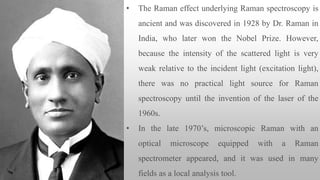
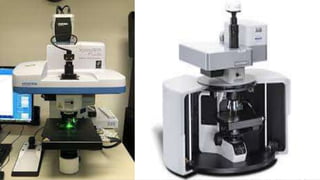
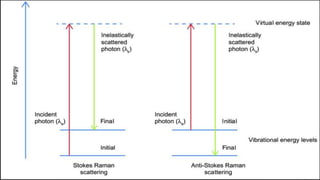
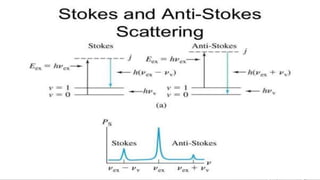
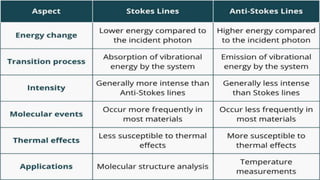
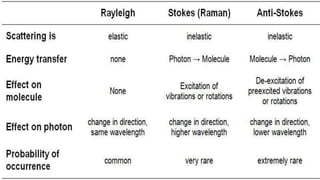
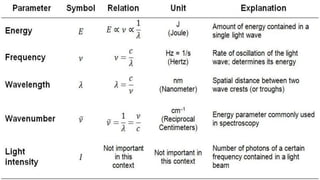
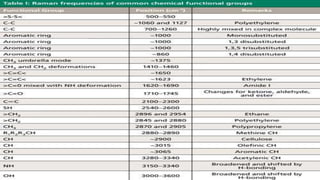
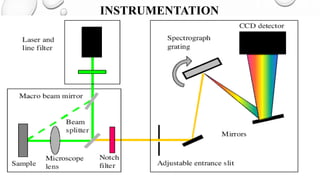
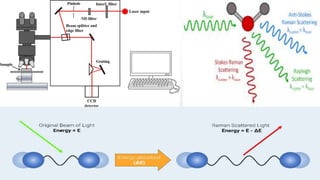
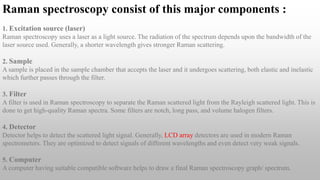
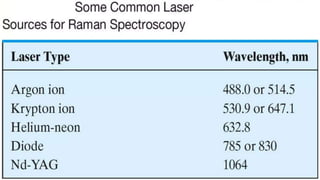
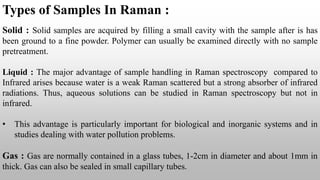
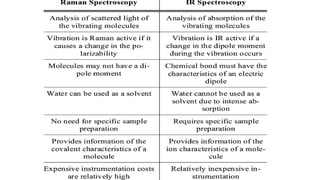
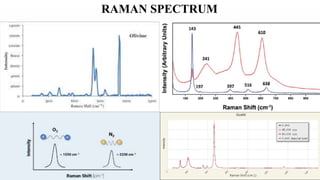
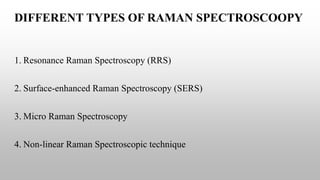
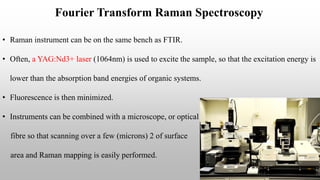
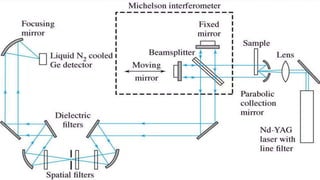
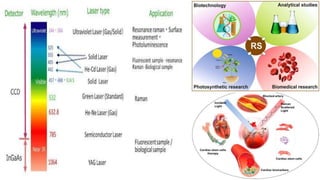
This document provides an overview of Raman spectroscopy. It begins with a brief history noting its discovery in 1928 by Raman for which he later won a Nobel Prize. It then covers the basic principles of Raman spectroscopy including the Raman effect, Stokes and anti-Stokes scattering. Instrumentation components like lasers, filters, and detectors are described. Different types of samples that can be analyzed including solids, liquids, and gases are mentioned. Finally, applications of Raman spectroscopy in various fields like chemistry, polymers, mixtures, inorganic/organic species, and biology are highlighted.