Topic: Nuclear Shell Model
Subject Nuclear physics-I
Nuclear Models
There are three models of nucleus
 Liquid Drop Model
 Nuclear Shell Model
 Collective Model
Here we are going to discuss the Nuclear shell Model.
Main Drawbacks of Liquid Drop Model
The main drawbacks of Liquid Drop Model are as follow:
1. It does not explain about the magic numbers.
2. It does not explain the excited states.
3. It does not able to calculate the nuclear spin.
Nuclear Shell Model
• Definition
In nuclear physics, the nuclear shell model is a theoretical model to
describe the atomic nucleus (in terms of energy levels).
 The nuclear shell model was proposed by Dmitry Ivanenko in 1932 and
further developed independently by several physicists such as Maria
Goeppert-Mayer, Eugene Paul Wigner and J. Hans D. Jensen in 1949.
It must be noted this model is based on the Pauli exclusion principle to
describe the structure of the nucleus in terms of energy levels.
Features of Shell Model
The important features of nuclear shell model are:
 The Shell Model is partly analogous to atomic shell model which
describes the arrangements of electrons in an atom.
 The nucleons move randomly in a nucleus and collide into each
other frequently in liquid drop model. The shell model suggests that
each nucleon in a nucleus moves in a well defined orbit and hardly
makes any collision. This is why this model is also called as
independent model..
Features of Shell Model
As Nuclear Shell Model is analogous to atomic shell model so filled shells
results in greater stability
The nucleons in a nucleus obey Pauli exclusion principle( no two
nucleons may occupy same state at the same time). The neutrons and
protons are treated separately when their states are considered . Each have
its own array of available quantized states.
Features of Shell Model
 In this model each nucleon is assume to exist in shell just like in atomic
model.
 The nuclei shell are associated with certain Magic Numbers.
Features of Shell Model
Magic Number
In nuclear physics the magic number is the “Number of nucleons ( either
protons and nuetrons) such that are arranged into complete shell withen the
atomic nucleus.
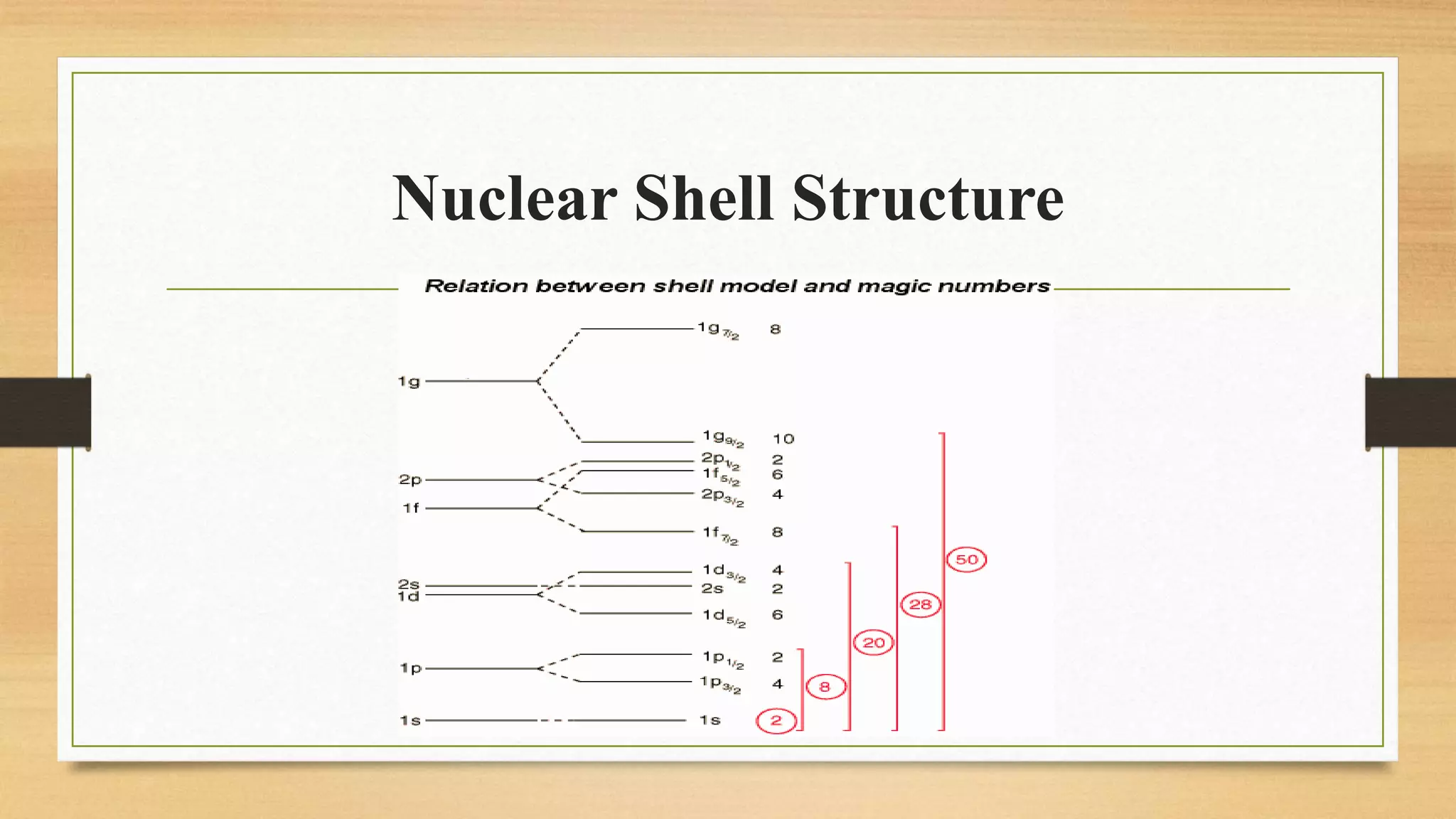
The seven most widely recognize magic numbers are 2,8,20,28,50,82,126.
The magic nuclei have special stability.
Features of Shell Model
 Doubly Magic Number
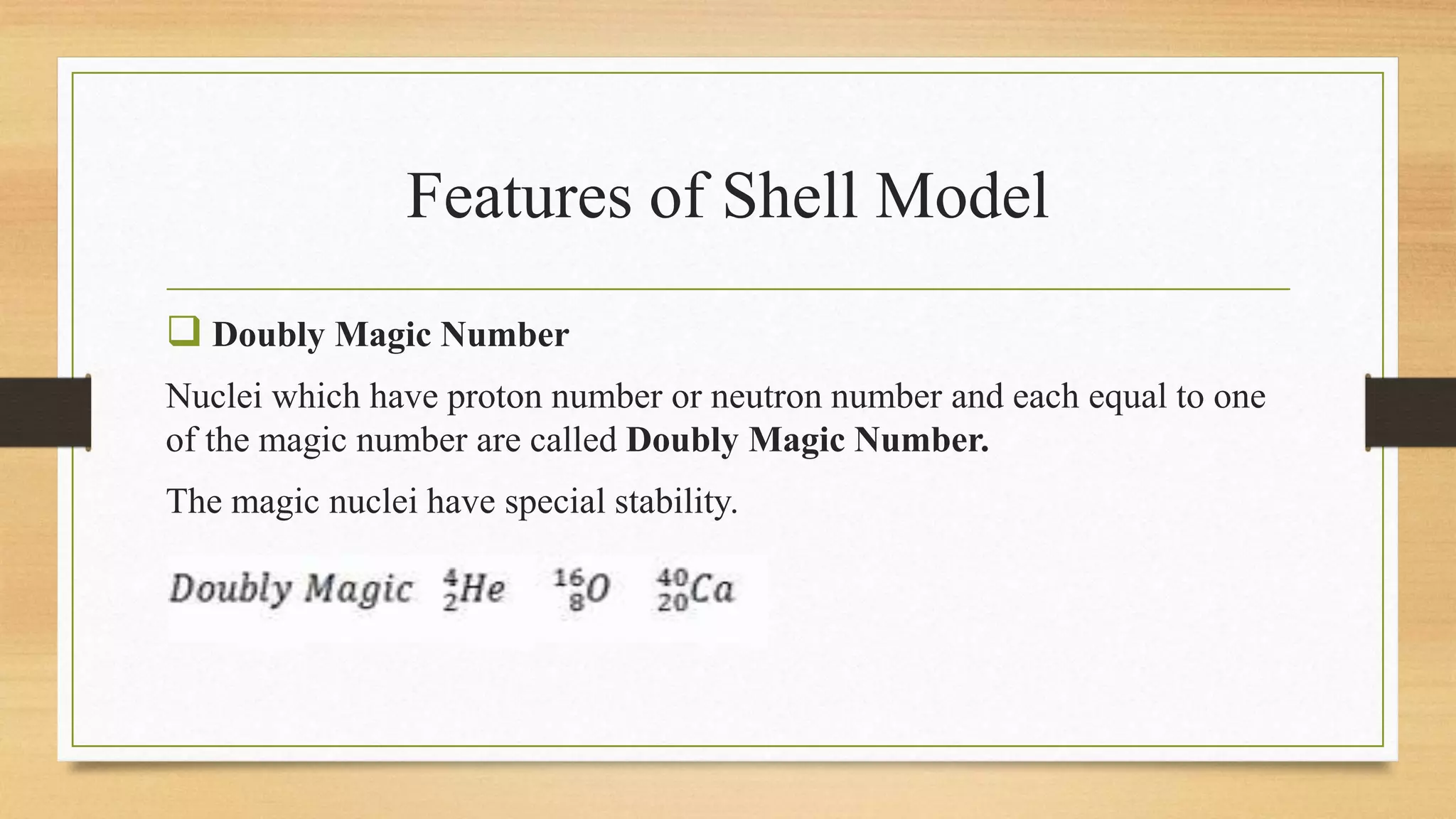
Nuclei which have proton number or neutron number and each equal to one
of the magic number are called Doubly Magic Number.
The magic nuclei have special stability.
Features of Magic Numbers
 If neutron (or proton ) corresponds to magic number then we need greater
energy to remove last neutron(or proton) which is called Separation
Energy.
 If both proton and neutron corresponds to magic number then they are
most stable nuclei.
 If number of neutrons corresponds to magic number then we have greater
number and stable isotones.
Features of Magic Numbers
If number of protons corresponds to magic numbers then we have greater
numbers and stable isotopes.
i.e Calcium has six isotopes.
 The element whose Z and N is a magic number has abundance.
Features of Magic Numbers
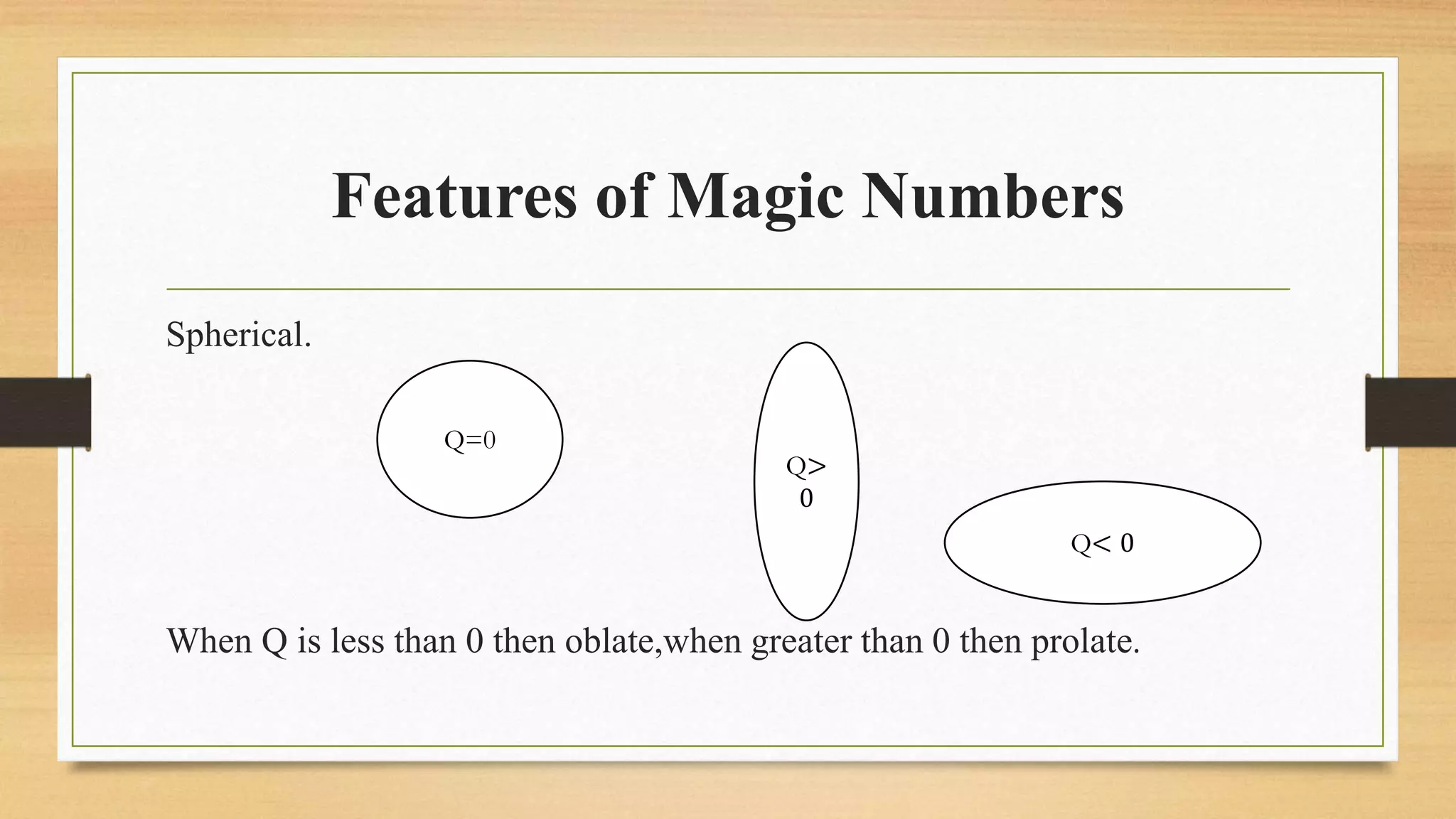
The Electric quadro-pole moment tells about the charge distribution in
nucleus that is either :
symmetric or
 non-symmetric.
Features of Magic Numbers
Spherical.
When Q is less than 0 then oblate,when greater than 0 then prolate.
Q=0
Q>
0
Q< 0
Significance of Magic Numbers
1.The nuclei either proton number or neutron number equal to magic
number are most stable as compared to other nuclei.
2. The number of isotopes containing magic number of protons are more
than that of other nuclei. Example The number of isotopes of Ca(Z=20) is
6.
Significance of Magic Numbers
• 3. The number of naturally occurring isotones containing the magic
number of neutrons are more than that of the other nuclei. Example N=82
has 7 isotones N=80 has 3 isotones
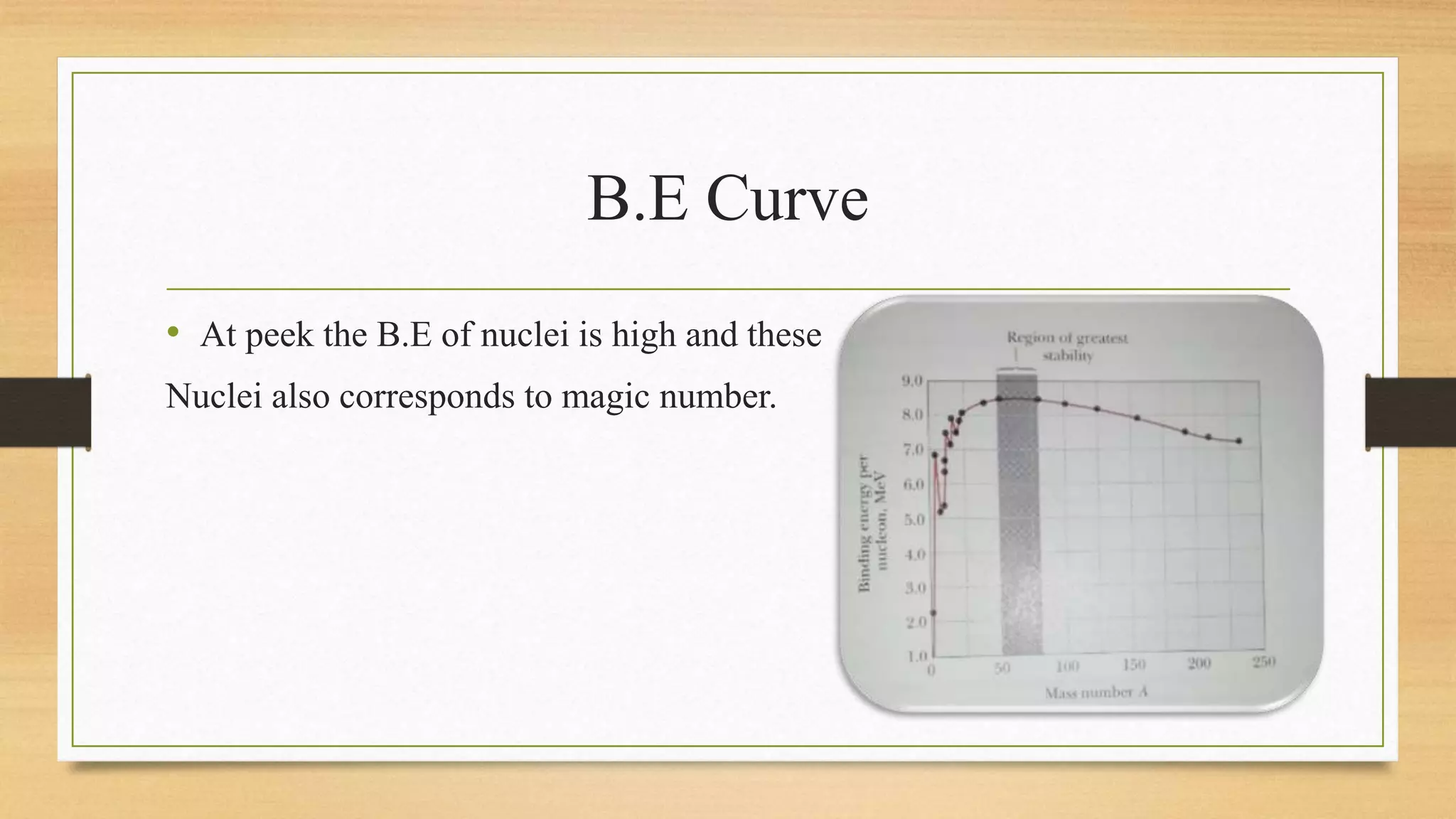
B.E Curve
• At peek the B.E of nuclei is high and these
Nuclei also corresponds to magic number.
Nuclear Shell Structure
Main Achievements of Shell Model
1. It explain the magic number.
2. It explain the magnetic moment of some nuclei.
3. It explain successfully ground state spin.
4. It explain the greater stability and high Binding energy
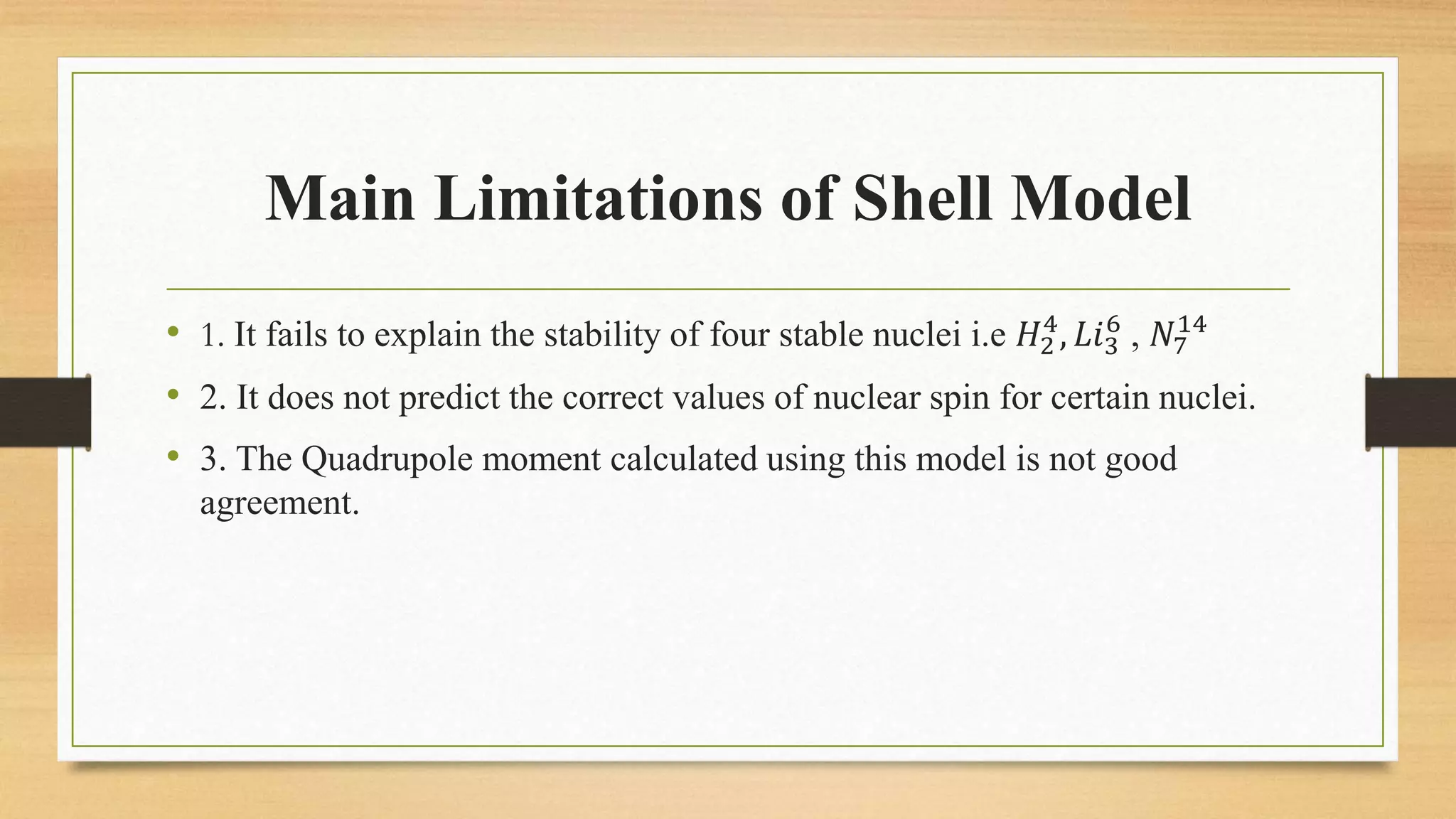
Main Limitations of Shell Model
• 1. It fails to explain the stability of four stable nuclei i.e 𝐻2
4
, 𝐿𝑖3
6
, 𝑁7
14
• 2. It does not predict the correct values of nuclear spin for certain nuclei.
• 3. The Quadrupole moment calculated using this model is not good
agreement.
References
1.K. L. Heyde, “The nuclear shell model”, in The nuclear shell model (Springer,
1994), pp. 58–154.
2.K. S. Krane, D. Halliday, et al., Introductory nuclear physics (1987)
•THANK YOU

Nuclear Shell models

  • 1.
    Topic: Nuclear ShellModel Subject Nuclear physics-I
  • 2.
    Nuclear Models There arethree models of nucleus  Liquid Drop Model  Nuclear Shell Model  Collective Model Here we are going to discuss the Nuclear shell Model.
  • 3.
    Main Drawbacks ofLiquid Drop Model The main drawbacks of Liquid Drop Model are as follow: 1. It does not explain about the magic numbers. 2. It does not explain the excited states. 3. It does not able to calculate the nuclear spin.
  • 4.
    Nuclear Shell Model •Definition In nuclear physics, the nuclear shell model is a theoretical model to describe the atomic nucleus (in terms of energy levels).  The nuclear shell model was proposed by Dmitry Ivanenko in 1932 and further developed independently by several physicists such as Maria Goeppert-Mayer, Eugene Paul Wigner and J. Hans D. Jensen in 1949. It must be noted this model is based on the Pauli exclusion principle to describe the structure of the nucleus in terms of energy levels.
  • 5.
    Features of ShellModel The important features of nuclear shell model are:  The Shell Model is partly analogous to atomic shell model which describes the arrangements of electrons in an atom.  The nucleons move randomly in a nucleus and collide into each other frequently in liquid drop model. The shell model suggests that each nucleon in a nucleus moves in a well defined orbit and hardly makes any collision. This is why this model is also called as independent model..
  • 6.
    Features of ShellModel As Nuclear Shell Model is analogous to atomic shell model so filled shells results in greater stability The nucleons in a nucleus obey Pauli exclusion principle( no two nucleons may occupy same state at the same time). The neutrons and protons are treated separately when their states are considered . Each have its own array of available quantized states.
  • 7.
    Features of ShellModel  In this model each nucleon is assume to exist in shell just like in atomic model.  The nuclei shell are associated with certain Magic Numbers.
  • 8.
    Features of ShellModel Magic Number In nuclear physics the magic number is the “Number of nucleons ( either protons and nuetrons) such that are arranged into complete shell withen the atomic nucleus. The seven most widely recognize magic numbers are 2,8,20,28,50,82,126. The magic nuclei have special stability.
  • 9.
    Features of ShellModel  Doubly Magic Number Nuclei which have proton number or neutron number and each equal to one of the magic number are called Doubly Magic Number. The magic nuclei have special stability.
  • 10.
    Features of MagicNumbers  If neutron (or proton ) corresponds to magic number then we need greater energy to remove last neutron(or proton) which is called Separation Energy.  If both proton and neutron corresponds to magic number then they are most stable nuclei.  If number of neutrons corresponds to magic number then we have greater number and stable isotones.
  • 11.
    Features of MagicNumbers If number of protons corresponds to magic numbers then we have greater numbers and stable isotopes. i.e Calcium has six isotopes.  The element whose Z and N is a magic number has abundance.
  • 12.
    Features of MagicNumbers The Electric quadro-pole moment tells about the charge distribution in nucleus that is either : symmetric or  non-symmetric.
  • 13.
    Features of MagicNumbers Spherical. When Q is less than 0 then oblate,when greater than 0 then prolate. Q=0 Q> 0 Q< 0
  • 14.
    Significance of MagicNumbers 1.The nuclei either proton number or neutron number equal to magic number are most stable as compared to other nuclei. 2. The number of isotopes containing magic number of protons are more than that of other nuclei. Example The number of isotopes of Ca(Z=20) is 6.
  • 15.
    Significance of MagicNumbers • 3. The number of naturally occurring isotones containing the magic number of neutrons are more than that of the other nuclei. Example N=82 has 7 isotones N=80 has 3 isotones
  • 16.
    B.E Curve • Atpeek the B.E of nuclei is high and these Nuclei also corresponds to magic number.
  • 17.
  • 18.
    Main Achievements ofShell Model 1. It explain the magic number. 2. It explain the magnetic moment of some nuclei. 3. It explain successfully ground state spin. 4. It explain the greater stability and high Binding energy
  • 19.
    Main Limitations ofShell Model • 1. It fails to explain the stability of four stable nuclei i.e 𝐻2 4 , 𝐿𝑖3 6 , 𝑁7 14 • 2. It does not predict the correct values of nuclear spin for certain nuclei. • 3. The Quadrupole moment calculated using this model is not good agreement.
  • 20.
    References 1.K. L. Heyde,“The nuclear shell model”, in The nuclear shell model (Springer, 1994), pp. 58–154. 2.K. S. Krane, D. Halliday, et al., Introductory nuclear physics (1987)
  • 21.