 2D-NMR : Two Dimensional Nuclear Magnetic Resonance
Spectroscopy
Dr. G. D. SHIROLE (M.Sc. SET. Ph.D.)
ASSOCIATE PROFESSOR
DEPARTMENT OF CHEMISTRY
ARTS, SCIENCE & COMMERCE COLLEGE, RAHATA
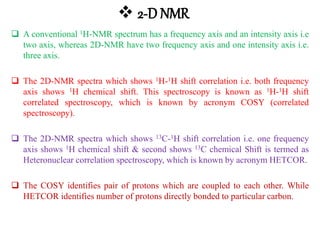
 2-D NMR
 A conventional 1H-NMR spectrum has a frequency axis and an intensity axis i.e
two axis, whereas 2D-NMR have two frequency axis and one intensity axis i.e.
three axis.
 The 2D-NMR spectra which shows 1H-1H shift correlation i.e. both frequency
axis shows 1H chemical shift. This spectroscopy is known as 1H-1H shift
correlated spectroscopy, which is known by acronym COSY (correlated
spectroscopy).
 The 2D-NMR spectra which shows 13C-1H shift correlation i.e. one frequency
axis shows 1H chemical shift & second shows 13C chemical Shift is termed as
Heteronuclear correlation spectroscopy, which is known by acronym HETCOR.
 The COSY identifies pair of protons which are coupled to each other. While
HETCOR identifies number of protons directly bonded to particular carbon.
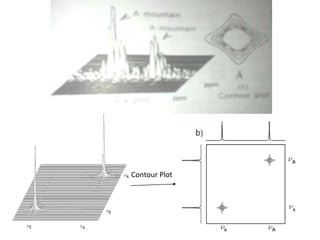
Contour Plot
 COSY
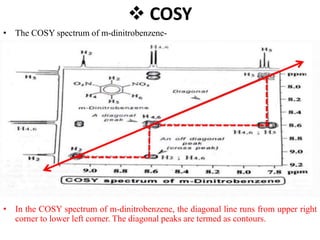
• The COSY spectrum of m-dinitrobenzene-
• In the COSY spectrum of m-dinitrobenzene, the diagonal line runs from upper right
corner to lower left corner. The diagonal peaks are termed as contours.
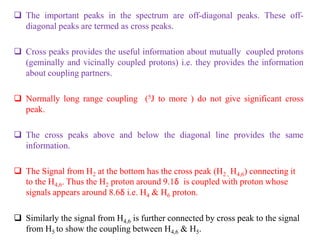
 The important peaks in the spectrum are off-diagonal peaks. These off-
diagonal peaks are termed as cross peaks.
 Cross peaks provides the useful information about mutually coupled protons
(geminally and vicinally coupled protons) i.e. they provides the information
about coupling partners.
 Normally long range coupling (5J to more ) do not give significant cross
peak.
 The cross peaks above and below the diagonal line provides the same
information.
 The Signal from H2 at the bottom has the cross peak (H2 , H4,6) connecting it
to the H4,6. Thus the H2 proton around 9.1δ is coupled with proton whose
signals appears around 8.6δ i.e. H4 & H6 proton.
 Similarly the signal from H4,6 is further connected by cross peak to the signal
from H5 to show the coupling between H4,6 & H5.
HETCOR
 The 2D-NMR spectra that display 13C-1H shift correlation are called
Hetero-nuclear correlation spectroscopy. (HETCOR)
 The HETCOR spectra shows coupling between carbon and the protons
which are directly bonded. i.e. Residual coupling.
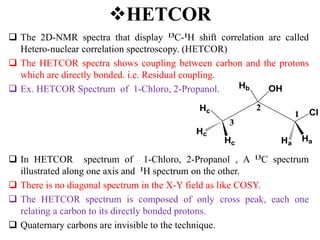
 Ex. HETCOR Spectrum of 1-Chloro, 2-Propanol.
 In HETCOR spectrum of 1-Chloro, 2-Propanol , A 13C spectrum
illustrated along one axis and 1H spectrum on the other.
 There is no diagonal spectrum in the X-Y field as like COSY.
 The HETCOR spectrum is composed of only cross peak, each one
relating a carbon to its directly bonded protons.
 Quaternary carbons are invisible to the technique.
Hb OH
Hc
Ha
Hc
Ha
Hc Cl
1
2
3
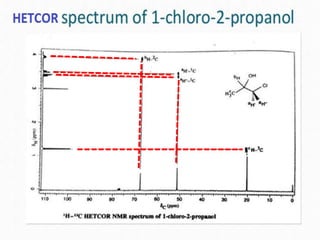
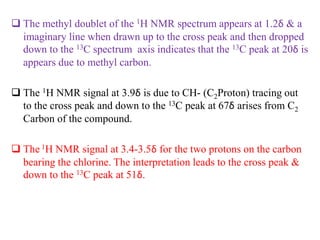
 The methyl doublet of the 1H NMR spectrum appears at 1.2δ & a
imaginary line when drawn up to the cross peak and then dropped
down to the 13C spectrum axis indicates that the 13C peak at 20δ is
appears due to methyl carbon.
 The 1H NMR signal at 3.9δ is due to CH- (C2Proton) tracing out
to the cross peak and down to the 13C peak at 67δ arises from C2
Carbon of the compound.
 The 1H NMR signal at 3.4-3.5δ for the two protons on the carbon
bearing the chlorine. The interpretation leads to the cross peak &
down to the 13C peak at 51δ.
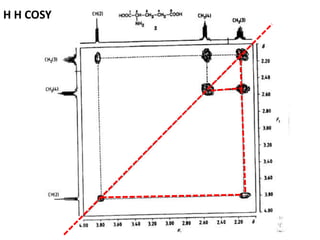
H H COSY
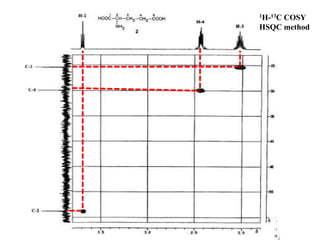
1H-13C COSY
HSQC method
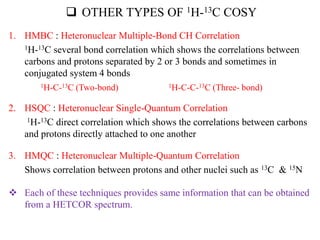
 OTHER TYPES OF 1H-13C COSY
1. HMBC : Heteronuclear Multiple-Bond CH Correlation
1H-13C several bond correlation which shows the correlations between
carbons and protons separated by 2 or 3 bonds and sometimes in
conjugated system 4 bonds
1H-C-13C (Two-bond) 1H-C-C-13C (Three- bond)
2. HSQC : Heteronuclear Single-Quantum Correlation
1H-13C direct correlation which shows the correlations between carbons
and protons directly attached to one another
3. HMQC : Heteronuclear Multiple-Quantum Correlation
Shows correlation between protons and other nuclei such as 13C & 15N
 Each of these techniques provides same information that can be obtained
from a HETCOR spectrum.
 TWO DIMENSIONAL 13C-13C CORRELATIONS:
 INADEQUATE Spectra : Incredible Natural Abundance DoublE
QUAntum Transfer Experiment
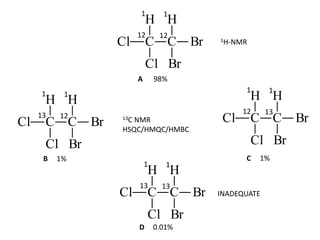
 2-D INADEQUATE provides direct carbon connectivity's
facilitating us to sketch the carbon skeleton definitely or
clearly.
 2-D INADEQUATE has very limited applicability
because of its extremely low sensitivity or low
abundance.
C C
H
Cl
Cl
H
Br
Br
12 13
1
1
C C
H
Cl
Cl
H
Br
Br
12 12
1
1
C C
H
Cl
Cl
H
Br
Br
13 13
1
1
C C
H
Cl
Cl
H
Br
Br
13 12
1
1
98%
1% 1%
0.01%
A
B C
D
1H-NMR
13C NMR
HSQC/HMQC/HMBC
INADEQUATE
 NUCLEAR OVERHAUSER ENHANCEMENT (NOE)
 When we obtained proton-decoupled spectrum, the intensities of many signals
increases significantly than the normal coupled spectra is known as Nuclear
Overhouser effect
 and the degree of increase in the signal intensity is called the Nuclear
Overhouser enhancement.
 The NOE operates through the space & is related to decoupling experiment.
 i.e. It also involves irradiation of a particular nuclei and measuring the intensities
of other signals due to other closely spaced nuclei in molecular framework.
 NOE also used to solve geometric problems within a molecule and provides the
information about the spatial arrangement of nuclei within a molecule i.e.
relative stereochemistry & regio-chemistry.
Ha OCOCH3
Cl Hb
Cl
Cl
Cl
Cl
Cl
N C
O
H
H3C
H3C
C C
COOH
H
H3C
H3C
+45%
+18%
- 2%
+17%
- 4%
Semiclathrate
Dimethyl
formamide 3-methylcrotonic
acid
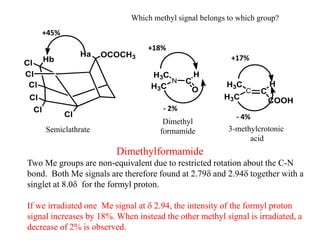
Dimethylformamide
Two Me groups are non-equivalent due to restricted rotation about the C-N
bond. Both Me signals are therefore found at 2.79 and 2.94 together with a
singlet at 8.0 for the formyl proton.
If we irradiated one Me signal at  2.94, the intensity of the formyl proton
signal increases by 18%. When instead the other methyl signal is irradiated, a
decrease of 2% is observed.
Which methyl signal belongs to which group?
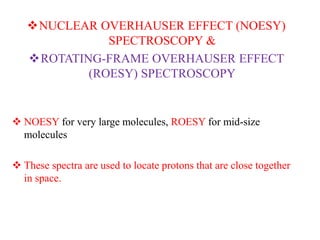
NUCLEAR OVERHAUSER EFFECT (NOESY)
SPECTROSCOPY &
ROTATING-FRAME OVERHAUSER EFFECT
(ROESY) SPECTROSCOPY
 NOESY for very large molecules, ROESY for mid-size
molecules
 These spectra are used to locate protons that are close together
in space.
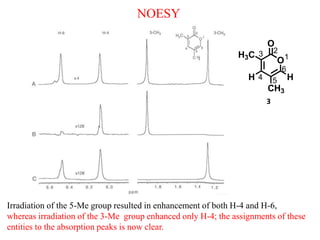
NOESY
O
O
H3C
CH3
H H
1
2
3
4 5
6
3
Irradiation of the 5-Me group resulted in enhancement of both H-4 and H-6,
whereas irradiation of the 3-Me group enhanced only H-4; the assignments of these
entities to the absorption peaks is now clear.
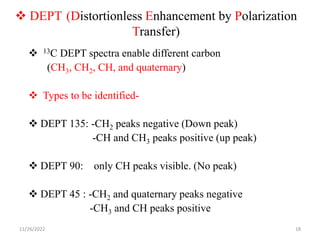
 13C DEPT spectra enable different carbon
(CH3, CH2, CH, and quaternary)
 Types to be identified-
 DEPT 135: -CH2 peaks negative (Down peak)
-CH and CH3 peaks positive (up peak)
 DEPT 90: only CH peaks visible. (No peak)
 DEPT 45 : -CH2 and quaternary peaks negative
-CH3 and CH peaks positive
11/26/2022 18
 DEPT (Distortionless Enhancement by Polarization
Transfer)
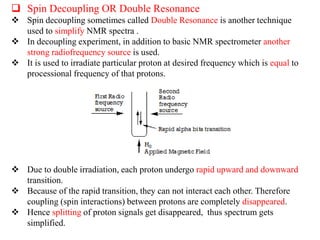
 Spin Decoupling OR Double Resonance
 Spin decoupling sometimes called Double Resonance is another technique
used to simplify NMR spectra .
 In decoupling experiment, in addition to basic NMR spectrometer another
strong radiofrequency source is used.
 It is used to irradiate particular proton at desired frequency which is equal to
processional frequency of that protons.
 Due to double irradiation, each proton undergo rapid upward and downward
transition.
 Because of the rapid transition, they can not interact each other. Therefore
coupling (spin interactions) between protons are completely disappeared.
 Hence splitting of proton signals get disappeared, thus spectrum gets
simplified.
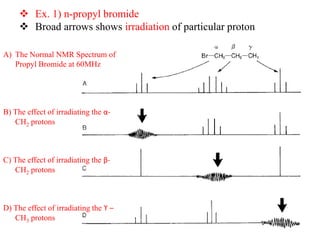
 Ex. 1) n-propyl bromide
 Broad arrows shows irradiation of particular proton
A) The Normal NMR Spectrum of
Propyl Bromide at 60MHz
B) The effect of irradiating the α-
CH2 protons
C) The effect of irradiating the β-
CH2 protons
D) The effect of irradiating the ϒ –
CH3 protons

M.Sc. 2D NMR.pptx

  • 1.
     2D-NMR :Two Dimensional Nuclear Magnetic Resonance Spectroscopy Dr. G. D. SHIROLE (M.Sc. SET. Ph.D.) ASSOCIATE PROFESSOR DEPARTMENT OF CHEMISTRY ARTS, SCIENCE & COMMERCE COLLEGE, RAHATA
  • 2.
     2-D NMR A conventional 1H-NMR spectrum has a frequency axis and an intensity axis i.e two axis, whereas 2D-NMR have two frequency axis and one intensity axis i.e. three axis.  The 2D-NMR spectra which shows 1H-1H shift correlation i.e. both frequency axis shows 1H chemical shift. This spectroscopy is known as 1H-1H shift correlated spectroscopy, which is known by acronym COSY (correlated spectroscopy).  The 2D-NMR spectra which shows 13C-1H shift correlation i.e. one frequency axis shows 1H chemical shift & second shows 13C chemical Shift is termed as Heteronuclear correlation spectroscopy, which is known by acronym HETCOR.  The COSY identifies pair of protons which are coupled to each other. While HETCOR identifies number of protons directly bonded to particular carbon.
  • 3.
  • 4.
     COSY • TheCOSY spectrum of m-dinitrobenzene- • In the COSY spectrum of m-dinitrobenzene, the diagonal line runs from upper right corner to lower left corner. The diagonal peaks are termed as contours.
  • 5.
     The importantpeaks in the spectrum are off-diagonal peaks. These off- diagonal peaks are termed as cross peaks.  Cross peaks provides the useful information about mutually coupled protons (geminally and vicinally coupled protons) i.e. they provides the information about coupling partners.  Normally long range coupling (5J to more ) do not give significant cross peak.  The cross peaks above and below the diagonal line provides the same information.  The Signal from H2 at the bottom has the cross peak (H2 , H4,6) connecting it to the H4,6. Thus the H2 proton around 9.1δ is coupled with proton whose signals appears around 8.6δ i.e. H4 & H6 proton.  Similarly the signal from H4,6 is further connected by cross peak to the signal from H5 to show the coupling between H4,6 & H5.
  • 6.
    HETCOR  The 2D-NMRspectra that display 13C-1H shift correlation are called Hetero-nuclear correlation spectroscopy. (HETCOR)  The HETCOR spectra shows coupling between carbon and the protons which are directly bonded. i.e. Residual coupling.  Ex. HETCOR Spectrum of 1-Chloro, 2-Propanol.  In HETCOR spectrum of 1-Chloro, 2-Propanol , A 13C spectrum illustrated along one axis and 1H spectrum on the other.  There is no diagonal spectrum in the X-Y field as like COSY.  The HETCOR spectrum is composed of only cross peak, each one relating a carbon to its directly bonded protons.  Quaternary carbons are invisible to the technique. Hb OH Hc Ha Hc Ha Hc Cl 1 2 3
  • 8.
     The methyldoublet of the 1H NMR spectrum appears at 1.2δ & a imaginary line when drawn up to the cross peak and then dropped down to the 13C spectrum axis indicates that the 13C peak at 20δ is appears due to methyl carbon.  The 1H NMR signal at 3.9δ is due to CH- (C2Proton) tracing out to the cross peak and down to the 13C peak at 67δ arises from C2 Carbon of the compound.  The 1H NMR signal at 3.4-3.5δ for the two protons on the carbon bearing the chlorine. The interpretation leads to the cross peak & down to the 13C peak at 51δ.
  • 9.
  • 10.
  • 11.
     OTHER TYPESOF 1H-13C COSY 1. HMBC : Heteronuclear Multiple-Bond CH Correlation 1H-13C several bond correlation which shows the correlations between carbons and protons separated by 2 or 3 bonds and sometimes in conjugated system 4 bonds 1H-C-13C (Two-bond) 1H-C-C-13C (Three- bond) 2. HSQC : Heteronuclear Single-Quantum Correlation 1H-13C direct correlation which shows the correlations between carbons and protons directly attached to one another 3. HMQC : Heteronuclear Multiple-Quantum Correlation Shows correlation between protons and other nuclei such as 13C & 15N  Each of these techniques provides same information that can be obtained from a HETCOR spectrum.
  • 12.
     TWO DIMENSIONAL13C-13C CORRELATIONS:  INADEQUATE Spectra : Incredible Natural Abundance DoublE QUAntum Transfer Experiment  2-D INADEQUATE provides direct carbon connectivity's facilitating us to sketch the carbon skeleton definitely or clearly.  2-D INADEQUATE has very limited applicability because of its extremely low sensitivity or low abundance.
  • 13.
    C C H Cl Cl H Br Br 12 13 1 1 CC H Cl Cl H Br Br 12 12 1 1 C C H Cl Cl H Br Br 13 13 1 1 C C H Cl Cl H Br Br 13 12 1 1 98% 1% 1% 0.01% A B C D 1H-NMR 13C NMR HSQC/HMQC/HMBC INADEQUATE
  • 14.
     NUCLEAR OVERHAUSERENHANCEMENT (NOE)  When we obtained proton-decoupled spectrum, the intensities of many signals increases significantly than the normal coupled spectra is known as Nuclear Overhouser effect  and the degree of increase in the signal intensity is called the Nuclear Overhouser enhancement.  The NOE operates through the space & is related to decoupling experiment.  i.e. It also involves irradiation of a particular nuclei and measuring the intensities of other signals due to other closely spaced nuclei in molecular framework.  NOE also used to solve geometric problems within a molecule and provides the information about the spatial arrangement of nuclei within a molecule i.e. relative stereochemistry & regio-chemistry.
  • 15.
    Ha OCOCH3 Cl Hb Cl Cl Cl Cl Cl NC O H H3C H3C C C COOH H H3C H3C +45% +18% - 2% +17% - 4% Semiclathrate Dimethyl formamide 3-methylcrotonic acid Dimethylformamide Two Me groups are non-equivalent due to restricted rotation about the C-N bond. Both Me signals are therefore found at 2.79 and 2.94 together with a singlet at 8.0 for the formyl proton. If we irradiated one Me signal at  2.94, the intensity of the formyl proton signal increases by 18%. When instead the other methyl signal is irradiated, a decrease of 2% is observed. Which methyl signal belongs to which group?
  • 16.
    NUCLEAR OVERHAUSER EFFECT(NOESY) SPECTROSCOPY & ROTATING-FRAME OVERHAUSER EFFECT (ROESY) SPECTROSCOPY  NOESY for very large molecules, ROESY for mid-size molecules  These spectra are used to locate protons that are close together in space.
  • 17.
    NOESY O O H3C CH3 H H 1 2 3 4 5 6 3 Irradiationof the 5-Me group resulted in enhancement of both H-4 and H-6, whereas irradiation of the 3-Me group enhanced only H-4; the assignments of these entities to the absorption peaks is now clear.
  • 18.
     13C DEPTspectra enable different carbon (CH3, CH2, CH, and quaternary)  Types to be identified-  DEPT 135: -CH2 peaks negative (Down peak) -CH and CH3 peaks positive (up peak)  DEPT 90: only CH peaks visible. (No peak)  DEPT 45 : -CH2 and quaternary peaks negative -CH3 and CH peaks positive 11/26/2022 18  DEPT (Distortionless Enhancement by Polarization Transfer)
  • 19.
     Spin DecouplingOR Double Resonance  Spin decoupling sometimes called Double Resonance is another technique used to simplify NMR spectra .  In decoupling experiment, in addition to basic NMR spectrometer another strong radiofrequency source is used.  It is used to irradiate particular proton at desired frequency which is equal to processional frequency of that protons.  Due to double irradiation, each proton undergo rapid upward and downward transition.  Because of the rapid transition, they can not interact each other. Therefore coupling (spin interactions) between protons are completely disappeared.  Hence splitting of proton signals get disappeared, thus spectrum gets simplified.
  • 20.
     Ex. 1)n-propyl bromide  Broad arrows shows irradiation of particular proton A) The Normal NMR Spectrum of Propyl Bromide at 60MHz B) The effect of irradiating the α- CH2 protons C) The effect of irradiating the β- CH2 protons D) The effect of irradiating the ϒ – CH3 protons