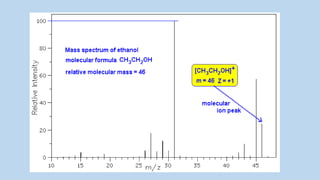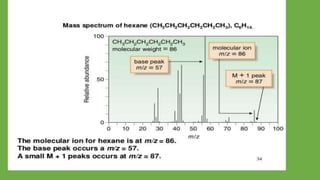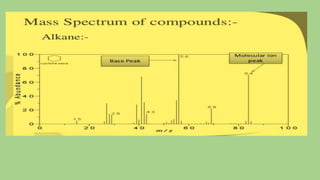
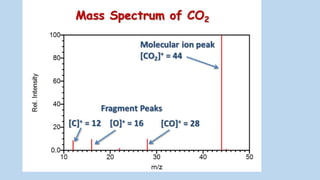
Molecular ion Peak
K.S.LOGANATHAN
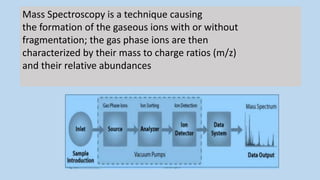
Mass Spectroscopy is a technique causing
the formation of the gaseous ions with or without
fragmentation; the gas phase ions are then
characterized by their mass to charge ratios (m/z)
and their relative abundances
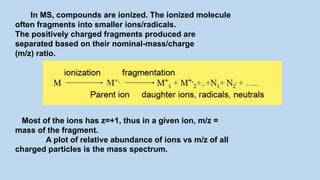
In MS, compounds are ionized. The ionized molecule
often fragments into smaller ions/radicals.
The positively charged fragments produced are
separated based on their nominal-mass/charge
(m/z) ratio.
Most of the ions has z=+1, thus in a given ion, m/z =
mass of the fragment.
A plot of relative abundance of ions vs m/z of all
charged particles is the mass spectrum.
Molecular ion peak
The order of energy required to remove electron is as
follows— σ electrons > non-conjugated π >
conjugated π > non bonding or lone pair of electrons.
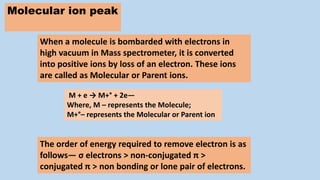
When a molecule is bombarded with electrons in
high vacuum in Mass spectrometer, it is converted
into positive ions by loss of an electron. These ions
are called as Molecular or Parent ions.
M + e → M+° + 2e—
Where, M – represents the Molecule;
M+°– represents the Molecular or Parent ion
Many of these molecular ions (M+°)
disintegrate at 10-10 to 10-13 seconds to give a
positively charged fragment and a radical in
the simplest case.
If some Molecular ions remain intact long
enough (about 10-6 seconds) to reach the
detector.
Most molecules show a peak for the molecular
ion, the stability of which is usually in the
order— Aromatic > Conjugated acyclic polyenes
> Alicyclics > hydrocarbons > ketones >
Ion formed from a molecule by removal of one electron of
lowest ionization potential
is known as Molecular ion
The molecular ion peak gives molecular weight of a
compound
The molecular ion peak is the highest mass no. except
isotope peak
The peak at the highest m/z ratio on the mass spectrum is
formed by the heaviest ion pass through
the spectrometer
Unless all molecules of the original substance
break up, this corresponds to the molecular ion
of sample substance
This value of m/z is equal to the molecular
mass of compound.
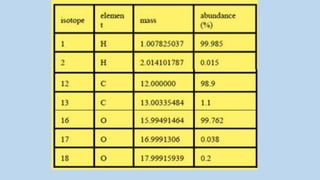
High Resolution Mass Spectrometer can be
used to determine the molecular formula of a
compound from
the accurate mass of the molecular ion
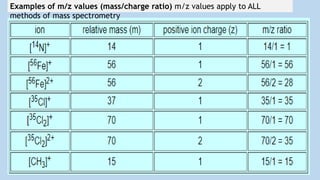
Examples of m/z values (mass/charge ratio) m/z values apply to ALL
methods of mass spectrometry
Chlorine consists of two principal stable isotopes, chlorine-37 (~25% is
37Cl) and chlorine-35 (~75% is 35Cl).
[37Cl37Cl]+ or [37Cl2]+ m/z = 74 (molecular ion)
[35Cl35Cl]+ or [35Cl2]+ m/z = 70 (molecular ion)
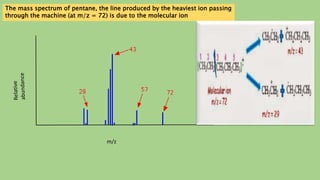
The mass spectrum of pentane, the line produced by the heaviest ion passing
through the machine (at m/z = 72) is due to the molecular ion
m/z
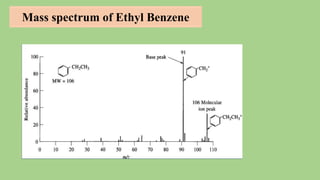
Mass spectrum of Ethyl Benzene
Molecular ion peak
Molecular ion peak
Molecular ion peak

Molecular ion peak

  • 1.
  • 2.
    Mass Spectroscopy isa technique causing the formation of the gaseous ions with or without fragmentation; the gas phase ions are then characterized by their mass to charge ratios (m/z) and their relative abundances
  • 3.
    In MS, compoundsare ionized. The ionized molecule often fragments into smaller ions/radicals. The positively charged fragments produced are separated based on their nominal-mass/charge (m/z) ratio. Most of the ions has z=+1, thus in a given ion, m/z = mass of the fragment. A plot of relative abundance of ions vs m/z of all charged particles is the mass spectrum.
  • 4.
    Molecular ion peak Theorder of energy required to remove electron is as follows— σ electrons > non-conjugated π > conjugated π > non bonding or lone pair of electrons. When a molecule is bombarded with electrons in high vacuum in Mass spectrometer, it is converted into positive ions by loss of an electron. These ions are called as Molecular or Parent ions. M + e → M+° + 2e— Where, M – represents the Molecule; M+°– represents the Molecular or Parent ion
  • 5.
    Many of thesemolecular ions (M+°) disintegrate at 10-10 to 10-13 seconds to give a positively charged fragment and a radical in the simplest case. If some Molecular ions remain intact long enough (about 10-6 seconds) to reach the detector. Most molecules show a peak for the molecular ion, the stability of which is usually in the order— Aromatic > Conjugated acyclic polyenes > Alicyclics > hydrocarbons > ketones >
  • 6.
    Ion formed froma molecule by removal of one electron of lowest ionization potential is known as Molecular ion The molecular ion peak gives molecular weight of a compound The molecular ion peak is the highest mass no. except isotope peak The peak at the highest m/z ratio on the mass spectrum is formed by the heaviest ion pass through the spectrometer
  • 7.
    Unless all moleculesof the original substance break up, this corresponds to the molecular ion of sample substance This value of m/z is equal to the molecular mass of compound. High Resolution Mass Spectrometer can be used to determine the molecular formula of a compound from the accurate mass of the molecular ion
  • 9.
    Examples of m/zvalues (mass/charge ratio) m/z values apply to ALL methods of mass spectrometry
  • 11.
    Chlorine consists oftwo principal stable isotopes, chlorine-37 (~25% is 37Cl) and chlorine-35 (~75% is 35Cl). [37Cl37Cl]+ or [37Cl2]+ m/z = 74 (molecular ion) [35Cl35Cl]+ or [35Cl2]+ m/z = 70 (molecular ion)
  • 13.
    The mass spectrumof pentane, the line produced by the heaviest ion passing through the machine (at m/z = 72) is due to the molecular ion m/z
  • 16.
    Mass spectrum ofEthyl Benzene