PROBIOTICS
A Concise Presentation
By
Mr. Deepak Sarangi M.Pharm
1
CONTENTS
 INTRODUCTION
 HISTORY
 WHAT ARE PROBIOTICS ?
 WHYARE PROBIOTICS IMPORTANT FOR HUMAN HEALTH
 MODE OF ACTION
 CHARACTERISTICS OF PROBIOTICS
 IDENTIFICATION OF PROBIOTICS
 PROBIOTICS ARE USED IN SEVERAL CLINICAL CONDITIONS
 ADVANTAGES
 DISADVANTAGES
 CONCLUSION
 REFERENCES
2
INTRODUCTION
 The world health organization defines probiotics as live
microorganisms, which when administered in adequate
amounts confer a health benefit on a host.
 The term probiotic comes from the Latin or Greek pro,
“before, forward”, and bios, or “life” — thus probiotics are
life-promoting. In this case, we use the term probiotics to
refer to beneficial bacteria.
 The most common types of these beneficial bacteria are
Lactobacilli and Bifidobacteria.
3
HISTORY OF PROBIOTICS- 1965
 Probiotics term coined in 1965 by Lilly And Stillwell
 Probiotics, which means “for life” was meant to contrast
“antibiotics”, popularly prescribed and known to also
destroy beneficial organisms and impact the immune
system.
4
WHAT ARE PROBIOTICS ?
 Probiotic - Probiotics defined as microorganisms that
have a beneficial effect on the host intestinal microbial
balance.
 Probiotic organisms are live microorganisms thought
to be beneficial to the host organism.
 According to the currently adopted definition by
FAO/WHO, probiotics are: "Live microorganisms
which when administered in adequate amounts
confer a health benefit on the host".
 Lactic acid bacteria (LAB) and bifidobacteria are the
most common types of microbes used as probiotics;
but certain yeasts and bacilli may also be used.
5
WHY ARE PROBIOTICS IMPORTANT FOR
HUMAN HEALTH?
6
Antibiotics
Alcohol
consumption
Stress
Destroy the gut
micro flora
Problems in
digestion
Problems in
absorption of
nutrients in the
body
Emergence of
antibiotic
resistant strains
WHO NEEDS PROBIOTICS?
 People who suffer from yeast infections of any kind,
including athlete's foot, jock itch, vaginal yeast
infections and nail fungus.
 People with weak immune systems, frequent respiratory
infections and congestion.
 People with food or respiratory allergies.
 People suffering from inflammatory bowel disorders,
constipation or intestinal infections.
7
MODE OF ACTION OF PROBIOTICS
 production of inhibitory compounds
 competition for chemicals/available energy
 competition for adhesion sites (exclusion)
 enhancement of the immune response
 improvement of water quality
 interaction with phytoplankton
 a source of macro- and micro-nutrients
 enzymatic contribution to digestion
8
ONTD…
 Production of low-molecular-weight antibacterial
substance that inhibits both gram-positive and gram-
negative enteric bacteria.
 Also use enzymatic mechanisms to modify toxin
receptors and block toxin-mediated pathology.
 Also prevent colonization of pathogenic microorganisms
by competitive inhibition for microbial adhesion sites.
9
CHARACTERISTICS OF PROBIOTICS
Probiotic microorganisms are:
 Able to survive the passage through the digestive system
 Able to attach to the intestinal epithelia and colonize
 Able to Maintain good viability
 Able to utilize the nutrients and substrates in a normal diet
 Non-pathogenic and non-toxic
 Capable of exerting a beneficial effect on the host 10
CONTD..
 It should be safe to the host.
 It should not produce any pathogenic or toxic effect.
 It must be resistance to hydrochloric acid, bile and
pancreatic juice.
 It should have anti-carcinogenic activity.
 It should produce lactic acid.
 It should retain viability during storage and use.
 It should stimulate the immune system of the body.
 It should have the ability to colonize the gastrointestinal
tract.
11
IDENTIFICATION OF STRAINS OF PROBIOTICS
 Effects of probiotics are strain specific.
 Strain identity is important to link a strain to a specific
health effect as well as to enable accurate surveillance
and epidemiological studies.
 Both phenotypic and genotypic tests should be done
using validated standard methodology.
 Nomenclature of the bacteria must conform to the
current, scientifically recognized names as per the
International Committee on Systematics of Prokaryotes
(ICPS).
12
ACTIONS OF PROBIOTICS
 Restore the balance b/w ‘Good’ and ‘bad’ bacteria in gut
secrete bactericidal proteins
↓ses the pH
• Block the attachment & invasion of epithelium by
pathogens
• Improve epithelial barrier function
↑ mucus production
↑ barrier integrity
13
CONTD…
 Alter host immune responses
stimulate IgA production
↓ proinflammatory cytokines
• Produce β-galactosidase, so digest lactose
• ↓ production of carcinogenic metabolites
14
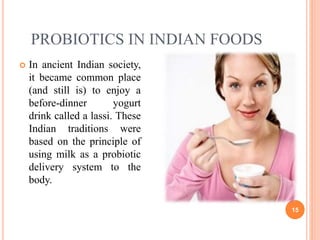
PROBIOTICS IN INDIAN FOODS
15
 In ancient Indian society,
it became common place
(and still is) to enjoy a
before-dinner yogurt
drink called a lassi. These
Indian traditions were
based on the principle of
using milk as a probiotic
delivery system to the
body.
PROBIOTICS ARE USED IN SEVERAL CLINICAL
CONDITIONS
 Probiotics were identified to beneficially affect the host
by improving its intestinal microbial balance, thus
inhibiting pathogens and toxin producing bacteria.
 Today, specific health effects are being investigated and
documented including alleviation of chronic intestinal
inflammatory diseases, prevention and treatment of
pathogen-induced diarrhoea, urogenital infections, and
atopic diseases.
16
ADVANTAGES OF PROBIOTICS
1. Antibiotic associated diarrhea
2. Probiotics and Cancer
3. Hepatic Diseases
4. Helicobacter pylori Infections
5. Treat high cholesterol
6. Use of probiotics beyond GIT (Allergy)
17
DISADVANTAGES
1. Taking them in larger amounts might produce digestive
issues, such as gas and bloating, but they are usually
temporary.
2. treating lactobacillus septicaemia which is a potentially
fatal disease caused by the consumption of probiotics.
3. Discomfort in the gastrointestinal tract
4. Allergy
18
CONCLUSION
Due to the many benefits of probiotics in the absence
of any risk, they have become a useful tool for the medical
community. They not only boost the functioning of the
immune system, they naturally aid in fighting bad bacteria
by supplying the body with enough good to keep the body
in symbiosis. Unlike most traditional therapies for disease
and illness, there are no side effects or risks associated with
them, nor is there a risk of overdose that leads to the need
for a prescription, or the monitoring of a physician.
19
REFERENCES
 Alvarez-Olmos MI, Oberhelman RA; Oberhelman
(2001). "Probiotic agents and infectious diseases: a
modern perspective on a traditional therapy". Clin.
Infect. Dis. 32 (11): 1567–76.
 Fuller R (May 1989). "Probiotics in man and animals".
The Journal of Applied Bacteriology 66 (5): 365–78.
 Journal of Microbiology and Biotechnology 20 (1367–
1377): 1367–1377.
 Quigley EMM: The future of probiotics. In Probiotics in
Pediatric Medicine. Edited by Michail S, Sherman P.
Totowa, NJ: Humana Press; 2008:323-329
20
THANKS FOR VIEWING THE PPT
FOR MORE PPTS
ON PHARMA RELATED TOPICS PLZ CONTACT
SARANGI.DIPU@GMAIL.COM
OR FIND ME AT FOLLOWING LINK
WWW.FACEBOOK.COM/SARANGI.DIPU
21

Probiotics ppt

  • 1.
  • 2.
    CONTENTS  INTRODUCTION  HISTORY WHAT ARE PROBIOTICS ?  WHYARE PROBIOTICS IMPORTANT FOR HUMAN HEALTH  MODE OF ACTION  CHARACTERISTICS OF PROBIOTICS  IDENTIFICATION OF PROBIOTICS  PROBIOTICS ARE USED IN SEVERAL CLINICAL CONDITIONS  ADVANTAGES  DISADVANTAGES  CONCLUSION  REFERENCES 2
  • 3.
    INTRODUCTION  The worldhealth organization defines probiotics as live microorganisms, which when administered in adequate amounts confer a health benefit on a host.  The term probiotic comes from the Latin or Greek pro, “before, forward”, and bios, or “life” — thus probiotics are life-promoting. In this case, we use the term probiotics to refer to beneficial bacteria.  The most common types of these beneficial bacteria are Lactobacilli and Bifidobacteria. 3
  • 4.
    HISTORY OF PROBIOTICS-1965  Probiotics term coined in 1965 by Lilly And Stillwell  Probiotics, which means “for life” was meant to contrast “antibiotics”, popularly prescribed and known to also destroy beneficial organisms and impact the immune system. 4
  • 5.
    WHAT ARE PROBIOTICS?  Probiotic - Probiotics defined as microorganisms that have a beneficial effect on the host intestinal microbial balance.  Probiotic organisms are live microorganisms thought to be beneficial to the host organism.  According to the currently adopted definition by FAO/WHO, probiotics are: "Live microorganisms which when administered in adequate amounts confer a health benefit on the host".  Lactic acid bacteria (LAB) and bifidobacteria are the most common types of microbes used as probiotics; but certain yeasts and bacilli may also be used. 5
  • 6.
    WHY ARE PROBIOTICSIMPORTANT FOR HUMAN HEALTH? 6 Antibiotics Alcohol consumption Stress Destroy the gut micro flora Problems in digestion Problems in absorption of nutrients in the body Emergence of antibiotic resistant strains
  • 7.
    WHO NEEDS PROBIOTICS? People who suffer from yeast infections of any kind, including athlete's foot, jock itch, vaginal yeast infections and nail fungus.  People with weak immune systems, frequent respiratory infections and congestion.  People with food or respiratory allergies.  People suffering from inflammatory bowel disorders, constipation or intestinal infections. 7
  • 8.
    MODE OF ACTIONOF PROBIOTICS  production of inhibitory compounds  competition for chemicals/available energy  competition for adhesion sites (exclusion)  enhancement of the immune response  improvement of water quality  interaction with phytoplankton  a source of macro- and micro-nutrients  enzymatic contribution to digestion 8
  • 9.
    ONTD…  Production oflow-molecular-weight antibacterial substance that inhibits both gram-positive and gram- negative enteric bacteria.  Also use enzymatic mechanisms to modify toxin receptors and block toxin-mediated pathology.  Also prevent colonization of pathogenic microorganisms by competitive inhibition for microbial adhesion sites. 9
  • 10.
    CHARACTERISTICS OF PROBIOTICS Probioticmicroorganisms are:  Able to survive the passage through the digestive system  Able to attach to the intestinal epithelia and colonize  Able to Maintain good viability  Able to utilize the nutrients and substrates in a normal diet  Non-pathogenic and non-toxic  Capable of exerting a beneficial effect on the host 10
  • 11.
    CONTD..  It shouldbe safe to the host.  It should not produce any pathogenic or toxic effect.  It must be resistance to hydrochloric acid, bile and pancreatic juice.  It should have anti-carcinogenic activity.  It should produce lactic acid.  It should retain viability during storage and use.  It should stimulate the immune system of the body.  It should have the ability to colonize the gastrointestinal tract. 11
  • 12.
    IDENTIFICATION OF STRAINSOF PROBIOTICS  Effects of probiotics are strain specific.  Strain identity is important to link a strain to a specific health effect as well as to enable accurate surveillance and epidemiological studies.  Both phenotypic and genotypic tests should be done using validated standard methodology.  Nomenclature of the bacteria must conform to the current, scientifically recognized names as per the International Committee on Systematics of Prokaryotes (ICPS). 12
  • 13.
    ACTIONS OF PROBIOTICS Restore the balance b/w ‘Good’ and ‘bad’ bacteria in gut secrete bactericidal proteins ↓ses the pH • Block the attachment & invasion of epithelium by pathogens • Improve epithelial barrier function ↑ mucus production ↑ barrier integrity 13
  • 14.
    CONTD…  Alter hostimmune responses stimulate IgA production ↓ proinflammatory cytokines • Produce β-galactosidase, so digest lactose • ↓ production of carcinogenic metabolites 14
  • 15.
    PROBIOTICS IN INDIANFOODS 15  In ancient Indian society, it became common place (and still is) to enjoy a before-dinner yogurt drink called a lassi. These Indian traditions were based on the principle of using milk as a probiotic delivery system to the body.
  • 16.
    PROBIOTICS ARE USEDIN SEVERAL CLINICAL CONDITIONS  Probiotics were identified to beneficially affect the host by improving its intestinal microbial balance, thus inhibiting pathogens and toxin producing bacteria.  Today, specific health effects are being investigated and documented including alleviation of chronic intestinal inflammatory diseases, prevention and treatment of pathogen-induced diarrhoea, urogenital infections, and atopic diseases. 16
  • 17.
    ADVANTAGES OF PROBIOTICS 1.Antibiotic associated diarrhea 2. Probiotics and Cancer 3. Hepatic Diseases 4. Helicobacter pylori Infections 5. Treat high cholesterol 6. Use of probiotics beyond GIT (Allergy) 17
  • 18.
    DISADVANTAGES 1. Taking themin larger amounts might produce digestive issues, such as gas and bloating, but they are usually temporary. 2. treating lactobacillus septicaemia which is a potentially fatal disease caused by the consumption of probiotics. 3. Discomfort in the gastrointestinal tract 4. Allergy 18
  • 19.
    CONCLUSION Due to themany benefits of probiotics in the absence of any risk, they have become a useful tool for the medical community. They not only boost the functioning of the immune system, they naturally aid in fighting bad bacteria by supplying the body with enough good to keep the body in symbiosis. Unlike most traditional therapies for disease and illness, there are no side effects or risks associated with them, nor is there a risk of overdose that leads to the need for a prescription, or the monitoring of a physician. 19
  • 20.
    REFERENCES  Alvarez-Olmos MI,Oberhelman RA; Oberhelman (2001). "Probiotic agents and infectious diseases: a modern perspective on a traditional therapy". Clin. Infect. Dis. 32 (11): 1567–76.  Fuller R (May 1989). "Probiotics in man and animals". The Journal of Applied Bacteriology 66 (5): 365–78.  Journal of Microbiology and Biotechnology 20 (1367– 1377): 1367–1377.  Quigley EMM: The future of probiotics. In Probiotics in Pediatric Medicine. Edited by Michail S, Sherman P. Totowa, NJ: Humana Press; 2008:323-329 20
  • 21.
    THANKS FOR VIEWINGTHE PPT FOR MORE PPTS ON PHARMA RELATED TOPICS PLZ CONTACT SARANGI.DIPU@GMAIL.COM OR FIND ME AT FOLLOWING LINK WWW.FACEBOOK.COM/SARANGI.DIPU 21

Editor's Notes

  • #5 It was not until 1965 that the term “Probiotics” was coined by Lilly and Stillwell