Probiotics , Prebiotics
and Synbiotics
Munna Iype Joy
315009
M-TECH, FSQM-
NIFTEM
Introduction
• GIT of Gutted organisms contains millions
of microbiota
• In humans the counts goes beyond the
total number of cells which makeup the
body
• Metabolic and endocrine activity of the GIT
results in a significant impact on health and
well-being
• Colonic bacteria plays an important role in
maintaining health
• The normal microflora of the gut is
mainly composed of strictly
anaerobic bacteria
• Disturbances in the normal intestinal
microbial community structure can
result in the proliferation of
pathogens
Introduction
Gut microflora exerts a considerable
influence on host biochemistry :
(1) enzymatic activity of intestinal
contents
(2) short chain fatty acid
(SCFA)production in the lumen
(3) oxidation-reduction potential of
luminal contents
(4) host physiology
(5) host immunology
(6) modification of host-synthesised
molecules
Probiotics
• The idea probiotics was first introduced
by Metchnikoff in 1908.
• Individuals who lived in a certain part of
Bulgaria which attributed to their
ingestion, on a regular basis, of a
fermented milk product
• Probiotics – Greek word meaning “for
life”
• large number of probiotics currently used
and available in dairy fermented foods,
especially in yogurts
Definition
• Probiotics can be defined as live
organisms that when ingested in
adequate amounts, exert a health
benefit to the host( Eamonn and
Quigley, 2010).
• Lactic acid bacteria beyond
fermentation positively influence our
health mainly by improving the
composition of intestinal microbiota
• For this reason, they are called
probiotics
• Lactobacillus, Bifidobacterium,
Streptococcus, Lactococcus and
Saccharomyces have been promoted in
food products because of their reputed
Probiotics
• They possess good sensorial
properties
• fermentative activity,
• good survival during freeze-drying or
spray-drying,
• proper growth and viability in food
products,
• phage resistance and high stability
during long-term storage
A number of beneficial roles for
probiotic strains
• (1) re-establishment of balanced intestinal micro
flora
• (2) improving colonization resistance and/or
prevention of diarrhea
• (3) systemic reduction of serum cholesterol
• (4) reduction of faecal enzymes, potential mutagens
which may induce tumours
• (5) metabolism of lactose and reduction of lactose
intolerance
• (6) enhancement of immune system response
• (7) improved calcium absorption
• (8) synthesis of vitamins and predigestion of proteins
Requirement to be defined as an
effective probiotic
• (a) adhere to cells
• (b) exclude or reduce pathogenic adherence
• (c) perisist and multiply
• (d) produce acids, hydrogen peroxide and
bacteriocins antagonistic to pathogen
growth
• (e) be safe, non-invasive, noncarcinogenic
and non-pathogenic
• (f) congregate to form a normal balanced
flora
Proofs
• Promising evidences have shown that prevention
of GIT colonizing by a variety of pathogens is a
primary mechanism of beneficial effects
mediated by probiotics( Lu and Walker, 2001;
Forestier et al., 2001).
• Probiotic bacteria attach to enterocytes and thus
inhibit the binding of enteric pathogens to the
intestinal mucosa by production of inhibitory
substances (competitive exclusion of pathogens.
These inhibitory substances include becteriocins,
lactic acid and toxic oxygen metabolites)
( Nemcova, 1997; Kopp Hoolihan, 2001).
Proofs
• Attachment of probiotic bacteria to cell
surface receptors of enterocytes also
initiates signaling events that results in
the synthesis of cytokines.
Furthermore, the production of butyric
acid by some probiotic bacteria affects
the turnover of enterocytes and
neutralizes the activity of dietary
carcinogens, such as nitrosamines
( Wollowski et al., 2001).
Challenges to probiotics
• Studies conducted by Kullen et al, 1997
using Bifidobacterium in the GIT of
humans it was found that in addition to
the challenges in the GIT for survival,
flourishing itself is diffcult.
• Analysis of feaces of volunteers revealed
that after 8 days there was no strains of
Bifidobacterium. This challenge gave rise
to another idea of similiar interest called
Prebiotics
Prebiotics
• They are defined as non-digestible or
low-digestible food ingredients that
benefit the host organism by
selectively stimulating the growth or
activity of one or a limited number of
probiotic bacteria in the colon
• Fermentable carbohydrates
(olgisaccharides) are the generally
used prebiotics
Prebiotics commonly used in human nutrition
• Lactulose,
• Galactooligosaccharides
• fructooligo saccharides
• inulin and its hydrolysates
• maltooligosaccharides
• resist ant starch are
Prebiotic oligosaccharides can be
produced in three different ways:
• By extraction from plant materials
• Microbiological synthesis or
enzymatic synthesis
• Enzymatic hydrolysis of
polysaccharides
Prebiotic should be-
1. It must be neither hydrolyzed, nor
absorbed in the upper part of the gastro-
inestinal tract.
2. Selective fermentation by potentially
beneficial bacteria in the colon.
3. Alteration in the cobposition of the colonic
microbiota towards a healthier
compostion.
4. Preferably, induce effects which are
beneficial to the host health
Prebiotics and health benefits
(1) reduce risk of Inflammatory and
bowel diseases.
(2) Anti hypertensive effects.
(3) Anti dibetic effect.
4) Hypocholesterolemic effect.
(5) Immunomodulatory effect
Main target
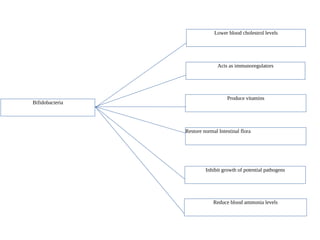
• Bifidobacterium is the major gut
organism targeted in prebiotics.
There are a number of effects that
bifidobacterium makes on humans.
Bifidobacteria
Lower blood cholestrol levels
Reduce blood ammonia levels
Inhibit growth of potential pathogens
Restore normal Intestinal flora
Produce vitamins
Acts as immunoregulators
Case studies
• Gibson and Wang, 1994 conducted in vitro
studies on oligofructose and inulin and
found that it had stimulatory effect on
Bifidobacteria, while maintaining E.coli
and clostridium populations at relatively
low levels.
• In vivo studies by Ohta et al., 1995 on
Fructooiligo saccharides(FOS) found
improved recovery from anemia and
increased absorption of iron(Fe), calcium
and Magnesium, in Fe- deficient anemic
rats.
• Ozcelik et al., 1996 shown ( in vivo) that
oral lactulose treatment prior to surgical
trauma reduced bacterial translocation to
mesenteric lymph nodes and portal
venous blood.
• Bovee Oudenhoven and Van der Meer,
1997 shown( In vivo) that combination of
dietary lactulose and calcium phosphate
were protective against Salmonella
infection.
Case studies
Synbiotics
• Synbiotics may be defined as a mixture of
probiotics and prebiotics that beneficially
affects the host by improving the survival
and implantation of live microbial dietary
supplements in the gastrointestinal tract.
• In other words the live microbial additions
(probiotics) may be used in conjunction with
specific substrates (prebiotics) for growth
(eg, a fructooligosaccharide in conjunction
with a bifidobacterial strain or lactitol in
conjunction with a lactobacillus organism).
Synbiotics & Health Benefits
Pediatric Surgery: For probiotics, live bacterial
preparations of Bifidobacterium breve strain yakult
and Lactobacillus casei strain Shirota were used
and galactooligosacharide were supplemented as
probiotics.As the intestinal bacterial flora was
improved by synbiotic therapy, intestinal
peristalsis recovered, intestinal expansion was
reduced, and the nutritional condition improved as
reflected by gain in body weight(Kanamori et
al.,2004; Kanamori et al.,2003).
Thank You

Probiotics , prebiotics and synbiotics

  • 1.
    Probiotics , Prebiotics andSynbiotics Munna Iype Joy 315009 M-TECH, FSQM- NIFTEM
  • 2.
    Introduction • GIT ofGutted organisms contains millions of microbiota • In humans the counts goes beyond the total number of cells which makeup the body • Metabolic and endocrine activity of the GIT results in a significant impact on health and well-being • Colonic bacteria plays an important role in maintaining health
  • 3.
    • The normalmicroflora of the gut is mainly composed of strictly anaerobic bacteria • Disturbances in the normal intestinal microbial community structure can result in the proliferation of pathogens Introduction
  • 4.
    Gut microflora exertsa considerable influence on host biochemistry : (1) enzymatic activity of intestinal contents (2) short chain fatty acid (SCFA)production in the lumen (3) oxidation-reduction potential of luminal contents (4) host physiology (5) host immunology (6) modification of host-synthesised molecules
  • 5.
    Probiotics • The ideaprobiotics was first introduced by Metchnikoff in 1908. • Individuals who lived in a certain part of Bulgaria which attributed to their ingestion, on a regular basis, of a fermented milk product • Probiotics – Greek word meaning “for life” • large number of probiotics currently used and available in dairy fermented foods, especially in yogurts
  • 6.
    Definition • Probiotics canbe defined as live organisms that when ingested in adequate amounts, exert a health benefit to the host( Eamonn and Quigley, 2010).
  • 7.
    • Lactic acidbacteria beyond fermentation positively influence our health mainly by improving the composition of intestinal microbiota • For this reason, they are called probiotics • Lactobacillus, Bifidobacterium, Streptococcus, Lactococcus and Saccharomyces have been promoted in food products because of their reputed Probiotics
  • 8.
    • They possessgood sensorial properties • fermentative activity, • good survival during freeze-drying or spray-drying, • proper growth and viability in food products, • phage resistance and high stability during long-term storage
  • 9.
    A number ofbeneficial roles for probiotic strains • (1) re-establishment of balanced intestinal micro flora • (2) improving colonization resistance and/or prevention of diarrhea • (3) systemic reduction of serum cholesterol • (4) reduction of faecal enzymes, potential mutagens which may induce tumours • (5) metabolism of lactose and reduction of lactose intolerance • (6) enhancement of immune system response • (7) improved calcium absorption • (8) synthesis of vitamins and predigestion of proteins
  • 10.
    Requirement to bedefined as an effective probiotic • (a) adhere to cells • (b) exclude or reduce pathogenic adherence • (c) perisist and multiply • (d) produce acids, hydrogen peroxide and bacteriocins antagonistic to pathogen growth • (e) be safe, non-invasive, noncarcinogenic and non-pathogenic • (f) congregate to form a normal balanced flora
  • 11.
    Proofs • Promising evidenceshave shown that prevention of GIT colonizing by a variety of pathogens is a primary mechanism of beneficial effects mediated by probiotics( Lu and Walker, 2001; Forestier et al., 2001). • Probiotic bacteria attach to enterocytes and thus inhibit the binding of enteric pathogens to the intestinal mucosa by production of inhibitory substances (competitive exclusion of pathogens. These inhibitory substances include becteriocins, lactic acid and toxic oxygen metabolites) ( Nemcova, 1997; Kopp Hoolihan, 2001).
  • 12.
    Proofs • Attachment ofprobiotic bacteria to cell surface receptors of enterocytes also initiates signaling events that results in the synthesis of cytokines. Furthermore, the production of butyric acid by some probiotic bacteria affects the turnover of enterocytes and neutralizes the activity of dietary carcinogens, such as nitrosamines ( Wollowski et al., 2001).
  • 13.
    Challenges to probiotics •Studies conducted by Kullen et al, 1997 using Bifidobacterium in the GIT of humans it was found that in addition to the challenges in the GIT for survival, flourishing itself is diffcult. • Analysis of feaces of volunteers revealed that after 8 days there was no strains of Bifidobacterium. This challenge gave rise to another idea of similiar interest called Prebiotics
  • 14.
    Prebiotics • They aredefined as non-digestible or low-digestible food ingredients that benefit the host organism by selectively stimulating the growth or activity of one or a limited number of probiotic bacteria in the colon • Fermentable carbohydrates (olgisaccharides) are the generally used prebiotics
  • 15.
    Prebiotics commonly usedin human nutrition • Lactulose, • Galactooligosaccharides • fructooligo saccharides • inulin and its hydrolysates • maltooligosaccharides • resist ant starch are
  • 16.
    Prebiotic oligosaccharides canbe produced in three different ways: • By extraction from plant materials • Microbiological synthesis or enzymatic synthesis • Enzymatic hydrolysis of polysaccharides
  • 17.
    Prebiotic should be- 1.It must be neither hydrolyzed, nor absorbed in the upper part of the gastro- inestinal tract. 2. Selective fermentation by potentially beneficial bacteria in the colon. 3. Alteration in the cobposition of the colonic microbiota towards a healthier compostion. 4. Preferably, induce effects which are beneficial to the host health
  • 18.
    Prebiotics and healthbenefits (1) reduce risk of Inflammatory and bowel diseases. (2) Anti hypertensive effects. (3) Anti dibetic effect. 4) Hypocholesterolemic effect. (5) Immunomodulatory effect
  • 19.
    Main target • Bifidobacteriumis the major gut organism targeted in prebiotics. There are a number of effects that bifidobacterium makes on humans.
  • 20.
    Bifidobacteria Lower blood cholestrollevels Reduce blood ammonia levels Inhibit growth of potential pathogens Restore normal Intestinal flora Produce vitamins Acts as immunoregulators
  • 21.
    Case studies • Gibsonand Wang, 1994 conducted in vitro studies on oligofructose and inulin and found that it had stimulatory effect on Bifidobacteria, while maintaining E.coli and clostridium populations at relatively low levels. • In vivo studies by Ohta et al., 1995 on Fructooiligo saccharides(FOS) found improved recovery from anemia and increased absorption of iron(Fe), calcium and Magnesium, in Fe- deficient anemic rats.
  • 22.
    • Ozcelik etal., 1996 shown ( in vivo) that oral lactulose treatment prior to surgical trauma reduced bacterial translocation to mesenteric lymph nodes and portal venous blood. • Bovee Oudenhoven and Van der Meer, 1997 shown( In vivo) that combination of dietary lactulose and calcium phosphate were protective against Salmonella infection. Case studies
  • 23.
    Synbiotics • Synbiotics maybe defined as a mixture of probiotics and prebiotics that beneficially affects the host by improving the survival and implantation of live microbial dietary supplements in the gastrointestinal tract. • In other words the live microbial additions (probiotics) may be used in conjunction with specific substrates (prebiotics) for growth (eg, a fructooligosaccharide in conjunction with a bifidobacterial strain or lactitol in conjunction with a lactobacillus organism).
  • 24.
    Synbiotics & HealthBenefits Pediatric Surgery: For probiotics, live bacterial preparations of Bifidobacterium breve strain yakult and Lactobacillus casei strain Shirota were used and galactooligosacharide were supplemented as probiotics.As the intestinal bacterial flora was improved by synbiotic therapy, intestinal peristalsis recovered, intestinal expansion was reduced, and the nutritional condition improved as reflected by gain in body weight(Kanamori et al.,2004; Kanamori et al.,2003).
  • 25.