ORGAN TRANSPLANTATION
1
A Concise
Presentation
By
Mr. Deepak Sarangi
M.Pharm
CONTENTS
 INTRODUCTION
 HISTORY OF ORGAN TRANSPLANTATION
 TYPES OF ORGAN TRANSPLANTATION
 TYPES OF ORGAN DONOR
 MEDICAL REQUIREMENTS
 STATUS IN INDIA
 LUNG TRANSPLANTATION
 QUALIFYING CONDITIONS
 CONTRAINDICATIONS
 TRANSPLANT REQUIREMENTS
 TYPES OF LUNG TRANSPLANT
 POST OPERATIVE CARE
 MISCELLANEOUS
 INFECTIONS AFTER TRANSPLANTATION
 CONCLUSION
 REFERENCES
2
INTRODUCTION
Organ transplant is the moving of an organ from
one body to another, for the purpose of
replacing the recipient’s damaged or failing
organ with a working one from the donor site.
Organ donors can be living or deceased.
3
HISTORY OF ORGAN TRANSPLANTATION
 The first human organ transplant was a kidney transplant
performed in 1954. The recipient of the first heart
transplant, performed in 1967 by Dr. Christiaan Barnard,
lived only 18 days.
 The recipient lived for eight years following the transplant
and the surgeon who performed the transplant, Dr. Joseph
Murray, went on to win the Nobel Prize for this work.
4
TYPES OF ORGAN DONOR
Persons after death.
Living persons to related patients.
Living persons to unrelated patients.
Brain death persons (cadaver transplant).
6
MEDICAL REQUIREMENTS
People of all ages.
Any healthy willing persons.
Only one exception is that HIV and active cancer
patients cannot donate.
Donor blood group should match with recipient blood
group.
7
STATUS IN INDIA
o In India around 6,000 people die every day waiting
for organ transplant.
o Every 17 minutes someone waiting for transplant.
o Every 30 minutes someone added to a waiting list.
8
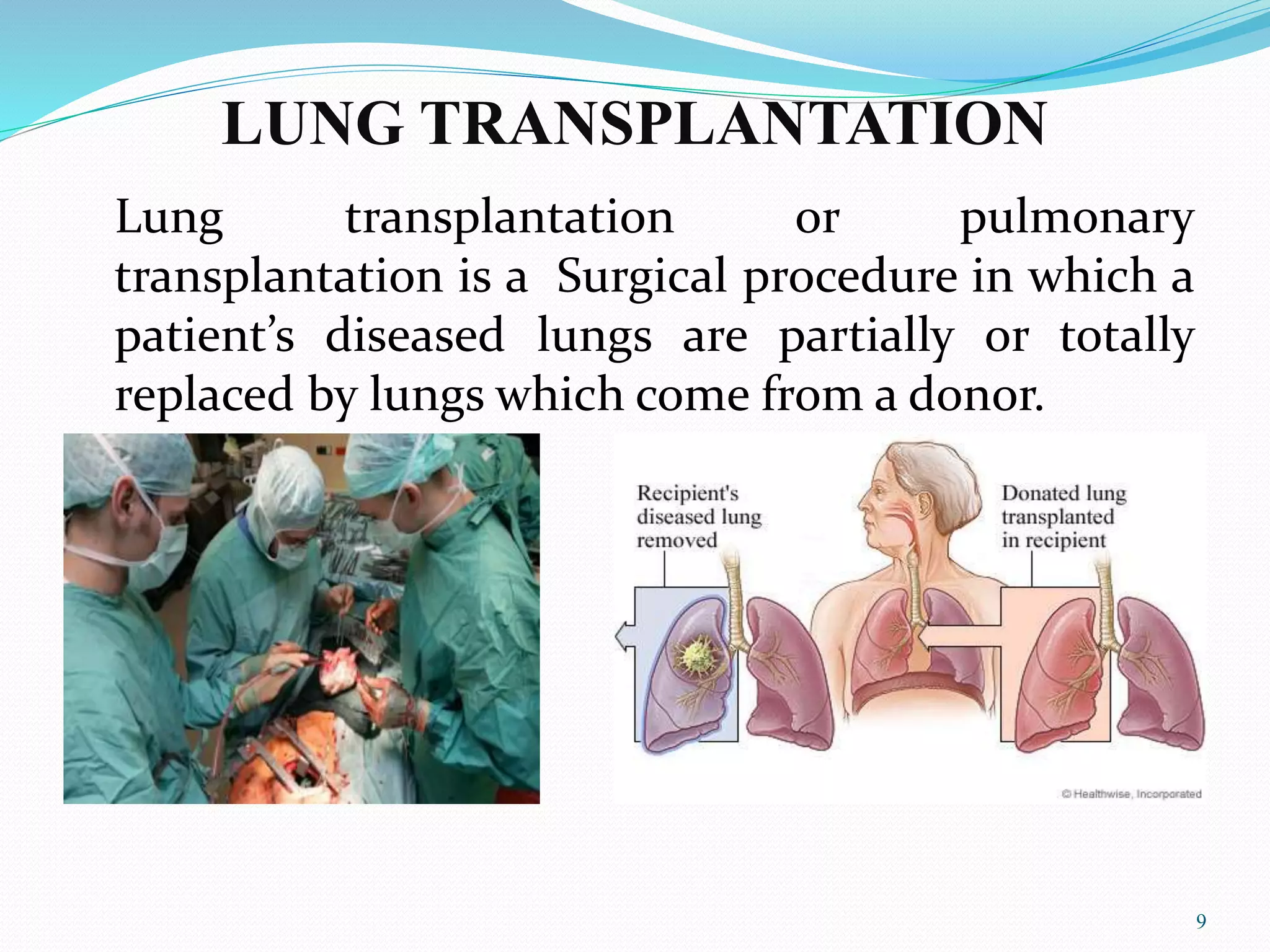
LUNG TRANSPLANTATION
Lung transplantation or pulmonary
transplantation is a Surgical procedure in which a
patient’s diseased lungs are partially or totally
replaced by lungs which come from a donor.
9
HISTORY
James Hardy of the University of Mississippi performed
the first human lung transplant on June 11, 1963.
From 1963 to 1978, multiple attempts at lung transplant
failed because of rejection and problems with
anastomotic bronchial healing .
The first successful transplant surgery involving the
lungs was a heart-lung transplant, performed by
Dr.Bruce Reitz of stanford University in 1981 on a
woman who had idiopathic pulmonary hypertension.
10
QUALIFYING CONDITIONS
A variety of conditions may make such surgery necessary. As
of 2005, the most common reasons for Lung transplantation in
the United states were.
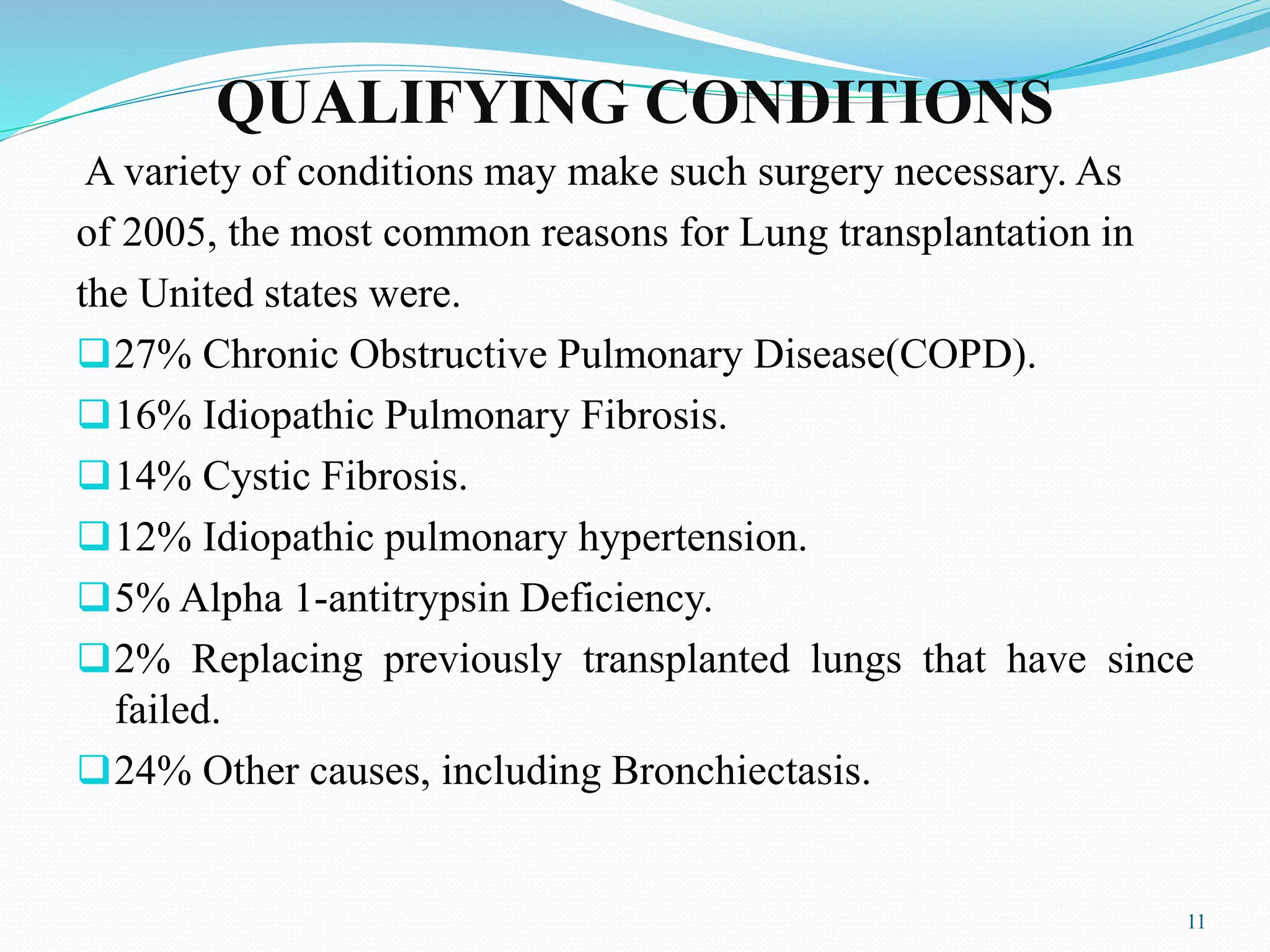
27% Chronic Obstructive Pulmonary Disease(COPD).
16% Idiopathic Pulmonary Fibrosis.
14% Cystic Fibrosis.
12% Idiopathic pulmonary hypertension.
5% Alpha 1-antitrypsin Deficiency.
2% Replacing previously transplanted lungs that have since
failed.
24% Other causes, including Bronchiectasis.
11
CONTRAINDICATIONS
Despite the severity of a patient’s respiratory condition,
certain pre-existing conditions may make a person
a poor candidate for lung transplantation.
 Concurrent chronic illness.
 Current infections, including HIV and hepatitis.
 Current or recent cancer.
 Current use of alcohol, tobacco or illegal drugs.
 Age.
 Psychiatric conditions.
 History of noncompliance with medical instructions.
12
TRANSPLANT REQUIREMENTS
Requirements for potential donor
• Healthy
• Size match
• Age
• Blood type
Requirements for potential recipient
• End-stage lung disease.
• No other chronic medical condition.
• Acceptable psychological profile.
• Financially able to pay for expenses.
13
Cont…….
Medical tests for potential transplant candidates
Blood typing
Tissue typing
Chest X-ray-PA and LAT
Pulmonary function tests
CT scan
Bone mineral density scan
 Gated cardiac blood pool scan
Cardiac stress test
Electrocardiogram
14
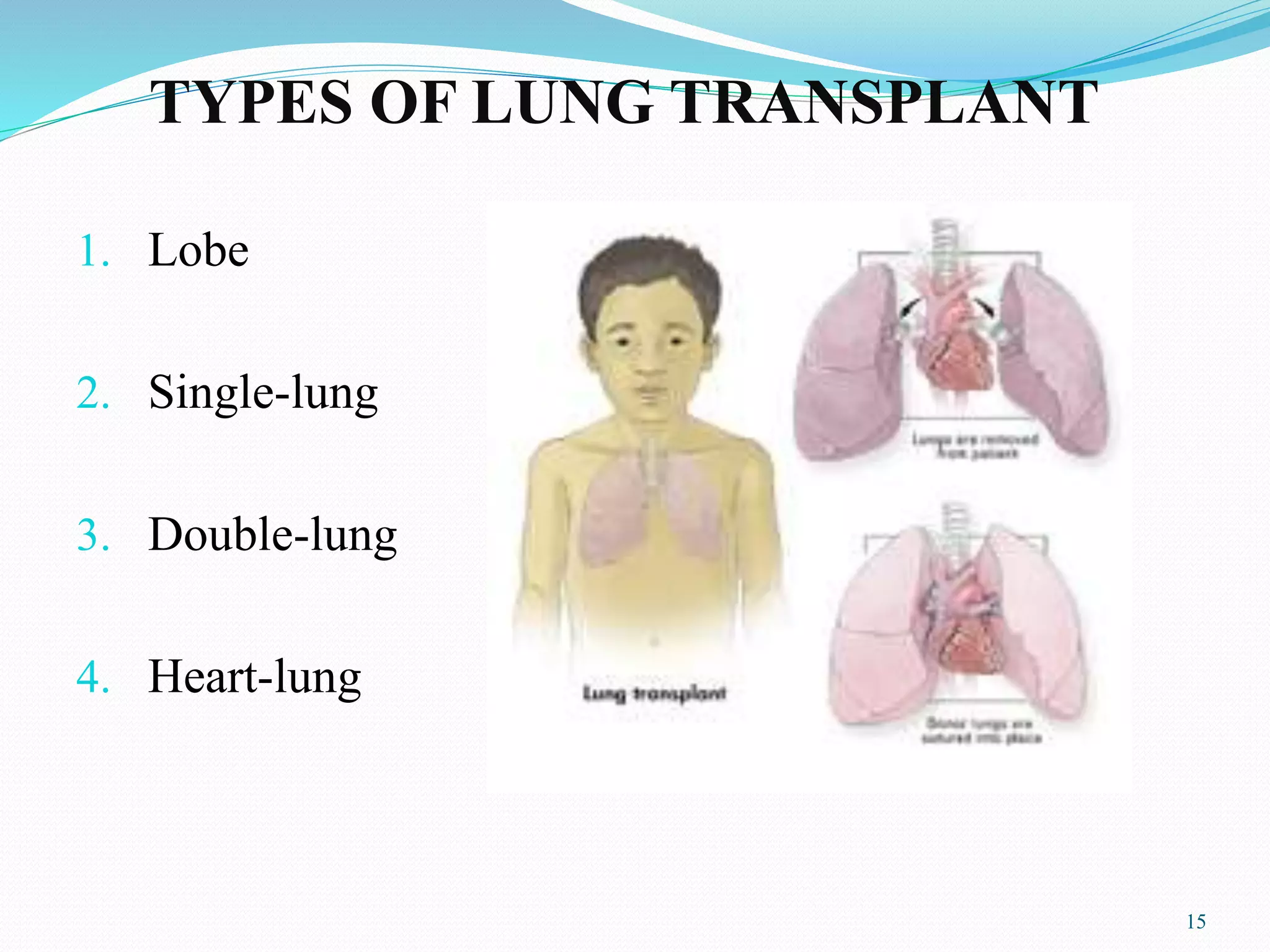
TYPES OF LUNG TRANSPLANT
1. Lobe
2. Single-lung
3. Double-lung
4. Heart-lung
15
PROCEDURE
 While the surgical details will depend on the type of Transplant,
many steps are common to all these procedures. Before operating
on the recipient, the transplant surgeon inspects the lung(s) for
signs of damage or disease.
 If the lung or lungs are approved, then the recipient is connected
to an IV line and various monitoring equipment, including pulse
oximetry. The patient will be given general anesthesia, and a
machine will breathe for him or her. A history of prior chest
surgery may complicate the procedure and require additional
time.
16
POST OPERATIVE CARE
After the surgery immediately following care should be
give to the patient:
The patient is placed in an intensive care unit for
monitoring normally for a period of a few days.
The patient is put on a ventilator to assist breathing.
Nutritional needs are generally met via total parenteral
nutrition and by nasogastric tube is sufficient for feeding.
Chest tubes are put in so that excess fluids may be
removed.
Because the patient is confined to bed, a urinary catheter
is used.
17
MISCELLANEOUS
Post-transplant patients are held from driving for the first
three months pending an assessment of the patients
capacity to drive .
Lack of a strong immune system leaves transplant
recipients vulnerable to infections.
Care must be taken into food preparation and hygiene as
gastroenteritis becomes more of a risk.
18
INFECTIONS AFTER LUNG
TRANSPLANTATION
Common symptoms of infection include:
 Fever, chills, sweats.
 Sore throat.
 Productive cough.
 Increased fatigue.
 Swelling, pain or redness around incision or drains.
 New drainage from the incisions.
 Headache.
 Shortness of breath.
19
HOW TO PROTECT YOURSELF FROM
INFECTIONS AFTER LUNG TRANSPLANT
Preventing infection is mostly common sense. Protect yourself
by following these simple guidelines:
 Wash your hands with soap and water often to remove bacteria
and viruses.
 When you cough or sneeze, use tissues, dispose of them
immediately, and wash your hands.
 If someone you know has a cold or the flu, avoid close contact.
 Avoid stagnant water because it too harbors bacteria.
Wear a respiratory mask in crowded public areas and hospitals.
20
CONCLUSION
In recent years, the science of organ transplantation has
gotten better. Unfortunately, there are not enough organ
donations for everyone who is in need.
Organ donors are needed to save thousands of lives
every year. agreeing to donate organs does
not affect the quality of care
a person receives. Transplantation processes start only
after the donor is no longer living.
The decision to donate organs is yours. If you
decide become an organ donor, put it in your
advance health directives and make sure your family
and health care agent know about your
decision. 21
22
THANKS for viewing the ppt
For more ppts
on pharma related topics plz contact
sarangi.dipu@gmail.com
Or find me at following link
www.facebook.com/sarangi.dipu

Organ transplantation ppt

  • 1.
  • 2.
    CONTENTS  INTRODUCTION  HISTORYOF ORGAN TRANSPLANTATION  TYPES OF ORGAN TRANSPLANTATION  TYPES OF ORGAN DONOR  MEDICAL REQUIREMENTS  STATUS IN INDIA  LUNG TRANSPLANTATION  QUALIFYING CONDITIONS  CONTRAINDICATIONS  TRANSPLANT REQUIREMENTS  TYPES OF LUNG TRANSPLANT  POST OPERATIVE CARE  MISCELLANEOUS  INFECTIONS AFTER TRANSPLANTATION  CONCLUSION  REFERENCES 2
  • 3.
    INTRODUCTION Organ transplant isthe moving of an organ from one body to another, for the purpose of replacing the recipient’s damaged or failing organ with a working one from the donor site. Organ donors can be living or deceased. 3
  • 4.
    HISTORY OF ORGANTRANSPLANTATION  The first human organ transplant was a kidney transplant performed in 1954. The recipient of the first heart transplant, performed in 1967 by Dr. Christiaan Barnard, lived only 18 days.  The recipient lived for eight years following the transplant and the surgeon who performed the transplant, Dr. Joseph Murray, went on to win the Nobel Prize for this work. 4
  • 5.
    TYPES OF ORGANDONOR Persons after death. Living persons to related patients. Living persons to unrelated patients. Brain death persons (cadaver transplant). 6
  • 6.
    MEDICAL REQUIREMENTS People ofall ages. Any healthy willing persons. Only one exception is that HIV and active cancer patients cannot donate. Donor blood group should match with recipient blood group. 7
  • 7.
    STATUS IN INDIA oIn India around 6,000 people die every day waiting for organ transplant. o Every 17 minutes someone waiting for transplant. o Every 30 minutes someone added to a waiting list. 8
  • 8.
    LUNG TRANSPLANTATION Lung transplantationor pulmonary transplantation is a Surgical procedure in which a patient’s diseased lungs are partially or totally replaced by lungs which come from a donor. 9
  • 9.
    HISTORY James Hardy ofthe University of Mississippi performed the first human lung transplant on June 11, 1963. From 1963 to 1978, multiple attempts at lung transplant failed because of rejection and problems with anastomotic bronchial healing . The first successful transplant surgery involving the lungs was a heart-lung transplant, performed by Dr.Bruce Reitz of stanford University in 1981 on a woman who had idiopathic pulmonary hypertension. 10
  • 10.
    QUALIFYING CONDITIONS A varietyof conditions may make such surgery necessary. As of 2005, the most common reasons for Lung transplantation in the United states were. 27% Chronic Obstructive Pulmonary Disease(COPD). 16% Idiopathic Pulmonary Fibrosis. 14% Cystic Fibrosis. 12% Idiopathic pulmonary hypertension. 5% Alpha 1-antitrypsin Deficiency. 2% Replacing previously transplanted lungs that have since failed. 24% Other causes, including Bronchiectasis. 11
  • 11.
    CONTRAINDICATIONS Despite the severityof a patient’s respiratory condition, certain pre-existing conditions may make a person a poor candidate for lung transplantation.  Concurrent chronic illness.  Current infections, including HIV and hepatitis.  Current or recent cancer.  Current use of alcohol, tobacco or illegal drugs.  Age.  Psychiatric conditions.  History of noncompliance with medical instructions. 12
  • 12.
    TRANSPLANT REQUIREMENTS Requirements forpotential donor • Healthy • Size match • Age • Blood type Requirements for potential recipient • End-stage lung disease. • No other chronic medical condition. • Acceptable psychological profile. • Financially able to pay for expenses. 13
  • 13.
    Cont……. Medical tests forpotential transplant candidates Blood typing Tissue typing Chest X-ray-PA and LAT Pulmonary function tests CT scan Bone mineral density scan  Gated cardiac blood pool scan Cardiac stress test Electrocardiogram 14
  • 14.
    TYPES OF LUNGTRANSPLANT 1. Lobe 2. Single-lung 3. Double-lung 4. Heart-lung 15
  • 15.
    PROCEDURE  While thesurgical details will depend on the type of Transplant, many steps are common to all these procedures. Before operating on the recipient, the transplant surgeon inspects the lung(s) for signs of damage or disease.  If the lung or lungs are approved, then the recipient is connected to an IV line and various monitoring equipment, including pulse oximetry. The patient will be given general anesthesia, and a machine will breathe for him or her. A history of prior chest surgery may complicate the procedure and require additional time. 16
  • 16.
    POST OPERATIVE CARE Afterthe surgery immediately following care should be give to the patient: The patient is placed in an intensive care unit for monitoring normally for a period of a few days. The patient is put on a ventilator to assist breathing. Nutritional needs are generally met via total parenteral nutrition and by nasogastric tube is sufficient for feeding. Chest tubes are put in so that excess fluids may be removed. Because the patient is confined to bed, a urinary catheter is used. 17
  • 17.
    MISCELLANEOUS Post-transplant patients areheld from driving for the first three months pending an assessment of the patients capacity to drive . Lack of a strong immune system leaves transplant recipients vulnerable to infections. Care must be taken into food preparation and hygiene as gastroenteritis becomes more of a risk. 18
  • 18.
    INFECTIONS AFTER LUNG TRANSPLANTATION Commonsymptoms of infection include:  Fever, chills, sweats.  Sore throat.  Productive cough.  Increased fatigue.  Swelling, pain or redness around incision or drains.  New drainage from the incisions.  Headache.  Shortness of breath. 19
  • 19.
    HOW TO PROTECTYOURSELF FROM INFECTIONS AFTER LUNG TRANSPLANT Preventing infection is mostly common sense. Protect yourself by following these simple guidelines:  Wash your hands with soap and water often to remove bacteria and viruses.  When you cough or sneeze, use tissues, dispose of them immediately, and wash your hands.  If someone you know has a cold or the flu, avoid close contact.  Avoid stagnant water because it too harbors bacteria. Wear a respiratory mask in crowded public areas and hospitals. 20
  • 20.
    CONCLUSION In recent years,the science of organ transplantation has gotten better. Unfortunately, there are not enough organ donations for everyone who is in need. Organ donors are needed to save thousands of lives every year. agreeing to donate organs does not affect the quality of care a person receives. Transplantation processes start only after the donor is no longer living. The decision to donate organs is yours. If you decide become an organ donor, put it in your advance health directives and make sure your family and health care agent know about your decision. 21
  • 21.
    22 THANKS for viewingthe ppt For more ppts on pharma related topics plz contact sarangi.dipu@gmail.com Or find me at following link www.facebook.com/sarangi.dipu