NANOROBOTICS
A Concise Presentation
By
Mr. Deepak Sarangi M.Pharm.
1
CONTENTS
 Introduction
 Advantages
 Disadvantages
 Working of nanorobotics
 Elements
 Swimming nanorobots
 Mechanism
 Approaches
 Applications
 Conclusion
 References
2
INTRODUCTION
 The possibility of nanorobots was first proposed by Richard
Feyman in his talk “There’s Plenty of Room at the Bottom”
in 1959.
 Robotics is the use of technology to design and
manufacture (intelligent) machines, built for specific
purposes, programmed to perform specific tasks.
 Generally nanotechnology deals with size ranging from 1 to
100 nanometer.
 Nanorobots are nanodevices that will be used for the
purpose of maintaining and protecting the human body
against pathogens. 3
NANOROBOTS : WHAT ARE THEY ?
 Nanorobots are theoretical microscopic devices measured on
the scale of nanometer (1nm equals one millionth of 1
millimeter).
 They would work at the atomic, molecular and cellular level
to perform in both the medical and industrial fields.
 These are very sensitive to the acoustic signal.
 These nanorobots can be programmed using the sound
waves to perform the specified tasks.
 These nanorobots identify the particular harmful cells and
try to quarantine it.
4
ADVANTAGES
 Rapid elimination of disease.
 The microscopic size of nanomachines translates into
high operational speed.
 Faster and more precise diagnosis.
 Non-degradation of treatment agents.
 The major advantage of nanorobots is thought to be their
durability, in theory, they can remain operational for
years, decades or centuries. 5
DISADVANTAGES
 Possible food chain interruption.
 Lack of knowledge.
 Nano implements could adjust human DNA
structure.
 Environmental hazards.
6
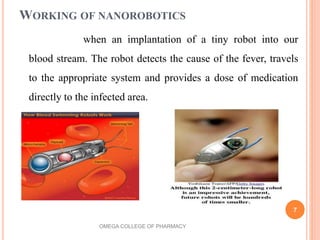
WORKING OF NANOROBOTICS
when an implantation of a tiny robot into our
blood stream. The robot detects the cause of the fever, travels
to the appropriate system and provides a dose of medication
directly to the infected area.
7
OMEGA COLLEGE OF PHARMACY
ELEMENTS
 Carbon is be the principal element comprising the bulk of
a medical nanorobot, probably in the form of diamond or
diamondoid nanocomposites.
 Many other light elements such as hydrogen, sulfur,
oxygen, nitrogen, fluorine, silicon, etc. will be used for
special purposes in nanoscale gears and other
components.
8
SWIMMING NANOROBOTS:
 Swimming robots are micro or nano robots that
can swim when injected into the body via vascular
and digestive system by using blood sugar as fuel.
 They are used to perform medical task the main
aim of these robots is to avoid major surgery and
enhance diagnosis of disease.
 The capabilities of nanorobots include therapeutic
and diagnostic functions such as ultrasounding,
biopsy, laser and produce heat by retractable arm.
9
MECHANISM
 The attached bacteria by rotating their flagella push the
microscope to forward by using different chemicals the
on/off motions of microrobots are controlled.
 These chemicals bind to the flagellar motor an restrict their
movement.
 Mainly used chemicals are EDTA and copper ions are used
to stop their motion and EDTA (ethylene diamine tetra
acetic acid) used to restart their motion1.
10
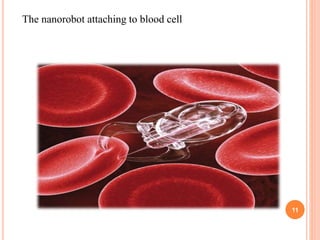
The nanorobot attaching to blood cell
11
The swimming robots contains robotic body,
poly styrene microspheres, which are also called
as micro beads.
The method used in the micro robot is bacteria
propulsion method, in which the bacteria was
propelled by rotating their flagella with high
speed then the bacteria adhere to the micro
beads.
12
1. Propulsion of the micro bead by bacteria:
The attachment takes place in 2 steps.
 Reversible:
In reversible attachment the bacteria adhere to the micro
bead with vanderwalls, acid-base interactions and
electostatic forces.
These are weaker bonds hence this attachment is reversible
 Irreversible:
Irreversibly attached to them by forming strong bonds.
2. Speed controlling technique 13
APPROACHES
Biochip
Nubots
Bacteria based
14
APPLICATIONS
 Breaking up blood clots.
 Fighting cancer.
 Parasite removal.
 Breaking up kidney stones.
 These are used to treat arterosclerosis can treat
arterosclerosis by breaking the plaques in the arteries
releasing chemicals at the site of injury.
15
16
 Targeted-delivery of pharmaceutical agents to specific
cellular and intracellular destinations within the human
body.
 Could be a very helpful and hopeful for the therapy
of patients, since current treatments like radiation
therapy and chemotherapy often end up destroying
more healthy cells than cancerous ones.
 It provides a non-depressed therapy for cancer patients.
Nanorobots in cancer detection and treatment
17
 The nanorobot can be programmed to activate sensors
and measure regularly the BGLs early in the morning,
before the expected breakfast time.
 The nanorobot is programmed also to emit a signal on
specified lunch times, and to measure the glucose levels in
desired intervals of time.
Controlling glucose level using nanorobots
18
Breaking up of kidney stones
 Kidney stones can be intensely painful.
 The larger the stone the more difficult it is to pass.
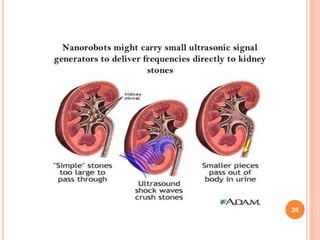
 Doctors break up large kidney stones using ultrasonic
frequencies, but it is not always effective.
 A nanorobot could break up a kidney stones using a small
laser.
19
20
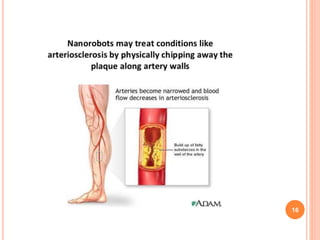
Arterosclerosis
 Arterosclerosis refers to a condition where plaque builds
along the walls of arteries.
 Nanorobots could conceivably treat the condition by cutting
away the plaque.
 Which would then enter the bloodstream.
21
CONCLUSIONS
 From these type of inventions, it will be useful
for man to cure many diseases then lead a
fantastic life.
 We can use the technology for more accuracy in
any field.
 Nanorobots are going to revolutionize in medical
industries in future.
 But in these technologies there is possible
danger also.
 Thus it is needful to invent these kind of special
featured nanorobot in the safe kind which will be
in nonhazardous to the living kind.
22
THANKS for viewing the ppt
For more ppts
on pharma related topics plz
contact
sarangi.dipu@gmail.com
Or find me at following link
www.facebook.com/sarangi.dipu
23

Nanorobotics ppt

  • 1.
  • 2.
    CONTENTS  Introduction  Advantages Disadvantages  Working of nanorobotics  Elements  Swimming nanorobots  Mechanism  Approaches  Applications  Conclusion  References 2
  • 3.
    INTRODUCTION  The possibilityof nanorobots was first proposed by Richard Feyman in his talk “There’s Plenty of Room at the Bottom” in 1959.  Robotics is the use of technology to design and manufacture (intelligent) machines, built for specific purposes, programmed to perform specific tasks.  Generally nanotechnology deals with size ranging from 1 to 100 nanometer.  Nanorobots are nanodevices that will be used for the purpose of maintaining and protecting the human body against pathogens. 3
  • 4.
    NANOROBOTS : WHATARE THEY ?  Nanorobots are theoretical microscopic devices measured on the scale of nanometer (1nm equals one millionth of 1 millimeter).  They would work at the atomic, molecular and cellular level to perform in both the medical and industrial fields.  These are very sensitive to the acoustic signal.  These nanorobots can be programmed using the sound waves to perform the specified tasks.  These nanorobots identify the particular harmful cells and try to quarantine it. 4
  • 5.
    ADVANTAGES  Rapid eliminationof disease.  The microscopic size of nanomachines translates into high operational speed.  Faster and more precise diagnosis.  Non-degradation of treatment agents.  The major advantage of nanorobots is thought to be their durability, in theory, they can remain operational for years, decades or centuries. 5
  • 6.
    DISADVANTAGES  Possible foodchain interruption.  Lack of knowledge.  Nano implements could adjust human DNA structure.  Environmental hazards. 6
  • 7.
    WORKING OF NANOROBOTICS whenan implantation of a tiny robot into our blood stream. The robot detects the cause of the fever, travels to the appropriate system and provides a dose of medication directly to the infected area. 7 OMEGA COLLEGE OF PHARMACY
  • 8.
    ELEMENTS  Carbon isbe the principal element comprising the bulk of a medical nanorobot, probably in the form of diamond or diamondoid nanocomposites.  Many other light elements such as hydrogen, sulfur, oxygen, nitrogen, fluorine, silicon, etc. will be used for special purposes in nanoscale gears and other components. 8
  • 9.
    SWIMMING NANOROBOTS:  Swimmingrobots are micro or nano robots that can swim when injected into the body via vascular and digestive system by using blood sugar as fuel.  They are used to perform medical task the main aim of these robots is to avoid major surgery and enhance diagnosis of disease.  The capabilities of nanorobots include therapeutic and diagnostic functions such as ultrasounding, biopsy, laser and produce heat by retractable arm. 9
  • 10.
    MECHANISM  The attachedbacteria by rotating their flagella push the microscope to forward by using different chemicals the on/off motions of microrobots are controlled.  These chemicals bind to the flagellar motor an restrict their movement.  Mainly used chemicals are EDTA and copper ions are used to stop their motion and EDTA (ethylene diamine tetra acetic acid) used to restart their motion1. 10
  • 11.
    The nanorobot attachingto blood cell 11
  • 12.
    The swimming robotscontains robotic body, poly styrene microspheres, which are also called as micro beads. The method used in the micro robot is bacteria propulsion method, in which the bacteria was propelled by rotating their flagella with high speed then the bacteria adhere to the micro beads. 12
  • 13.
    1. Propulsion ofthe micro bead by bacteria: The attachment takes place in 2 steps.  Reversible: In reversible attachment the bacteria adhere to the micro bead with vanderwalls, acid-base interactions and electostatic forces. These are weaker bonds hence this attachment is reversible  Irreversible: Irreversibly attached to them by forming strong bonds. 2. Speed controlling technique 13
  • 14.
  • 15.
    APPLICATIONS  Breaking upblood clots.  Fighting cancer.  Parasite removal.  Breaking up kidney stones.  These are used to treat arterosclerosis can treat arterosclerosis by breaking the plaques in the arteries releasing chemicals at the site of injury. 15
  • 16.
  • 17.
     Targeted-delivery ofpharmaceutical agents to specific cellular and intracellular destinations within the human body.  Could be a very helpful and hopeful for the therapy of patients, since current treatments like radiation therapy and chemotherapy often end up destroying more healthy cells than cancerous ones.  It provides a non-depressed therapy for cancer patients. Nanorobots in cancer detection and treatment 17
  • 18.
     The nanorobotcan be programmed to activate sensors and measure regularly the BGLs early in the morning, before the expected breakfast time.  The nanorobot is programmed also to emit a signal on specified lunch times, and to measure the glucose levels in desired intervals of time. Controlling glucose level using nanorobots 18
  • 19.
    Breaking up ofkidney stones  Kidney stones can be intensely painful.  The larger the stone the more difficult it is to pass.  Doctors break up large kidney stones using ultrasonic frequencies, but it is not always effective.  A nanorobot could break up a kidney stones using a small laser. 19
  • 20.
  • 21.
    Arterosclerosis  Arterosclerosis refersto a condition where plaque builds along the walls of arteries.  Nanorobots could conceivably treat the condition by cutting away the plaque.  Which would then enter the bloodstream. 21
  • 22.
    CONCLUSIONS  From thesetype of inventions, it will be useful for man to cure many diseases then lead a fantastic life.  We can use the technology for more accuracy in any field.  Nanorobots are going to revolutionize in medical industries in future.  But in these technologies there is possible danger also.  Thus it is needful to invent these kind of special featured nanorobot in the safe kind which will be in nonhazardous to the living kind. 22
  • 23.
    THANKS for viewingthe ppt For more ppts on pharma related topics plz contact sarangi.dipu@gmail.com Or find me at following link www.facebook.com/sarangi.dipu 23