College of Health Sciences
Dep. of Medical Laboratories
Food Microbiology Theory
3rd stage
Lecture 4
Dr: Shameeran S. Ismael
BVM & S, M.Sc Medical Microbiology(Parasitology),
PhD Molecular Parasitology
Introduction
• Microflora of the large intestine complete
digestion through fermentation, protect against
pathogenic bacteria and stimulate the immune
system.
• Probiotics and prebiotics in the diet can modify
the composition and some metabolic activities of
the microflora
• Probiotics appear effective in treatment of
childhood diarrhea, post-antibiotic diarrhea and
etc.
• They affect immune modulation and there are
varied but encouraging results in vaginosis,
Irritable Bowel Syndrome (IBS) and
Inflammtory Bowel Diseases (IBD)
History of probiotics
• At the start of the 20th century, Russian Nobel
prize winner and father of modern
immunology, Elie Metchnikoff , a scientist at
the Pasteur Institute, was the first to
conceptualize “Probiotics”
• In early 1930’s, in Japan, Minoru Shirota
developed a fermented milk product called
Yakult with a special strain of Lactobacillus
casei shirota.
• The word “probiotic” (origins: Latin pro
meaning “for” and Greek bios meaning “life”)
was first used to indicate substances that were
required for a healthy life
Probiotic
Probiotic - (for life):a substance that contains
microorganisms or bacteria that are beneficial to
the host organism.
Prebiotic - (greek - before life): a substance
(usually an oligosaccharide) that cannot be
digested but does promote the growth of
beneficial bacteria or probiotics
Synbiotic - (plus life) a substance containing both a
prebiotic and probiotic
Probiotic
• Probiotics are live bacteria and yeasts that are
good for life and have beneficial effects on the
host by improving its intestinal microbial
balance.
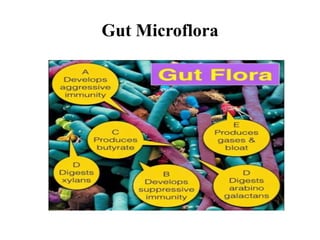
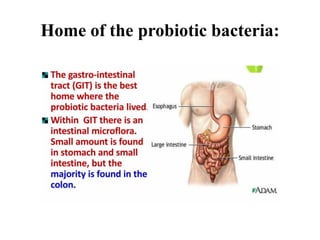
Gut Microflora
Home of the probiotic bacteria:
Factor affecting probiotic bacteria:-
• Intrinsic as well as extrinsic factors may
influence the survival of probiotics in food.
Importance factor affecting viability of
probiotics are:-
• Physical condition: including temperature and
humidity.
• Chemical condition: such as content of
oxygen nitrogen or pH
Factors affecting the intestinal
micro ecosystem
Antibiotics and other drug intake
Microbial infections
Diet (highly processed, low fiber foods)
Chronic diarrhea
Stress
Chlorinated water
Radiation and chemotherapy
Colonic therapies for detoxification
Characteristics of Effective
Probiotics
• It should be safe to the host (Non pathogenic and non
toxic)
• It should not produce any pathogenic or toxic effect.
• It must be resistance to hydrochloric acid, bile and
pancreatic juice.
• It should have anti-carcinogenic activity.
• It should produce lactic acid.
• It should retain viability during storage and use.
• It should stimulate the immune system of the body.
• It should have the ability to colonize the
gastrointestinal tract
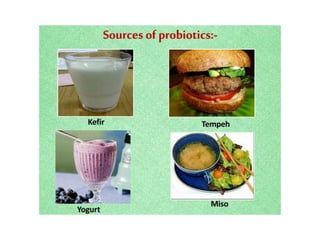
Food containing Probiotics:
Yogurt that contains live bacteria culture.
Cheese that is NOT baked.
Fermented milk.
Mechanism of action of Probiotics:
Production of low-molecular-weight antibacterial
substance that inhibits both gram-positive and gram-
negative enteric bacteria
Also use enzymatic mechanisms to modify toxin
receptors and block toxin-mediated pathology
Also prevent colonization of pathogenic
microorganisms by competitive inhibition for microbial
adhesion sites
Possible Mode of Action of Probiotics
 Production of inhibitory compounds
 Competition for chemicals/available energy
 Competition for adhesion sites (exclusion)
 Enhancement of the immune response
 Improvement of water quality
 Interaction with phytoplankton
 A source of macro- and micro-nutrients
 Enzymatic contribution to digestion
Advantages:
• Produce lactic acid: lowers the pH of intestines
and inhibiting bacterial villains such as
Clostridium, Salmonella, Shigella, E. coli, etc.
• Decreases the production of a variety of toxic or
carcinogenic metabolites.
• Aid absorption of minerals, especially calcium,
due to increased intestinal acidity.
• Production of β- D- galactosidase enzymes that
break down lactose.
• Produce a wide range of antimicrobial substances
-acidophilin and bacteriocin etc. help to control
pathogenic bacteria .
• Produce vitamins (especially Vitamin B and vitamin
K)
• Act as barriers to prevent harmful bacteria from
colonizing the intestines
Colon cancer: Certain probiotics (Lactobacillus bulcaricus)
may help prevent colon cancer by preventing the
breakdown of enzymes (β- glucuronidase)
that contribute to the growth of cancer causing agents.
Lowering cholesterol :
a range of LAB able to break down
bile in the gut, thus inhibiting its re-absorption (which enters
the blood as cholesterol)
Blood pressure reduction: Consumption of milk fermented with various
strains of LAB may result in modest reductions in blood pressure, due to the
ACE inhibition-like peptides produced during fermentation.
Primary Pediatric Uses of Probiotics
• Manage lactose intolerance (L acidophilus)
• Antibiotic-associated diarrhea and
infectious diarrhea
• Decrease constipation
• Decrease dental caries
• Treatment of H pylorii infections
• Decrease colic
• Decrease risk of developing eczema
• Decrease upper respiratory tract infections
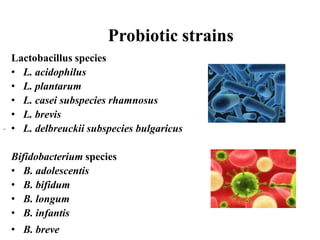
Probiotic strains
Lactobacillus species
• L. acidophilus
• L. plantarum
• L. casei subspecies rhamnosus
• L. brevis
• L. delbreuckii subspecies bulgaricus
Bifidobacterium species
• B. adolescentis
• B. bifidum
• B. longum
• B. infantis
• B. breve
Others:
• Streptococcus salivarius ssp. thermophilus
• Lactococcus lactis ssp. lactis
• Lactococcus lactis s ssp. cremoris
• Enterococcus faecium
• Leuconostoc mesenteroides ssp. dextranicum
• Propionibacterium freudenreichii
• Pediococcus acidilactici
• Saccharomyces boulardii
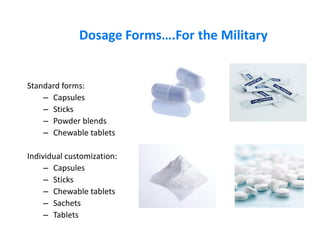
Dosage Forms….For the Military
Standard forms:
– Capsules
– Sticks
– Powder blends
– Chewable tablets
Individual customization:
– Capsules
– Sticks
– Chewable tablets
– Sachets
– Tablets
Disadvantages of Probiotics:
• Rare cases cause bloating, diarrhea, abdominal
pain.
• If in excess cause infection that require medical
attentions.
• People having on underlying disease or
compromised immune system cause potential
health problems like skin rash, fever, bloody stools
etc.
Prebiotics
• A prebiotic is a nondigestible component which
beneficially affects the host by selectively stimulating
the growth and/or activity of one or a limited number
of colonic bacteria, thereby improving the health of the
host .
• Examples- insulin, garlic, onions, chicory root,
Asparagus, whole wheat, rye, barley
Characteristics of Prebiotics:
• Should not be hydrolyzed or absorbed in the upper part
of G.I tract.
• Should be a selective substrate for one or a limited
number of potentially bacterial commercial to the colon
culture protagonist.
• Should be able to alter the colonic microflora towards a
healthier composition or selectively stimulates the
growth and or activity of intestinal bacteria associated
with health and well being.
Health Benefits Prebiotic
• Immune System Strength: Prebiotic fiber promotes
the growth and colonization of beneficial bacteria in
the gut. These bacteria aid the immune system in
fighting illness-causing bacteria and viruses.
• Normal Bowel Function: Irritable bowel syndrome,
which is characterized by bloating, gas, stomach pain,
cramping, bouts of constipation and diarrhea, is
caused by food being digested improperly , prebiotic
fiber causes foods to be digested normally, over a
normal period of time, not too quickly or too
slowly.
• Cancer Prevention: Bifidobacteria digests insulin in
the gut flora and produces short chain fatty-acids:
acetic acid, propionic acid, and butyric acid. Within
the intestine, it is believed that these acids can help
prevent certain forms of Cancer.
• Colon cancer: The insoluble fiber from
prebiotics, some experts believe, are actually
doing a part in preventing colon cancer by
sweeping up carcinogens and other
dangerous toxins before they can be
absorbed into the bloodstream where they
can do damage
• Should help increase the absorption of certain
minerals such as calcium and magnesium.
• Favorable effect on the immune system and provide
improved resistance against infection.
Uses of Prebiotic
• Enhance bone density and increase Calcium absorption.
• Improve immune function in both the gut and body.
• Establish a healthier balance of bacteria in the gut.
• Promote regular bowel movements.
• Suppress appetite.
• Reduces the risk of an intestinal infection.
• Increase in mineral absorption and improvement of bone
health.
• Modulation of gastro-intestinal peptides production, energy
metabolism and satiety.
• Initiation (after birth) and regulation/modulation of immune
functions.
Side effect
• Excessive consumption of prebiotics
particularly those in the oligosaccharides
category may cause abdominal discomfort and
distension, as well as significant levels of
flatulence.
Synbiotics
• Probiotics + Prebiotics
• Foods containing the combination of probiotics and
prebiotics are referred to as sybiotics.
• Improved survival in upper GIT and more efficient
implantation.
A habit
that can really benefits
our overall health-
“TAKING PROBIOTICS”

Food microbiology the.4

  • 1.
    College of HealthSciences Dep. of Medical Laboratories Food Microbiology Theory 3rd stage Lecture 4 Dr: Shameeran S. Ismael BVM & S, M.Sc Medical Microbiology(Parasitology), PhD Molecular Parasitology
  • 2.
    Introduction • Microflora ofthe large intestine complete digestion through fermentation, protect against pathogenic bacteria and stimulate the immune system. • Probiotics and prebiotics in the diet can modify the composition and some metabolic activities of the microflora • Probiotics appear effective in treatment of childhood diarrhea, post-antibiotic diarrhea and etc.
  • 3.
    • They affectimmune modulation and there are varied but encouraging results in vaginosis, Irritable Bowel Syndrome (IBS) and Inflammtory Bowel Diseases (IBD)
  • 4.
    History of probiotics •At the start of the 20th century, Russian Nobel prize winner and father of modern immunology, Elie Metchnikoff , a scientist at the Pasteur Institute, was the first to conceptualize “Probiotics”
  • 5.
    • In early1930’s, in Japan, Minoru Shirota developed a fermented milk product called Yakult with a special strain of Lactobacillus casei shirota. • The word “probiotic” (origins: Latin pro meaning “for” and Greek bios meaning “life”) was first used to indicate substances that were required for a healthy life
  • 6.
    Probiotic Probiotic - (forlife):a substance that contains microorganisms or bacteria that are beneficial to the host organism. Prebiotic - (greek - before life): a substance (usually an oligosaccharide) that cannot be digested but does promote the growth of beneficial bacteria or probiotics Synbiotic - (plus life) a substance containing both a prebiotic and probiotic
  • 7.
    Probiotic • Probiotics arelive bacteria and yeasts that are good for life and have beneficial effects on the host by improving its intestinal microbial balance.
  • 8.
  • 9.
    Home of theprobiotic bacteria:
  • 10.
    Factor affecting probioticbacteria:- • Intrinsic as well as extrinsic factors may influence the survival of probiotics in food. Importance factor affecting viability of probiotics are:- • Physical condition: including temperature and humidity. • Chemical condition: such as content of oxygen nitrogen or pH
  • 11.
    Factors affecting theintestinal micro ecosystem Antibiotics and other drug intake Microbial infections Diet (highly processed, low fiber foods) Chronic diarrhea Stress Chlorinated water Radiation and chemotherapy Colonic therapies for detoxification
  • 12.
    Characteristics of Effective Probiotics •It should be safe to the host (Non pathogenic and non toxic) • It should not produce any pathogenic or toxic effect. • It must be resistance to hydrochloric acid, bile and pancreatic juice. • It should have anti-carcinogenic activity. • It should produce lactic acid. • It should retain viability during storage and use. • It should stimulate the immune system of the body. • It should have the ability to colonize the gastrointestinal tract
  • 13.
    Food containing Probiotics: Yogurtthat contains live bacteria culture. Cheese that is NOT baked. Fermented milk.
  • 15.
    Mechanism of actionof Probiotics: Production of low-molecular-weight antibacterial substance that inhibits both gram-positive and gram- negative enteric bacteria Also use enzymatic mechanisms to modify toxin receptors and block toxin-mediated pathology Also prevent colonization of pathogenic microorganisms by competitive inhibition for microbial adhesion sites
  • 16.
    Possible Mode ofAction of Probiotics  Production of inhibitory compounds  Competition for chemicals/available energy  Competition for adhesion sites (exclusion)  Enhancement of the immune response  Improvement of water quality  Interaction with phytoplankton  A source of macro- and micro-nutrients  Enzymatic contribution to digestion
  • 17.
    Advantages: • Produce lacticacid: lowers the pH of intestines and inhibiting bacterial villains such as Clostridium, Salmonella, Shigella, E. coli, etc. • Decreases the production of a variety of toxic or carcinogenic metabolites. • Aid absorption of minerals, especially calcium, due to increased intestinal acidity.
  • 18.
    • Production ofβ- D- galactosidase enzymes that break down lactose. • Produce a wide range of antimicrobial substances -acidophilin and bacteriocin etc. help to control pathogenic bacteria . • Produce vitamins (especially Vitamin B and vitamin K) • Act as barriers to prevent harmful bacteria from colonizing the intestines
  • 19.
    Colon cancer: Certainprobiotics (Lactobacillus bulcaricus) may help prevent colon cancer by preventing the breakdown of enzymes (β- glucuronidase) that contribute to the growth of cancer causing agents. Lowering cholesterol : a range of LAB able to break down bile in the gut, thus inhibiting its re-absorption (which enters the blood as cholesterol) Blood pressure reduction: Consumption of milk fermented with various strains of LAB may result in modest reductions in blood pressure, due to the ACE inhibition-like peptides produced during fermentation.
  • 20.
    Primary Pediatric Usesof Probiotics • Manage lactose intolerance (L acidophilus) • Antibiotic-associated diarrhea and infectious diarrhea • Decrease constipation • Decrease dental caries • Treatment of H pylorii infections • Decrease colic • Decrease risk of developing eczema • Decrease upper respiratory tract infections
  • 21.
    Probiotic strains Lactobacillus species •L. acidophilus • L. plantarum • L. casei subspecies rhamnosus • L. brevis • L. delbreuckii subspecies bulgaricus Bifidobacterium species • B. adolescentis • B. bifidum • B. longum • B. infantis • B. breve
  • 22.
    Others: • Streptococcus salivariusssp. thermophilus • Lactococcus lactis ssp. lactis • Lactococcus lactis s ssp. cremoris • Enterococcus faecium • Leuconostoc mesenteroides ssp. dextranicum • Propionibacterium freudenreichii • Pediococcus acidilactici • Saccharomyces boulardii
  • 23.
    Dosage Forms….For theMilitary Standard forms: – Capsules – Sticks – Powder blends – Chewable tablets Individual customization: – Capsules – Sticks – Chewable tablets – Sachets – Tablets
  • 24.
    Disadvantages of Probiotics: •Rare cases cause bloating, diarrhea, abdominal pain. • If in excess cause infection that require medical attentions. • People having on underlying disease or compromised immune system cause potential health problems like skin rash, fever, bloody stools etc.
  • 25.
    Prebiotics • A prebioticis a nondigestible component which beneficially affects the host by selectively stimulating the growth and/or activity of one or a limited number of colonic bacteria, thereby improving the health of the host . • Examples- insulin, garlic, onions, chicory root, Asparagus, whole wheat, rye, barley
  • 27.
    Characteristics of Prebiotics: •Should not be hydrolyzed or absorbed in the upper part of G.I tract. • Should be a selective substrate for one or a limited number of potentially bacterial commercial to the colon culture protagonist. • Should be able to alter the colonic microflora towards a healthier composition or selectively stimulates the growth and or activity of intestinal bacteria associated with health and well being.
  • 28.
    Health Benefits Prebiotic •Immune System Strength: Prebiotic fiber promotes the growth and colonization of beneficial bacteria in the gut. These bacteria aid the immune system in fighting illness-causing bacteria and viruses. • Normal Bowel Function: Irritable bowel syndrome, which is characterized by bloating, gas, stomach pain, cramping, bouts of constipation and diarrhea, is caused by food being digested improperly , prebiotic fiber causes foods to be digested normally, over a normal period of time, not too quickly or too slowly.
  • 29.
    • Cancer Prevention:Bifidobacteria digests insulin in the gut flora and produces short chain fatty-acids: acetic acid, propionic acid, and butyric acid. Within the intestine, it is believed that these acids can help prevent certain forms of Cancer.
  • 30.
    • Colon cancer:The insoluble fiber from prebiotics, some experts believe, are actually doing a part in preventing colon cancer by sweeping up carcinogens and other dangerous toxins before they can be absorbed into the bloodstream where they can do damage
  • 31.
    • Should helpincrease the absorption of certain minerals such as calcium and magnesium. • Favorable effect on the immune system and provide improved resistance against infection.
  • 33.
    Uses of Prebiotic •Enhance bone density and increase Calcium absorption. • Improve immune function in both the gut and body. • Establish a healthier balance of bacteria in the gut. • Promote regular bowel movements. • Suppress appetite. • Reduces the risk of an intestinal infection. • Increase in mineral absorption and improvement of bone health. • Modulation of gastro-intestinal peptides production, energy metabolism and satiety. • Initiation (after birth) and regulation/modulation of immune functions.
  • 34.
    Side effect • Excessiveconsumption of prebiotics particularly those in the oligosaccharides category may cause abdominal discomfort and distension, as well as significant levels of flatulence.
  • 35.
    Synbiotics • Probiotics +Prebiotics • Foods containing the combination of probiotics and prebiotics are referred to as sybiotics. • Improved survival in upper GIT and more efficient implantation.
  • 36.
    A habit that canreally benefits our overall health- “TAKING PROBIOTICS”