INDUSTRIAL HAZARDS AND
SAFETY PRECAUTIONS
A Concise Presentation
By
Mr. Deepak Sarangi M.Pharm
1
CONTENTS
1. Introduction
2. Definition
3. Hazardous waste rules
4. Types of hazards
5. Industrial dermatitis
6. Accident records
7. Routes of infection
8. Types of hazards toxicity
9. Diagnosis and control of industrial hazards
10. Treatment of hazardous wastes
11. Precautions of industrial hazards
12. Conclusion
13. References 2
INTRODUCTION
 Hazard is a term associated with a substance that is
likelihood to cause an injury in a given environment or
situation.
 Safety in simple terms means freedom from the
occurrence of risk or injury or loss. Industrial safety
refers to the protection of workers from the danger of
industrial accidents.
3
DEFINITION
Industrial hazard may be defined as
any condition produced by industries that
may cause injury or death to personnel or
loss of product or property.
4
HAZARDOUS WASTE RULES
 Hazardous wastes to be collected, treated, stored and disposed
off only on authorised places.
 Authorisation for above to be issued by SPCB.
 Hazardous waste to be packed and transported in sufficiently
safe conditions.
 State government or a person authorised shall undertake a
continuing programme to identify the sites and publish
periodically an inventory of disposal sites within the state for
disposal of hazardous wastes. 5
TYPES OF HAZARDS
1. Biological hazards
2. Chemical hazards
3. Mechanical hazards
4. Physical hazards
5. Electrical hazards
6. Fire and dust hazards
6
1. BIOLOGICAL HAZARDS
 A biological hazard is one originating from an organism that is
foreign to the organism being affected.
 Many biological hazards are associated with food, including
certain viruses, parasites, fungi, bacteria, and plant and seafood
toxins.
 Disease in human can come from biological hazards in the form
of infection by bacteria, antigents, car, plane, bus, viruses and
parasites.
7
2. CHEMICAL HAZARDS
 A chemical can be considered a hazards by virtue of its intrinsic
properties it can cause harm or danger to humans, property, or
the environment.
 Some chemicals occur naturally in certain geological
formations, such as radon gas or arsenic.
 Many other chemicals used in industrial and laboratory settings
can cause respiratory, digestive, or nervous systems problems if
they are inhaled, ingested or absorbed through the skin.
8
3. MECHANICAL HAZARDS
A mechanical hazard is any hazard involving a machine or
process. Motor vehicles, aircrafts and air bags pose
mechanical hazards. Compressed gases or liquids can also
be considered a mechanical hazard.
9
4. PHYSICAL HAZARDS
 A physical hazard is a naturally occurring process that has the
potential to create loss or damage.
 Physical hazards often have both human and natural elements.
 Flood problems can be affected by climate fluctuations and
storm frequency, both natural elements, and by land drainage
and building in a flood plain, human elements.
10
5. ELECTRICAL HAZARDS
Electrical injuries consist of four main types:
 Electrocution (fatal),
 Electric shock,
 Burns and
 Falls caused as a result of contact with electrical energy.
11
CONTD….
An worker will receive a shock when he/she:
i. Touches two wires at different voltages at the same time.
ii. Touches phase and neutral wire at a time
iii. Touches the phase standing on the ground
iv. Touches the phase having wet cloth, high humidity and
perspiration.
12
6. FIRE AND DUST HAZARDS
Source of dust hazards in pharmaceutical industries
 Grinding or milling of drugs, excipients, or herbal products.
 During weighing dusts may float on air.
 During powder mixing dusts may be generated.
 During coating operation dusts are generated.
 During capsule filling and tablet punching operation dusts may be
generated.
Methods of controlling dust
 Filtration
 Inertial separator
 Electrostatic separator
13
CONTD…..
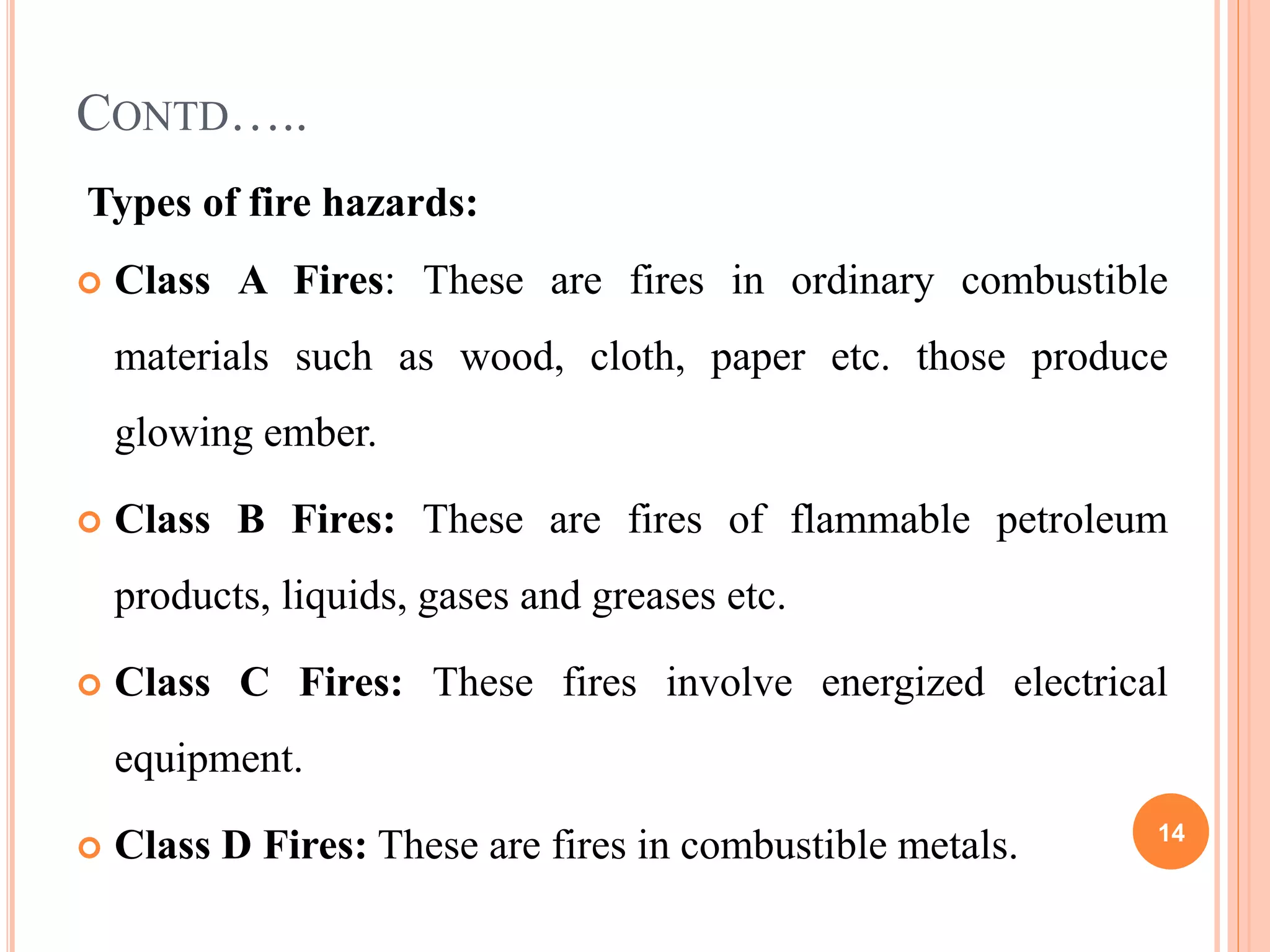
Types of fire hazards:
 Class A Fires: These are fires in ordinary combustible
materials such as wood, cloth, paper etc. those produce
glowing ember.
 Class B Fires: These are fires of flammable petroleum
products, liquids, gases and greases etc.
 Class C Fires: These fires involve energized electrical
equipment.
 Class D Fires: These are fires in combustible metals. 14
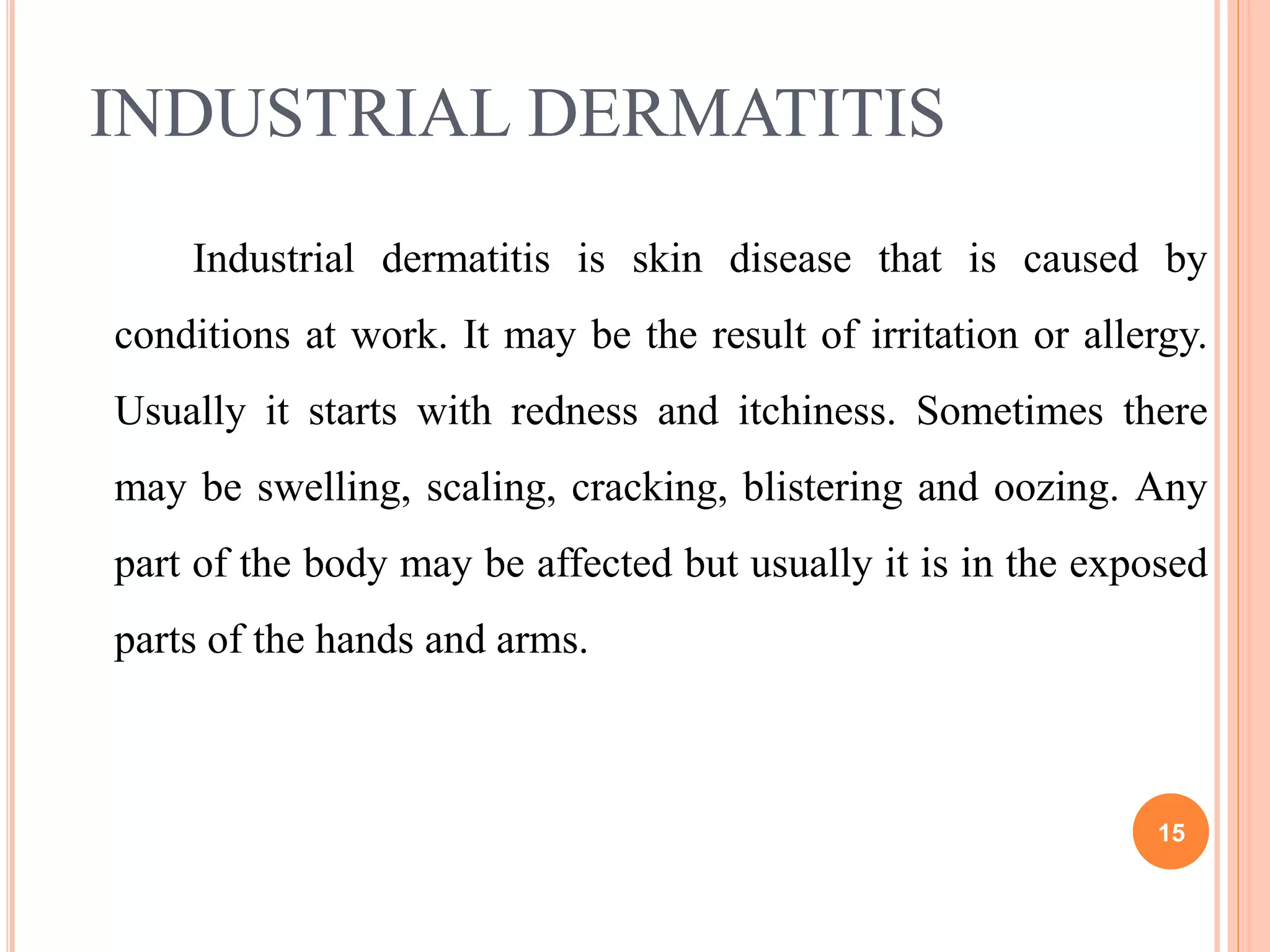
INDUSTRIAL DERMATITIS
Industrial dermatitis is skin disease that is caused by
conditions at work. It may be the result of irritation or allergy.
Usually it starts with redness and itchiness. Sometimes there
may be swelling, scaling, cracking, blistering and oozing. Any
part of the body may be affected but usually it is in the exposed
parts of the hands and arms.
15
CONTD…
Prevention of industrial dermatitis at work:
 Work clothes should be changed daily.
 For Chemicals, which dry the skin such as, solvents,
moisturisers should be applied daily.
 If skin problem arises, the worker should report to your
supervisor and consult your doctor.
 Personal protective equipments e.g.: gloves, impervious
sleeves and boots should be wore to minimise contact with
chemicals. 16
ACCIDENT RECORDS
After any accident or incident during work an accident
record should be maintained. Generally a standard form is filed
up and a copy is kept at the factory premises and another copy
is sent to respective authorities of that country.
17
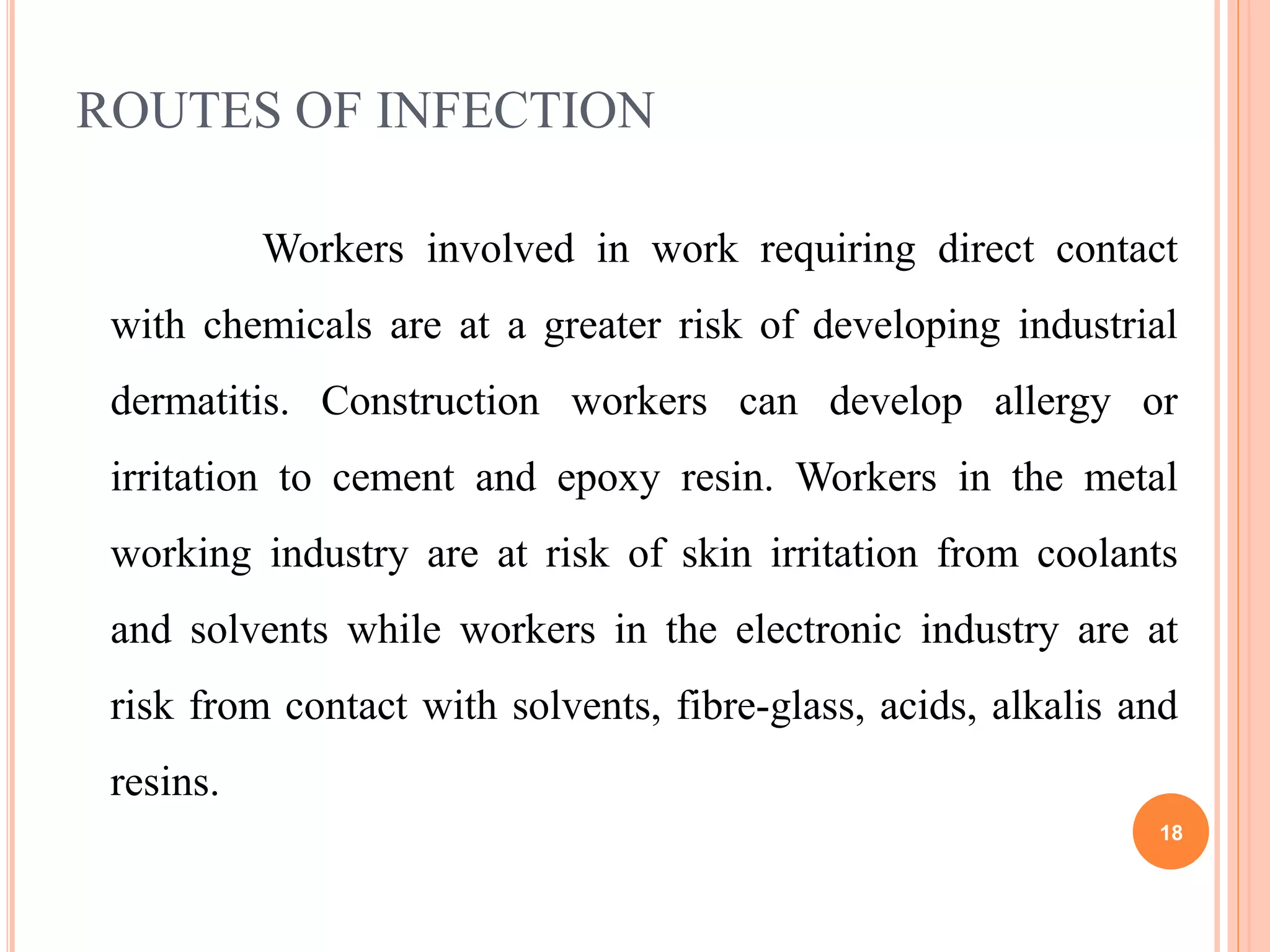
ROUTES OF INFECTION
Workers involved in work requiring direct contact
with chemicals are at a greater risk of developing industrial
dermatitis. Construction workers can develop allergy or
irritation to cement and epoxy resin. Workers in the metal
working industry are at risk of skin irritation from coolants
and solvents while workers in the electronic industry are at
risk from contact with solvents, fibre-glass, acids, alkalis and
resins.
18
TYPES OF HAZARDS TOXICITY
 Acute poisoning is characterized by rapid absorption of the substance
and the exposure is sudden & severe. Normally, a single large
exposure is involved. Examples: carbon monoxide or cyanide
poisoning.
 Chronic poisoning is characterized by prolonged or repeated
exposures of a duration measured in days, months or
years. Symptoms may not be immediately apparent, but tend to build
up in the body as a result of chronic exposure. The effects are not
seen until a critical body burden is reached. Examples: lead or
mercury poisoning or pesticide exposure.
19
DIAGNOSIS AND CONTROL OF
INDUSTRIAL HAZARDS
20
TREATMENT OF HAZARDOUS WASTES
 Reduction of source/ reuse/ recycle.
 Dilution of hazardous waste.
 Commercial available alternatives
1. Physical treatment
2. Chemical treatment
3. Biological treatment
4. Thermal treatment
5. Stabilization/ solidification/ sorption. 21
CONTD....
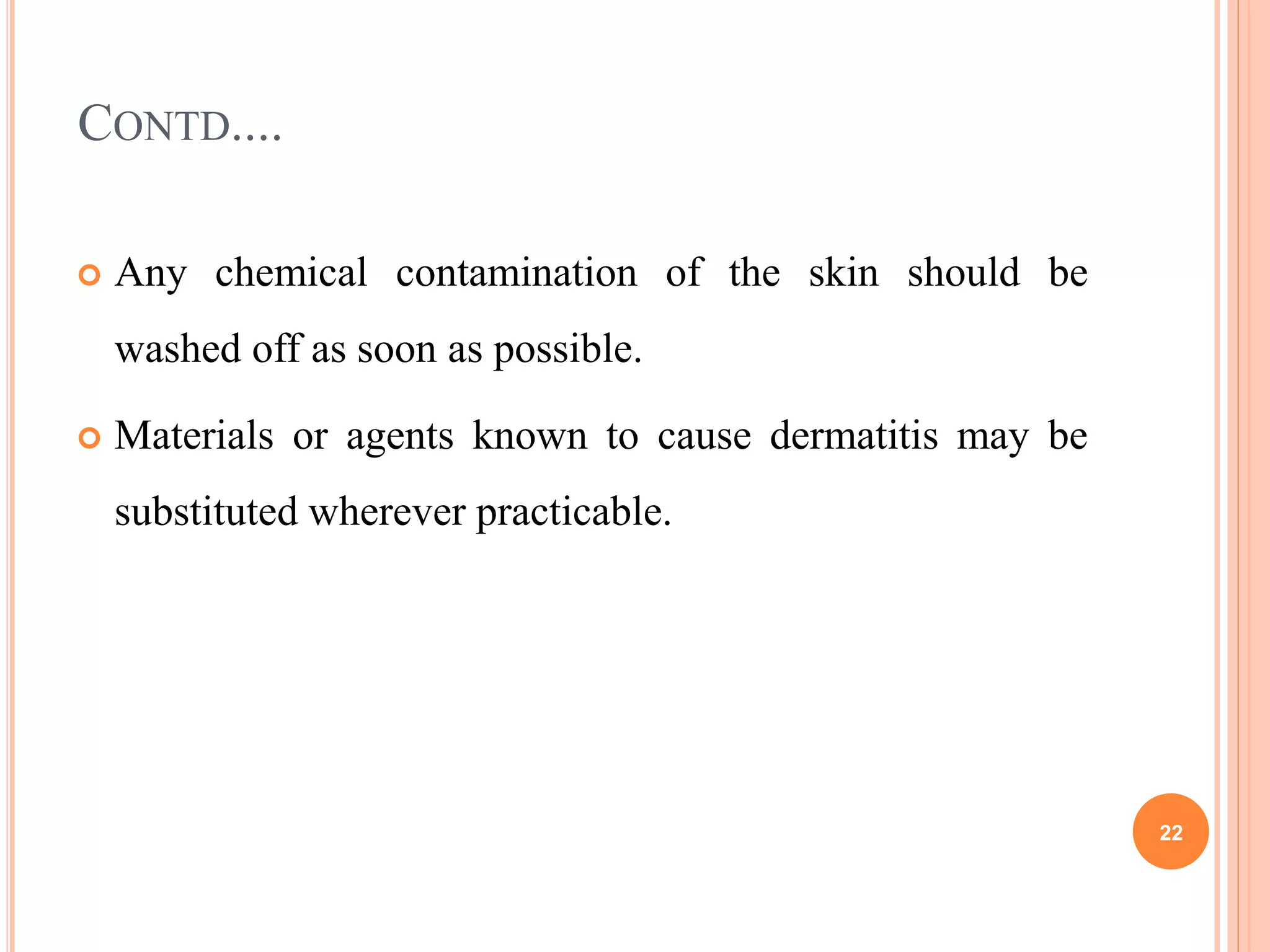
 Any chemical contamination of the skin should be
washed off as soon as possible.
 Materials or agents known to cause dermatitis may be
substituted wherever practicable.
22
ECAUTIONS OF INDUSTRIAL HAZARDS
 Protect the head and eyes with the help of goggles,
helmets, hooks, masks.
 Protection of hand, arms, legs and feet with rubber
gloves, rubber boots, aprons, shoes, other clothing.
 Prevention of breathing of poisonous gases with
respiration protective devices.
23
SAFETY PROGRAM
The basic principals are:-
 To identify potential hazards, provide effective safety
equipment and facilities.
 To develop safety policies.
 To train in safe method of working and provide continuing
education and guidance on eliminating safety hazards and
prevention of accidents.
24
CONCLUSION
 From the previous discussion it is clear that the safety aspects
must be considered by the pharmaceutical industry not only in
the interest of the employees or property but also in the terms of
the neighbouring environment as well.
 The source of possible hazards, risk analysis, control procedures,
preventive measures and contingency plan are the main five
essentials for ensuring a complete work atmosphere in the
industry.
25
REFERENCES
1. Subramanyam C.V.S. Thaimma J. Setty Pharmaceutical
production management, first Edition 2004 vallabh prakashan
New Delhi 393-412.
2. Subramanyam C.V.S. Thaimma J. Setty, Devi V.K.
Pharmaceutical Engineering Principle and Practice, first
Edition 2003, M.K. Jain for vallabh prakashan New Delhi
483,2
3. Samba Murthy K Pharmaceutical Engineering, New Age
International publishers 449. 26
THANKS for viewing the ppt
For more ppts
on pharma related topics plz
contact
sarangi.dipu@gmail.com
Or find me at following link
www.facebook.com/sarangi.dipu
27

Industrial hazard ppt

  • 1.
    INDUSTRIAL HAZARDS AND SAFETYPRECAUTIONS A Concise Presentation By Mr. Deepak Sarangi M.Pharm 1
  • 2.
    CONTENTS 1. Introduction 2. Definition 3.Hazardous waste rules 4. Types of hazards 5. Industrial dermatitis 6. Accident records 7. Routes of infection 8. Types of hazards toxicity 9. Diagnosis and control of industrial hazards 10. Treatment of hazardous wastes 11. Precautions of industrial hazards 12. Conclusion 13. References 2
  • 3.
    INTRODUCTION  Hazard isa term associated with a substance that is likelihood to cause an injury in a given environment or situation.  Safety in simple terms means freedom from the occurrence of risk or injury or loss. Industrial safety refers to the protection of workers from the danger of industrial accidents. 3
  • 4.
    DEFINITION Industrial hazard maybe defined as any condition produced by industries that may cause injury or death to personnel or loss of product or property. 4
  • 5.
    HAZARDOUS WASTE RULES Hazardous wastes to be collected, treated, stored and disposed off only on authorised places.  Authorisation for above to be issued by SPCB.  Hazardous waste to be packed and transported in sufficiently safe conditions.  State government or a person authorised shall undertake a continuing programme to identify the sites and publish periodically an inventory of disposal sites within the state for disposal of hazardous wastes. 5
  • 6.
    TYPES OF HAZARDS 1.Biological hazards 2. Chemical hazards 3. Mechanical hazards 4. Physical hazards 5. Electrical hazards 6. Fire and dust hazards 6
  • 7.
    1. BIOLOGICAL HAZARDS A biological hazard is one originating from an organism that is foreign to the organism being affected.  Many biological hazards are associated with food, including certain viruses, parasites, fungi, bacteria, and plant and seafood toxins.  Disease in human can come from biological hazards in the form of infection by bacteria, antigents, car, plane, bus, viruses and parasites. 7
  • 8.
    2. CHEMICAL HAZARDS A chemical can be considered a hazards by virtue of its intrinsic properties it can cause harm or danger to humans, property, or the environment.  Some chemicals occur naturally in certain geological formations, such as radon gas or arsenic.  Many other chemicals used in industrial and laboratory settings can cause respiratory, digestive, or nervous systems problems if they are inhaled, ingested or absorbed through the skin. 8
  • 9.
    3. MECHANICAL HAZARDS Amechanical hazard is any hazard involving a machine or process. Motor vehicles, aircrafts and air bags pose mechanical hazards. Compressed gases or liquids can also be considered a mechanical hazard. 9
  • 10.
    4. PHYSICAL HAZARDS A physical hazard is a naturally occurring process that has the potential to create loss or damage.  Physical hazards often have both human and natural elements.  Flood problems can be affected by climate fluctuations and storm frequency, both natural elements, and by land drainage and building in a flood plain, human elements. 10
  • 11.
    5. ELECTRICAL HAZARDS Electricalinjuries consist of four main types:  Electrocution (fatal),  Electric shock,  Burns and  Falls caused as a result of contact with electrical energy. 11
  • 12.
    CONTD…. An worker willreceive a shock when he/she: i. Touches two wires at different voltages at the same time. ii. Touches phase and neutral wire at a time iii. Touches the phase standing on the ground iv. Touches the phase having wet cloth, high humidity and perspiration. 12
  • 13.
    6. FIRE ANDDUST HAZARDS Source of dust hazards in pharmaceutical industries  Grinding or milling of drugs, excipients, or herbal products.  During weighing dusts may float on air.  During powder mixing dusts may be generated.  During coating operation dusts are generated.  During capsule filling and tablet punching operation dusts may be generated. Methods of controlling dust  Filtration  Inertial separator  Electrostatic separator 13
  • 14.
    CONTD….. Types of firehazards:  Class A Fires: These are fires in ordinary combustible materials such as wood, cloth, paper etc. those produce glowing ember.  Class B Fires: These are fires of flammable petroleum products, liquids, gases and greases etc.  Class C Fires: These fires involve energized electrical equipment.  Class D Fires: These are fires in combustible metals. 14
  • 15.
    INDUSTRIAL DERMATITIS Industrial dermatitisis skin disease that is caused by conditions at work. It may be the result of irritation or allergy. Usually it starts with redness and itchiness. Sometimes there may be swelling, scaling, cracking, blistering and oozing. Any part of the body may be affected but usually it is in the exposed parts of the hands and arms. 15
  • 16.
    CONTD… Prevention of industrialdermatitis at work:  Work clothes should be changed daily.  For Chemicals, which dry the skin such as, solvents, moisturisers should be applied daily.  If skin problem arises, the worker should report to your supervisor and consult your doctor.  Personal protective equipments e.g.: gloves, impervious sleeves and boots should be wore to minimise contact with chemicals. 16
  • 17.
    ACCIDENT RECORDS After anyaccident or incident during work an accident record should be maintained. Generally a standard form is filed up and a copy is kept at the factory premises and another copy is sent to respective authorities of that country. 17
  • 18.
    ROUTES OF INFECTION Workersinvolved in work requiring direct contact with chemicals are at a greater risk of developing industrial dermatitis. Construction workers can develop allergy or irritation to cement and epoxy resin. Workers in the metal working industry are at risk of skin irritation from coolants and solvents while workers in the electronic industry are at risk from contact with solvents, fibre-glass, acids, alkalis and resins. 18
  • 19.
    TYPES OF HAZARDSTOXICITY  Acute poisoning is characterized by rapid absorption of the substance and the exposure is sudden & severe. Normally, a single large exposure is involved. Examples: carbon monoxide or cyanide poisoning.  Chronic poisoning is characterized by prolonged or repeated exposures of a duration measured in days, months or years. Symptoms may not be immediately apparent, but tend to build up in the body as a result of chronic exposure. The effects are not seen until a critical body burden is reached. Examples: lead or mercury poisoning or pesticide exposure. 19
  • 20.
    DIAGNOSIS AND CONTROLOF INDUSTRIAL HAZARDS 20
  • 21.
    TREATMENT OF HAZARDOUSWASTES  Reduction of source/ reuse/ recycle.  Dilution of hazardous waste.  Commercial available alternatives 1. Physical treatment 2. Chemical treatment 3. Biological treatment 4. Thermal treatment 5. Stabilization/ solidification/ sorption. 21
  • 22.
    CONTD....  Any chemicalcontamination of the skin should be washed off as soon as possible.  Materials or agents known to cause dermatitis may be substituted wherever practicable. 22
  • 23.
    ECAUTIONS OF INDUSTRIALHAZARDS  Protect the head and eyes with the help of goggles, helmets, hooks, masks.  Protection of hand, arms, legs and feet with rubber gloves, rubber boots, aprons, shoes, other clothing.  Prevention of breathing of poisonous gases with respiration protective devices. 23
  • 24.
    SAFETY PROGRAM The basicprincipals are:-  To identify potential hazards, provide effective safety equipment and facilities.  To develop safety policies.  To train in safe method of working and provide continuing education and guidance on eliminating safety hazards and prevention of accidents. 24
  • 25.
    CONCLUSION  From theprevious discussion it is clear that the safety aspects must be considered by the pharmaceutical industry not only in the interest of the employees or property but also in the terms of the neighbouring environment as well.  The source of possible hazards, risk analysis, control procedures, preventive measures and contingency plan are the main five essentials for ensuring a complete work atmosphere in the industry. 25
  • 26.
    REFERENCES 1. Subramanyam C.V.S.Thaimma J. Setty Pharmaceutical production management, first Edition 2004 vallabh prakashan New Delhi 393-412. 2. Subramanyam C.V.S. Thaimma J. Setty, Devi V.K. Pharmaceutical Engineering Principle and Practice, first Edition 2003, M.K. Jain for vallabh prakashan New Delhi 483,2 3. Samba Murthy K Pharmaceutical Engineering, New Age International publishers 449. 26
  • 27.
    THANKS for viewingthe ppt For more ppts on pharma related topics plz contact sarangi.dipu@gmail.com Or find me at following link www.facebook.com/sarangi.dipu 27