Contamination, Preservation, and
Spoilage of Milk and Milk products
Anil Shrestha
MSc Medical Microbiology
Sources of contamination
1)On the Farm
• Milk contains relatively few bacteria when it
leaves the udder of the healthy cow and
generally these bacteria do not grow in milk.
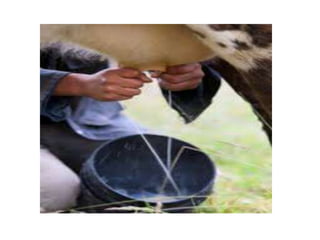
• During milking, the contamination of milk is by
the exterior of the udder and adjacent areas.
Bacteria found in the manure, soil and water
may enter from this source.
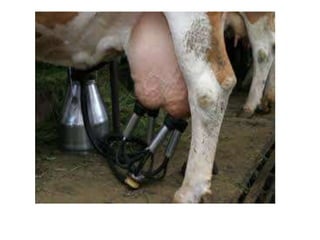
• Two most significant sources of contamination
are dairy utensils and milk-contact surface,
including the milk pail or milking machines.
• Undesirable bacteria from these sources
include lactic streptococci, coliform bacteria,
psychrotrophic gram-negative rods, and
thermodurics, those which survive
pasteurization, e.g., micrococci, enterococci,
bacilli, and brevibacteria.
• Other possible sources of contamination are
the hands and arms of the milker or dairy
workers, the air of the barn or milking parlor,
and flies.
• The number of bacteria per milliliter of milk
added from various sources depends on the
care taken to avoid contamination.
2)In Transit and at Manufacturing Level
• After milk is left in the farm, the possible
contamination include the tanker truck, transfer
pipes, sampling utensils, and the equipment at
the market-milk plant or other processing plant.
• Pipelines, vats, tanks pumps, valves, separators
are the possible sources of bacteria.
• The amount or level of contamination from each
of these sources depends on cleaning and
sanitizing methods.
• Hands and arms of the employees are a possible
source of contamination and pathogens.
PRESERVATION
• Asepsis
• Removal of microorganism
• Use of heat
• Use of low temperature
• Drying
• Use of preservatives
SPOILAGE
Milk and cream
• Milk is an excellent culture medium for many
kinds of microorganisms, being high in moisture,
nearly neutral pH, and rich in microbial foods.
• The genera found in cold-stored milk include,
Pseudomonas, Acinetobacter, Aerobacter
Alcaligens, and Flavobacterium as well as some
members of Enterobacteriaceae. With extended
storage of milk products at refrigerated
temperatures, psychrophilic or psychrotrophic
organisms are a cause of spoilage.
• Spoilage of milk usually is caused by
psychrotrophs that recontaminate the milk
after pasteurization. Also involved are
thermoduric psychrotrophs as well as heat-
stable proteases produced before
pasteurization.
Gas Production
• Gas formation with acid formation
• Chief gas former are coliform bacteria, Clostridium
spp., gas forming Bacillus species that yield both
hydrogen and carbondioxide, yeats and
heterofermentative lactics that produce only carbon
dioxide.
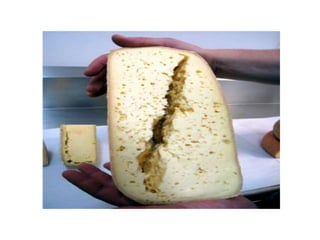
• Gas production evidenced by foam at the top of milk
and is supersaturated with the gas, by gas bubbles
caught in curd, by floating curd containing gas bubbles,
or by a ripping apart of the curd by rapid gas
production, causing the so called stromy fermentation
of milk.
• Coliform bacteria are responsible for most gas
formation.
• Heterofermentative lactis also may produce gas,
but usually not enough to be evident.
• Yeasts usually are absent or in low numbers in
milk and donot compete well with the bacteria.
• Bacillus and clostridium do not compete well with
acid former at higher temperature but may
function if the acid former are absent. Thus in
pasteurizing temperature or above, the spores of
Clostridium and Bacillus species will survive, and
gas formation by the sporeformers may take
place.
Proteolysis
• The hydrolysis of milk proteins by
microorganism usually is accompanied by the
production of bitter flavor caused by some of
the peptides released.
• Proteolysis is favored by storage at low
temperature, by destruction of lactics and
other acid formers by heat, and by the
destruction of formed acid in the milk by
molds and film yeasts or the neutralization of
acids by products of microorganisms.
• Actively proteolytic bacteria are found among
species of micrococcus, Alcaligens,
Pesudomonas, Proteus, Flavobacterium, and
Serratia, all of which are genera of non-spore-
forming bacteria and of genera Bacillus and
Clostridium of the sporeformers.
• Some species of the genera Micrococcus,
Pseudomonas, Proteus, Flavobacterium,
Alcaligens and Bacillus can grow at low
temperatures and hence are likely to cause
some proteolysis and/ or bitterness of milk
held at chilling temperature.
Ropiness
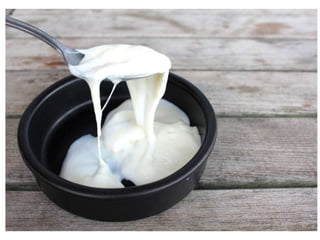
• Ropiness and sliminess can occur in milk,
cream.
• Bacterial ropiness is caused by slimy capsular
material from the cells and ordinarily develops
best at low temperature.
• The ropiness usually decreases as the acidity
of the milk or cream increases.
• Two main types of ropiness: Surface ropiness
and Ropiness throughout milk
• Surface ropiness is caused often by Alcaligens
viscolactis, an organism chiefly from water or soil
that can grow fairly well in the vicinity of 10 C.
Micrococcus freudenreichii can also cause
ropiness.
• Ropiness throughtout is caused often by
Enterobacter aerogens, Klebsiella oxytoca and
rarely Escherichia coli.
• Sources of the bacteria causing ropiness are
water, manure, utensils, and feed, the reduction
or elimination of contamination from these
sources helps prevent ropiness.
Changes in Milk fat
• Milk fat may be decomposed by various
bacteria, yeasts and molds.
A) Oxidation of the unsaturated fatty acids.
- yields aldehydes, ketones and acids and
results in tallow odors and tastes.
B) Hydrolysis of the butterfat to fatty acids and
glycerol by the enzyme lipase.
C) Combined oxidation and hydrolysis to
produce rancidity.
• Species of lipase forming bacteria are found in
many of the bacterial genera e.g.,
Pseudomonas, Proteus, Alcaligens, Bacillus,
Micrococcus, Clostridium and many others.
• Pseudomonas fragi and Staphylococcus aureus
produce fairly heat-resistant lipases which
may survive pasteurization if present in the
raw milk.
Alkali production
• Pseudomonas fluorescens and Alcaligenes
viscolactis.
• Production of ammonia from organic acids
and urea reults in alkali formation.
Flavor changes
• Sour or acid flavor:
Clean: produced by Streptococcus lactis and
other lactics.
Aromatic: By Streptococci and aroma forming
Leuconostoc species
Sharp: by coliform bacteria, Clostridium spp.,
Clean and aromatic flavours are desired in
fermented milk products, but sharp flavours are
undesirable.
• Bitter flavours : Results from proteolysis,
lipolysis or even fermentation of lactose.
Organisms: Coliform bacteria, yeasts,
actinomycetes
• Burnt flavour: Streptococcus lactis var.
maltigens produce this flavour.
Color changes
• Blue milk: Pseudomonas syncyanea when
grow with Streptococcus lactis
• Yellow milk: Pseudomonas synxantha and
species of Flavobacterium.
• Red milk: Serratia marcescens, Micrococcus
roseus
• Brown milk: Pseudomonas putrefaciens