1
A Concise Presentation
By
Mr. Deepak Sarangi M.Pharm
CONTENTS
INTRODUCTION
 PROPERTIES OF HEAVY METALS
 HEAVY METALS AND LIVING ORGANISMS
 HEAVY METALS EFFECTS ON PLANTS
 HEAVY METALS AND ENVIRONMENTAL POLLUTION
 HEAVY METALS EFFECT ON WATER AND
CONSEQUENCES
 OVERVIEW OF HEAVY METALS
 METHODS FOR MEASUREMENT OF TRACE METALS
 CONTROL METHODS
 TREATMENT OF HEAVY METALS
 CONCLUSION
 REFERENCES
2
INTRODUCTION
 Heavy metals are natural constituents of the earth’s crust ,
but indiscriminate human activities have drastically
altered their geochemical cycles and biochemicals
balance.
 Any toxic metals may be called heavy metals.
 Since heavy metals have a propensity to accumulate in
selective body organs.
 The average safety levels in food or water are often
misleading high.
3
DEFINITION
Heavy is any metal or metalloid of environmental
concern. The term originated with reference to the harmful
effects of arsenic, beryllium, cadmium, chromium, lead,
mercury, nickel and selenium are some of the metals
persists in nature and causes damage or death in animals,
humans and plants even at very low concentrations.
4
PROPERTIES OF HEAVY METALS
 They occur near the bottom of the periodic table.
 Have high densities.
 Toxic in nature.
 Nondegradable.
5
Note : Arsenic is not actually a metal but is a
semimetal i.e., its properties are intermediate
between those of metals and nonmetals.
HEAVY METALS AND LIVING ORGANISMS
 Living organisms require varying amounts of heavy metals.
Iron, copper, manganese and zinc are required by humans.
 All metals are toxic at higher concentrations and can cause
damaging to the organisms.
 For example plutonium, and lead are toxic metals that have no
known vital or beneficial effects and organisms.
 They accumulate and thus disturb function in vital organs and
glands of our body such as heart, brain, kidneys, bone, liver,
etc.
 They dislocate vital nutritional minerals from their original
place and thus hinder their biological function. There are many
ways by which these toxins can be introduced into the body
such as by consumption of different food products, exposure to
household products, personal products and varying numbers of
industrial products and chemicals.
6
7
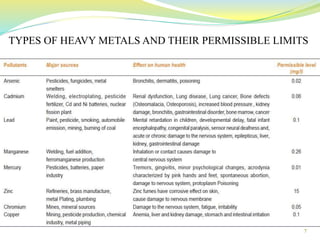
TYPES OF HEAVY METALS AND THEIR PERMISSIBLE LIMITS
HEAVY METALS EFFECTS ON PLANTS
 Plant experiences oxidative stress upon exposure to heavy
metals that leads to cellular damage and disturbance of
cellular ionic homeostasis .
 To minimize the detrimental effects of heavy metals
exposure and their accumulation plants have evolved
detoxification effect mainly based on chelation sub-
cellular compartmentalisation.
8
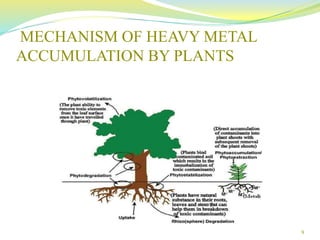
MECHANISM OF HEAVY METAL
ACCUMULATION BY PLANTS
9
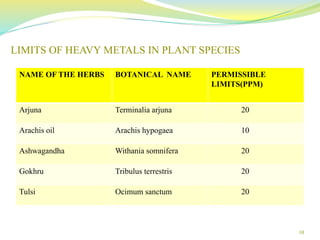
LIMITS OF HEAVY METALS IN PLANT SPECIES
10
NAME OF THE HERBS BOTANICAL NAME PERMISSIBLE
LIMITS(PPM)
Arjuna Terminalia arjuna 20
Arachis oil Arachis hypogaea 10
Ashwagandha Withania somnifera 20
Gokhru Tribulus terrestris 20
Tulsi Ocimum sanctum 20
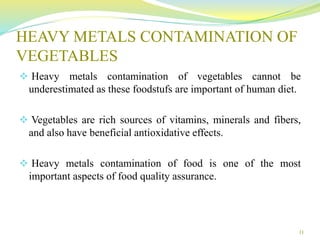
HEAVY METALS CONTAMINATION OF
VEGETABLES
 Heavy metals contamination of vegetables cannot be
underestimated as these foodstufs are important of human diet.
 Vegetables are rich sources of vitamins, minerals and fibers,
and also have beneficial antioxidative effects.
 Heavy metals contamination of food is one of the most
important aspects of food quality assurance.
11
HEAVY METALS AND
ENVIRONMENTAL POLLUTION
 Metal concentration in soil typically ranges from less than one
to as high as 100,000mg/kg.
 Heavy metals are the main group of inorganic contaminants
large area land contaminated with them due to use of
pesticides, fertilizers and emission from municipal waste
incinerates and smelting industries.
12
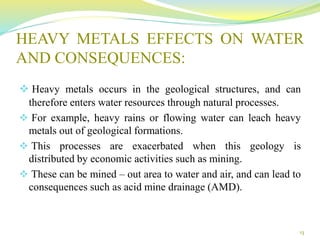
HEAVY METALS EFFECTS ON WATER
AND CONSEQUENCES:
 Heavy metals occurs in the geological structures, and can
therefore enters water resources through natural processes.
 For example, heavy rains or flowing water can leach heavy
metals out of geological formations.
 This processes are exacerbated when this geology is
distributed by economic activities such as mining.
 These can be mined – out area to water and air, and can lead to
consequences such as acid mine drainage (AMD).
13
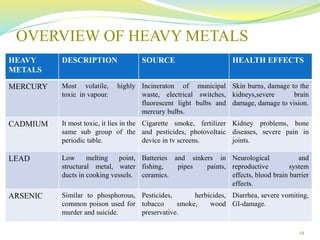
OVERVIEW OF HEAVY METALS
HEAVY
METALS
DESCRIPTION SOURCE HEALTH EFFECTS
MERCURY Most volatile, highly
toxic in vapour.
Incineraton of municipal
waste, electrical switches,
fluorescent light bulbs and
mercury bulbs.
Skin burns, damage to the
kidneys,severe brain
damage, damage to vision.
CADMIUM It most toxic, it lies in the
same sub group of the
periodic table.
Cigarette smoke, fertilizer
and pesticides, photovoltaic
device in tv screens.
Kidney problems, bone
diseases, severe pain in
joints.
LEAD Low melting point,
structural metal, water
ducts in cooking vessels.
Batteries and sinkers in
fishing, pipes paints,
ceramics.
Neurological and
reproductive system
effects, blood brain barrier
effects.
ARSENIC Similar to phosphorous,
common poison used for
murder and suicide.
Pesticides, herbicides,
tobacco smoke, wood
preservative.
Diarrhea, severe vomiting,
GI-damage.
14
GENERAL SOURCES OF HEAVY
METALS IN RESIDENTIAL HOUSES
 Infiltration from outside, along with the dust carried on
shoes and clothes.
 Indoor sources include old-lead and latex based paints ,
domestic water supply, burning of wood, and tobacco
smoke.
 Pesticides and fungicides are major sources of arsenic and
mercury indoors.
15
METHODS FOR MEASUREMENT OF
TRACE METALS
 Most common method of collecting particulate matter is
through filters.
 Identification and concentration of individual trace metals like
lead, cadmium, arsenic, mercury and chromium is determined
by
Atomic absorption spectrophotometry, is a destructive
method and requires atleast 1 to2ml of solution.
X-ray flourescence, is a nondestructive method and
works independent of the chemical state of the sample.
16
CONTROL METHODS
 Periodic vaccuming of the house can be effective in removal
of these pollutants.
 Replacement of wood-burning by an equivalent gas or
electrical appliance.
 Removal of old lead and mercury-based paints.
 The effective method for removal of mercury vapours is by the
use of packed bed of absorbents.
 Gold-coated denuder can also be used for the removal of
mercury from air.
17
18
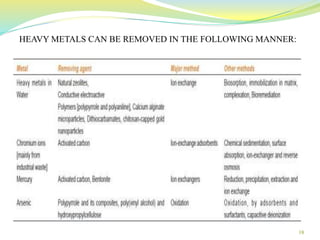
HEAVY METALS CAN BE REMOVED IN THE FOLLOWING MANNER:
TREATMENT OF HEAVY METALS
 The first step in treating any heavy metal toxicity is to
identify the toxic elements and begin the removal process.
 The easiest screening process is a Hair Analysis.
 Additional testing involves the use of chelating drugs
along with a 24-hrs urine collection to determine levels of
heavy metals.
 Treatment based on the involve the use of metal chelating
drugs on intravenous EDTA chelation.
19
CONCLUSION
 Heavy metals are toxic elements, highly effects to living
organisms. So to be taken in permissible limits.
 Heavy metals can be detected by hair analysis, urine
sample techniques.
 Consumption of heavy metals too much may leads to
toxicity so should be taken in limits.
20
21
THANKS for viewing the ppt
For more ppts
on pharma related topics plz contact
sarangi.dipu@gmail.com
Or find me at following link
www.facebook.com/sarangi.dipu

Heavymetals & living system ppt

  • 1.
    1 A Concise Presentation By Mr.Deepak Sarangi M.Pharm
  • 2.
    CONTENTS INTRODUCTION  PROPERTIES OFHEAVY METALS  HEAVY METALS AND LIVING ORGANISMS  HEAVY METALS EFFECTS ON PLANTS  HEAVY METALS AND ENVIRONMENTAL POLLUTION  HEAVY METALS EFFECT ON WATER AND CONSEQUENCES  OVERVIEW OF HEAVY METALS  METHODS FOR MEASUREMENT OF TRACE METALS  CONTROL METHODS  TREATMENT OF HEAVY METALS  CONCLUSION  REFERENCES 2
  • 3.
    INTRODUCTION  Heavy metalsare natural constituents of the earth’s crust , but indiscriminate human activities have drastically altered their geochemical cycles and biochemicals balance.  Any toxic metals may be called heavy metals.  Since heavy metals have a propensity to accumulate in selective body organs.  The average safety levels in food or water are often misleading high. 3
  • 4.
    DEFINITION Heavy is anymetal or metalloid of environmental concern. The term originated with reference to the harmful effects of arsenic, beryllium, cadmium, chromium, lead, mercury, nickel and selenium are some of the metals persists in nature and causes damage or death in animals, humans and plants even at very low concentrations. 4
  • 5.
    PROPERTIES OF HEAVYMETALS  They occur near the bottom of the periodic table.  Have high densities.  Toxic in nature.  Nondegradable. 5 Note : Arsenic is not actually a metal but is a semimetal i.e., its properties are intermediate between those of metals and nonmetals.
  • 6.
    HEAVY METALS ANDLIVING ORGANISMS  Living organisms require varying amounts of heavy metals. Iron, copper, manganese and zinc are required by humans.  All metals are toxic at higher concentrations and can cause damaging to the organisms.  For example plutonium, and lead are toxic metals that have no known vital or beneficial effects and organisms.  They accumulate and thus disturb function in vital organs and glands of our body such as heart, brain, kidneys, bone, liver, etc.  They dislocate vital nutritional minerals from their original place and thus hinder their biological function. There are many ways by which these toxins can be introduced into the body such as by consumption of different food products, exposure to household products, personal products and varying numbers of industrial products and chemicals. 6
  • 7.
    7 TYPES OF HEAVYMETALS AND THEIR PERMISSIBLE LIMITS
  • 8.
    HEAVY METALS EFFECTSON PLANTS  Plant experiences oxidative stress upon exposure to heavy metals that leads to cellular damage and disturbance of cellular ionic homeostasis .  To minimize the detrimental effects of heavy metals exposure and their accumulation plants have evolved detoxification effect mainly based on chelation sub- cellular compartmentalisation. 8
  • 9.
    MECHANISM OF HEAVYMETAL ACCUMULATION BY PLANTS 9
  • 10.
    LIMITS OF HEAVYMETALS IN PLANT SPECIES 10 NAME OF THE HERBS BOTANICAL NAME PERMISSIBLE LIMITS(PPM) Arjuna Terminalia arjuna 20 Arachis oil Arachis hypogaea 10 Ashwagandha Withania somnifera 20 Gokhru Tribulus terrestris 20 Tulsi Ocimum sanctum 20
  • 11.
    HEAVY METALS CONTAMINATIONOF VEGETABLES  Heavy metals contamination of vegetables cannot be underestimated as these foodstufs are important of human diet.  Vegetables are rich sources of vitamins, minerals and fibers, and also have beneficial antioxidative effects.  Heavy metals contamination of food is one of the most important aspects of food quality assurance. 11
  • 12.
    HEAVY METALS AND ENVIRONMENTALPOLLUTION  Metal concentration in soil typically ranges from less than one to as high as 100,000mg/kg.  Heavy metals are the main group of inorganic contaminants large area land contaminated with them due to use of pesticides, fertilizers and emission from municipal waste incinerates and smelting industries. 12
  • 13.
    HEAVY METALS EFFECTSON WATER AND CONSEQUENCES:  Heavy metals occurs in the geological structures, and can therefore enters water resources through natural processes.  For example, heavy rains or flowing water can leach heavy metals out of geological formations.  This processes are exacerbated when this geology is distributed by economic activities such as mining.  These can be mined – out area to water and air, and can lead to consequences such as acid mine drainage (AMD). 13
  • 14.
    OVERVIEW OF HEAVYMETALS HEAVY METALS DESCRIPTION SOURCE HEALTH EFFECTS MERCURY Most volatile, highly toxic in vapour. Incineraton of municipal waste, electrical switches, fluorescent light bulbs and mercury bulbs. Skin burns, damage to the kidneys,severe brain damage, damage to vision. CADMIUM It most toxic, it lies in the same sub group of the periodic table. Cigarette smoke, fertilizer and pesticides, photovoltaic device in tv screens. Kidney problems, bone diseases, severe pain in joints. LEAD Low melting point, structural metal, water ducts in cooking vessels. Batteries and sinkers in fishing, pipes paints, ceramics. Neurological and reproductive system effects, blood brain barrier effects. ARSENIC Similar to phosphorous, common poison used for murder and suicide. Pesticides, herbicides, tobacco smoke, wood preservative. Diarrhea, severe vomiting, GI-damage. 14
  • 15.
    GENERAL SOURCES OFHEAVY METALS IN RESIDENTIAL HOUSES  Infiltration from outside, along with the dust carried on shoes and clothes.  Indoor sources include old-lead and latex based paints , domestic water supply, burning of wood, and tobacco smoke.  Pesticides and fungicides are major sources of arsenic and mercury indoors. 15
  • 16.
    METHODS FOR MEASUREMENTOF TRACE METALS  Most common method of collecting particulate matter is through filters.  Identification and concentration of individual trace metals like lead, cadmium, arsenic, mercury and chromium is determined by Atomic absorption spectrophotometry, is a destructive method and requires atleast 1 to2ml of solution. X-ray flourescence, is a nondestructive method and works independent of the chemical state of the sample. 16
  • 17.
    CONTROL METHODS  Periodicvaccuming of the house can be effective in removal of these pollutants.  Replacement of wood-burning by an equivalent gas or electrical appliance.  Removal of old lead and mercury-based paints.  The effective method for removal of mercury vapours is by the use of packed bed of absorbents.  Gold-coated denuder can also be used for the removal of mercury from air. 17
  • 18.
    18 HEAVY METALS CANBE REMOVED IN THE FOLLOWING MANNER:
  • 19.
    TREATMENT OF HEAVYMETALS  The first step in treating any heavy metal toxicity is to identify the toxic elements and begin the removal process.  The easiest screening process is a Hair Analysis.  Additional testing involves the use of chelating drugs along with a 24-hrs urine collection to determine levels of heavy metals.  Treatment based on the involve the use of metal chelating drugs on intravenous EDTA chelation. 19
  • 20.
    CONCLUSION  Heavy metalsare toxic elements, highly effects to living organisms. So to be taken in permissible limits.  Heavy metals can be detected by hair analysis, urine sample techniques.  Consumption of heavy metals too much may leads to toxicity so should be taken in limits. 20
  • 21.
    21 THANKS for viewingthe ppt For more ppts on pharma related topics plz contact sarangi.dipu@gmail.com Or find me at following link www.facebook.com/sarangi.dipu