By
                                          Swetha .k
                                  (170212887009)
                              Under the guidance of
                                         Dr. Sneha

GRCP( DEPT OF PHARMACOLOGY)                      1
DEFINITION
The term nutraceutical was coined by Stephen
Defelice .
       “A NEUTRACEUTICAL is any substance that
is a food or a part of food and provides medical or
health benefits, including the prevention and
treatment of disease”.


         GRCP( DEPT OF PHARMACOLOGY)                  2
CLASSIFICATION
Neutraceuticals can be classified based on:
 Natural source
 Pharmacological conditions
 Chemical constitution


               GRCP( DEPT OF PHARMACOLOGY)    3
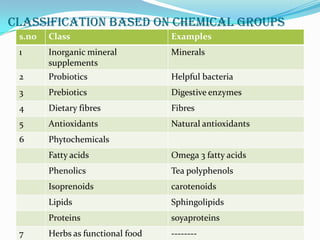
CLASSIFICATION BASED ON CHEMICAL GROUPS
 s.no   Class                      Examples
 1      Inorganic mineral          Minerals
        supplements
 2      Probiotics                 Helpful bacteria
 3      Prebiotics                 Digestive enzymes
 4      Dietary fibres             Fibres
 5      Antioxidants               Natural antioxidants
 6      Phytochemicals
        Fatty acids                Omega 3 fatty acids
        Phenolics                  Tea polyphenols
        Isoprenoids                carotenoids
        Lipids                     Sphingolipids
        Proteins                   soyaproteins
 7      Herbs as functional food   --------
INORGANIC MINERAL SUPPLEMENT
     Calcium
     Magnesium
     Manganese
     Boron
     Copper
     Zinc
     Phosphorus


      GRCP( DEPT OF PHARMACOLOGY)   5
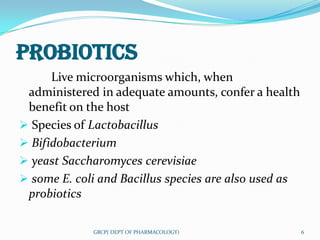
PROBIOTICS
      Live microorganisms which, when
 administered in adequate amounts, confer a health
 benefit on the host
 Species of Lactobacillus
 Bifidobacterium
 yeast Saccharomyces cerevisiae
 some E. coli and Bacillus species are also used as
 probiotics

             GRCP( DEPT OF PHARMACOLOGY)               6
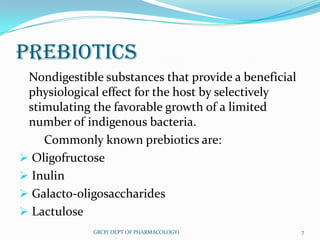
PREBIOTICS
 Nondigestible substances that provide a beneficial
 physiological effect for the host by selectively
 stimulating the favorable growth of a limited
 number of indigenous bacteria.
    Commonly known prebiotics are:
 Oligofructose
 Inulin
 Galacto-oligosaccharides
 Lactulose
             GRCP( DEPT OF PHARMACOLOGY)              7
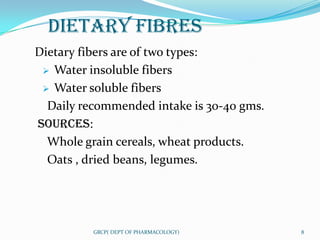
DIETARY FIBRES
Dietary fibers are of two types:
  Water insoluble fibers

  Water soluble fibers

  Daily recommended intake is 30-40 gms.
SOURCES:
  Whole grain cereals, wheat products.
  Oats , dried beans, legumes.


          GRCP( DEPT OF PHARMACOLOGY)      8
ANTIOXIDANTS
Antioxidants are of 3 categories:
     True antioxidants
     Reducing agents
    Antioxidant synergists
 Deficiency causes diseases like cancers,
 rheumatoid arthritis, alzheimers disease,
 cardiovascular diseases.


         GRCP( DEPT OF PHARMACOLOGY)         9
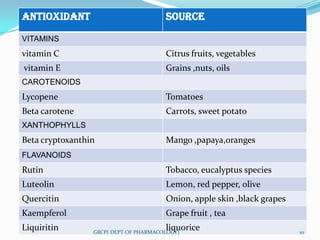
ANTIOXIDANT                            SOURCE

VITAMINS
vitamin C                              Citrus fruits, vegetables
vitamin E                              Grains ,nuts, oils
CAROTENOIDS
Lycopene                               Tomatoes
Beta carotene                          Carrots, sweet potato
XANTHOPHYLLS
Beta cryptoxanthin                     Mango ,papaya,oranges
FLAVANOIDS
Rutin                                  Tobacco, eucalyptus species
Luteolin                               Lemon, red pepper, olive
Quercitin                              Onion, apple skin ,black grapes
Kaempferol                             Grape fruit , tea
Liquiritin                             liquorice
                 GRCP( DEPT OF PHARMACOLOGY)                             10
HERBS AS FUNCTIONAL FOODS
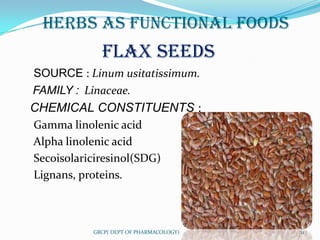
             FLAX SEEDS
SOURCE : Linum usitatissimum.
FAMILY : Linaceae.
CHEMICAL CONSTITUENTS :
Gamma linolenic acid
Alpha linolenic acid
Secoisolariciresinol(SDG)
Lignans, proteins.


           GRCP( DEPT OF PHARMACOLOGY)   11
FLAX SEEDS
USES :
     Prevents mammary, colon and
      rectal cancers.
     Reduces BP in hypertensive patients.
     Reduces diabetes and coronary
      heart diseases.


             GRCP( DEPT OF PHARMACOLOGY)     12
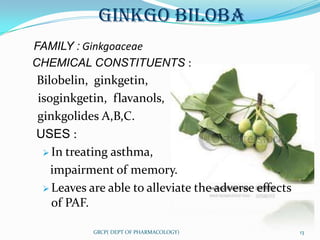
GINKGO BILOBA
FAMILY : Ginkgoaceae
CHEMICAL CONSTITUENTS :
Bilobelin, ginkgetin,
isoginkgetin, flavanols,
ginkgolides A,B,C.
USES :
  In treating asthma,

   impairment of memory.
  Leaves are able to alleviate the adverse effects
   of PAF.

           GRCP( DEPT OF PHARMACOLOGY)                13
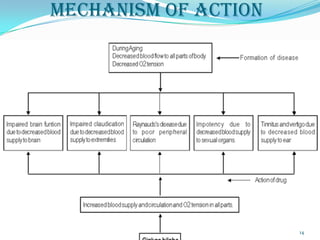
MECHANISM OF ACTION


                      14
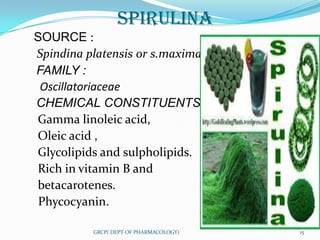
SPIRULINA
SOURCE :
Spindina platensis or s.maxima
FAMILY :
 Oscillatoriaceae
CHEMICAL CONSTITUENTS
Gamma linoleic acid,
Oleic acid ,
Glycolipids and sulpholipids.
Rich in vitamin B and
betacarotenes.
 Phycocyanin.

          GRCP( DEPT OF PHARMACOLOGY)   15
SPIRULINA
USES :
 Immunostimulant activity.
 Management of HIV and other viral
 infections such as herpes,
 cytomegalovirus, influenza, mumps
 To treat arthritis, atherosclerosis, diabetes and
  aging process


          GRCP( DEPT OF PHARMACOLOGY)                 16
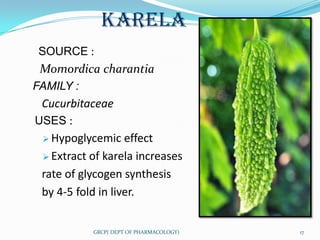
KARELA
SOURCE :
 Momordica charantia
FAMILY :
 Cucurbitaceae
USES :
  Hypoglycemic    effect
  Extract of karela increases

 rate of glycogen synthesis
 by 4-5 fold in liver.


           GRCP( DEPT OF PHARMACOLOGY)   17
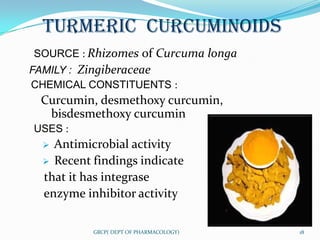
TURMERIC CURCUMINOIDS
SOURCE : Rhizomes of Curcuma longa
FAMILY : Zingiberaceae
CHEMICAL CONSTITUENTS :
 Curcumin, desmethoxy curcumin,
  bisdesmethoxy curcumin
USES :
   Antimicrobial activity
   Recent findings indicate
  that it has integrase
  enzyme inhibitor activity

           GRCP( DEPT OF PHARMACOLOGY)   18
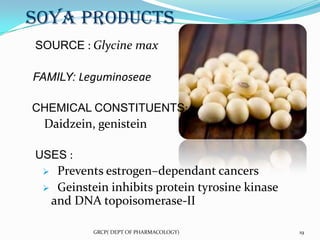
SOYA PRODUCTS
SOURCE : Glycine max

FAMILY: Leguminoseae

CHEMICAL CONSTITUENTS:
 Daidzein, genistein

USES :
  Prevents estrogen–dependant cancers
  Geinstein inhibits protein tyrosine kinase
  and DNA topoisomerase-II

          GRCP( DEPT OF PHARMACOLOGY)           19
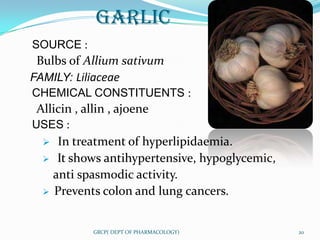
GARLIC
SOURCE :
 Bulbs of Allium sativum
FAMILY: Liliaceae
CHEMICAL CONSTITUENTS :
 Allicin , allin , ajoene
USES :
    In treatment of hyperlipidaemia.
   It shows antihypertensive, hypoglycemic,
    anti spasmodic activity.
   Prevents colon and lung cancers.


             GRCP( DEPT OF PHARMACOLOGY)       20
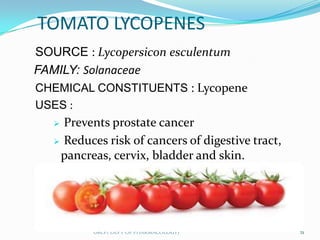
TOMATO LYCOPENES
SOURCE : Lycopersicon esculentum
FAMILY: Solanaceae
CHEMICAL CONSTITUENTS : Lycopene
USES :
   Prevents prostate cancer
   Reduces risk of cancers of digestive tract,
   pancreas, cervix, bladder and skin.


         GRCP( DEPT OF PHARMACOLOGY)              21
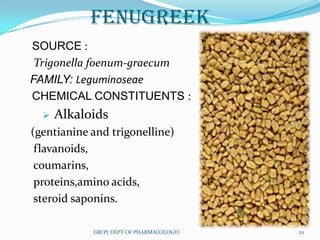
FENUGREEK
SOURCE :
 Trigonella foenum-graecum
FAMILY: Leguminoseae
CHEMICAL CONSTITUENTS :
     Alkaloids
(gentianine and trigonelline)
 flavanoids,
 coumarins,
 proteins,amino acids,
 steroid saponins.

            GRCP( DEPT OF PHARMACOLOGY)   22
FENUGREEK

USES :
   In treatment of anorexia,

     gastritis.
   Fenugreek possess
    laxative, expectorant, demulcent
    properties.
   Shows hypoglycemic and
    hypocholesterolemic properties
           GRCP( DEPT OF PHARMACOLOGY)   23
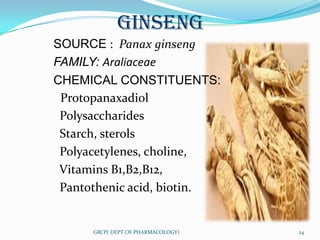
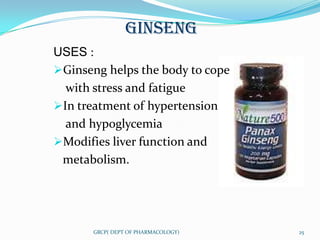
GINSENG
SOURCE : Panax ginseng
FAMILY: Araliaceae
CHEMICAL CONSTITUENTS:
 Protopanaxadiol
 Polysaccharides
 Starch, sterols
 Polyacetylenes, choline,
 Vitamins B1,B2,B12,
 Pantothenic acid, biotin.


      GRCP( DEPT OF PHARMACOLOGY)   24
GINSENG
USES :
Ginseng helps the body to cope
  with stress and fatigue
In treatment of hypertension
  and hypoglycemia
Modifies liver function and
 metabolism.


       GRCP( DEPT OF PHARMACOLOGY)   25
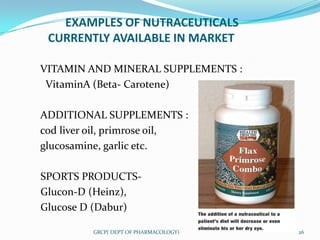
EXAMPLES OF NUTRACEUTICALS
 CURRENTLY AVAILABLE IN MARKET

VITAMIN AND MINERAL SUPPLEMENTS :
 VitaminA (Beta- Carotene)

ADDITIONAL SUPPLEMENTS :
cod liver oil, primrose oil,
glucosamine, garlic etc.

SPORTS PRODUCTS-
Glucon-D (Heinz),
Glucose D (Dabur)

          GRCP( DEPT OF PHARMACOLOGY)   26
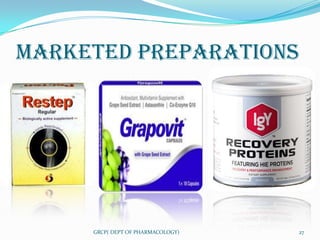
MARKETED PREPARATIONS


     GRCP( DEPT OF PHARMACOLOGY)   27
REFERENCES
 Text book of pharmacognosy and phytochemistry by Biren shah and
   A.K.Seth, pg.no-471-479.
 Probiotics: Applications in Gastrointestinal Health & Disease Presented
   in conjunction with the American College of Gastroenterology’s 72nd
   Annual Scientific Meeting, Autumn 2007)
 http://www.fao.org/ag/agn/agns/micro_probiotics_en.asp
 De Felice L Stephen. The nutraceutical revolution, its
   impact on food industry. Trends in Food Sci. and Tech
  1995; 6:59-61.
 Jack DB. Keep taking the tomatoes - the exciting world of
  nutraceuticals. Mol Med Today 1995; 1(3):118-21.
 Brower B. Nutraceuticals: poised for a healthy slice of the
  market. Nat Biotechnology 1998; 16: 728-33.
  Mannion M. Nutraceutical revolution continues at
  foundation for innovation in medicine conference. Am J
  Nat Med 1998; 5:30-3.


           GRCP( DEPT OF PHARMACOLOGY)                                28
GRCP( DEPT OF PHARMACOLOGY)   29

Nutraceuticals

  • 1.
    By Swetha .k (170212887009) Under the guidance of Dr. Sneha GRCP( DEPT OF PHARMACOLOGY) 1
  • 2.
    DEFINITION The term nutraceuticalwas coined by Stephen Defelice . “A NEUTRACEUTICAL is any substance that is a food or a part of food and provides medical or health benefits, including the prevention and treatment of disease”. GRCP( DEPT OF PHARMACOLOGY) 2
  • 3.
    CLASSIFICATION Neutraceuticals can beclassified based on:  Natural source  Pharmacological conditions  Chemical constitution GRCP( DEPT OF PHARMACOLOGY) 3
  • 4.
    CLASSIFICATION BASED ONCHEMICAL GROUPS s.no Class Examples 1 Inorganic mineral Minerals supplements 2 Probiotics Helpful bacteria 3 Prebiotics Digestive enzymes 4 Dietary fibres Fibres 5 Antioxidants Natural antioxidants 6 Phytochemicals Fatty acids Omega 3 fatty acids Phenolics Tea polyphenols Isoprenoids carotenoids Lipids Sphingolipids Proteins soyaproteins 7 Herbs as functional food --------
  • 5.
    INORGANIC MINERAL SUPPLEMENT Calcium Magnesium Manganese Boron Copper Zinc Phosphorus GRCP( DEPT OF PHARMACOLOGY) 5
  • 6.
    PROBIOTICS Live microorganisms which, when administered in adequate amounts, confer a health benefit on the host  Species of Lactobacillus  Bifidobacterium  yeast Saccharomyces cerevisiae  some E. coli and Bacillus species are also used as probiotics GRCP( DEPT OF PHARMACOLOGY) 6
  • 7.
    PREBIOTICS Nondigestible substancesthat provide a beneficial physiological effect for the host by selectively stimulating the favorable growth of a limited number of indigenous bacteria. Commonly known prebiotics are:  Oligofructose  Inulin  Galacto-oligosaccharides  Lactulose GRCP( DEPT OF PHARMACOLOGY) 7
  • 8.
    DIETARY FIBRES Dietary fibersare of two types:  Water insoluble fibers  Water soluble fibers Daily recommended intake is 30-40 gms. SOURCES: Whole grain cereals, wheat products. Oats , dried beans, legumes. GRCP( DEPT OF PHARMACOLOGY) 8
  • 9.
    ANTIOXIDANTS Antioxidants are of3 categories: True antioxidants Reducing agents Antioxidant synergists Deficiency causes diseases like cancers, rheumatoid arthritis, alzheimers disease, cardiovascular diseases. GRCP( DEPT OF PHARMACOLOGY) 9
  • 10.
    ANTIOXIDANT SOURCE VITAMINS vitamin C Citrus fruits, vegetables vitamin E Grains ,nuts, oils CAROTENOIDS Lycopene Tomatoes Beta carotene Carrots, sweet potato XANTHOPHYLLS Beta cryptoxanthin Mango ,papaya,oranges FLAVANOIDS Rutin Tobacco, eucalyptus species Luteolin Lemon, red pepper, olive Quercitin Onion, apple skin ,black grapes Kaempferol Grape fruit , tea Liquiritin liquorice GRCP( DEPT OF PHARMACOLOGY) 10
  • 11.
    HERBS AS FUNCTIONALFOODS FLAX SEEDS SOURCE : Linum usitatissimum. FAMILY : Linaceae. CHEMICAL CONSTITUENTS : Gamma linolenic acid Alpha linolenic acid Secoisolariciresinol(SDG) Lignans, proteins. GRCP( DEPT OF PHARMACOLOGY) 11
  • 12.
    FLAX SEEDS USES :  Prevents mammary, colon and rectal cancers.  Reduces BP in hypertensive patients.  Reduces diabetes and coronary heart diseases. GRCP( DEPT OF PHARMACOLOGY) 12
  • 13.
    GINKGO BILOBA FAMILY :Ginkgoaceae CHEMICAL CONSTITUENTS : Bilobelin, ginkgetin, isoginkgetin, flavanols, ginkgolides A,B,C. USES :  In treating asthma, impairment of memory.  Leaves are able to alleviate the adverse effects of PAF. GRCP( DEPT OF PHARMACOLOGY) 13
  • 14.
  • 15.
    SPIRULINA SOURCE : Spindina platensisor s.maxima FAMILY : Oscillatoriaceae CHEMICAL CONSTITUENTS Gamma linoleic acid, Oleic acid , Glycolipids and sulpholipids. Rich in vitamin B and betacarotenes. Phycocyanin. GRCP( DEPT OF PHARMACOLOGY) 15
  • 16.
    SPIRULINA USES :  Immunostimulantactivity.  Management of HIV and other viral infections such as herpes, cytomegalovirus, influenza, mumps  To treat arthritis, atherosclerosis, diabetes and aging process GRCP( DEPT OF PHARMACOLOGY) 16
  • 17.
    KARELA SOURCE : Momordicacharantia FAMILY : Cucurbitaceae USES :  Hypoglycemic effect  Extract of karela increases rate of glycogen synthesis by 4-5 fold in liver. GRCP( DEPT OF PHARMACOLOGY) 17
  • 18.
    TURMERIC CURCUMINOIDS SOURCE :Rhizomes of Curcuma longa FAMILY : Zingiberaceae CHEMICAL CONSTITUENTS : Curcumin, desmethoxy curcumin, bisdesmethoxy curcumin USES :  Antimicrobial activity  Recent findings indicate that it has integrase enzyme inhibitor activity GRCP( DEPT OF PHARMACOLOGY) 18
  • 19.
    SOYA PRODUCTS SOURCE :Glycine max FAMILY: Leguminoseae CHEMICAL CONSTITUENTS: Daidzein, genistein USES :  Prevents estrogen–dependant cancers  Geinstein inhibits protein tyrosine kinase and DNA topoisomerase-II GRCP( DEPT OF PHARMACOLOGY) 19
  • 20.
    GARLIC SOURCE : Bulbsof Allium sativum FAMILY: Liliaceae CHEMICAL CONSTITUENTS : Allicin , allin , ajoene USES :  In treatment of hyperlipidaemia.  It shows antihypertensive, hypoglycemic, anti spasmodic activity.  Prevents colon and lung cancers. GRCP( DEPT OF PHARMACOLOGY) 20
  • 21.
    TOMATO LYCOPENES SOURCE :Lycopersicon esculentum FAMILY: Solanaceae CHEMICAL CONSTITUENTS : Lycopene USES :  Prevents prostate cancer  Reduces risk of cancers of digestive tract, pancreas, cervix, bladder and skin. GRCP( DEPT OF PHARMACOLOGY) 21
  • 22.
    FENUGREEK SOURCE : Trigonellafoenum-graecum FAMILY: Leguminoseae CHEMICAL CONSTITUENTS :  Alkaloids (gentianine and trigonelline) flavanoids, coumarins, proteins,amino acids, steroid saponins. GRCP( DEPT OF PHARMACOLOGY) 22
  • 23.
    FENUGREEK USES :  In treatment of anorexia, gastritis.  Fenugreek possess laxative, expectorant, demulcent properties.  Shows hypoglycemic and hypocholesterolemic properties GRCP( DEPT OF PHARMACOLOGY) 23
  • 24.
    GINSENG SOURCE : Panaxginseng FAMILY: Araliaceae CHEMICAL CONSTITUENTS: Protopanaxadiol Polysaccharides Starch, sterols Polyacetylenes, choline, Vitamins B1,B2,B12, Pantothenic acid, biotin. GRCP( DEPT OF PHARMACOLOGY) 24
  • 25.
    GINSENG USES : Ginseng helpsthe body to cope with stress and fatigue In treatment of hypertension and hypoglycemia Modifies liver function and metabolism. GRCP( DEPT OF PHARMACOLOGY) 25
  • 26.
    EXAMPLES OF NUTRACEUTICALS CURRENTLY AVAILABLE IN MARKET VITAMIN AND MINERAL SUPPLEMENTS : VitaminA (Beta- Carotene) ADDITIONAL SUPPLEMENTS : cod liver oil, primrose oil, glucosamine, garlic etc. SPORTS PRODUCTS- Glucon-D (Heinz), Glucose D (Dabur) GRCP( DEPT OF PHARMACOLOGY) 26
  • 27.
    MARKETED PREPARATIONS GRCP( DEPT OF PHARMACOLOGY) 27
  • 28.
    REFERENCES  Text bookof pharmacognosy and phytochemistry by Biren shah and A.K.Seth, pg.no-471-479.  Probiotics: Applications in Gastrointestinal Health & Disease Presented in conjunction with the American College of Gastroenterology’s 72nd Annual Scientific Meeting, Autumn 2007)  http://www.fao.org/ag/agn/agns/micro_probiotics_en.asp  De Felice L Stephen. The nutraceutical revolution, its impact on food industry. Trends in Food Sci. and Tech 1995; 6:59-61.  Jack DB. Keep taking the tomatoes - the exciting world of nutraceuticals. Mol Med Today 1995; 1(3):118-21.  Brower B. Nutraceuticals: poised for a healthy slice of the market. Nat Biotechnology 1998; 16: 728-33. Mannion M. Nutraceutical revolution continues at foundation for innovation in medicine conference. Am J Nat Med 1998; 5:30-3. GRCP( DEPT OF PHARMACOLOGY) 28
  • 29.
    GRCP( DEPT OFPHARMACOLOGY) 29