Contents
• Introduction
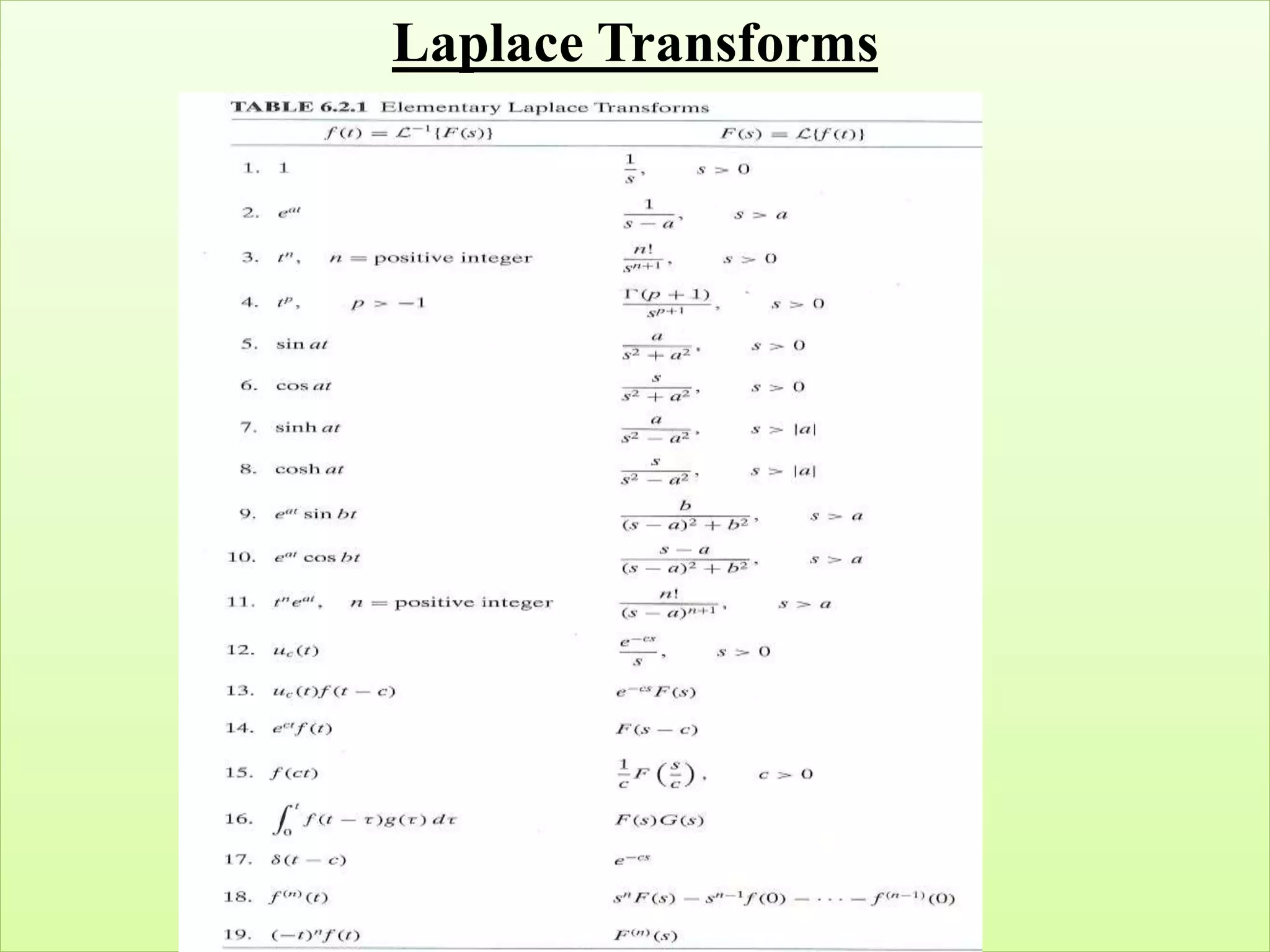
• Laplace Transform Theory
• Application
The French Newton
Pierre-Simon Laplace
• Developed mathematics in
astronomy, physics, and statistics.
• Began work in calculus which led
to the Laplace Transform.
• Focused later on celestial mechanics.
• One of the first scientists to suggest
the existence of black holes.
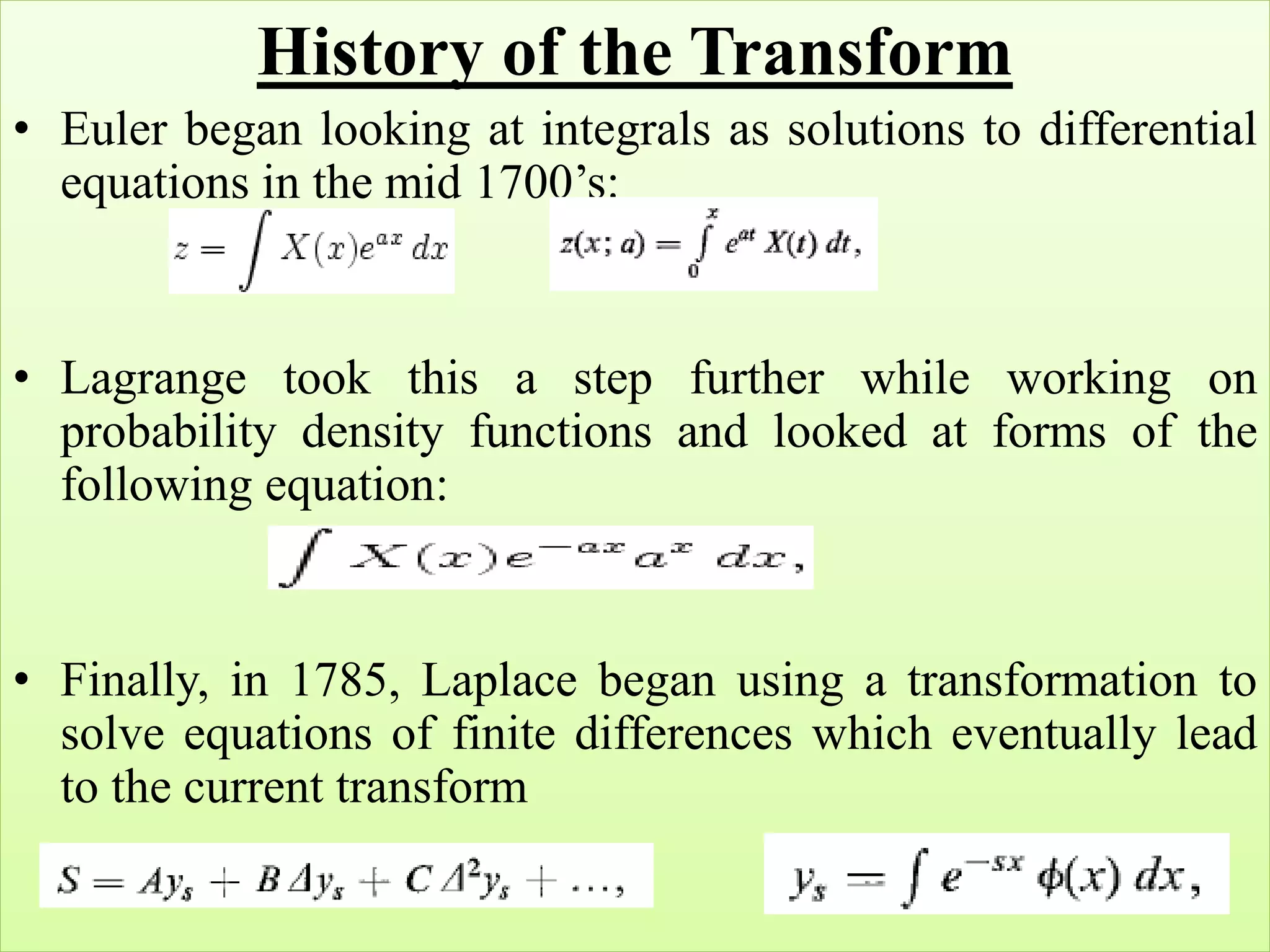
History of the Transform
• Euler began looking at integrals as solutions to differential
equations in the mid 1700’s:
• Lagrange took this a step further while working on
probability density functions and looked at forms of the
following equation:
• Finally, in 1785, Laplace began using a transformation to
solve equations of finite differences which eventually lead
to the current transform
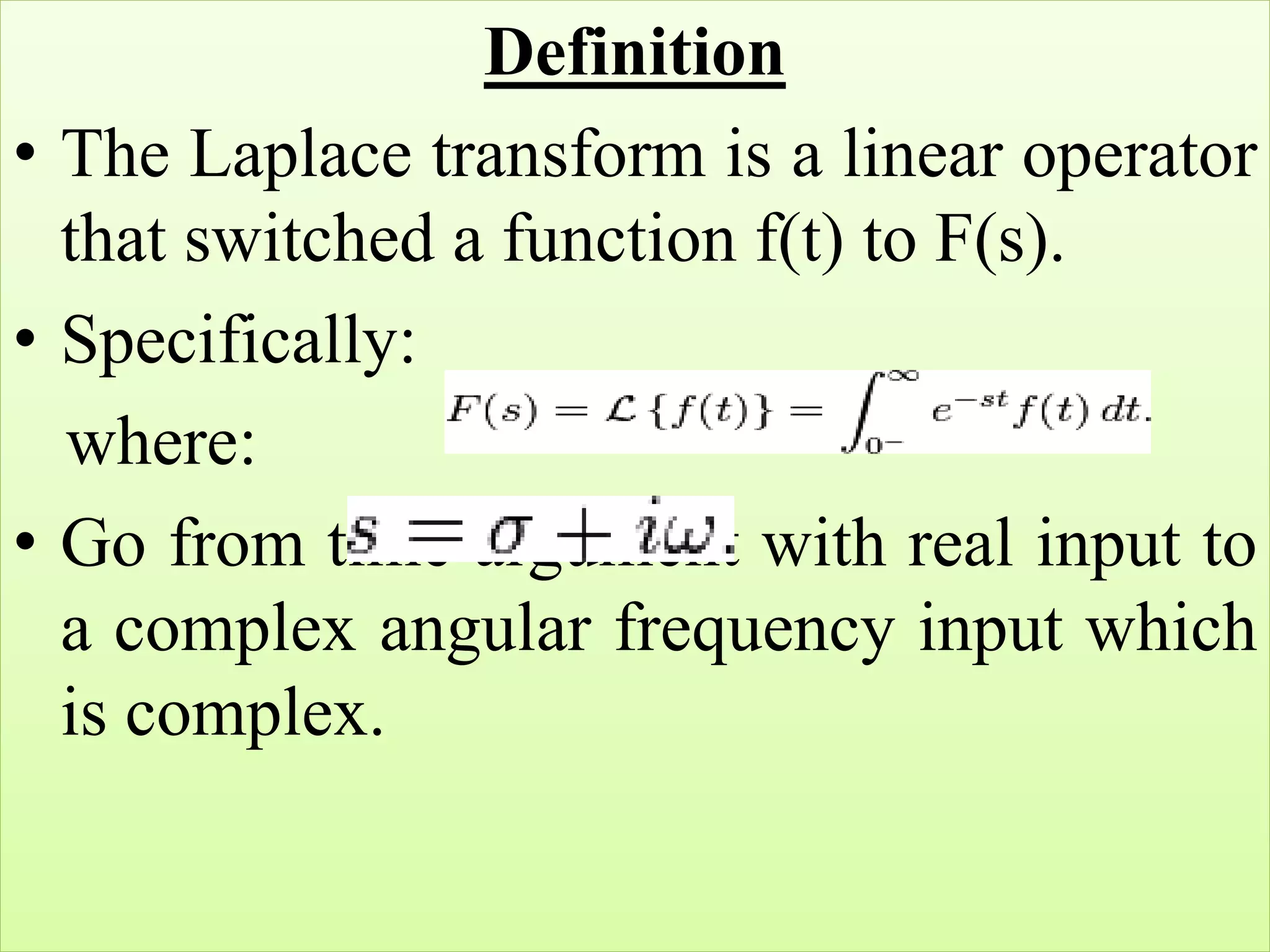
Definition
• The Laplace transform is a linear operator
that switched a function f(t) to F(s).
• Specifically:
where:
• Go from time argument with real input to
a complex angular frequency input which
is complex.
Continuity
• Since the general form of the Laplace
transform is:
it makes sense that f(t) must be at least
piecewise continuous for t ≥ 0.
• If f(t) were very nasty, the integral would
not be computable.
Laplace Transform Theory
Laplace Transforms
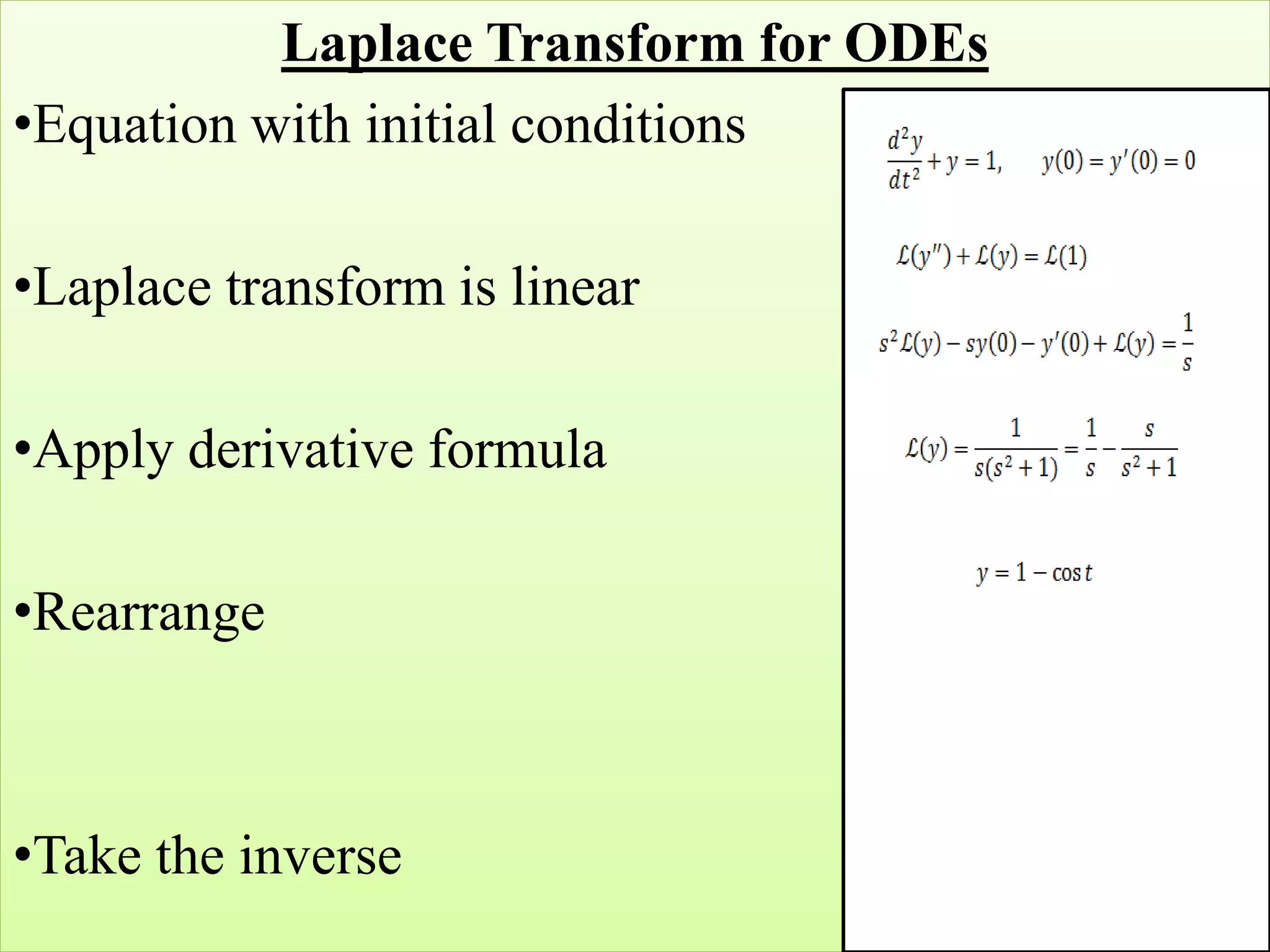
Laplace Transform for ODEs
•Equation with initial conditions
•Laplace transform is linear
•Apply derivative formula
•Rearrange
•Take the inverse
Real-Life Applications
Semiconductor mobility
Call completion in wireless networks
Vehicle vibrations on compressed rails
Behavior of magnetic and electric fields above the atmosphere
Laplace Transform

Laplace Transform

  • 2.
    Contents • Introduction • LaplaceTransform Theory • Application
  • 3.
    The French Newton Pierre-SimonLaplace • Developed mathematics in astronomy, physics, and statistics. • Began work in calculus which led to the Laplace Transform. • Focused later on celestial mechanics. • One of the first scientists to suggest the existence of black holes.
  • 4.
    History of theTransform • Euler began looking at integrals as solutions to differential equations in the mid 1700’s: • Lagrange took this a step further while working on probability density functions and looked at forms of the following equation: • Finally, in 1785, Laplace began using a transformation to solve equations of finite differences which eventually lead to the current transform
  • 5.
    Definition • The Laplacetransform is a linear operator that switched a function f(t) to F(s). • Specifically: where: • Go from time argument with real input to a complex angular frequency input which is complex.
  • 6.
    Continuity • Since thegeneral form of the Laplace transform is: it makes sense that f(t) must be at least piecewise continuous for t ≥ 0. • If f(t) were very nasty, the integral would not be computable.
  • 7.
  • 8.
  • 9.
    Laplace Transform forODEs •Equation with initial conditions •Laplace transform is linear •Apply derivative formula •Rearrange •Take the inverse
  • 10.
    Real-Life Applications Semiconductor mobility Callcompletion in wireless networks Vehicle vibrations on compressed rails Behavior of magnetic and electric fields above the atmosphere