﷽
National College of Business
Administration & Economics
Group Members
• Muhammad Ahsan
• M Shahid Zafar
• Wamiq Ali
• M Sarmad Shuja
• Zain Abid
Laplace
Transform
Multi Variable
Calculus
History
• Invented
• Discovered
• Laplace mean
Invented
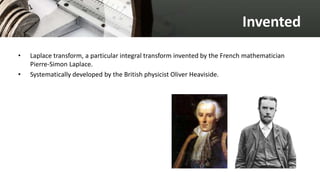
• Laplace transform, a particular integral transform invented by the French mathematician
Pierre-Simon Laplace.
• Systematically developed by the British physicist Oliver Heaviside.
Discovered
• Pierre-Simon Laplace was a prominent French mathematical physicist and
astronomer of the 19th century, who made crucial contributions in the
arena of planetary motion by applying Sir Isaac Newton's theory of
gravitation to the entire solar system.
Laplace Mean
• The Laplace transform is an integral transform named after its inventor
Pierre-Simon Laplace (/ləˈplɑːs/). It transforms a function of a real variable
t (often time) to a function of a complex variable s (complex frequency).
Definition
• The conversion in mathematics, It transforms a function of a real
number t (often time) to a function of a complex variable
s(complex frequency).
• In other word the conversion of time to complex frequency is
called Laplace transform. The Laplace has many applications in
science and engineering.
Types
• Unilateral Transform
• Bilateral Transform
• Inverse Transform
Unilateral Transform
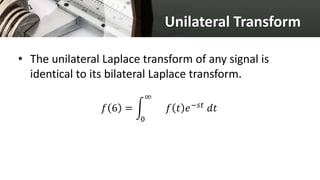
• The unilateral Laplace transform of any signal is
identical to its bilateral Laplace transform.
𝑓 6 =
0
∞
𝑓 𝑡 𝑒−𝑠𝑡 𝑑𝑡
Bilateral transform
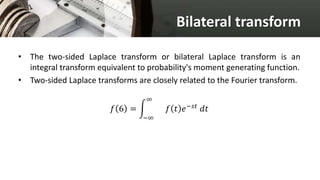
• The two-sided Laplace transform or bilateral Laplace transform is an
integral transform equivalent to probability's moment generating function.
• Two-sided Laplace transforms are closely related to the Fourier transform.
𝑓 6 =
−∞
∞
𝑓 𝑡 𝑒−𝑠𝑡 𝑑𝑡
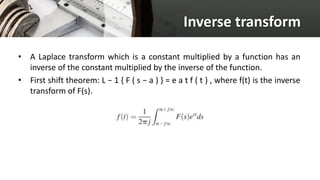
Inverse transform
• A Laplace transform which is a constant multiplied by a function has an
inverse of the constant multiplied by the inverse of the function.
• First shift theorem: L − 1 { F ( s − a ) } = e a t f ( t ) , where f(t) is the inverse
transform of F(s).
Examples
1) Find Laplace transform of f(t),
Where,
f(t) = 3, 0 < t <5
f(t) = 0, t > 5
By definition Laplace transform
Examples
2) F(t) = t, for 0 < t < 4 and f(t) = 5 for t > 4
By definition of Laplace transform
Examples
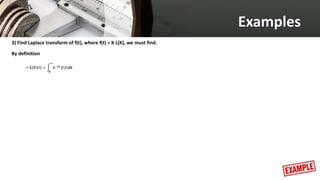
3) Find Laplace transform of f(t), where f(t) = K L(K), we must find.
By definition
= 𝐋{𝐟 𝒕 } =
𝟎
∞
𝒆−𝒔𝒕 𝒇(𝒕)𝒅𝒕
Uses
• Why does we use?
• Where are Laplace transforms used?
Why does we use?
• The Laplace Transform is a
generalized Fourier Transform, since
it allows one to obtain transforms of
functions that have no Fourier
Transforms.
Where are Laplace transforms used?
The Laplace transform can also be used to solve differential equations and is
used extensively in electrical engineering.
1) Basically, a Laplace transform will convert a function in some domain
into a function in another domain without the changing the values of the
function.
2) Since equations having polynomials are easier to solve, we employ
Laplace transform to make calculation easier.
Importance of Laplace Transforms
• In electrical circuits, a Laplace transform is
used for the analysis of linear time-
invariant systems.
• Laplace transform is widely used by
Electronics engineers to quickly solve
differential equations occurring in the
analysis of electronic circuits.
Advantages
• Laplace transforms methods offer the following
advantages over the classical methods.
• Initial conditions are automatically considered in the
transformed equations.
• Much less time is involved in solving differential
equations.
• It gives systematic and routine solutions for differential
equations.
Disadvantages
• Unsuitability for data processing in random
vibrations.
• Analysis of discontinuous inputs.
• Inability to exist for few Probability Distribution
Functions
Thank You 

Laplace Transform || Multi Variable Calculus

  • 1.
  • 2.
    National College ofBusiness Administration & Economics
  • 3.
    Group Members • MuhammadAhsan • M Shahid Zafar • Wamiq Ali • M Sarmad Shuja • Zain Abid
  • 4.
  • 5.
  • 6.
    Invented • Laplace transform,a particular integral transform invented by the French mathematician Pierre-Simon Laplace. • Systematically developed by the British physicist Oliver Heaviside.
  • 7.
    Discovered • Pierre-Simon Laplacewas a prominent French mathematical physicist and astronomer of the 19th century, who made crucial contributions in the arena of planetary motion by applying Sir Isaac Newton's theory of gravitation to the entire solar system.
  • 8.
    Laplace Mean • TheLaplace transform is an integral transform named after its inventor Pierre-Simon Laplace (/ləˈplɑːs/). It transforms a function of a real variable t (often time) to a function of a complex variable s (complex frequency).
  • 9.
    Definition • The conversionin mathematics, It transforms a function of a real number t (often time) to a function of a complex variable s(complex frequency). • In other word the conversion of time to complex frequency is called Laplace transform. The Laplace has many applications in science and engineering.
  • 10.
    Types • Unilateral Transform •Bilateral Transform • Inverse Transform
  • 11.
    Unilateral Transform • Theunilateral Laplace transform of any signal is identical to its bilateral Laplace transform. 𝑓 6 = 0 ∞ 𝑓 𝑡 𝑒−𝑠𝑡 𝑑𝑡
  • 12.
    Bilateral transform • Thetwo-sided Laplace transform or bilateral Laplace transform is an integral transform equivalent to probability's moment generating function. • Two-sided Laplace transforms are closely related to the Fourier transform. 𝑓 6 = −∞ ∞ 𝑓 𝑡 𝑒−𝑠𝑡 𝑑𝑡
  • 13.
    Inverse transform • ALaplace transform which is a constant multiplied by a function has an inverse of the constant multiplied by the inverse of the function. • First shift theorem: L − 1 { F ( s − a ) } = e a t f ( t ) , where f(t) is the inverse transform of F(s).
  • 14.
    Examples 1) Find Laplacetransform of f(t), Where, f(t) = 3, 0 < t <5 f(t) = 0, t > 5 By definition Laplace transform
  • 15.
    Examples 2) F(t) =t, for 0 < t < 4 and f(t) = 5 for t > 4 By definition of Laplace transform
  • 16.
    Examples 3) Find Laplacetransform of f(t), where f(t) = K L(K), we must find. By definition = 𝐋{𝐟 𝒕 } = 𝟎 ∞ 𝒆−𝒔𝒕 𝒇(𝒕)𝒅𝒕
  • 17.
    Uses • Why doeswe use? • Where are Laplace transforms used?
  • 18.
    Why does weuse? • The Laplace Transform is a generalized Fourier Transform, since it allows one to obtain transforms of functions that have no Fourier Transforms.
  • 19.
    Where are Laplacetransforms used? The Laplace transform can also be used to solve differential equations and is used extensively in electrical engineering. 1) Basically, a Laplace transform will convert a function in some domain into a function in another domain without the changing the values of the function. 2) Since equations having polynomials are easier to solve, we employ Laplace transform to make calculation easier.
  • 20.
    Importance of LaplaceTransforms • In electrical circuits, a Laplace transform is used for the analysis of linear time- invariant systems. • Laplace transform is widely used by Electronics engineers to quickly solve differential equations occurring in the analysis of electronic circuits.
  • 21.
    Advantages • Laplace transformsmethods offer the following advantages over the classical methods. • Initial conditions are automatically considered in the transformed equations. • Much less time is involved in solving differential equations. • It gives systematic and routine solutions for differential equations.
  • 22.
    Disadvantages • Unsuitability fordata processing in random vibrations. • Analysis of discontinuous inputs. • Inability to exist for few Probability Distribution Functions
  • 23.