Principles of pre-analytic and
      post-analytic test
        management
       Dr Varsha Shahane
Objectives
• To familiarize with selection , assessment and
  incorporation of diagnostic tests
• To review principles of test evaluation and utilisation and
  their effect on patient outcomes
• To describe major elements of requisition and test menu
  formats
• To review principles of formatting of reports of test
  results
• To review needs for record storage
Introduction
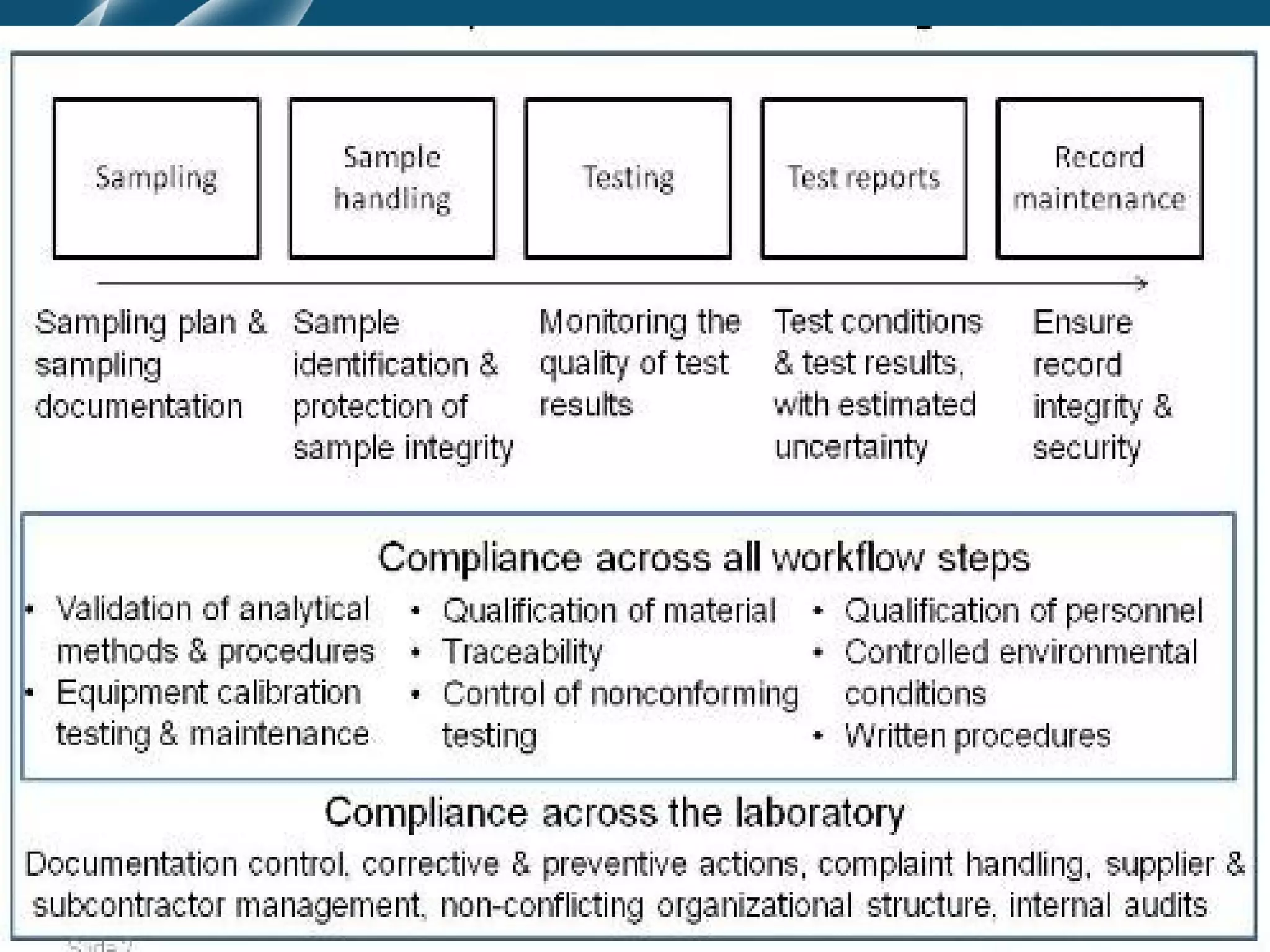
• Quality Assurance : refers to the systematic
  activities implemented in a quality system so
  that quality requirements for a product or service
  will be fulfilled
• ‘PATH OF WORKFLOW’ - 3 phases of QA
   cycle :
 Pre analytical
 Analytical
 Post analytical
• Level of Quality →minimize errors, minimize
  resources waste, maximise efficacy
                   ↓
  Quality standard guidelines and regulatory
  accreditation (NCCLS & CLIA guidelines)
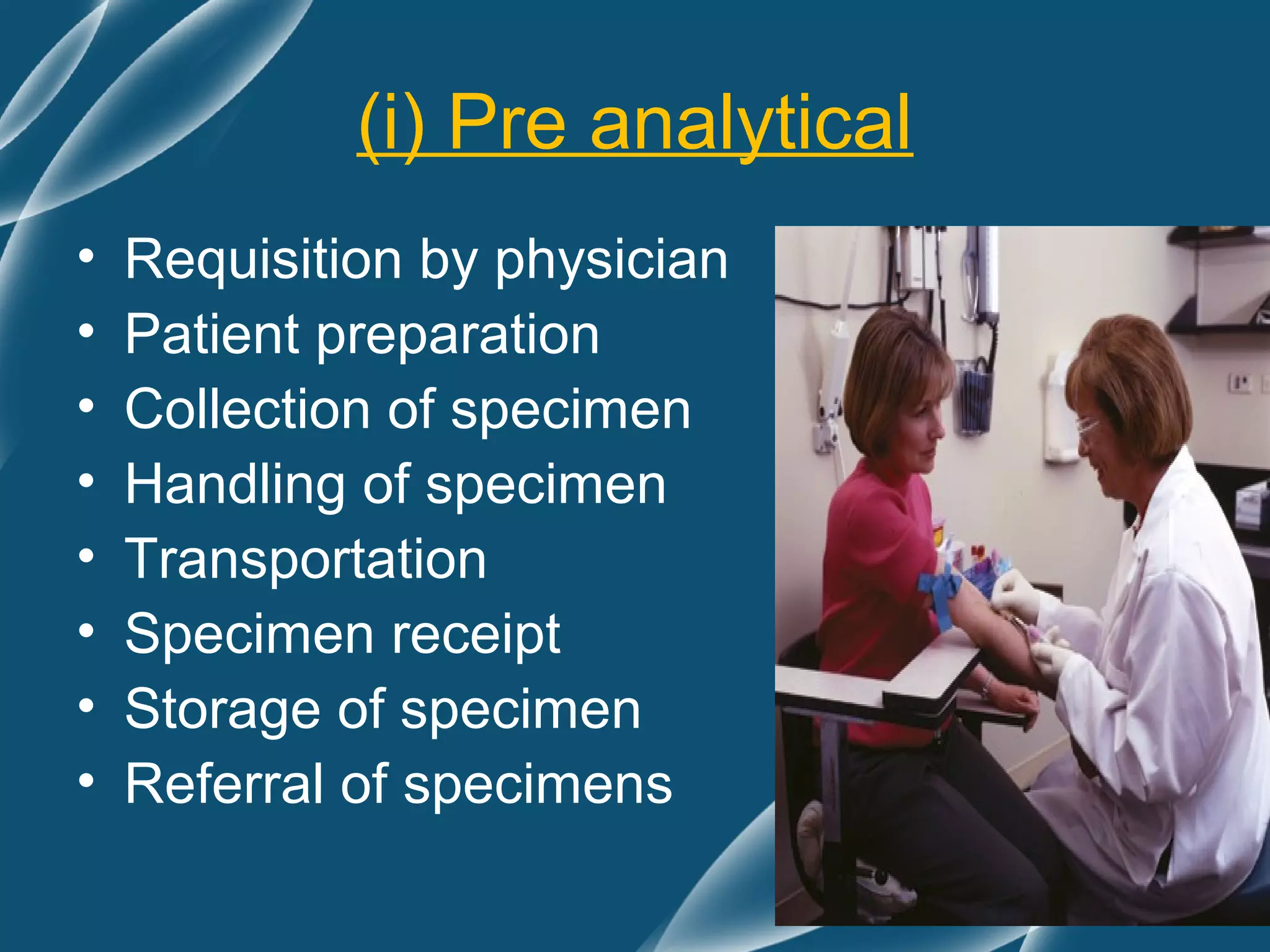
(i) Pre analytical
•   Requisition by physician
•   Patient preparation
•   Collection of specimen
•   Handling of specimen
•   Transportation
•   Specimen receipt
•   Storage of specimen
•   Referral of specimens
Purposes of lab tests
•   Screening
•   Provisional diagnosis
•   Differential diagnosis
•   Final diagnosis
•   Prognosis
•   Treatment
•   Monitor response to treatment
•   Specific events (rape, antenatal, post
    mortem)
CATEGORIZATION OF TESTS

• Waived tests : are those that have few steps
  and have been shown to be accurate and
  easy to perform eg –BSL, pregnancy tests,
  urine dipstick tests, haemoglobin etc
• Non waived tests: are the moderately and
  highly complex tests
• Screening tests : good sensitivity and
  specificity, low cost and risk, confirmatory test
  available and practical, presymptomatic
  period detectable and treatable, high
  prevalence of disease, increased morbidity
  and mortality of disease
• Diagnostic tests : method well described
  and easily reproducible, accurate,
  established reference range, sensitivity
  and specificity established after a wide
  study.
FACTORS TO BE CONSIDERED BEFORE
         PERFORMING TESTS
(i) Direct access testing [DAT]- patients are
   health conscious
• No markups or kick backs
• Ethical or social issues attached to reports
• Usually waived
• Doctor X patient relationship 
(ii) Cost benefit analysis :
     benefit/cost ˃ 1 is cost effective

(iii) To implement or discontinue the test – adequacy
  and trained staff ?, kits available or not ?, test
  volume too low, advanced technology, in vogue or
  obsolete, reimbursed or not

(iv) Pareto principle : 80/20 rule
 80% of total revenues generated by 20% of its
  products –list all tests performed in the lab and rank
  them according to the total annual revenues
  produced by each test
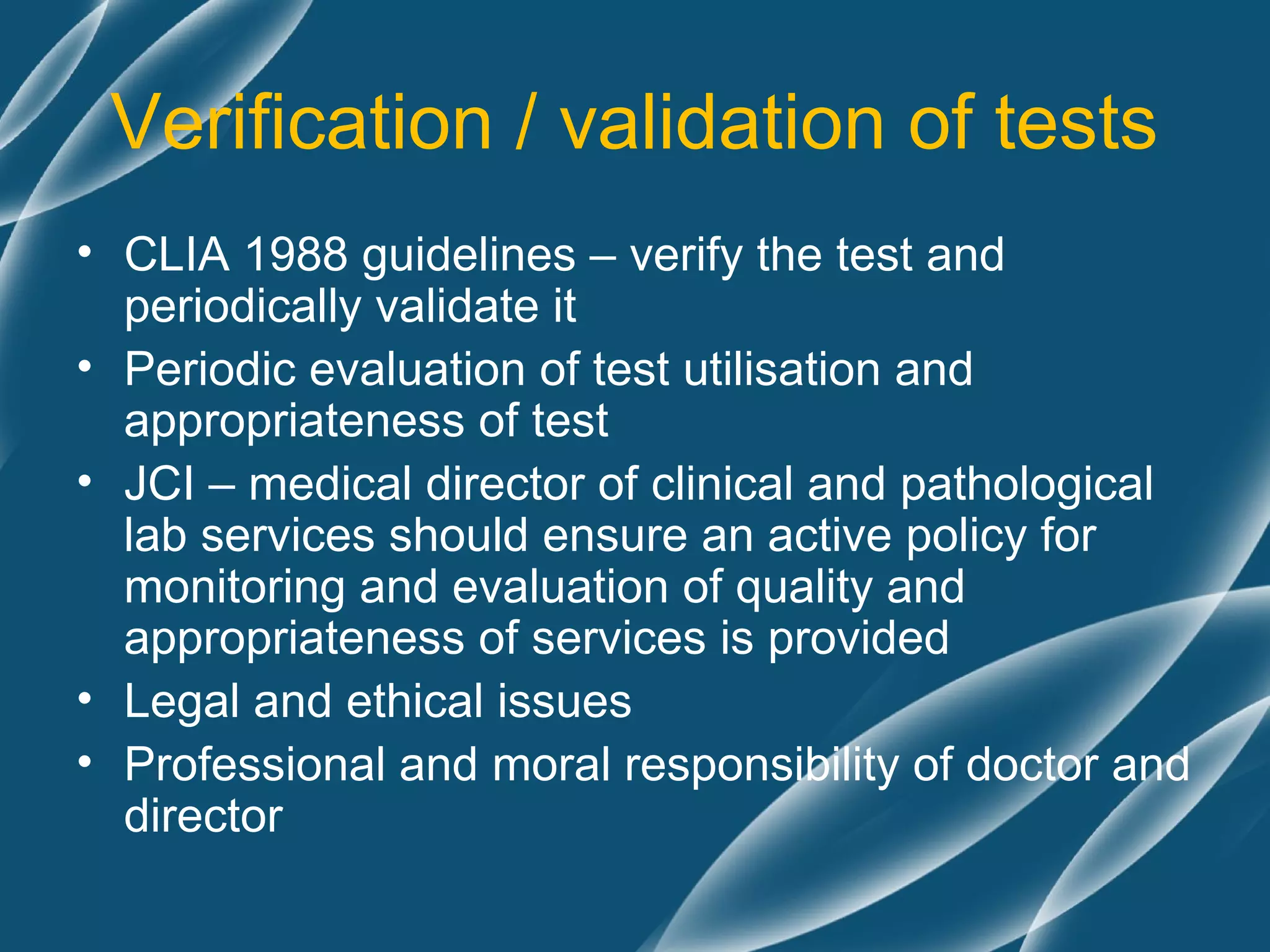
Verification / validation of tests
• CLIA 1988 guidelines – verify the test and
  periodically validate it
• Periodic evaluation of test utilisation and
  appropriateness of test
• JCI – medical director of clinical and pathological
  lab services should ensure an active policy for
  monitoring and evaluation of quality and
  appropriateness of services is provided
• Legal and ethical issues
• Professional and moral responsibility of doctor and
  director
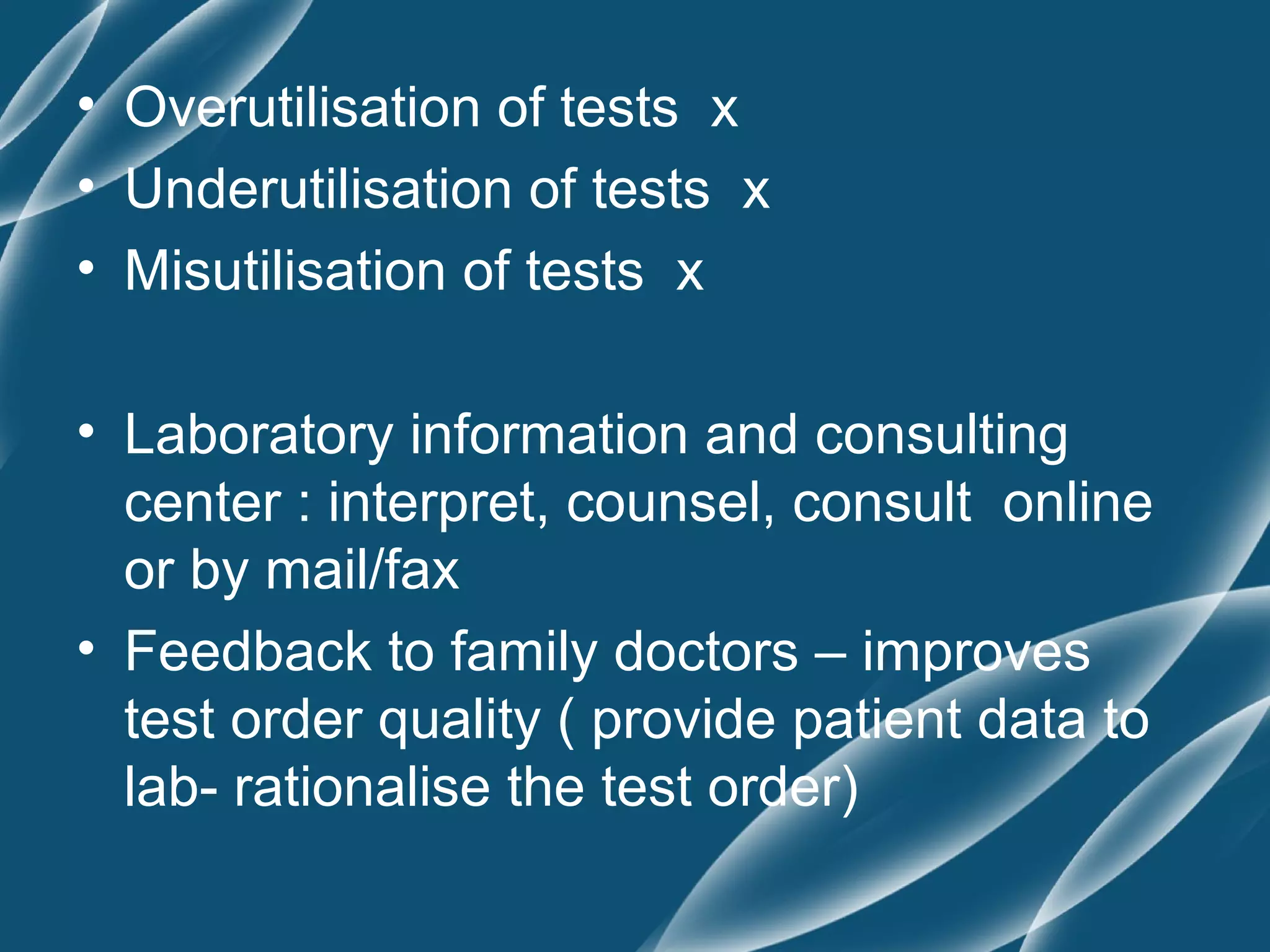
• Overutilisation of tests x
• Underutilisation of tests x
• Misutilisation of tests x

• Laboratory information and consulting
  center : interpret, counsel, consult online
  or by mail/fax
• Feedback to family doctors – improves
  test order quality ( provide patient data to
  lab- rationalise the test order)
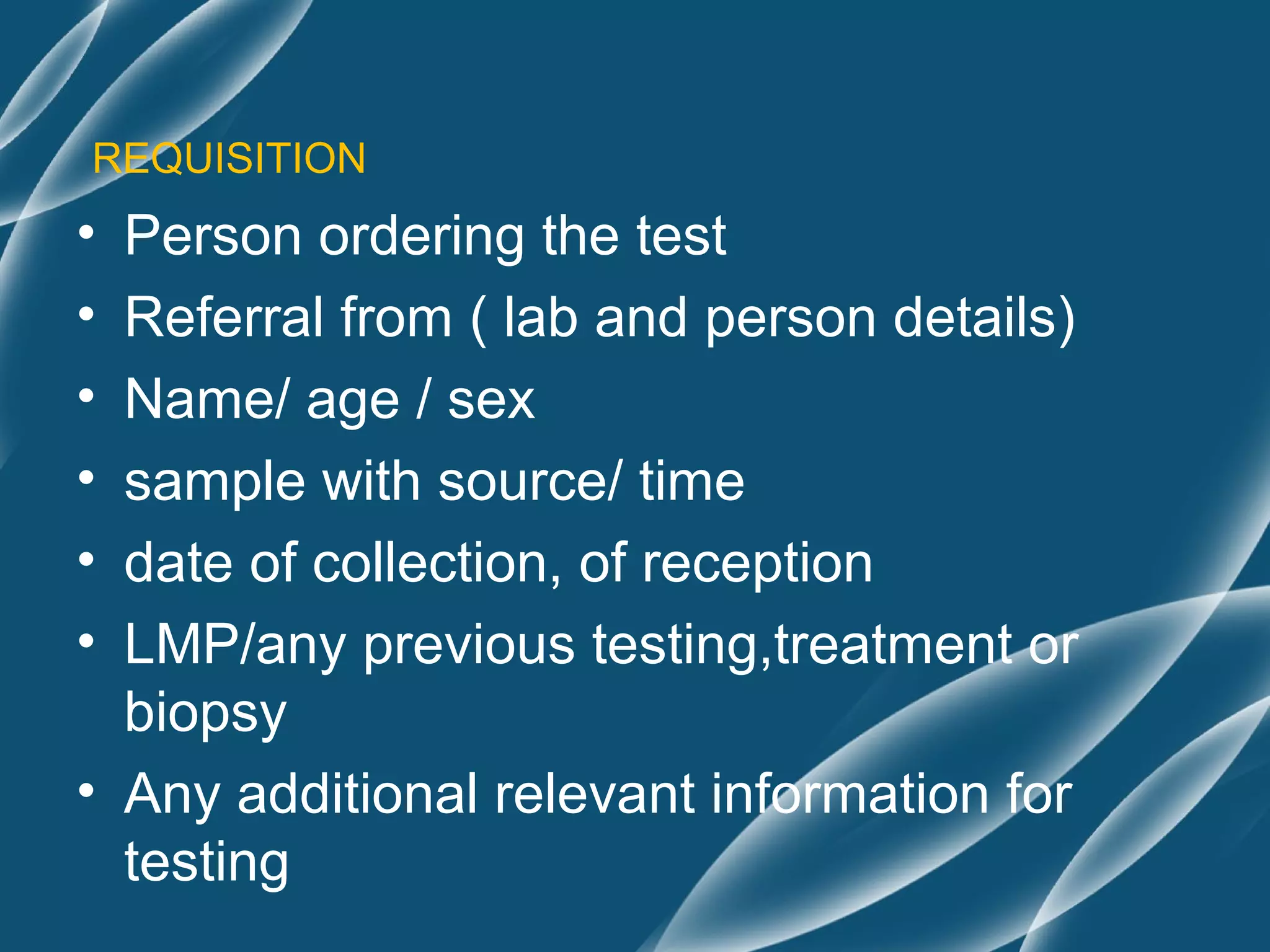
REQUISITION
• Person ordering the test
• Referral from ( lab and person details)
• Name/ age / sex
• sample with source/ time
• date of collection, of reception
• LMP/any previous testing,treatment or
  biopsy
• Any additional relevant information for
  testing
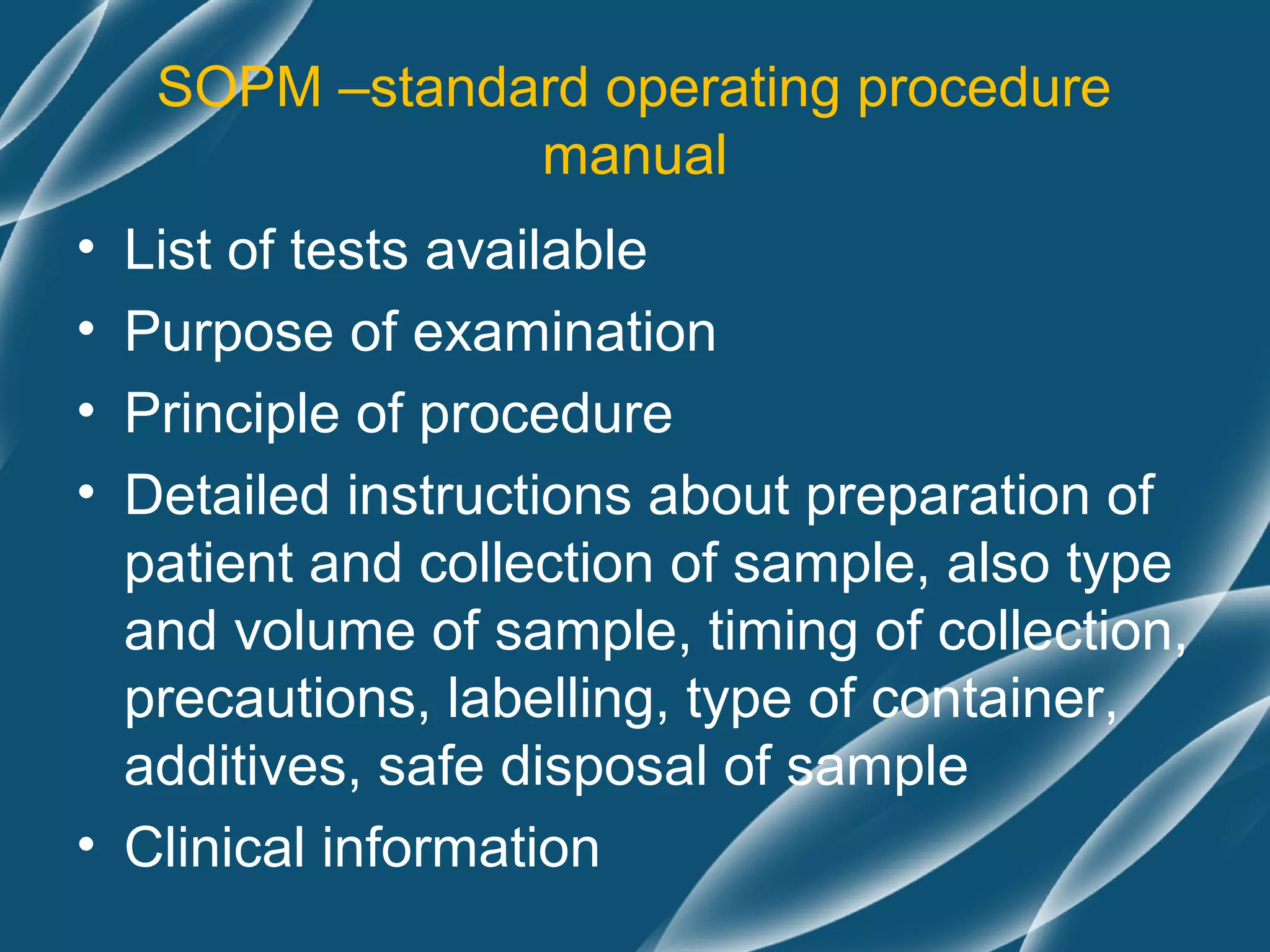
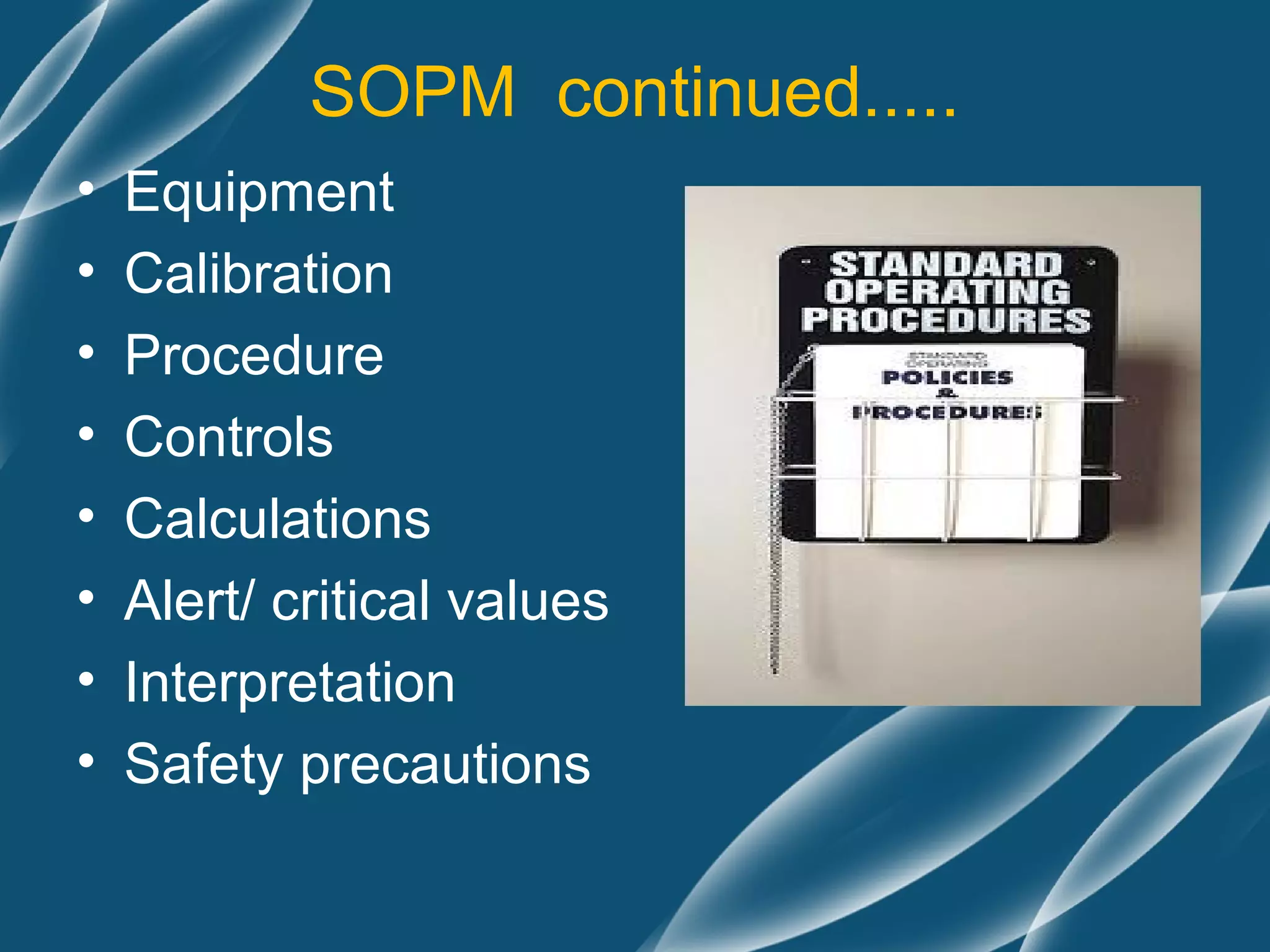
SOPM –standard operating procedure
                manual
• List of tests available
• Purpose of examination
• Principle of procedure
• Detailed instructions about preparation of
  patient and collection of sample, also type
  and volume of sample, timing of collection,
  precautions, labelling, type of container,
  additives, safe disposal of sample
• Clinical information
SOPM continued.....
•   Equipment
•   Calibration
•   Procedure
•   Controls
•   Calculations
•   Alert/ critical values
•   Interpretation
•   Safety precautions
Pre analytical loopholes
•   Test requests
•   Order entry errors
•   Identification of patient
•   Identification of specimen
•   Evaluation of specimen adequacy
•   Type of medium and/ preservative
•   Transport delay
•   Improper patient preparation
•   Improper collection
•   Wrong specimen container
•   Incorrect storage
•   Unlabelled/ mislabelled specimen
•   Improperly/ incompletely filled form
•   Specimen collected X test ordered
(ii) Analytical
• Actual performance of test
Analytic activities
•   Specific reagents
•   Test kits
•   Proper patient information
•   Proper interpretation- include disclaimers
Factors influencing analytic
                activities
• Proficiency of personnel
• Stability, integrity and reliability of
  reagents
• Equipment reliability
• Specificity and sensitivity of tests
• Use of appropriate controls
• Documentation
• Assessment
3 components of Analytic phase
• Monitor, evaluate and maintain this phase
  for ensuring reliability of results. This can
  be done by :
 Equipment – reliability and maintainence
 Examination procedures
 Quality of examination procedure
a) Equipment
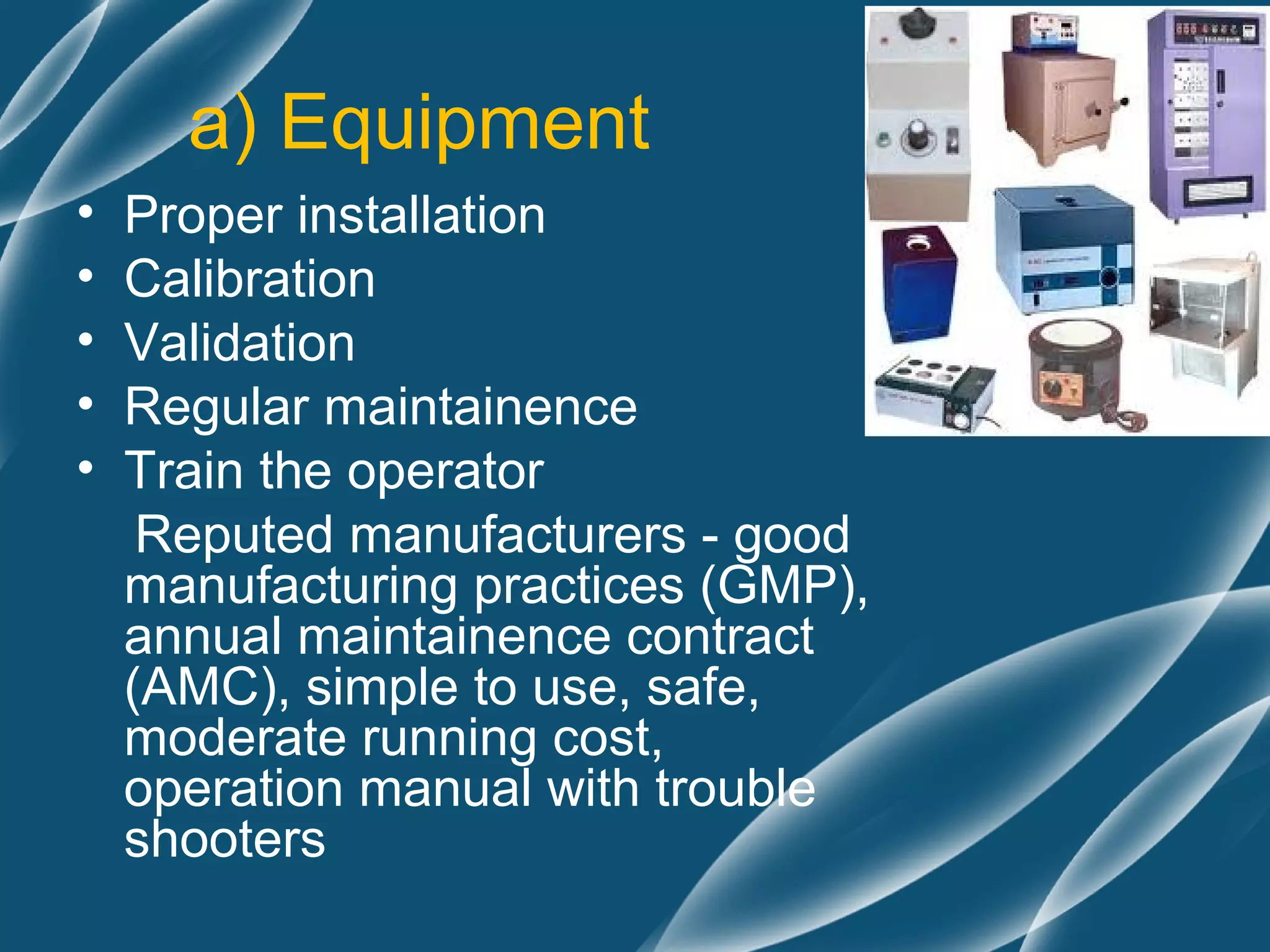
•   Proper installation
•   Calibration
•   Validation
•   Regular maintainence
•   Train the operator
     Reputed manufacturers - good
    manufacturing practices (GMP),
    annual maintainence contract
    (AMC), simple to use, safe,
    moderate running cost,
    operation manual with trouble
    shooters
b) Examination procedure
• Standard procedures
• In house – to be validated – references,
  interlab comparisons, other references in
  literature
• Review of all procedures periodically
c) Quality of examination
            procedures
• Quality Control : Operational
  techniques and activities used to fulfill
  requirements of quality is called
  Quality Control (QC)

• Quality assuranCe : Planned and
  systematic actions to provide quality in
  services is called Quality Asssurance
  (QA)
3 main aspects of QC
• ACCURACY
• ASSURANCE
• REPRODUCTIBILITY

 Nowadays, there is large dependance on the
 laboratories (labs) and hence increasing load
 on technicians – errors ; On a global scale,
 increasing demand for accreditation of labs
 has further necessitated QC in labs.
• AIM : To assure the patient, doctor and
  the laboratory personnel of the validity
  and preciseness of ALL the tests
  performed in the lab.
2 types of QC
• Internal – the lab itself conducts these
  processes, maybe once a week , to
  ensure its credibility
• External – an outside agency or reference
  lab monitors/ supervises the working of
  the lab to test its quality. Once in 3-4
  months.
QC program- DMPOIV
• Design : proper facilities, expertise,
  prepare and maintain SOPM- standard
  operating manual, daily performed tests
  signed by director/ head of the lab
• Material : reagents, chemicals, media, kits,
  sera, stains, all certified
• Process : Maintainence and calibration of
  all equipment, SOPM.
• Output: check exceptionally high/low
  values. Reference ranges are determined.
  There should be baseline values of all
  records
• Inspection and verification : is done by
  government or professional groups,
  medical director, lab consultant, chief lab
  technician or scientist
(iii) Post Analytical

•   Results and data review
•   Reports
•   Interpretation
•   Communicate reports to physician
•   Storage of specimen
Post analytic activities
     Review and evaluate the following:

• Effectiveness of the corrective actions
• Procedures and policies to prevent recurrences
• Accuracy and completeness of results and
  reports
• Disposition of unacceptable specimens
• Turnaround times
• Referral specimens and their reports
• Corrected reports
Contd.....
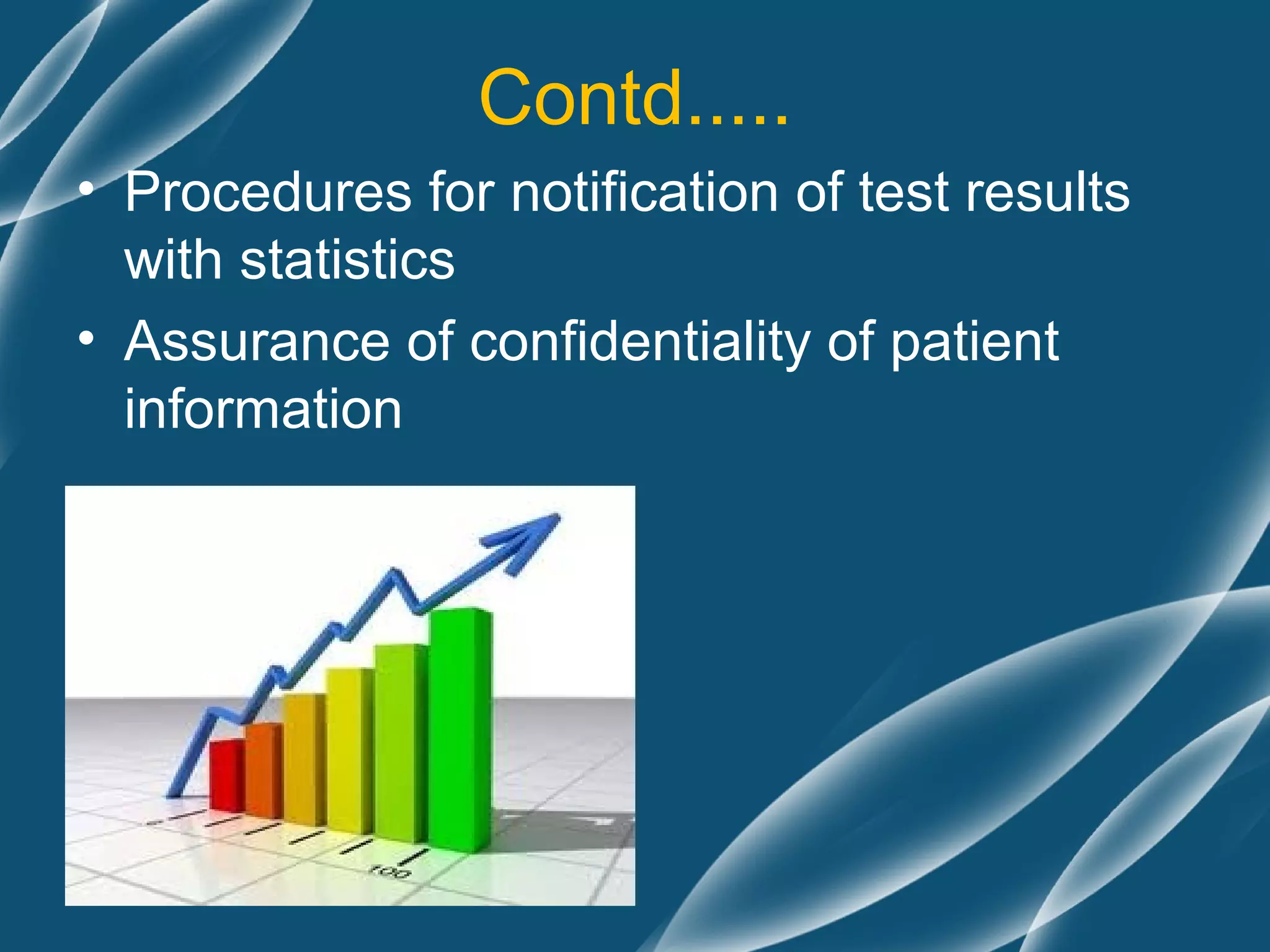
• Procedures for notification of test results
  with statistics
• Assurance of confidentiality of patient
  information
(a) Reporting of results
• Release of reports only to the authorized
  person
• Timely release of provisional and final
  report
• Any value which exceeds the normal limit
  must be clearly published, understood and
  conveyed verbally, electronically or printed
  form - when, where, what and to whom
  was reported - document it
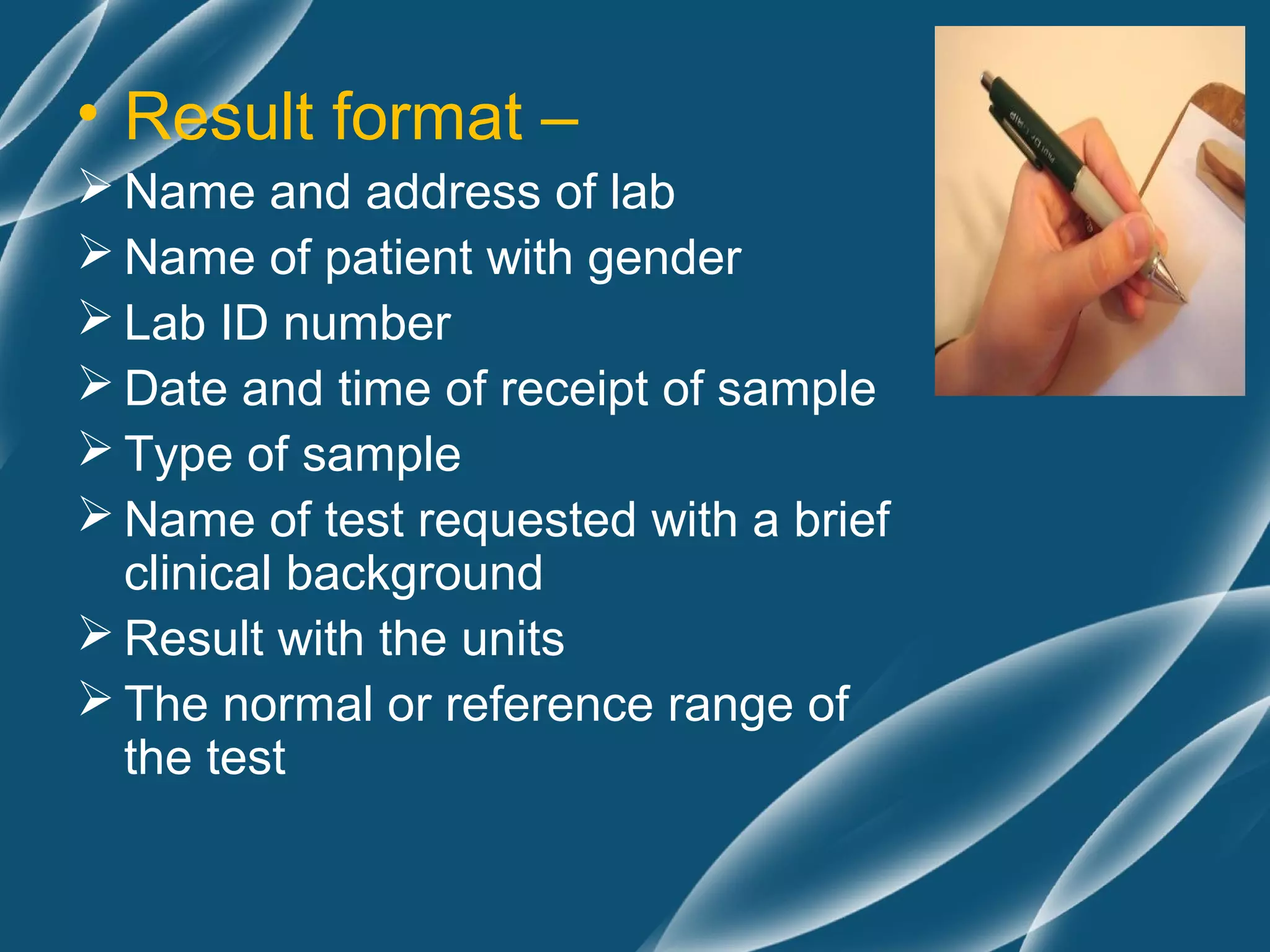
• Result format –
 Name and address of lab
 Name of patient with gender
 Lab ID number
 Date and time of receipt of sample
 Type of sample
 Name of test requested with a brief
  clinical background
 Result with the units
 The normal or reference range of
  the test
 Interpretation and explanation of the value
  of result
 Any disclaimer/s
 Value added textual comments
 Name of the person authorising the
  release of the report
 Signature of the person releasing the
  report
• Expected turnaround time – if delay, notify
  the doctor
• Types of reports – standard paper,
  electronic and web based
• Quality assessment and corrected reports-
  monitor and evaluate its results
• If sample was unacceptable – prompt
  communication
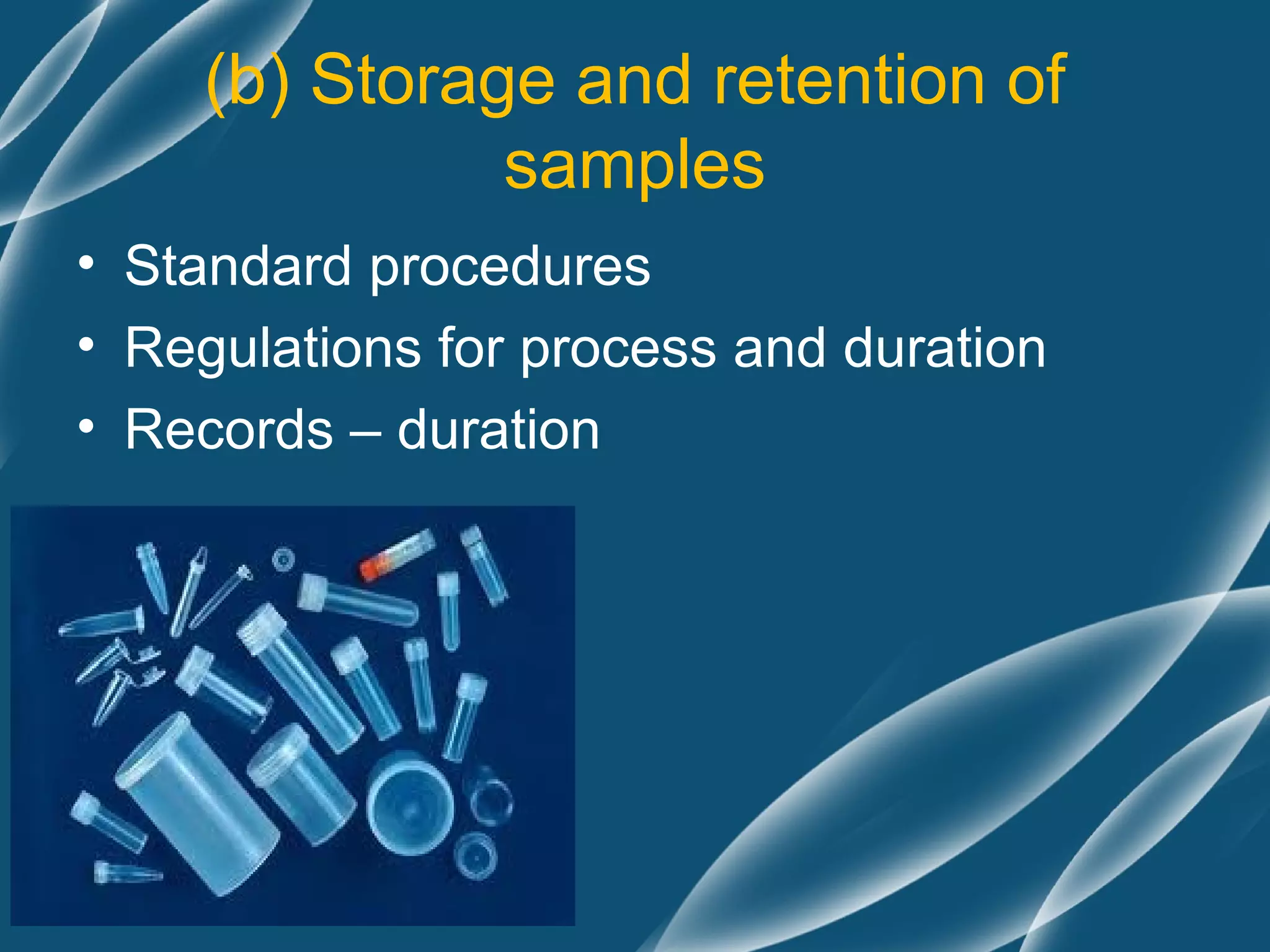
(b) Storage and retention of
              samples
• Standard procedures
• Regulations for process and duration
• Records – duration
(c) Assessment of test results on
           patient outcomes
•   Patient’ s health – quality of life
•   Financial outcomes
•   Publications
•   Discoveries
•   Case studies – interventions
•   Educational programs
•   Formulate empirical line of treatment
Sequelae to the path of workflow
• Interact with teams of :
 Infectious disease clinicians
 Hospitalists
 Infection control epidemiologist
 Pharmacist
 Clinical case managers
 Nursing staff
 House keeping
 Cafeteria
Laboratory management –
     good team work

Pre analytic and postanalytic test management

  • 1.
    Principles of pre-analyticand post-analytic test management Dr Varsha Shahane
  • 2.
    Objectives • To familiarizewith selection , assessment and incorporation of diagnostic tests • To review principles of test evaluation and utilisation and their effect on patient outcomes • To describe major elements of requisition and test menu formats • To review principles of formatting of reports of test results • To review needs for record storage
  • 3.
    Introduction • Quality Assurance: refers to the systematic activities implemented in a quality system so that quality requirements for a product or service will be fulfilled • ‘PATH OF WORKFLOW’ - 3 phases of QA cycle :  Pre analytical  Analytical  Post analytical
  • 5.
    • Level ofQuality →minimize errors, minimize resources waste, maximise efficacy ↓ Quality standard guidelines and regulatory accreditation (NCCLS & CLIA guidelines)
  • 6.
    (i) Pre analytical • Requisition by physician • Patient preparation • Collection of specimen • Handling of specimen • Transportation • Specimen receipt • Storage of specimen • Referral of specimens
  • 7.
    Purposes of labtests • Screening • Provisional diagnosis • Differential diagnosis • Final diagnosis • Prognosis • Treatment • Monitor response to treatment • Specific events (rape, antenatal, post mortem)
  • 8.
    CATEGORIZATION OF TESTS •Waived tests : are those that have few steps and have been shown to be accurate and easy to perform eg –BSL, pregnancy tests, urine dipstick tests, haemoglobin etc • Non waived tests: are the moderately and highly complex tests • Screening tests : good sensitivity and specificity, low cost and risk, confirmatory test available and practical, presymptomatic period detectable and treatable, high prevalence of disease, increased morbidity and mortality of disease
  • 9.
    • Diagnostic tests: method well described and easily reproducible, accurate, established reference range, sensitivity and specificity established after a wide study.
  • 10.
    FACTORS TO BECONSIDERED BEFORE PERFORMING TESTS (i) Direct access testing [DAT]- patients are health conscious • No markups or kick backs • Ethical or social issues attached to reports • Usually waived • Doctor X patient relationship 
  • 11.
    (ii) Cost benefitanalysis : benefit/cost ˃ 1 is cost effective (iii) To implement or discontinue the test – adequacy and trained staff ?, kits available or not ?, test volume too low, advanced technology, in vogue or obsolete, reimbursed or not (iv) Pareto principle : 80/20 rule 80% of total revenues generated by 20% of its products –list all tests performed in the lab and rank them according to the total annual revenues produced by each test
  • 12.
    Verification / validationof tests • CLIA 1988 guidelines – verify the test and periodically validate it • Periodic evaluation of test utilisation and appropriateness of test • JCI – medical director of clinical and pathological lab services should ensure an active policy for monitoring and evaluation of quality and appropriateness of services is provided • Legal and ethical issues • Professional and moral responsibility of doctor and director
  • 13.
    • Overutilisation oftests x • Underutilisation of tests x • Misutilisation of tests x • Laboratory information and consulting center : interpret, counsel, consult online or by mail/fax • Feedback to family doctors – improves test order quality ( provide patient data to lab- rationalise the test order)
  • 14.
    REQUISITION • Person orderingthe test • Referral from ( lab and person details) • Name/ age / sex • sample with source/ time • date of collection, of reception • LMP/any previous testing,treatment or biopsy • Any additional relevant information for testing
  • 15.
    SOPM –standard operatingprocedure manual • List of tests available • Purpose of examination • Principle of procedure • Detailed instructions about preparation of patient and collection of sample, also type and volume of sample, timing of collection, precautions, labelling, type of container, additives, safe disposal of sample • Clinical information
  • 16.
    SOPM continued..... • Equipment • Calibration • Procedure • Controls • Calculations • Alert/ critical values • Interpretation • Safety precautions
  • 17.
    Pre analytical loopholes • Test requests • Order entry errors • Identification of patient • Identification of specimen • Evaluation of specimen adequacy • Type of medium and/ preservative • Transport delay • Improper patient preparation
  • 18.
    Improper collection • Wrong specimen container • Incorrect storage • Unlabelled/ mislabelled specimen • Improperly/ incompletely filled form • Specimen collected X test ordered
  • 19.
    (ii) Analytical • Actualperformance of test
  • 20.
    Analytic activities • Specific reagents • Test kits • Proper patient information • Proper interpretation- include disclaimers
  • 21.
    Factors influencing analytic activities • Proficiency of personnel • Stability, integrity and reliability of reagents • Equipment reliability • Specificity and sensitivity of tests • Use of appropriate controls • Documentation • Assessment
  • 22.
    3 components ofAnalytic phase • Monitor, evaluate and maintain this phase for ensuring reliability of results. This can be done by :  Equipment – reliability and maintainence  Examination procedures  Quality of examination procedure
  • 23.
    a) Equipment • Proper installation • Calibration • Validation • Regular maintainence • Train the operator Reputed manufacturers - good manufacturing practices (GMP), annual maintainence contract (AMC), simple to use, safe, moderate running cost, operation manual with trouble shooters
  • 24.
    b) Examination procedure •Standard procedures • In house – to be validated – references, interlab comparisons, other references in literature • Review of all procedures periodically
  • 25.
    c) Quality ofexamination procedures • Quality Control : Operational techniques and activities used to fulfill requirements of quality is called Quality Control (QC) • Quality assuranCe : Planned and systematic actions to provide quality in services is called Quality Asssurance (QA)
  • 26.
    3 main aspectsof QC • ACCURACY • ASSURANCE • REPRODUCTIBILITY Nowadays, there is large dependance on the laboratories (labs) and hence increasing load on technicians – errors ; On a global scale, increasing demand for accreditation of labs has further necessitated QC in labs.
  • 27.
    • AIM :To assure the patient, doctor and the laboratory personnel of the validity and preciseness of ALL the tests performed in the lab.
  • 28.
    2 types ofQC • Internal – the lab itself conducts these processes, maybe once a week , to ensure its credibility • External – an outside agency or reference lab monitors/ supervises the working of the lab to test its quality. Once in 3-4 months.
  • 29.
    QC program- DMPOIV •Design : proper facilities, expertise, prepare and maintain SOPM- standard operating manual, daily performed tests signed by director/ head of the lab • Material : reagents, chemicals, media, kits, sera, stains, all certified • Process : Maintainence and calibration of all equipment, SOPM.
  • 30.
    • Output: checkexceptionally high/low values. Reference ranges are determined. There should be baseline values of all records • Inspection and verification : is done by government or professional groups, medical director, lab consultant, chief lab technician or scientist
  • 31.
    (iii) Post Analytical • Results and data review • Reports • Interpretation • Communicate reports to physician • Storage of specimen
  • 32.
    Post analytic activities Review and evaluate the following: • Effectiveness of the corrective actions • Procedures and policies to prevent recurrences • Accuracy and completeness of results and reports • Disposition of unacceptable specimens • Turnaround times • Referral specimens and their reports • Corrected reports
  • 33.
    Contd..... • Procedures fornotification of test results with statistics • Assurance of confidentiality of patient information
  • 34.
    (a) Reporting ofresults • Release of reports only to the authorized person • Timely release of provisional and final report • Any value which exceeds the normal limit must be clearly published, understood and conveyed verbally, electronically or printed form - when, where, what and to whom was reported - document it
  • 35.
    • Result format–  Name and address of lab  Name of patient with gender  Lab ID number  Date and time of receipt of sample  Type of sample  Name of test requested with a brief clinical background  Result with the units  The normal or reference range of the test
  • 36.
     Interpretation andexplanation of the value of result  Any disclaimer/s  Value added textual comments  Name of the person authorising the release of the report  Signature of the person releasing the report
  • 37.
    • Expected turnaroundtime – if delay, notify the doctor • Types of reports – standard paper, electronic and web based • Quality assessment and corrected reports- monitor and evaluate its results • If sample was unacceptable – prompt communication
  • 38.
    (b) Storage andretention of samples • Standard procedures • Regulations for process and duration • Records – duration
  • 39.
    (c) Assessment oftest results on patient outcomes • Patient’ s health – quality of life • Financial outcomes • Publications • Discoveries • Case studies – interventions • Educational programs • Formulate empirical line of treatment
  • 40.
    Sequelae to thepath of workflow • Interact with teams of :  Infectious disease clinicians  Hospitalists  Infection control epidemiologist  Pharmacist  Clinical case managers  Nursing staff  House keeping  Cafeteria
  • 41.