School of Medical and Allied Sciences
CourseName: Principal of Management With Special reference to medical laboratory Science management Couse Code: BMLS1009
Program Name: B.Sc. Medical Laboratory Technology
Topic: Laboratory information system
Submitted to: Mr. Sankar (Asst Prof, MLT)
Submitted by: Prince Maurya
Admission Number: 21SMAS1050004
Definition–
A laboratory information system (LIS) is a healthcare
software solution that processes, stores, and manages
patient data related to laboratory processes and testing.
Providers and laboratory professionals use laboratory
information systems to coordinate the workflow and quality
control of inpatient and outpatient medical testing, including
hematology, chemistry, immunology, microbiology, toxicology,
public health, and other laboratory areas. Laboratory
information systems track, store, and update clinical details
about a patient during a provider visit and stores the
information in its database for future reference.
How Does LIS Work?
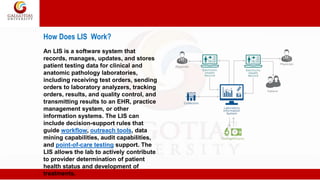
An LIS is a software system that
records, manages, updates, and stores
patient testing data for clinical and
anatomic pathology laboratories,
including receiving test orders, sending
orders to laboratory analyzers, tracking
orders, results, and quality control, and
transmitting results to an EHR, practice
management system, or other
information systems. The LIS can
include decision-support rules that
guide workflow, outreach tools, data
mining capabilities, audit capabilities,
and point-of-care testing support. The
LIS allows the lab to actively contribute
to provider determination of patient
health status and development of
treatments.
Laboratory Information System
A medical laboratory is a laboratory where specimen samples are stored, examined, and processed. For example, a person can go to a medical
laboratory to get a sample of blood taken from their arm. The laboratory can then examine and test this sample of blood to possibly diagnose a
disease. Medical labs are often found in hospitals, large doctor's offices, and community health clinics.
A laboratory information system (LIS) is a computer system that helps to manage many aspects of a medical laboratory, including inputting,
processing, and storing the information and data of a lab. For example, when Larry went to the medical laboratory to get his blood drawn and
analyzed, the LIS helped to manage all the information that related to his visit. This information included:
•The date of his visit
•His primary care physician
•Pertinent patient information and demographics
•The type of sample that was drawn
•Physician test orders
•Who got billed for his visit
•When the test results were sent to his physician
A busy medical lab may have hundreds of patients each week. It can be very difficult to keep all this information organized, but an LIS does just
that. An LIS helps to keep all this information organized, which is vitally important for a medical lab to run smoothly.
What are the Core Components of LIS?
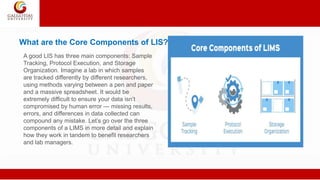
A good LIS has three main components: Sample
Tracking, Protocol Execution, and Storage
Organization. Imagine a lab in which samples
are tracked differently by different researchers,
using methods varying between a pen and paper
and a massive spreadsheet. It would be
extremely difficult to ensure your data isn’t
compromised by human error — missing results,
errors, and differences in data collected can
compound any mistake. Let’s go over the three
components of a LIMS in more detail and explain
how they work in tandem to benefit researchers
and lab managers.
Why is LIMS important for modern laboratories?
Now that we know how a LIMS works, we’ll cover some advantages of LIMS, and why they
are so important for modern laboratories. Today’s labs process and analyze an incredible
amount of information — without a reliable LIMS system in place, it’s easy for errors to
impact the speed and accuracy with which results are delivered. In some cases, this could
mean a new product launch gets delayed — in some cases, that could be a life-saving
vaccine that is urgently needed. An online lab management system is crucial for
organization, accuracy, and collaboration.
From a collaboration standpoint, a Laboratory Information Management System can
help a lab group stay connected. Tasks can be automatically assigned to various team
members as a sample moves through a protocol. Documents can be annotated, shared,
and commented on within the LIMS. Emails and phone calls can even be captured so
communication amongst team members and external collaborators can be shared with
everyone.
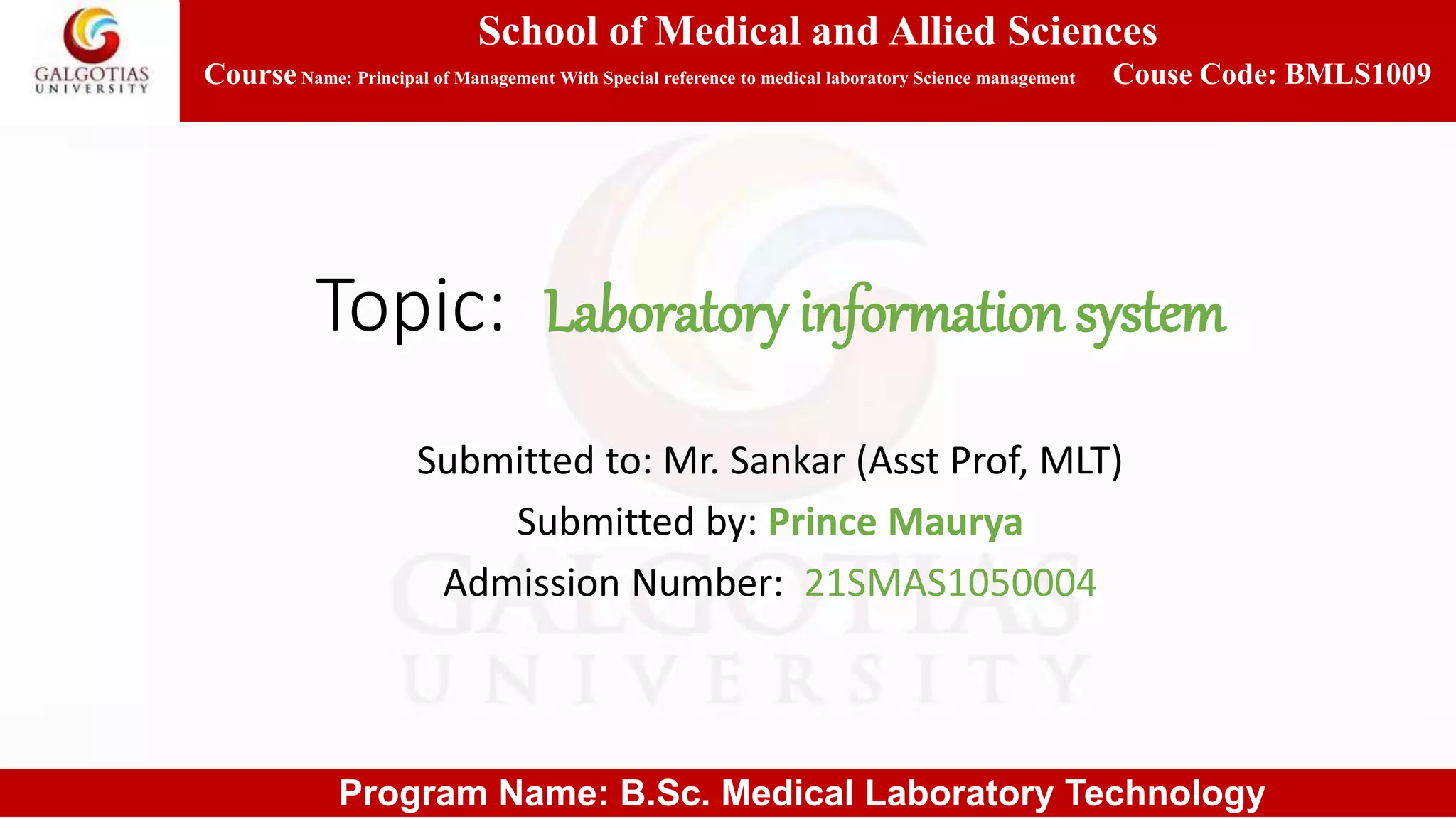
So what is the best LIMS system on the market? Well, that depends on the lab and its individual needs.
That said, with greater efficiency and clear organizational benefits, it’s clear to see why today’s most
successful laboratories rely on a laboratory information management system like Lockbox LIMS. LIMS
systems give labs the ability to organize sample tracking, workflow support, data management,
and collaboration opportunities in a single piece of software, making it the backbone of the lab.
References:
• https://thirdwaveanalytics.com/blog/what-doe
• s-a-lims-do/
• Thankyou

LABORATORY INFORMATION SYSTEM

  • 1.
    School of Medicaland Allied Sciences CourseName: Principal of Management With Special reference to medical laboratory Science management Couse Code: BMLS1009 Program Name: B.Sc. Medical Laboratory Technology Topic: Laboratory information system Submitted to: Mr. Sankar (Asst Prof, MLT) Submitted by: Prince Maurya Admission Number: 21SMAS1050004
  • 2.
    Definition– A laboratory informationsystem (LIS) is a healthcare software solution that processes, stores, and manages patient data related to laboratory processes and testing. Providers and laboratory professionals use laboratory information systems to coordinate the workflow and quality control of inpatient and outpatient medical testing, including hematology, chemistry, immunology, microbiology, toxicology, public health, and other laboratory areas. Laboratory information systems track, store, and update clinical details about a patient during a provider visit and stores the information in its database for future reference.
  • 3.
    How Does LISWork? An LIS is a software system that records, manages, updates, and stores patient testing data for clinical and anatomic pathology laboratories, including receiving test orders, sending orders to laboratory analyzers, tracking orders, results, and quality control, and transmitting results to an EHR, practice management system, or other information systems. The LIS can include decision-support rules that guide workflow, outreach tools, data mining capabilities, audit capabilities, and point-of-care testing support. The LIS allows the lab to actively contribute to provider determination of patient health status and development of treatments.
  • 4.
    Laboratory Information System Amedical laboratory is a laboratory where specimen samples are stored, examined, and processed. For example, a person can go to a medical laboratory to get a sample of blood taken from their arm. The laboratory can then examine and test this sample of blood to possibly diagnose a disease. Medical labs are often found in hospitals, large doctor's offices, and community health clinics. A laboratory information system (LIS) is a computer system that helps to manage many aspects of a medical laboratory, including inputting, processing, and storing the information and data of a lab. For example, when Larry went to the medical laboratory to get his blood drawn and analyzed, the LIS helped to manage all the information that related to his visit. This information included: •The date of his visit •His primary care physician •Pertinent patient information and demographics •The type of sample that was drawn •Physician test orders •Who got billed for his visit •When the test results were sent to his physician A busy medical lab may have hundreds of patients each week. It can be very difficult to keep all this information organized, but an LIS does just that. An LIS helps to keep all this information organized, which is vitally important for a medical lab to run smoothly.
  • 5.
    What are theCore Components of LIS? A good LIS has three main components: Sample Tracking, Protocol Execution, and Storage Organization. Imagine a lab in which samples are tracked differently by different researchers, using methods varying between a pen and paper and a massive spreadsheet. It would be extremely difficult to ensure your data isn’t compromised by human error — missing results, errors, and differences in data collected can compound any mistake. Let’s go over the three components of a LIMS in more detail and explain how they work in tandem to benefit researchers and lab managers.
  • 6.
    Why is LIMSimportant for modern laboratories? Now that we know how a LIMS works, we’ll cover some advantages of LIMS, and why they are so important for modern laboratories. Today’s labs process and analyze an incredible amount of information — without a reliable LIMS system in place, it’s easy for errors to impact the speed and accuracy with which results are delivered. In some cases, this could mean a new product launch gets delayed — in some cases, that could be a life-saving vaccine that is urgently needed. An online lab management system is crucial for organization, accuracy, and collaboration. From a collaboration standpoint, a Laboratory Information Management System can help a lab group stay connected. Tasks can be automatically assigned to various team members as a sample moves through a protocol. Documents can be annotated, shared, and commented on within the LIMS. Emails and phone calls can even be captured so communication amongst team members and external collaborators can be shared with everyone.
  • 7.
    So what isthe best LIMS system on the market? Well, that depends on the lab and its individual needs. That said, with greater efficiency and clear organizational benefits, it’s clear to see why today’s most successful laboratories rely on a laboratory information management system like Lockbox LIMS. LIMS systems give labs the ability to organize sample tracking, workflow support, data management, and collaboration opportunities in a single piece of software, making it the backbone of the lab.
  • 8.