PRE AND POST
ANALYTICAL ERRORS
BY
Rrof. Dr. MOUSTAFA RIZK
CLINICAL PATHOLOGY
DEPARTMEMNT
In larger laboratories , it is common to see a
disconnection between different areas of :
1-Specimen
receiving
2-Sampling
3-Sample transport , Processing
4-Testing
5-Results reporting areas.
The specimen receiving area that enters the
full patient data and test information
into the laboratory information system
(LIS) is one of commonest areas that can
lead into serious errors in the lab
especially if individuals managing this
area do not have a laboratory background.
REQUEST FORM
1 -Hospital nomber 2- Lab
nomber
3 -Patient name
4 -Sex 5-Age
6 -Consultant Unit
7 -Date 8-Time
9 -Diagnosis
10-Specimen type Urgent/ routine
11-Investigations required
Commonest errors
 Wrong patient entery.
 Incomplete patient name.
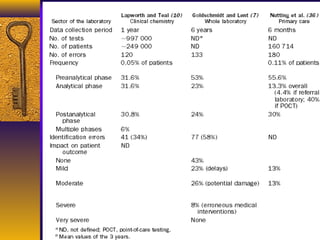
 Incorrect patient data.
 Misidentifying tests with similar names.
 The patient ready for sample withdraw
with Wrong order.
 Not fulfilling all investigations needed.
Specimen Collection Must Be Handeled
by Experienced and Skilled Doctors
Who Revised the Following:
1- Request form
2- Patient condition and instruction
3- Patient preparation
4- Specimen collection &handling
5- Sample transport
6- Urgent request protocol
THE ANALYSES PERFORMED BY
LABORATORIES ARE SUBJECT TO
BIOLOGICAL AND ENVIRONMENTAL
EFFECTS ,THE PHYSIOLOGICAL
CHANGES THAT OCCUR IN HEALTH AND
DISEASED SUBJECTS ARE FREQUENT
SOURCES OF MISINTERPRETATION OF
LABORATORY RESULTS
Patient condition may strongly influence the
result analysis, so the patient must receive
good instruction before and during
sample collection.
A-CONTROLLABLE
BIOLOGICAL VARIABLES
1-Posture
2-Hospitalization and immobilization
3-Exercise
4-Physical training
5-Circadian variation
6-Blindness&Travel
8-Influence of foods and stimulants
10-Smoking
11-Alcohol ingestion
12-Underlying medical conditions:
a-Fever
b-Shock and Trauma
c-Transfusion
1-POSTURE
a- Change from lying to upright position
8-10%Increase in plasma protein conc.
Double increase of Catecholamines
Aldosteron,Renin
ADH
Decreased Na,K,Li excretion
Decrease urinary PH
b-Standing for long time K increase.
Other changes of concentrations
Analyte Change
AST +15%
ALT +15%
ALP +12%
Ht +10%
THERFORE SERIAL BLOOD SAMPLES
SHOULD BE COLLECTED FROM THE
PATIENT KEEPING THE SAME POSITION.
2-HOSPITALIZATION AND
IMMOBILIZATION
Prolonged bed rest 1- Decrease of
serum proteins and albumin
2-Decrease of protein bound calcium
with increase of ionized calcium.
3-Initial increase in CK activity
4-Increase Ca,Na,K,P excretion
5-The circadian variation of plasma
cortisol is reduced.
3-EXERCISE
How long after an exercise a specimen was
collected.
a-Moderate exercise twofold increase of
lactate and pyruvate, slight increase in the
activities of AST,LDH,CK,ALDOLASE
b-Strenuous exercise 10 folds of
lactate,double of CK, of proteins,
of GH,PRL,COR,CATECHOLAMINES,
ALDOSTERON.
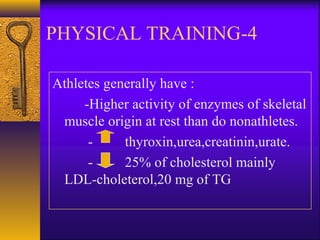
4-PHYSICAL TRAINING
Athletes generally have :
-Higher activity of enzymes of skeletal
muscle origin at rest than do nonathletes.
- thyroxin,urea,creatinin,urate.
- 25% of cholesterol mainly
LDL-choleterol,20 mg of TG
5-CIRCADIAN VARIATION
Cyclical variations may be quite large and
therefore the drawing of the specimen must
be strictly controlled. Examples:
1-Iron ,Cortisol change as much as 50% from
8 a.m. to 4 p.m .ACTH,renin,aldosteron,
insulin show similar pattern.
2-TSH is at a maximum at 2-4 a.m.and at a
minimum at 6-10 p.m.
3-GH is greatest shortly after sleep.
6-BLINDNESS AND TRAVEL
1-With blindness ,the normal stimulation of
the hypothalamic pituitary axis is reduced
hypopituitrism and hypoadrenalism.
2-Travel across several time zones affects the
normal circadian rhythm,5 days are
recquired to establish a new stable diurnal
rhythm.
7-INFLUENCE OF FOODS
The concentration of certain plasma constituents is
affected by the ingestion of a meal:
1 -Glucose,Iron,Lipids,Alkaline phosphatase.
2 -Ingestion of protein rich meal in the evening
cause increases in serum urea nitrogen,urate .
3-Fasting for food and even water for more than 15
hours.
4-Caffeine ,which is contained in coffee,tea and
colas,has considerable effect on blood
constituents.
8-DRUG ADMINISTRATION
It is rare for a pateint to be hospitalized
without receiving some drugs,for certain
medical conditions ,more than 10 drugs
may be administered at one time
DRUGS MAY HAVE BOTH IN VIVO
AND IN VITRO EFFECTS ON
LABORATORY TESTS.
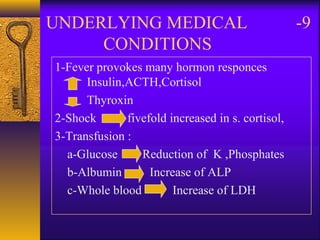
9-UNDERLYING MEDICAL
CONDITIONS
1-Fever provokes many hormon responces
Insulin,ACTH,Cortisol
Thyroxin
2-Shock fivefold increased in s. cortisol,
3-Transfusion :
a-Glucose Reduction of K ,Phosphates
b-Albumin Increase of ALP
c-Whole blood Increase of LDH
B-LONG-TERM BIOLOGICAL
INFLEUNCES
1-Age
2-Gender & Race
3-Seasonal Influences
4-Infleunce of Menstrual cycle
5-Body Habitus
6-Vegetarianism
7-Malnutrition
8-Fasting and Starvation
1-INFLUENCE OF AGE
1-Newborn : Most of Hb is the adult form
-CK,AST,GGT are high at birth
-Bilirubin may rise and peaks at 5th
day
-Glucose is low
-Serum thyroxin is higher than adult level
2-Childhood to puberty:ALP,Creatinine
3-Significant increases in many costituents
in women after the menopause.
2-GENDER & RACE
 ALP,ALT,AST,CK,ALDOLASE are
higher in men than in women.
 Albumin,Calcium,Magnesium,Uric acid
choleterol, urea are also higher.
 Total proteins are higher in blacks than
whites while albumin is less.
 CK,LDH are also higher in blacks
SPECIMEN COLLECTION
 Before collecting a specimen of any type
a phlebotomist ask the pateint to state his
or her name .
 Specimen collection must be labeled with
the name,I.D. nomber,location in hospital
and date and time of collection.
 A phlebotomist should put on disposable
latex rubber gloves.
 Before a venipuncture,the phlebotomist
should verify that the patient is fasting
according to investigations needed.
 The patient should be confortably seated or
supine , should have been in this position
for 20 min befor specimen is drawn.
 An arm with an inserted I.V. line,extensive
scarring or hematome should be avoided .
 If a women has had a mastectomy , arm veins on
that side of the body should not be used.
 An arm containing a cannula or I.V. fistula should
not be used without consent of the patient
physician.
 If fluid is being infused I.V.,the fluid should be
shut off for 3 min and a suitable note made on the
result report,opposite arm may be satisfactoy for
most tests except for those analytes that are
contained in the infused solutions (glucose or
electrolytes).
 No alcohol should remain on the skin
because traces cause hemolysis.
 For ethanol determination the skin should
be cleaned with a bezalkonium chloride
solution not bovidone-iodine which interfer
with several chemistry procedures.
 For blood culture all precautions must be
taken to guard against blood cotamination.
 A tourniquet should not be left for more
than 1 min,and the patient should not be
allowed to pump his or her fist while the
tourniquet is in place.
 Before performing a venipuncture , the
phlebotomist should estimate the volume of
blood to be drawn and select the appropriate
number and types of tubes for tests needed.
 If blood is drawn for trace element ,the
needle should be stainless sleel .
 The time at which a specimen is obtained
must be recorded (drug monitoring,diuranl
rhythm).
 The composition of blood drawn first –that
is ,that blood closest to the tourniquet-is
most representative of circulating blood .
 In young children who are frightened,
struggling and held in physical restraint,
collection may give errors.
 Vigorous suction on a syringe during
collection or forcible transfer from the
syringe , may cause hemolysis of blood.
 Collection with evacuated blood tube may
be preffered to syringes.
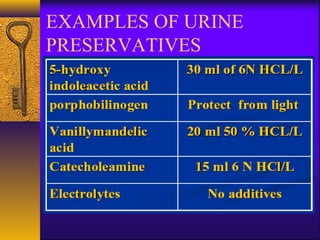
EXAMPLES OF URINE
PRESERVATIVES
SAMPLE TRANSPORT
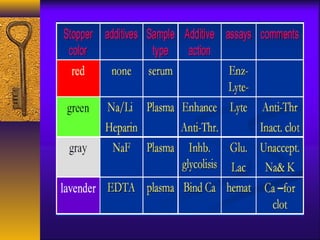
1- Selection of proper transport method
Example:
2- Transport in ice ,why?
3- Keeping the specimen from the light ,
why ?
4- Delay in transportation may cause
variations in some tests results, How?
♦Although there is abundant scientific
literature dealing withincreased laboratory
quality (mainly analytical), the literatureon
errors in laboratory medicine is scarce. One
reason for this,in addition to the insufficient
attention paid to the problem,is the practical
difficulty in reporting and measuring the
numberof errors.
♦Most of the studies focus simplyon
analytical errors, which represent only a
percentage of theerrors in the total testing
process, which includes all pre-,intra-, and
post analytical phases.
Other studies are based onmethodologies
that are insensitiveto total testing process
problems that can occur before specimens
are collected and after results are obtained
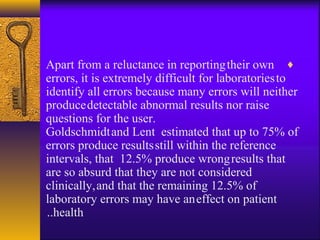
♦Apart from a reluctance in reportingtheir own
errors, it is extremely difficult for laboratoriesto
identify all errors because many errors will neither
producedetectable abnormal results nor raise
questions for the user.
Goldschmidtand Lent estimated that up to 75% of
errors produce resultsstill within the reference
intervals, that 12.5% produce wrongresults that
are so absurd that they are not considered
clinically,and that the remaining 12.5% of
laboratory errors may have aneffect on patient
health..
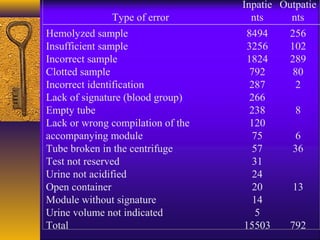
Type of error
Inpatie
nts
Outpatie
nts
Hemolyzed sample 8494 256
Insufficient sample 3256 102
Incorrect sample 1824 289
Clotted sample 792 80
Incorrect identification 287 2
)Lack of signature (blood group 266
Empty tube 238 8
Lack or wrong compilation of the
accompanying module
120
75 6
Tube broken in the centrifuge 57 36
Test not reserved 31
Urine not acidified 24
Open container 20 13
Module without signature 14
Urine volume not indicated 5
Total 15503 792
PRE AND POST ANALYTICAL ERRORS

PRE AND POST ANALYTICAL ERRORS

  • 1.
    PRE AND POST ANALYTICALERRORS BY Rrof. Dr. MOUSTAFA RIZK CLINICAL PATHOLOGY DEPARTMEMNT
  • 2.
    In larger laboratories, it is common to see a disconnection between different areas of : 1-Specimen receiving 2-Sampling 3-Sample transport , Processing 4-Testing 5-Results reporting areas.
  • 3.
    The specimen receivingarea that enters the full patient data and test information into the laboratory information system (LIS) is one of commonest areas that can lead into serious errors in the lab especially if individuals managing this area do not have a laboratory background.
  • 4.
    REQUEST FORM 1 -Hospitalnomber 2- Lab nomber 3 -Patient name 4 -Sex 5-Age 6 -Consultant Unit 7 -Date 8-Time 9 -Diagnosis 10-Specimen type Urgent/ routine 11-Investigations required
  • 5.
    Commonest errors  Wrongpatient entery.  Incomplete patient name.  Incorrect patient data.  Misidentifying tests with similar names.  The patient ready for sample withdraw with Wrong order.  Not fulfilling all investigations needed.
  • 6.
    Specimen Collection MustBe Handeled by Experienced and Skilled Doctors Who Revised the Following: 1- Request form 2- Patient condition and instruction 3- Patient preparation 4- Specimen collection &handling 5- Sample transport 6- Urgent request protocol
  • 7.
    THE ANALYSES PERFORMEDBY LABORATORIES ARE SUBJECT TO BIOLOGICAL AND ENVIRONMENTAL EFFECTS ,THE PHYSIOLOGICAL CHANGES THAT OCCUR IN HEALTH AND DISEASED SUBJECTS ARE FREQUENT SOURCES OF MISINTERPRETATION OF LABORATORY RESULTS
  • 8.
    Patient condition maystrongly influence the result analysis, so the patient must receive good instruction before and during sample collection.
  • 9.
    A-CONTROLLABLE BIOLOGICAL VARIABLES 1-Posture 2-Hospitalization andimmobilization 3-Exercise 4-Physical training 5-Circadian variation 6-Blindness&Travel
  • 10.
    8-Influence of foodsand stimulants 10-Smoking 11-Alcohol ingestion 12-Underlying medical conditions: a-Fever b-Shock and Trauma c-Transfusion
  • 11.
    1-POSTURE a- Change fromlying to upright position 8-10%Increase in plasma protein conc. Double increase of Catecholamines Aldosteron,Renin ADH Decreased Na,K,Li excretion Decrease urinary PH b-Standing for long time K increase.
  • 12.
    Other changes ofconcentrations Analyte Change AST +15% ALT +15% ALP +12% Ht +10% THERFORE SERIAL BLOOD SAMPLES SHOULD BE COLLECTED FROM THE PATIENT KEEPING THE SAME POSITION.
  • 13.
    2-HOSPITALIZATION AND IMMOBILIZATION Prolonged bedrest 1- Decrease of serum proteins and albumin 2-Decrease of protein bound calcium with increase of ionized calcium. 3-Initial increase in CK activity 4-Increase Ca,Na,K,P excretion 5-The circadian variation of plasma cortisol is reduced.
  • 14.
    3-EXERCISE How long afteran exercise a specimen was collected. a-Moderate exercise twofold increase of lactate and pyruvate, slight increase in the activities of AST,LDH,CK,ALDOLASE b-Strenuous exercise 10 folds of lactate,double of CK, of proteins, of GH,PRL,COR,CATECHOLAMINES, ALDOSTERON.
  • 15.
    4-PHYSICAL TRAINING Athletes generallyhave : -Higher activity of enzymes of skeletal muscle origin at rest than do nonathletes. - thyroxin,urea,creatinin,urate. - 25% of cholesterol mainly LDL-choleterol,20 mg of TG
  • 16.
    5-CIRCADIAN VARIATION Cyclical variationsmay be quite large and therefore the drawing of the specimen must be strictly controlled. Examples: 1-Iron ,Cortisol change as much as 50% from 8 a.m. to 4 p.m .ACTH,renin,aldosteron, insulin show similar pattern. 2-TSH is at a maximum at 2-4 a.m.and at a minimum at 6-10 p.m. 3-GH is greatest shortly after sleep.
  • 17.
    6-BLINDNESS AND TRAVEL 1-Withblindness ,the normal stimulation of the hypothalamic pituitary axis is reduced hypopituitrism and hypoadrenalism. 2-Travel across several time zones affects the normal circadian rhythm,5 days are recquired to establish a new stable diurnal rhythm.
  • 18.
    7-INFLUENCE OF FOODS Theconcentration of certain plasma constituents is affected by the ingestion of a meal: 1 -Glucose,Iron,Lipids,Alkaline phosphatase. 2 -Ingestion of protein rich meal in the evening cause increases in serum urea nitrogen,urate . 3-Fasting for food and even water for more than 15 hours. 4-Caffeine ,which is contained in coffee,tea and colas,has considerable effect on blood constituents.
  • 19.
    8-DRUG ADMINISTRATION It israre for a pateint to be hospitalized without receiving some drugs,for certain medical conditions ,more than 10 drugs may be administered at one time DRUGS MAY HAVE BOTH IN VIVO AND IN VITRO EFFECTS ON LABORATORY TESTS.
  • 20.
    9-UNDERLYING MEDICAL CONDITIONS 1-Fever provokesmany hormon responces Insulin,ACTH,Cortisol Thyroxin 2-Shock fivefold increased in s. cortisol, 3-Transfusion : a-Glucose Reduction of K ,Phosphates b-Albumin Increase of ALP c-Whole blood Increase of LDH
  • 21.
    B-LONG-TERM BIOLOGICAL INFLEUNCES 1-Age 2-Gender &Race 3-Seasonal Influences 4-Infleunce of Menstrual cycle 5-Body Habitus 6-Vegetarianism 7-Malnutrition 8-Fasting and Starvation
  • 22.
    1-INFLUENCE OF AGE 1-Newborn: Most of Hb is the adult form -CK,AST,GGT are high at birth -Bilirubin may rise and peaks at 5th day -Glucose is low -Serum thyroxin is higher than adult level 2-Childhood to puberty:ALP,Creatinine 3-Significant increases in many costituents in women after the menopause.
  • 23.
    2-GENDER & RACE ALP,ALT,AST,CK,ALDOLASE are higher in men than in women.  Albumin,Calcium,Magnesium,Uric acid choleterol, urea are also higher.  Total proteins are higher in blacks than whites while albumin is less.  CK,LDH are also higher in blacks
  • 24.
    SPECIMEN COLLECTION  Beforecollecting a specimen of any type a phlebotomist ask the pateint to state his or her name .  Specimen collection must be labeled with the name,I.D. nomber,location in hospital and date and time of collection.  A phlebotomist should put on disposable latex rubber gloves.
  • 25.
     Before avenipuncture,the phlebotomist should verify that the patient is fasting according to investigations needed.  The patient should be confortably seated or supine , should have been in this position for 20 min befor specimen is drawn.  An arm with an inserted I.V. line,extensive scarring or hematome should be avoided .
  • 26.
     If awomen has had a mastectomy , arm veins on that side of the body should not be used.  An arm containing a cannula or I.V. fistula should not be used without consent of the patient physician.  If fluid is being infused I.V.,the fluid should be shut off for 3 min and a suitable note made on the result report,opposite arm may be satisfactoy for most tests except for those analytes that are contained in the infused solutions (glucose or electrolytes).
  • 27.
     No alcoholshould remain on the skin because traces cause hemolysis.  For ethanol determination the skin should be cleaned with a bezalkonium chloride solution not bovidone-iodine which interfer with several chemistry procedures.  For blood culture all precautions must be taken to guard against blood cotamination.
  • 28.
     A tourniquetshould not be left for more than 1 min,and the patient should not be allowed to pump his or her fist while the tourniquet is in place.  Before performing a venipuncture , the phlebotomist should estimate the volume of blood to be drawn and select the appropriate number and types of tubes for tests needed.
  • 29.
     If bloodis drawn for trace element ,the needle should be stainless sleel .  The time at which a specimen is obtained must be recorded (drug monitoring,diuranl rhythm).  The composition of blood drawn first –that is ,that blood closest to the tourniquet-is most representative of circulating blood .
  • 30.
     In youngchildren who are frightened, struggling and held in physical restraint, collection may give errors.  Vigorous suction on a syringe during collection or forcible transfer from the syringe , may cause hemolysis of blood.  Collection with evacuated blood tube may be preffered to syringes.
  • 32.
  • 33.
    SAMPLE TRANSPORT 1- Selectionof proper transport method Example: 2- Transport in ice ,why? 3- Keeping the specimen from the light , why ? 4- Delay in transportation may cause variations in some tests results, How?
  • 34.
    ♦Although there isabundant scientific literature dealing withincreased laboratory quality (mainly analytical), the literatureon errors in laboratory medicine is scarce. One reason for this,in addition to the insufficient attention paid to the problem,is the practical difficulty in reporting and measuring the numberof errors.
  • 35.
    ♦Most of thestudies focus simplyon analytical errors, which represent only a percentage of theerrors in the total testing process, which includes all pre-,intra-, and post analytical phases. Other studies are based onmethodologies that are insensitiveto total testing process problems that can occur before specimens are collected and after results are obtained
  • 36.
    ♦Apart from areluctance in reportingtheir own errors, it is extremely difficult for laboratoriesto identify all errors because many errors will neither producedetectable abnormal results nor raise questions for the user. Goldschmidtand Lent estimated that up to 75% of errors produce resultsstill within the reference intervals, that 12.5% produce wrongresults that are so absurd that they are not considered clinically,and that the remaining 12.5% of laboratory errors may have aneffect on patient health..
  • 37.
    Type of error Inpatie nts Outpatie nts Hemolyzedsample 8494 256 Insufficient sample 3256 102 Incorrect sample 1824 289 Clotted sample 792 80 Incorrect identification 287 2 )Lack of signature (blood group 266 Empty tube 238 8 Lack or wrong compilation of the accompanying module 120 75 6 Tube broken in the centrifuge 57 36 Test not reserved 31 Urine not acidified 24 Open container 20 13 Module without signature 14 Urine volume not indicated 5 Total 15503 792